


To future‑proof gambling-like mechanics in games, design for compliance first: map where your feature is regulated, gate access with robust identity and age checks, and build auditability into the technical architecture (including optional on-chain evidence) without leaking personal data. Treat RNG fairness, custody, and responsible-play UX as auditable controls, not only product choices.
Critical checklist for implementing compliant gambling mechanics
- Define whether your mechanic is gambling, a loot mechanic, or a skill-based contest under the rules that apply to your launch regions.
- Implement age gates and identity checks that can be audited, including safe fallbacks for users who cannot be verified.
- Separate player PII from gameplay/audit logs; prove integrity with hashes and signed events.
- Use provably fair RNG patterns (commit-reveal or verifiable randomness) and document the verification procedure.
- Ship responsible-play controls (limits, timeouts, self-exclusion) as core flows, not support-only features.
- Operationalize compliance: monitoring, incident response, access controls, and periodic internal audits.
Mapping global and regional regulation: compliance pathways and triggers

This section helps teams shipping across regions (including Thailand as an operating context) decide when a gambling-like mechanic must be treated as regulated gambling or can be treated as a lower-risk monetization feature. It is also the fastest way to identify when you should not ship at all until licensing and legal review are complete. Track changes under online gambling regulation 2026 as a living requirement, not a one-time checklist.
When this approach fits
- You run a game with paid chance outcomes, tokenized rewards, or player-to-player value exchange.
- You operate a platform that distributes third-party games and you control payments, wallets, or odds.
- You need a defensible audit trail for regulators, payment partners, or app-store reviews.
When you should not proceed (without specialist approval)
- You cannot implement reliable geolocation and jurisdiction-based feature gating.
- You cannot restrict access for underage users or users who fail verification.
- You plan to allow cash-out, transferable tokens, or external markets without custody and AML-risk controls.
| Requirement | Owner | Priority | Verification step |
|---|---|---|---|
| Jurisdiction matrix (where feature is allowed, restricted, or requires licensing) | Legal + Product | P0 | Sign-off on region rules; test geofence + feature flags per country/region |
| Feature classification: chance, consideration (payment), prize/value | Legal | P0 | Written classification memo stored in compliance repository |
| Trigger list (cash-out, tradability, P2P, tokens, ads targeting minors) | Compliance | P0 | Threat model review; confirm controls exist for each trigger |
| Launch gating plan (geo + age + KYC tiers) | Engineering + Ops | P1 | Staged rollout checklist; canary tests in each tier |
Practical design of age‑verification and gating workflows
For age verification for gambling apps, plan for two separate decisions: (1) "is this user old enough?" and (2) "is this user the same person over time?" You also need region-based rules, privacy-safe storage, and a clear fallback path when verification fails or is unavailable.
What you need before building
- Policy requirements: minimum age per jurisdiction, re-check cadence, what features require verification (viewing vs playing vs depositing vs withdrawing).
- Identity proofing method: document verification, database checks, trusted third-party verification, or operator-assisted checks.
- Risk tiering: low-risk features (free spins with no value) vs high-risk (deposit, wagering, cash-out).
- Data minimization plan: what you store (ideally a verification token + metadata), and what you never store (raw ID images unless mandated and secured).
- Operational access: support tooling for disputes, re-verification, and lawful requests with strict access controls.
Reference workflow (gating logic)
// Inputs: user, region, action
// Output: allow | deny | verify | limited_mode

decision gate(user, region, action):
  rules = policy.lookup(region, action)

  if rules.requires_geo and !geo.isAllowed(user.ip, user.gps, region):
    return deny

  if rules.requires_age:
    if user.age_status == "verified" and user.age_verified_at >= rules.minRecency:
      if user.age_years >= rules.minAge:
        return allow
      else:
        return deny

    if rules.allowLimitedMode:
      return limited_mode
    else:
      return verify

  return allow
Minimal data model (store proofs, not documents)
user_verification {
  user_id
  region
  age_status: "unverified" | "pending" | "verified" | "failed"
  age_over_threshold: boolean
  method: "provider_x" | "manual" | "document" | "bank"
  verified_at
  expires_at
  evidence_hash  // hash(pointer or provider payload), not raw PII
  provider_ref   // opaque reference if needed
  reviewer_id    // if manual, internal staff id
}
| Requirement | Owner | Priority | Verification step |
|---|---|---|---|
| Tiered gating by action (play, deposit, withdraw, trade) | Product + Compliance | P0 | Unit tests cover each action/region/risk tier; QA scripts validate UI gating |
| Verification provider integration (tokenized response) | Engineering | P0 | Audit log shows request/response IDs; replay-safe signatures validated |
| Privacy controls (PII separation, encryption, retention) | Security | P0 | Data map review; access logs show least-privilege; retention job tested |
| Fallback path (limited mode or denial) + appeal flow | Product + Support | P1 | Support runbook; test "cannot verify" and "false positive" scenarios |
On‑chain audit design: transparency, data minimization, and proofs
Use blockchain audit for gambling platforms only for integrity proofs and public verifiability, not as a dumping ground for user data. The goal is to let an auditor verify event ordering, odds/RNG inputs, and payout correctness while keeping PII off-chain and minimizing sensitive linkage across sessions.
Preparation mini-checklist
- Decide what must be publicly verifiable (fairness, payouts, reserves) vs privately auditable (KYC, fraud signals).
- Define your "audit event" schema and canonical serialization (stable fields, stable ordering).
- Pick an anchoring method: public chain, permissioned ledger, or timestamping service.
- Set retention rules and access controls for off-chain logs and evidence.
- Write a verifier script spec (inputs, outputs, failure modes) before coding.
-
Define an auditable event stream
Model gameplay as immutable events (bet placed, RNG committed, RNG revealed, payout executed) with stable IDs. Keep user identifiers as salted, rotating pseudonyms to reduce linkage risk.
- Risk: re-identification via stable IDs. Mitigation: rotate pseudonyms per period and store the mapping only in a secured vault.
-
Canonicalize and hash events off-chain
Serialize each event deterministically, hash it, and store the full event in secure storage. Only the hash (and minimal metadata like timestamp bucket) is prepared for anchoring.
- Risk: different serializers yield different hashes. Mitigation: publish a canonical schema and conformance tests.
-
Build Merkle batches for daily (or session) commitments
Group event hashes into a Merkle tree; store the Merkle root and batch metadata. This gives auditors inclusion proofs without exposing all data.
- Risk: selective disclosure disputes. Mitigation: provide inclusion proof tooling and an escalation path for full disclosure under NDA/regulator request.
-
Anchor the Merkle root on-chain with minimal payload
Write a transaction that records the Merkle root, batch ID, and a version tag for the schema. Avoid user identifiers, IP addresses, device IDs, or raw bet details on-chain.
- Risk: on-chain metadata correlates sessions. Mitigation: batch at fixed intervals and avoid unique per-user anchors.
-
Publish a verifier workflow for auditors and players
Provide a tool that takes an event, its inclusion proof, and the on-chain root to verify integrity and ordering constraints. For on-chain provably fair gambling, pair this with RNG proof verification (commit-reveal or verifiable randomness).
- Risk: verifier is opaque. Mitigation: open-source the verifier or provide reproducible builds and test vectors.
-
Define correction and incident semantics
You cannot delete on-chain anchors, so define how to handle reversals: create compensating events, re-anchor corrected batches, and document the reason codes.
- Risk: silent corrections reduce trust. Mitigation: require incident IDs and signed approvals for compensations.
| Requirement | Owner | Priority | Verification step |
|---|---|---|---|
| Event schema + canonical serialization spec | Engineering + Compliance | P0 | Golden test vectors; independent implementation reproduces identical hashes |
| Merkle batching + inclusion proofs | Engineering | P0 | Random sampling: event → proof validates against anchored root |
| PII minimization and pseudonym rotation | Security | P0 | Privacy review; confirm no direct identifiers on-chain or in public logs |
| Verifier tooling (auditor + optional player-facing) | Engineering + QA | P1 | Reproducible verification results across environments; documented failure modes |
RNG provability, token economics, and custody interactions
Fairness and funds safety fail in predictable places: weak randomness, ambiguous rules, and unclear custody boundaries. Treat RNG proof, token issuance, and wallet flows as one control system, especially when you advertise "provably fair" outcomes.
Verification checklist for fairness and custody
- RNG method is documented and testable (commit-reveal, VRF, or audited RNG service) with a clear verifier procedure.
- All player-visible rules (odds, payouts, house edge if applicable, rounding) are versioned and tied to each bet event.
- Seeds/keys are protected (HSM or equivalent key management); operational staff cannot retroactively change outcomes.
- Payout execution is atomic with bet settlement (or has compensating events) to avoid partial states.
- Custody boundaries are explicit: who controls private keys, who authorizes transfers, and how approvals are logged.
- Token mechanics are constrained to avoid hidden value transfer (e.g., "bonus" tokens that become tradeable without controls).
- Deposit/withdraw limits and velocity checks exist, with clear user messaging when limits apply.
- Replay protection exists for client actions and settlement messages (idempotency keys, nonce checking).
Approach selection table (RNG + audit surface)
| Approach | Best for | Auditability | Privacy risk |
|---|---|---|---|
| Commit-reveal (server seed + client seed) | Fast games with low latency needs | High if seeds and reveals are logged and anchored | Low if seeds are not linkable to identity |
| VRF / verifiable randomness | High-trust claims and third-party verification | Very high when proofs are stored with events | Medium if on-chain calls leak timing/behavior |
| Audited RNG service (off-chain) | Teams prioritizing integration simplicity | Medium; depends on provider attestations | Medium; provider sees metadata unless minimized |
| Requirement | Owner | Priority | Verification step |
|---|---|---|---|
| Provability spec (what a third party can verify from logs) | Engineering + Compliance | P0 | Run verifier against sampled games; mismatches produce a deterministic error |
| Custody model (self-custody, custodial, hybrid) | Security + Finance/Ops | P0 | Access review; signing policy tested; emergency pause procedure validated |
| Token/points economics constraints and upgrade paths | Product | P1 | Rule versioning; migration plan prevents stealth value transfer |
| Idempotent settlement and compensating transactions | Engineering | P1 | Chaos testing: retries do not double-pay; ledger balances reconcile |
Responsible play UX: nudges, limits, and escalation flows
Responsible-play features are part of compliance solutions for gambling operators and also reduce chargebacks and disputes. Implement them as consistent, logged user controls with clear outcomes and escalation routes, not as hidden settings.
Common mistakes (and one-line mitigations)
- Limits exist but are easy to bypass. Mitigation: enforce limits server-side and log every limit decision.
- Self-exclusion is treated as a UI toggle. Mitigation: self-exclusion must hard-block wagering and deposits across devices.
- Cooling-off timers are unclear. Mitigation: show exact end time and enforce it consistently across sessions.
- Too much friction only after losses. Mitigation: offer optional limits at onboarding and before first deposit.
- Notifications are manipulative or promotional. Mitigation: separate marketing messaging from responsible-play prompts and respect opt-outs.
- Support cannot see why a user was blocked. Mitigation: provide reason codes and a minimal audit view (without exposing sensitive signals).
- Escalation is missing. Mitigation: define thresholds for manual review and provide safe handoff to support resources.
Concrete escalation flow (server-enforced)
if risk_score >= threshold_high:
  enforce("cooling_off", duration=24h, reason="risk_high")
  notify_user("Your play is paused until ...")
  create_case(queue="responsible_play", severity="high")
elif user_hits_limit:
  enforce("limit_reached", until=period_end, reason="user_limit")
| Requirement | Owner | Priority | Verification step |
|---|---|---|---|
| User-set limits (deposit, spend, time) with server enforcement | Product + Engineering | P0 | Attempt bypass via client tampering; server still blocks and logs |
| Self-exclusion and cooling-off with clear messaging | Compliance + UX | P0 | Cross-device test; re-login does not remove the block |
| Audit trail for prompts, limit changes, and enforcement decisions | Engineering | P1 | Sample user journey produces a complete, ordered log with reason codes |
| Escalation runbook (support + risk review) | Ops + Support | P1 | Tabletop exercise: case creation → review → resolution → documentation |
Operations & enforcement: logging, incident response, and audits
Operational maturity is where most compliance programs fail: missing logs, unclear ownership, and inconsistent enforcement. Build routine evidence collection and a repeatable incident process so you can answer regulator, partner, and user disputes quickly-especially as blockchain audit for gambling platforms and public claims increase scrutiny.
Viable alternatives (choose based on risk and resources)
-
Centralized compliance stack (no blockchain anchoring)
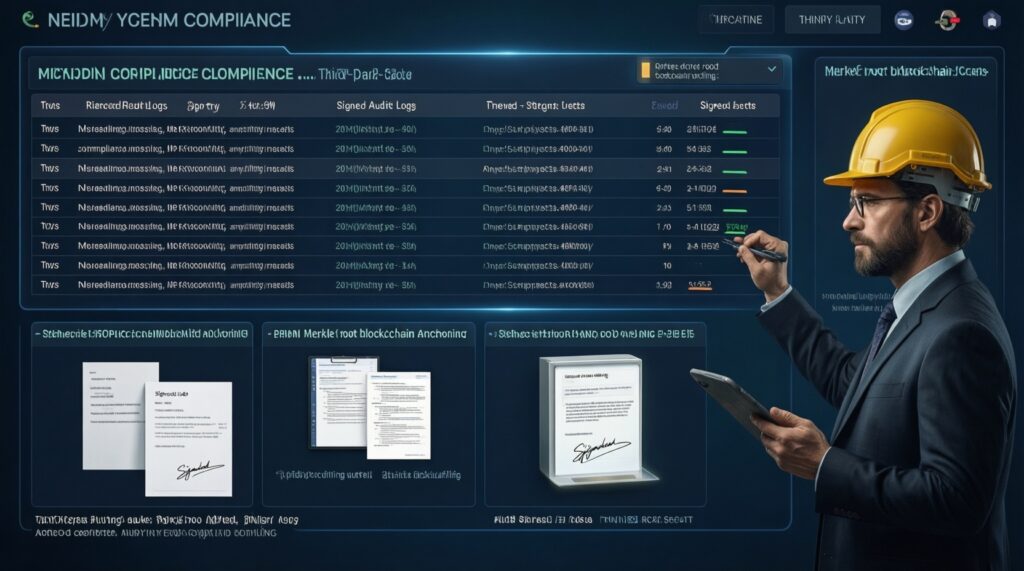
Use standard logging, signed audit events, and internal/third-party audits. Fits teams that need speed and privacy, and don't need public verification.
-
Hybrid anchoring (off-chain logs + on-chain roots)
Anchor Merkle roots periodically while keeping detailed evidence off-chain. Fits products making transparency claims like on-chain provably fair gambling without exposing personal data.
-
Outsourced verification and monitoring
Use external providers for age verification for gambling apps and transaction monitoring, with strict contracts and data minimization. Fits lean teams but requires vendor risk management.
-
Region-limited launch with feature downgrades
Disable high-risk triggers (cash-out, tradable rewards) in sensitive jurisdictions and ship only low-risk modes. Fits when online gambling regulation 2026 uncertainty makes licensing timelines unclear.
Operational controls to standardize
- Log integrity: append-only storage, signed entries, periodic reconciliation.
- Access governance: least privilege, break-glass access, quarterly reviews.
- Incident response: severity definitions, pause switches, communication templates, postmortems.
- Audit cadence: internal evidence checks and external audits as needed.
| Requirement | Owner | Priority | Verification step |
|---|---|---|---|
| Append-only audit log with signing and time-based retention | Engineering + Security | P0 | Attempt log tampering; integrity check fails and alerts |
| Incident playbooks (fairness dispute, payout error, verification outage) | Ops | P0 | Tabletop drill; measured time to detect, pause, and communicate |
| Evidence pack generation for audits (export + verifier scripts) | Compliance | P1 | Random audit sample can be reproduced from exports within defined SLA |
| Vendor risk management for compliance solutions for gambling operators | Procurement + Security | P1 | Contract checklist; periodic access and data handling reviews |
Quick clarifications for common implementation hurdles
Do I need a license if my game has loot boxes or randomized rewards?
It depends on whether the mechanic includes payment/consideration, chance, and a prize with real-world value or cash-out. Treat any tradable or withdrawable value as a high-risk trigger that usually requires deeper legal review and stronger controls.
What is the safest default if age verification fails?
Fail closed for wagering, deposits, and withdrawals, and optionally offer a limited mode that has no paid chance outcomes and no cash-out. Log the reason code so support can resolve disputes without re-asking for unnecessary data.
How do I implement age verification for gambling apps without storing ID images?
Prefer a provider response token plus a minimal verification record (status, method, timestamps, evidence hash). Store raw documents only if explicitly required and protected by strict access and retention rules.
Is blockchain required for transparency claims?
No, but if you market public verifiability, on-chain anchoring of Merkle roots can make integrity checks easier for third parties. Keep personal data off-chain and publish a verifier workflow that matches what you anchor.
What should I anchor on-chain for a blockchain audit for gambling platforms?
Anchor only batch commitments (Merkle roots), schema versions, and non-identifying metadata needed for verification. Do not anchor user identifiers, raw bets, or anything that can re-identify players.
How can I support on-chain provably fair gambling without exposing player behavior?
Use batch anchoring and inclusion proofs, and rotate pseudonyms so event streams are harder to link across time. Provide a verifier that proves integrity and fairness from the minimal disclosed evidence.
What's the biggest operational gap teams miss under online gambling regulation 2026 pressure?
Inconsistent enforcement and incomplete audit logs. If you cannot reproduce a disputed outcome end-to-end (rules version, RNG proof, settlement, custody authorization), you will struggle during audits and escalations.