

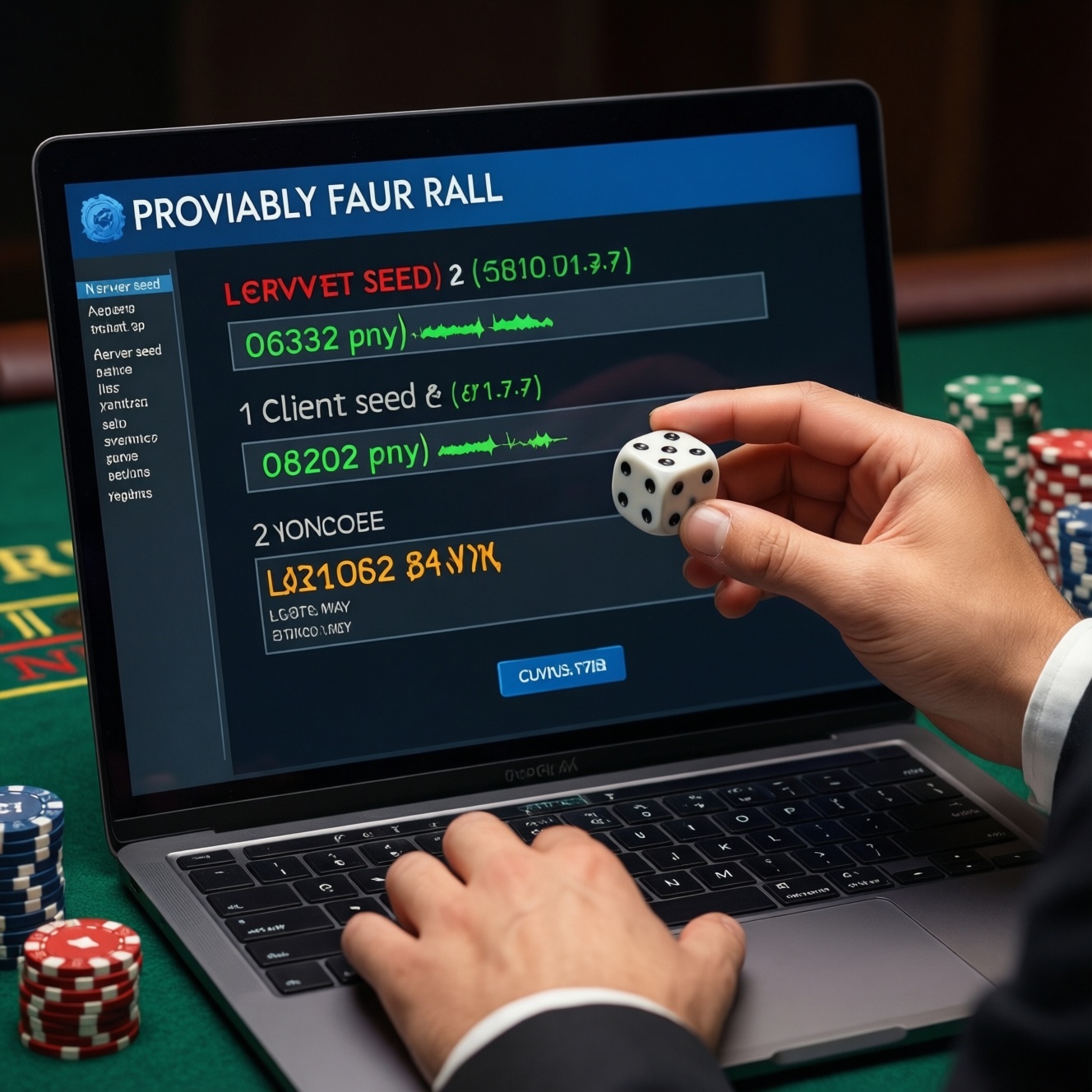
To verify results in a provably fair gaming gambling hybrid, you recreate the exact roll using the published server hash, the revealed server seed, your client seed, and a nonce. If your locally computed outcome matches the game's reported outcome, the round is verifiable. If any input is missing or the formula is undocumented, treat the result as non-verifiable.
Essentials for Verifying Provable Fairness
- Always confirm the server seed hash was shown before you played, and the server seed was revealed after.
- Use the exact client seed and nonce tied to the round you're checking.
- Recompute using the game's stated primitive (commonly HMAC-SHA256) and the same input concatenation rules.
- Verify the hash(commit): hash(revealed server seed) must equal the pre-game commitment hash.
- Confirm the mapping rule (bytes/hex to float to range) matches the operator's published spec.
- Prefer reproducible verification (scripted) over manual recalculation once you trust your script.
How Provably Fair Systems Work: Core Cryptography and Protocol Flow
Most provably fair gambling systems follow a commit-reveal pattern: the operator commits to a hidden server seed via a hash, you provide or influence a client seed, and each bet increments a nonce. A deterministic function (often HMAC) derives an outcome from these inputs, enabling provably fair verification after reveal.
This is a good fit when you can access full round data and the operator publishes the exact algorithm (common in a provably fair casino). Don't bother doing deep checks if the game hides the nonce, changes client seeds without your control, or does not publish the byte-to-outcome mapping-then you cannot reliably how to verify provably fair results beyond superficial hash matching.
| Approach | What you do | Best for | Limitations |
|---|---|---|---|
| Manual | Check commitment hash, recompute one round by hand or with a calculator | Spot checks, learning the flow | Error-prone; slow for many rounds |
| Automated | Run a script to recompute outcomes from exported round data | Batch auditing, reproducible provably fair verification | Requires correct parsing and exact spec adherence |
| Hybrid | Verify local derivation plus an external anchor (e.g., a blockchain reference) | Provably fair gaming gambling hybrid products | Anchor may not bind to per-round outcomes; extra moving parts |
Preparing and Validating Inputs: Server Seed, Client Seed, Nonce, and Hashes
Before you compute anything, collect and freeze the exact inputs for the specific round. In provably fair gambling, small mismatches (wrong nonce, trimmed seed, wrong encoding) cause false "failures."
What you need
- Pre-game commitment: the server seed hash (the "commit").
- Post-game reveal: the server seed (the "reveal").
- Your client seed: exactly as used (case-sensitive; no extra spaces).
- Nonce: per-bet counter, usually starting at 0 or 1 (must match the operator's rule).
- Game spec: HMAC/hash algorithm, input format (e.g., "HMAC(key=serverSeed, message=clientSeed:nonce)"), and mapping to outcomes.
- Tooling: a trustworthy hashing/HMAC implementation (local script or a known library), plus a way to copy raw values without formatting changes.
Validation checks before computing

- Hash the revealed server seed using the stated hash function (often SHA-256) and confirm it matches the committed server seed hash.
- Confirm whether the operator uses UTF-8 strings, hex-decoded bytes, or base64-decoded bytes for seeds.
- Confirm the nonce for that round (not your account total, not the UI counter unless specified).
Manual Verification Walkthrough: Calculating the Outcome Step by Step
This walkthrough mirrors what a provably fair casino verifier widget should do. Do it manually once to establish trust in the process, then switch to automation for consistency.
-
Capture the round data without modifying it
Copy the committed server hash, revealed server seed, client seed, nonce, and the game's reported outcome for the same round. Keep a screenshot or export if available.
- Watch for hidden whitespace or auto-capitalization in client seeds.
- Record the game type (dice, crash, wheel) because mapping differs.
-
Verify the commit-reveal integrity
Compute hash(revealedServerSeed) using the operator's commitment hash algorithm and compare to the committed hash shown before the bet. If it doesn't match, stop: the round is not provably fair.
- If multiple hashes are shown (e.g., per-session and per-round), use the one explicitly tied to the bet.
-
Recreate the HMAC/hash input exactly
Follow the published message format precisely (delimiters, order, and encoding). A common pattern is message = clientSeed + ":" + nonce with key = serverSeed, but you must use the game's exact spec.
- Confirm whether nonce is decimal text (e.g., "12") or a binary integer representation.
- Confirm whether client seed is user-chosen or system-assigned in this provably fair gaming gambling hybrid.
-
Compute the digest deterministically
Run the stated primitive (often HMAC-SHA256) and obtain a hex digest. This digest is the "randomness source" from which the game derives a number.
- If the game uses multiple rolls per round, it may advance by taking additional bytes or re-hashing with an incremented nonce.
-
Apply the game's mapping rule to get the final outcome
Convert the digest to a number using the operator's mapping rules (for example, taking the first N bytes, converting from hex to an integer, then scaling into a range). Compare your computed outcome to the game's displayed result.
- If you match: the round passes provably fair verification.
- If you don't match: re-check encoding, delimiters, and nonce base before assuming manipulation.
Quick mode (fast-track) for repeat checks
- Confirm hash(revealedServerSeed) == committedServerHash.
- Build the exact message string/bytes from clientSeed + nonce per spec.
- Compute HMAC/hash digest with the correct key/message roles.
- Apply the published mapping to compute the outcome.
- Match computed outcome to the UI result for that round.
Automated Verification: Tools, Scripts, and Reproducible Tests
Automation is the safest way to audit many rounds because it reduces transcription errors. Keep your verifier local, version-controlled, and test it against at least one round that the operator's own verifier marks as valid.
Minimal reproducible example (Python)
The template below demonstrates the common pattern (HMAC-SHA256 with message = clientSeed:nonce, key = serverSeed). You must adjust it to the operator's published rules.
import hmac, hashlib

def hmac_sha256_hex(key_str: str, msg_str: str) -> str:
    return hmac.new(
        key_str.encode("utf-8"),
        msg_str.encode("utf-8"),
        hashlib.sha256
    ).hexdigest()

server_seed = "REVEALED_SERVER_SEED"
client_seed = "YOUR_CLIENT_SEED"
nonce = 1

digest = hmac_sha256_hex(server_seed, f"{client_seed}:{nonce}")
print(digest)  # Use the game's spec to map this digest to the final outcome
Automation checklist for a trustworthy verifier
- Parse round exports without changing encoding (UTF-8 vs hex/base64) and without trimming whitespace.
- Assert commitment validity: hash(revealedServerSeed) equals committed server hash for every checked round.
- Lock the exact algorithm identifier (e.g., HMAC-SHA256 vs SHA-256) and input order (key/message).
- Unit-test delimiter and concatenation rules (":" vs "-" vs JSON, etc.).
- Implement the mapping rule as a pure function; avoid "close enough" floating-point shortcuts unless specified.
- Verify nonce handling: starting value, increment rules, and whether different bet types share the same nonce stream.
- Log all computed intermediate values (message bytes, digest, extracted bytes) for failed cases.
- Re-run the same input twice and confirm identical outputs (determinism check).
Hybrid Architectures: Combining Traditional RNGs with Blockchain Anchors
A provably fair gaming gambling hybrid often mixes a classic commit-reveal RNG with an external "anchor" (e.g., a public chain height, block hash, or time-based beacon). This can improve transparency, but only if the anchor is truly bound to the per-round outcome.
Frequent implementation and verification mistakes
- Anchor not binding the outcome: the blockchain value is displayed, but the game's actual roll ignores it.
- Anchor chosen after the fact: the operator selects a favorable block/hash post-bet instead of committing beforehand.
- Ambiguous anchoring rule: "use latest block" is underspecified (reorgs, confirmation depth, chain choice).
- Multiple randomness sources with unclear combination: XOR/concat/hashing without a published rule makes verification impossible.
- Nonce stream mismatch across modes: switching from "gaming" to "gambling" UI changes nonce increments or resets silently.
- Seed rotation without disclosure: server seed changes mid-session without showing a new commitment first.
- Client seed overwritten: system resets the client seed on reconnect, but the UI shows only the latest value.
- Different mapping per game skin: same digest but different scaling rules between game variants causes apparent inconsistencies.
When evaluating provably fair gambling claims in a hybrid product, require a clear statement of what is committed, when it is committed, and how each public anchor value is selected and combined.
Handling Discrepancies: Audits, Reconciliation, and Dispute Procedures
If your computed result doesn't match the platform's result, treat it as a data-quality problem first, then escalate with evidence. These alternatives help when a single-step verification isn't enough.
- Reconcile inputs using an immutable round record: export the round history (or request it) including server hash at time of bet, revealed seed, client seed, nonce, and game version/build identifier.
- Cross-check with an independent verifier implementation: run a second library or a community script to rule out a bug in your code or encoding assumptions.
- Request a formal operator audit trail: ask for the exact formula, delimiter rules, mapping steps, and any seed rotation schedule tied to the disputed rounds.
- Use platform dispute channels with a reproducible case: provide the full input tuple (commit hash, reveal seed, client seed, nonce) and your intermediate digest so support can reproduce exactly.
Common Verification Pitfalls and Quick Fixes
Why does the server seed hash match, but the outcome still differs?
Most mismatches come from using the wrong nonce, wrong delimiter/order, or wrong encoding (string vs hex/base64). Re-check the exact message format and the nonce for that specific bet.
Does a "provably fair casino" guarantee I'll win fairly?
No. Provably fair verification only shows the RNG outcome wasn't altered after commitment; it does not guarantee favorable payout rules or house edge details.
Can I verify provably fair results if the platform won't reveal the server seed?
Not fully. Without reveal, you can't recompute the roll, so you cannot complete provably fair verification beyond checking that a hash was displayed.
What if the platform changes my client seed automatically?
You can still verify if the exact client seed used per round is recorded and exportable. If only the "current" client seed is shown, historical rounds may be non-verifiable.
In a provably fair gaming gambling hybrid, what should the blockchain anchor prove?
It should be committed before the bet and mathematically included in the randomness derivation. If it's only displayed as a badge, it proves nothing about the specific round.
Is using an online hash calculator safe for verification?
It can leak your seeds and betting history. Prefer an offline script or local tool when verifying provably fair gambling rounds.
My script matches some rounds but not others-what does that indicate?
Usually a nonce stream reset, a hidden seed rotation, or different mapping rules per game mode. Compare failing rounds for changes in game version, bet type, or session boundaries.