


Token economies in Web3 games are the rules that create (emissions) and remove (sinks) in-game tokens, plus how players convert those tokens into value. "Play-to-earn" collapses when emissions outpace real demand, sinks are optional or non-competitive, and external markets amplify sell pressure-turning gameplay rewards into accelerating inflation and price decline.
Core Concepts Snapshot
- Emissions are token minting schedules; if rewards scale faster than demand, inflation shows up as falling token purchasing power.
- Sinks must be frequent, attractive, and "competitive" versus cashing out; cosmetic-only sinks rarely keep up with grinders.
- Velocity matters: when most rewards are immediately sold, the same emission rate becomes far more destabilizing.
- Demand must come from gameplay utility or status, not only new entrants; otherwise the model becomes a referral loop in disguise.
- External liquidity turns internal balance problems into price crashes via speculation, leverage, and fast exits.
- Sustainable design treats tokens as a resource with a budget: forecast sources/sinks, then gate rewards behind durable engagement.
How Token Emissions Drive In-Game Inflation
In web3 games tokenomics, "emissions" are any mechanics that add tokens to circulation: match rewards, quest payouts, staking yields, referral bonuses, and compensation events. Inflation happens when the game increases token supply faster than the game can create reasons to hold or spend tokens at comparable scale.
A compact way to think about it is: Net Token Flow = Emissions − Sinks. If net flow stays positive for long periods, the average player ends each day with more sellable balance. Unless there is proportional token demand (upgrades, crafting, entry fees, competitive bidding), the clearing price falls and players need more tokens to buy the same in-game utility.
Example (hypothetical): if your blockchain game token economy emits 1,000,000 tokens/day and sinks remove 600,000/day, then 400,000/day accumulates as sell pressure. Even if only 30% is sold immediately, that's still 120,000 tokens/day hitting the market; if utility demand is weaker than that flow, price and sentiment trend down.
- Quantify daily emissions by source (PvE, PvP, referrals, "idle yield") and separate predictable from event-driven mints.
- Measure sinks as a rate (tokens/day) and as a coverage ratio (sinks ÷ emissions) per player segment.
- Gate emission multipliers (boosts, guild bonuses) behind activities that also increase sinks or create new demand.
Designing Token Sinks: Types, Effectiveness, and Side Effects
Sinks are mechanics that permanently remove tokens (burn) or lock them long enough to reduce circulating supply. In a web3 game economy, sinks must be structured so that spending tokens improves player outcomes more than selling them-otherwise rational players will extract value and the token becomes a pure cash-out instrument.
- Progression sinks (power/utility): upgrades, crafting, skill resets. Effective because they affect win rate; risk: pay-to-win optics if unbounded.
- Access sinks (entry fees): dungeon keys, tournaments, ranked queues. Effective when rewards are skill-based; risk: excludes low-balance players.
- Maintenance sinks: durability repair, land upkeep, pet food. Effective for recurring burn; risk: feels like a tax if not tied to fun.
- Risk sinks: forging with failure chance, item destruction on loss. Effective for high-end economy; risk: rage quits if probabilities feel unfair.
- Social/status sinks: cosmetics, names, guild banners. Effective for whales; risk: doesn't scale with grinder emissions.
- Time-lock sinks (staking/escrow): lock tokens to access features. Effective to smooth supply; risk: creates "unlock cliffs" and coordinated dumps.
- Design sinks so they compete with selling: spending should increase future earning power or access, not only aesthetics.
- Match sink frequency to emission frequency (daily rewards need daily sinks; weekly sinks won't keep up).
- Plan side effects upfront: every sink changes retention, fairness perception, and player segmentation.
Player Earnings Dynamics: Supply, Demand and Velocity Metrics
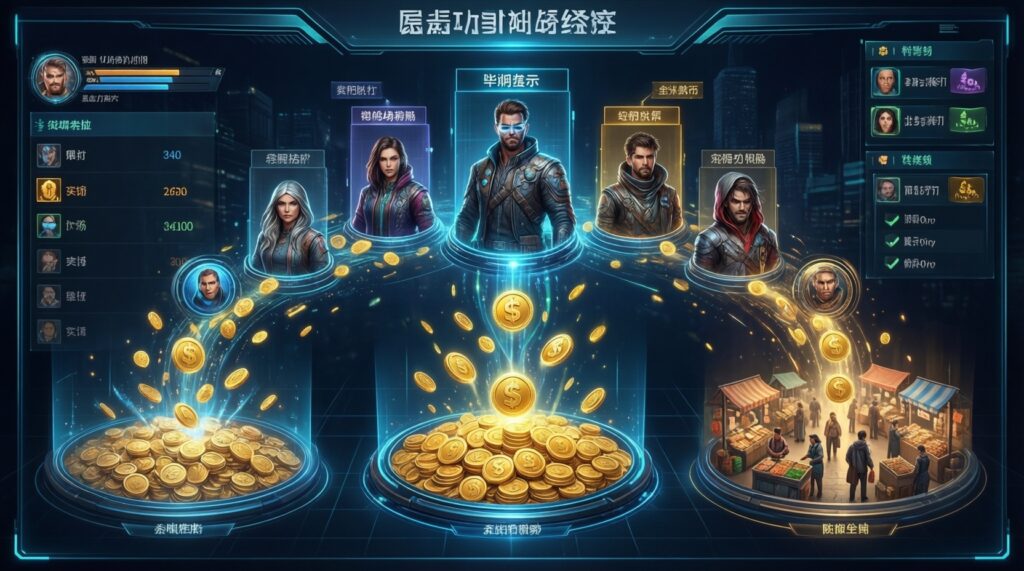
Player earnings in play to earn games are not just "income"; they are a flow that interacts with behavior: grinders maximize emissions, optimizers minimize sinks, and sellers maximize velocity. You manage sustainability by modeling segments and tracking how quickly tokens move from "earned" to "sold."
Typical scenarios where the same token design behaves very differently:
- Early growth: new players buy assets, creating temporary demand; emissions look safe until onboarding slows.
- Meta shift: one strategy becomes dominant, raising average emissions per hour and reducing sink diversity.
- Guild extraction: coordinated farming increases velocity (sell schedules), overwhelming organic buyers.
- Scholarship/rental models: earnings are routed to managers, increasing consistent sell pressure.
- Event farming: limited-time multipliers spike emissions; sinks lag because players hoard for post-event selling.
Practical metrics (use them as internal dashboards): Emission per active user, Sink per active user, Net flow per active user, and Sell-through rate (share of earned tokens sold within N hours/days). High sell-through turns even "reasonable" emissions into immediate market pressure for crypto gaming tokens.
- Segment players (new/returning/grinders/whales/guilds) and calculate emissions/sinks per segment, not only averages.
- Track velocity proxies: time-to-sell, exchange outflows, and in-game wallet balance decay after reward claims.
- Couple reward rates to behaviors that also raise sinks (e.g., higher rewards only in modes with entry fees).
Collapse Mechanisms in Play-to-Earn Economies
Most collapses look different on the surface but share the same internal pattern: emissions are a guaranteed liability, while demand is optional. When optional demand weakens, the system's "equilibrium" requires lower prices and more grinding, which further increases emissions and accelerates the decline.
What tends to work (when applied early)
- Hard caps and adaptive rewards: emissions reduce when net flow stays positive for too long.
- Skill-gated earnings: rewards depend on performance, not only time; reduces farmability.
- Mandatory sinks in core loops: entry fees, repairs, crafting dependencies tied to the most-played modes.
- Non-fungible progression: shift some value to account-bound progression so selling isn't the only "win."
Limits you cannot patch later with marketing

- Reflexive onboarding: if new buyers are required to pay old sellers, growth slowdown triggers payout failure.
- Optional sink design: if the optimal strategy is "never spend," token becomes a pure extraction tool.
- Unlimited farming: bots and optimized guild play will find the ceiling of your emission model.
- Unlock cliffs: mass staking unlocks or vesting releases can create synchronized dumps.
- Define "collapse" operationally (e.g., sustained negative net flow coverage ratio, rising sell-through, shrinking buyers).
- Introduce adaptive controls before the first major downturn; late changes look like moving goalposts.
- Remove farmability first (caps, anti-bot, skill gates), then tune sinks-otherwise you're draining a flooding bathtub.
External Market Couplings: Liquidity, Speculation, and Price Feedback
Once your token is tradable, your internal economy is no longer closed. Liquidity venues and speculation create feedback loops: price changes alter player motivation, which changes emissions and selling, which further changes price. This coupling is why "internal balance" alone doesn't stabilize a blockchain game token economy.
- Myth: "More liquidity fixes everything." More liquidity makes exits easier; if net flow is positive, liquidity accelerates selling.
- Mistake: pricing gameplay around token USD value. When price falls, you unintentionally raise required grind time, driving churn.
- Mistake: rewarding in a freely tradable token with no mandatory sinks. Players treat it as salary; the market treats it as inflation.
- Myth: "Buybacks will stabilize the floor." Buybacks create expectations and can be gamed; they do not fix structural net flow.
- Mistake: synchronized unlocks. Vesting cliffs, season-end payouts, or mass reward claims create predictable dump events.
- Model token design assuming rational selling and fast exits; treat "holding" as an earned behavior, not a default.
- Stagger unlocks and smooth reward claims to reduce coordinated sell spikes.
- Keep core gameplay pricing stable in non-token units where possible; avoid tying fun directly to token price volatility.
Operational Framework for Sustainable Token Flow Design
A practical way to design is to treat token rewards as a budget you allocate per day, then enforce sinks and caps so the budget cannot be exceeded by optimization. This is the minimum viable framework for web3 games tokenomics that want to avoid "infinite farm" dynamics.
Mini-case: daily budget + segment caps + sink coverage
Assume you want 100,000 tokens/day total emissions across all players. You set target sink coverage at 90,000 tokens/day through entry fees, crafting, and repairs, leaving 10,000/day as controlled net growth for onboarding liquidity.
# Inputs (set by design)
E_total_target = 100000          # tokens/day
S_total_target = 90000           # tokens/day
net_target = E_total_target - S_total_target  # 10000/day

# Runtime controls (computed daily/weekly)
sell_through = sold_tokens_last_24h / earned_tokens_last_24h
sink_coverage = sunk_tokens_last_24h / earned_tokens_last_24h

if sink_coverage < 0.9 or sell_through > 0.6:
    reduce_emission_multiplier()     # lower rewards in farmable loops
    increase_mandatory_fees()        # shift sinks into most-played modes
    tighten_per_account_caps()       # limit multi-account extraction
else:
    slowly_restore_rewards()         # avoid oscillations and shock changes
Implementation notes that prevent "moving goalposts" backlash
- Publish a clear policy: rewards are adaptive to keep the economy playable, not to target a price.
- Prefer smooth control (small weekly changes) over sudden nerfs; reserve hard actions for exploit events.
- Align incentives: the best way to earn should also be the best way to spend inside the game.
- Set explicit daily emission and sink targets; tune content to hit them with real player behavior, not ideal behavior.
- Use adaptive levers (caps, multipliers, fees) tied to measured sell-through and sink coverage.
- Stress-test against bots/guilds by simulating the top 1% optimizer path and ensuring net flow stays bounded.
Practitioner self-check before you ship
- Can a rational player maximize profit while spending near-zero tokens? If yes, your sinks are non-competitive.
- Does any loop allow "earn more tokens to earn even more tokens" without meaningful constraints? If yes, collapse is a timing question.
- Are major unlocks/season payouts synchronized? If yes, you have predictable dump days.
- If onboarding slows for a month, do sinks still cover emissions? If no, you're dependent on new entrants.
Critical Practitioner Questions
What is the single fastest signal that a token economy is destabilizing?
A rising sell-through rate (earned tokens sold quickly) alongside declining sink coverage. It means your token is being treated as cash-out, not gameplay fuel.
Are "play to earn games" inherently unsustainable?

They become unsustainable when earnings are guaranteed while demand is optional. You can sustain payouts if rewards are capped, skill-gated, and matched by mandatory sinks and durable utility demand.
How many tokens should a game emit per day?
There is no universal number; set an emissions budget based on expected active users and required sink coverage. If you cannot design sinks that scale with your highest-emission segment, reduce emissions or redesign the earning loop.
Do cosmetics count as a meaningful sink?
They help for whales and status-driven players, but usually do not scale with grinders who generate most emissions. Treat cosmetics as additive, not as your primary stabilization mechanism.
Should we use one token or two tokens?
Two tokens can separate "spend" utility from "value capture," but it also creates more conversion paths and arbitrage. Choose based on whether you can enforce sinks and caps on the reward token without breaking gameplay.
What role does liquidity play for crypto gaming tokens?
Liquidity improves price discovery and user access, but it also makes exiting easier. If net emissions exceed sinks, deeper liquidity tends to accelerate the price adjustment downward.
What is the safest way to change emissions after launch?
Use a published adaptive policy (based on sink coverage and sell-through), apply gradual adjustments, and pair reward reductions with new or improved sinks. Avoid sudden nerfs unless you are closing an exploit.