


Loot box RNG transparency depends on what the publisher discloses (drop tables, pity rules, timing) and what you can independently validate with safe sampling. You can read posted rates like a probability model, then ตรวจสอบอัตราดรอป ลูทบ็อกซ์ by logging outcomes and comparing observed frequencies against expected ranges-without hacking, exploits, or ToS-breaking automation.
At-a-Glance: Core Findings on RNG Transparency
- "Transparent RNG" means you can map every possible reward to a published probability and understand modifiers (pity, guarantees, banners, pools).
- Reading rates is not just "% per pull"; you must account for pool composition, conditional rates, and time-limited rules.
- Small samples mislead; the goal is consistency with the published model, not "proving" exact percentages from a few pulls.
- Independent testing can be done safely using manual logs, session recordings, and basic statistics-no reverse engineering required.
- Third-party audits and cryptographic proofs help only if their scope matches the exact loot box configuration you're using.
- Operational behaviors (silent changes, vague disclosures, missing pity details) are stronger signals than any single community spreadsheet.
How RNG Works in Loot Boxes: Algorithms, Entropy Sources and Implementation
- Who this is for: intermediate players, analysts, community moderators, or QA-minded creators who want to answer "RNG ลูทบ็อกซ์ คืออะไร" in practical terms and assess whether ลูทบ็อกซ์ โปร่งใสไหม using observable behavior and published info.
- When not to do it: if your plan involves packet tampering, bots, memory editors, or any method that violates the game's Terms of Service. This page focuses on safe, user-level verification.
Prep model: what RNG usually means in loot boxes
- Server-side draw: most games roll outcomes on the server; your client only displays results.
- Pseudo-random, not "mystical": outcomes come from a PRNG seeded with entropy (timing, system events, server state), then mapped to a reward table.
- Mapping step matters: even with fair randomness, non-obvious mapping rules (separate pools, pity counters, featured boosts) can change effective odds.
Reproducible mental model (pseudocode)

# Simplified loot box draw model (conceptual)
u = UniformRandom(0, 1)
if pity_counter >= pity_threshold:
    return guaranteed_item
else:
    return pick_from_weighted_table(u, banner_table)
Interpreting Published Drop Rates: Probability Models and Real-World Caveats
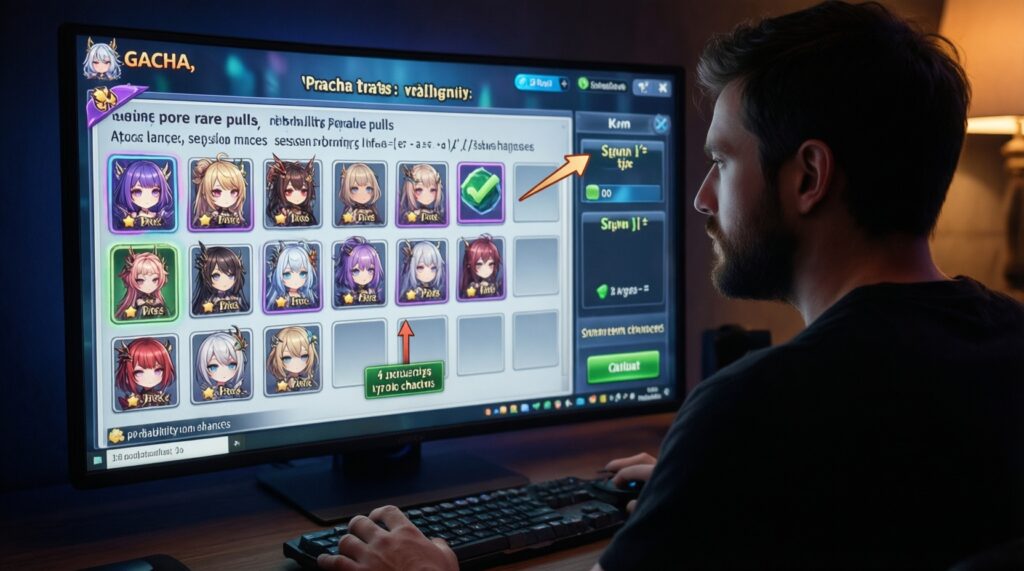
- Find the exact disclosure page for your banner: not just "rare = 5%". You need per-item rates or at least category rates plus pool size.
- Capture rule modifiers: pity/guarantee, "featured" boosts, step-up ladders, first-time bonuses, duplicates protection, and "shared pool" details.
- Document constraints: single pull vs 10-pull differences, currency type, region account, platform, and time window.
- Tools you'll need: a spreadsheet (Google Sheets/Excel), a note app, and a way to timestamp outcomes (screen recording or screenshots).
How to read rates like a model (quick calculation)
If a posted rare rate is p per pull, the chance of getting at least one rare in n pulls is:
P(at least one) = 1 - (1 - p)^nThis is the backbone of วิธีอ่านอัตราดรอป gacha: it translates a per-pull rate into "session experience." It is only valid if pulls are independent and there are no pity/guarantee rules-so always check the fine print.
Caveats checklist (what breaks naive interpretation)
- Conditional probabilities: "Featured 50% on hit" changes the model after the first event (a hit).
- Multiple tables: weapon vs character pools, or different rarity tables per banner.
- Pity counters: the probability is not constant across pulls if pity increases odds or forces a guarantee.
- Disclosure granularity: category rates without per-item breakdown can still hide big differences within the category.
Practical Sampling: Designing Tests to Read and Validate Drop Rates
Mini prep checklist (safe and reproducible)
- Record the banner name, version, and exact time range you tested (timezone included).
- Save screenshots of the official rate disclosure and any pity/guarantee description.
- Decide your test scope: category rates only, featured-vs-nonfeatured split, or "any rare" rate.
- Set a stopping rule before you start (example: "stop after N pulls or when currency runs out").
- Log every pull sequentially; don't cherry-pick highlights.
-
Define the hypothesis from the published rules
Write a testable statement like "Rare items drop at rate p," or "On a rare hit, featured appears with probability q." This aligns your work with what the publisher actually claims, which is the core of ตรวจสอบอัตราดรอป ลูทบ็อกซ์.
- Example: H0: p = 0.05 for "rare or higher" on this banner.
-
Choose an outcome coding scheme
Use consistent categories: rarity tier, featured flag, item ID/name, and whether pity/guarantee was triggered. Don't mix banners or currencies in one dataset.
- Example columns: pull_index, timestamp, banner, currency, rarity, featured(Y/N), item_name, pity_counter.
-
Collect data without ToS-breaking automation
Do manual pulls (or normal in-game multi-pulls) and log results using screenshots or screen recordings for auditability. Your goal is verifiable evidence, not speed.
- Tip: If the game has a built-in history log, cross-check your manual log against it.
-
Compute observed rates and compare to expectations
Calculate observed frequency p̂ = successes / n. Then compare to the published p using a simple confidence interval or a binomial test; you're checking consistency, not "exact match."
- Quick math: p̂ = k/n, where k is count of "rare or higher."
- Rule of thumb: avoid conclusions when k is extremely small (too little signal).
-
Segment by rule boundaries
If pity exists, split analysis into "pre-pity region" vs "near/at pity." Also segment by featured-on-hit mechanics: evaluate featured share among rare hits, not among all pulls.
- Example: compute featured_rate = featured_hits / total_rare_hits.
-
Write a reproducible summary
Publish your dataset schema, time window, and methodology so others can replicate. This is what makes "เครื่องมือเช็ค RNG และอัตราดรอป เกม" useful: not the app itself, but the reproducible process around it.
Concise verification plan (sample)
| Goal | Data you must log | Suggested scale (no hard numbers) | Test to run | What a "pass" looks like |
|---|---|---|---|---|
| Validate "rare-or-higher" rate | Per-pull rarity tier, banner, time window | Enough pulls to see multiple rare hits | Binomial test or confidence interval for p̂ vs p | Observed p̂ is plausible under the published p |
| Validate featured share on hit | All rare hits marked featured/non-featured | Enough rare hits to compare shares | Binomial test on featured among rare hits | Featured proportion matches the published rule |
| Check pity/guarantee behavior | Pull index, pity counter (or inferred), hit positions | Runs that reach the pity region | Rule-consistency check (deterministic) | Guarantee triggers exactly as described |
Tools and Data: Logging, Statistical Tests, and a Reproducible Checklist
- Confirm you can explain the exact model you're testing (banner + pool + pity rules), not "RNG in general."
- Keep raw evidence (screenshots/video) tied to timestamps and pull indices.
- Ensure your dataset has no mixed configurations (different banners, different regions, different patch versions).
- Use consistent coding for outcomes (same rarity labels, same featured flags, same item names/IDs).
- Compute p̂ (observed rate) and document the published p beside it for each metric.
- Run at least one statistical check (binomial test or confidence interval) and store the result/output.
- Segment analysis where rules change (pity thresholds, guaranteed steps, "first hit" rules).
- Sanity-check against the in-game history log if available.
- Publish methodology and schema so others can replicate, not just your conclusion about whether ลูทบ็อกซ์ โปร่งใสไหม.
Reproducible example: binomial test in Python (optional tooling)
# Safe offline analysis: you manually enter k successes out of n pulls
from math import comb

def binom_p_value_two_sided(k, n, p):
    # Simple exact two-sided p-value by summing probabilities
    # (not optimized; fine for small/medium n)
    def pmf(x):
        return comb(n, x) * (p**x) * ((1-p)**(n-x))
    obs = pmf(k)
    return sum(pmf(x) for x in range(n+1) if pmf(x) <= obs)

k, n, p = 12, 200, 0.05
print("p-value:", binom_p_value_two_sided(k, n, p))
Third-Party Audits and Cryptographic Proofs: Assessing Their Reliability
- Scope mismatch: the audit covers "the loot box system" but not your specific banner/pool configuration.
- Time mismatch: audits that don't clearly state the game version or date range may not apply after patches.
- Opaque methodology: "certified fair" without explaining what was tested (PRNG quality, mapping logic, pity rules) is not actionable.
- Selective disclosure: only category rates are disclosed, while within-category weights remain hidden.
- Cryptographic proof without user verifiability: "provably fair" claims where players can't independently verify seeds, commits, or draws.
- Client-side theater: flashy animations implying randomness while server logic is undisclosed and changeable.
- Ambiguous definitions: "drop rate" described without clarifying whether it's per pull, per box, per session, or conditional on a prior event.
- Community datasets without controls: pooled reports that mix regions, banners, and time windows can look precise but be invalid.
Reproducible check: what a verifiable proof would let you do
# Conceptual steps for verifiable draws (not game-specific)
# 1) Publisher commits to a server seed hash before the event.
# 2) After draws, publisher reveals the seed.
# 3) Player recomputes each draw using the seed + nonce and matches outcomes.
Operational Red Flags: What Publisher Practices Undermine Transparency
If your goal is player-safe confidence, consider these alternatives when red flags appear (silent changes, missing pity detail, vague pools):
- Prefer systems with full banner tables and pity math disclosed: use games that publish per-item or per-tier plus pool size and clearly describe guarantees; your "วิธีอ่านอัตราดรอป gacha" becomes testable.
- Rely on deterministic acquisition paths where possible: crafting, token shops, battle pass tracks, or exchange systems reduce dependence on RNG and make value predictable.
- Use community verification with strict dataset rules: only join projects that enforce banner/version/time segmentation and require evidence logs; this makes เครื่องมือเช็ค RNG และอัตราดรอป เกม meaningful rather than anecdotal.
- Limit exposure by setting personal caps: pre-commit budgets/time caps and stopping rules so uncertainty doesn't escalate into uncontrolled spend.
Practitioner Questions on Trusting and Testing Loot Box RNG
What does "RNG ลูทบ็อกซ์ คืออะไร" mean in practical terms?
It's a random draw process (usually server-side) that maps a random number to a reward table, often modified by pity, guarantees, and banner-specific pools.
Is "ลูทบ็อกซ์ โปร่งใสไหม" something you can prove from player testing alone?
You can't prove the internal algorithm, but you can test whether observed outcomes are consistent with published rules and whether the publisher's disclosures are complete and stable over time.
What's the most common mistake when people try to ตรวจสอบอัตราดรอป ลูทบ็อกซ์?
Mixing different banners/patches/currencies into one dataset, which breaks the assumptions and makes the results uninterpretable.
In วิธีอ่านอัตราดรอป gacha, what should I focus on first: per-pull rate or pity?
Start with pity/guarantee rules because they change probabilities across pulls; then interpret the per-pull base rate within the correct segment (pre-pity vs pity region).
Do 10-pulls change probabilities compared to single pulls?
Sometimes. Some games add guarantees or different rules for multi-pulls, so you must log and analyze them as a distinct configuration.
What เครื่องมือเช็ค RNG และอัตราดรอป เกม are safe to use?
Safe tools are offline spreadsheets, personal logging templates, screen recording, and statistical scripts run on your own data-no packet interception or automation that violates ToS.
How do I interpret "featured 50% on hit" correctly?
Compute featured probability conditional on getting a rare hit (featured_hits / total_rare_hits), not featured_hits / total_pulls.