

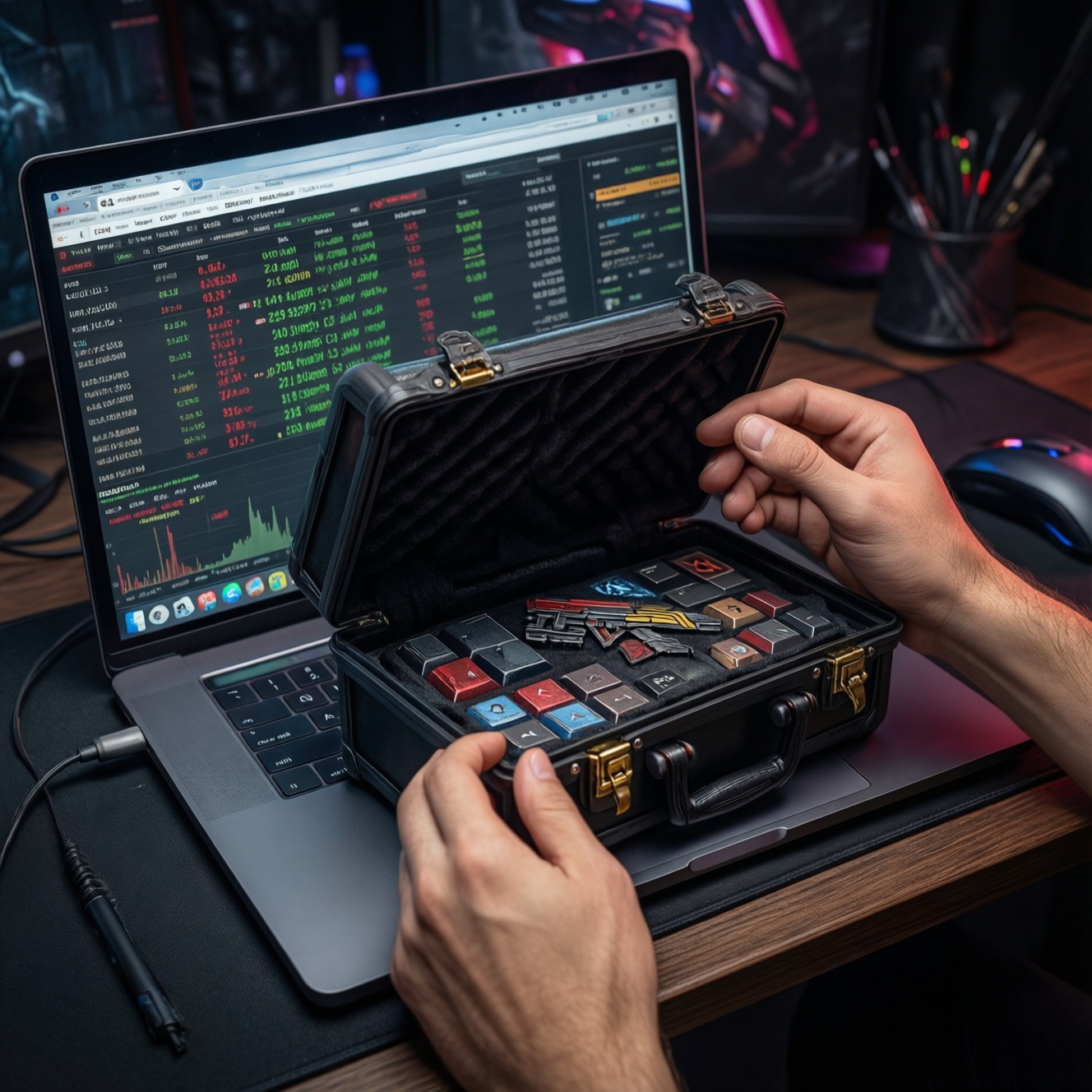
If your goal is to choose the best option, treat CS2 case/capsule opening as a negative‑EV lottery unless your own inputs (drop odds + current market sell prices + fees + key price) make the math work. In most real decisions, buying the exact skin/sticker you want beats opening. Use a CS2 cases EV calculator to verify.
EV Summary and Immediate Conclusions
- Compute CS2 case opening expected value from your own price snapshot; don't rely on "good case" reputation.
- Most "best CS2 cases to open EV" lists ignore variance; you should also check bust rate and median outcome.
- CS2 capsule opening expected value is usually even more skewed (many tiny outcomes, few huge hits), so bankroll discipline matters more.
- For a targeted outcome (one skin or one sticker), buying the item directly typically dominates opening on risk-adjusted terms.
- If you still want the opening experience, prefer options with (a) lower total cost per roll and (b) multiple mid-tier items with real liquidity.
How CS2 Case Mechanics Affect Expected Value
- Total cost per roll: case/capsule cost + key cost (cases) + any conversion costs (e.g., currency, wallet friction). EV must clear this.
- Distribution shape: a few ultra-rare outcomes can inflate "average" EV while your typical result stays far below cost.
- Rarity tier ladder: more steps between common and top-tier typically increases variance and lowers median return.
- Market liquidity: items with thin volume can look valuable but are hard to sell at posted prices.
- Sell fees and spreads: Steam fee + bid/ask gaps reduce realized value versus displayed listings.
- Condition/float and special variants: if your case's value depends heavily on special rolls, your bust rate rises.
- Time sensitivity: prices move; EV computed today can flip after a patch, event end, or hype cycle.
- Opportunity cost: the same budget can buy a guaranteed skin/sticker now (or be held as balance for later dips).
Calculating EV: Probabilities, Rarity Tiers, and Market Price Inputs
At minimum, EV needs: (1) your estimated probability for each outcome (or rarity tier), (2) your expected sell price net of fees, and (3) your all-in opening cost. A practical workflow is: snapshot prices → apply fee haircut → map prices to outcome probabilities → sum. If you want a reusable template, build a sheet or use a CS2 cases EV calculator and verify its assumptions.
| Option | Who it fits | Pros | Cons | When to choose |
|---|---|---|---|---|
| Buy the exact skin on the market | Goal-driven buyers; collectors | Guaranteed outcome; easiest budgeting; no probability guesswork | No "jackpot" upside; must time liquidity and spreads | When you know what you want and care about predictable cost |
| Open a CS2 case (case + key) | Entertainment-first openers who accept variance | Thrill factor; chance at high-tier items; can be repeated | Usually low median return; fees reduce realized value; requires odds + pricing inputs | When your computed EV is close to cost and you can tolerate long losing streaks |
| Open a CS2 capsule | Sticker-focused users; event-driven speculation | Lower unit price sometimes; simple inventory; can align with hype cycles | Highly skewed outcomes; many low-value results; liquidity can collapse after events | When sticker demand is strong and your sell-through plan is clear |
| Sell the case/capsule instead of opening | Users who receive drops; low-risk players | Locks in value; zero variance; no key cost | Misses upside; may face low bids | When your computed opening EV is below total cost or you dislike risk |
| Buy a diversified "basket" of items (skins/stickers) rather than open | Intermediate users managing risk | Lower variance than openings; can target liquid items; flexible exit | Requires picking items and monitoring prices; still market risk | When you want upside but prefer market risk over RNG risk |
EV formula you can reproduce
- Define all-in cost: C = case_or_capsule_price + key_price (if any).
- For each possible outcome i, estimate probability pi and net sell value vi (after fees/spread).
- Compute expected value: EV = Σ(pi × vi) − C.
- Compute expected return ratio: ROI = (Σ(pi × vi)) / C − 1.
- Do a sensitivity check: re-run with conservative net values (e.g., "quick sell" prices) and see if EV stays acceptable.
Case vs Capsule: Side‑by‑Side EV Models and Sensitivity Analysis
- If your case EV only looks good using top listing prices, then redo the model using conservative net values; if it flips negative, prefer buying the skin or selling the case.
- If key cost dominates your per-roll cost, then cases become very sensitive to small price drops; capsules (no key) may be less sensitive to that specific input but can be more sensitive to hype cycles.
- If most value comes from one or two ultra-rare hits, then capsules/cases will show a misleading "average"; choose based on median and bust rate, not only EV.
- If you are opening for a specific desired item, then compare expected "cost to hit" (1/probability) against buying; buying usually wins unless the market price is extremely inflated.
- If you plan to buy CS2 cases and capsules for opening, then set a strict price ceiling where your conservative EV is closest to breakeven; above that ceiling, switch to direct purchases.
Risk Profile Metrics: Variance, Median Return, and Bust Rate
- Compute EV using conservative net values (fees + realistic sell price).
- Estimate bust rate: sum probabilities of outcomes where vi < C.
- Find the median outcome: order outcomes by value and locate where cumulative probability crosses 50%.
- Approximate variability (simple approach): group outcomes into tiers (low/mid/high) and compare how concentrated probability is in the low tier.
- Set a stop rule: maximum number of opens per session and per week; never "chase" the high-tier hit.
- Choose the action: open only if EV is acceptable and bust rate/median align with your tolerance; otherwise buy or sell.
Decision Tree for Opening: Thresholds, Bankroll, and Opportunity Cost
- Ignoring fees: modeling with gross listing prices instead of net sell proceeds turns "near breakeven" into quietly negative.
- Not separating goals: "I want this skin" is a buying problem; "I want to gamble for fun" is an opening problem-don't mix them in one budget.
- No bankroll boundaries: opening without a hard cap invites chasing losses; define an amount you can fully lose.
- Overweighting the jackpot: focusing on the top outcome while the median outcome is far below cost.
- Using stale prices: EV depends on today's market; re-check before each batch.
- Assuming liquidity: thinly traded items can require undercutting; your realized value may be lower than modeled.
- Buying at peak hype: cases/capsules often rise into events and fall afterward; opening at peaks worsens EV.
- Skipping a "sell instead" comparison: if selling the drop funds most of the skin you want, opening is an expensive detour.
Worked Examples and Comparative Tables for Popular Cases and Capsules
These examples are illustrative math to show how to calculate EV and risk metrics; replace the probabilities and net prices with your own current inputs. Do not treat the numbers as real odds or current market values.
Worked example A (case): stepwise EV
- Assume all-in cost C = 100 (case + key), in your chosen currency.
- Assume three simplified outcome buckets (example only): low tier p=0.80, v=30; mid tier p=0.19, v=120; high tier p=0.01, v=2000 (all net after fees/spread).
- Compute expected gross value: 0.80×30 + 0.19×120 + 0.01×2000 = 24 + 22.8 + 20 = 66.8.
- Compute EV: EV = 66.8 − 100 = −33.2.
- Bust rate (v<C): 0.80 (only the low tier is below cost in this toy model).
Worked example B (capsule): stepwise EV

- Assume all-in cost C = 50 (capsule price, no key).
- Assume simplified outcomes (example only): common p=0.85, v=10; rare p=0.14, v=80; ultra p=0.01, v=800 (net).
- Expected gross value: 0.85×10 + 0.14×80 + 0.01×800 = 8.5 + 11.2 + 8 = 27.7.
- EV: EV = 27.7 − 50 = −22.3.
- Bust rate (v<C): 0.85 in this toy model.
Compact EV comparison table (plug in your real inputs)
| Type | All-in cost (C) | Model EV (example) | Risk proxy (bust rate) | Breakeven condition |
|---|---|---|---|---|
| Case opening | C = case + key | EV = Σ(p×v) − C | Σ p(v<C) | Needs higher net sell values and/or lower C until Σ(p×v) ≈ C |
| Capsule opening | C = capsule | EV = Σ(p×v) − C | Σ p(v<C) | Needs strong sticker demand and reliable liquidity so net v rises |
| Buy the skin/sticker | C = market price | EV (RNG) = 0 | None (no RNG) | Breakeven is simply whether you like the item at that price |
Mini decision-tree you can follow before spending

- Is your goal a specific skin/sticker? → Buy it directly (or place a buy order) rather than open.
- Is your goal entertainment? → Continue only with a fixed budget cap and stop rule.
- Do you already own drops? → Compare "sell drop now" versus "open"; if EV is negative under conservative prices, sell.
- Can you sell outcomes quickly at realistic net values? → If no, treat v lower and assume worse EV.
- After conservative EV + bust rate check, does it still fit your risk tolerance? → If yes, open; if no, buy items or hold balance.
For most intermediate players deciding "best value," buying the exact skin is typically best for certainty, while selling drops is often best for low-risk value capture. Opening can be the better fit for entertainment or for users testing a clearly modeled, time-sensitive edge-only after verifying inputs for your own market snapshot in Thailand.
Short Answers to Practical EV and Strategy Doubts
What does "CS2 case opening expected value" mean in practice?
It's the average net value you would get per open over many trials, minus the all-in cost (case + key). It does not tell you what you'll get in your next 10 opens.
Is there a reliable "best CS2 cases to open EV" list?
Not reliably, because EV changes with case price, key cost, and market prices. Treat any list as a starting point and re-check with your own inputs.
What should a CS2 cases EV calculator include to be useful?
It should allow editable probabilities, net (after-fee) prices, and your local all-in cost. If it hardcodes prices or ignores fees/spread, it will overstate EV.
How is CS2 capsule opening expected value different from cases?
Capsules often have more extreme skew: lots of low-value outcomes and a tiny chance of a big hit. That usually increases bust rate and makes median return worse.
Should I buy CS2 cases and capsules to open, or just buy items?
If your goal is a specific item, buy it. If your goal is entertainment, only buy to open after setting a strict budget and confirming conservative EV is acceptable to you.
Does a positive EV guarantee profit if I open enough?
No. Even with positive EV, variance can be large, and you can be down for a long time before results converge. Liquidity and price moves can also remove the edge.