


If you're choosing between Play-to-Earn and gambling-style mechanics in web3 crypto games, start from your primary value: sustainable fun, regulated wagering, or token-driven exit value. P2E optimizes perceived ownership but risks inflation and churn. Gambling mechanics can monetize fast but raise legal and harm risks. Hybrid models work when you separate entertainment loops from financial outcomes.
Core trade-offs: token economics vs player experience
- Retention driver: P2E relies on progression and social status; wagering relies on excitement and liquidity; hybrids need both without letting payouts dominate.
- Revenue quality: Gambling-style spend is clearer and can be steadier; P2E often shifts value to early sellers unless sinks are strong.
- Volatility exposure: Tokenized economies amplify market cycles; house-edge economies amplify bankroll and liquidity risk.
- Legal and platform risk: web3 gambling games and crypto casino games face higher licensing and geo-block requirements than most play to earn crypto games.
- Trust surface: RNG/oracle integrity is central for wagering; economy integrity (supply, sinks, emissions) is central for P2E.
- User expectations: "Best play to earn games" audiences want predictable progression; gamblers want fairness proofs, fast settlement, and limits.
Mechanics Overview: Play-to-Earn, Gambling, and Hybrid Models
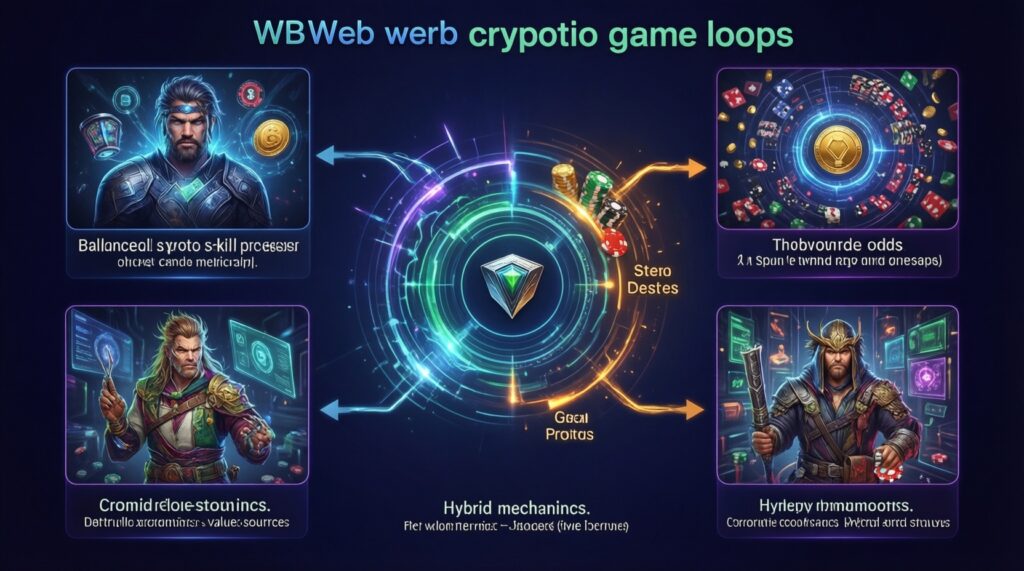
Use these criteria to choose a core mechanic set for web3 crypto games (and avoid mixing incentives that fight each other):
- Primary loop: skill/progression (P2E) vs probability/odds (gambling) vs layered loops (hybrid).
- Value source: player-to-player trading, issuer emissions, house edge, sponsorships, or off-chain revenue.
- Outcome determinism: mostly deterministic rewards vs RNG-driven payouts vs deterministic gameplay with RNG monetization.
- Time-to-value: long-tail progression earnings vs instant settlement wagers vs staged unlocks and capped cashout.
- Liquidity dependency: marketplace depth for items/tokens vs bankroll/liquidity pools vs segmented liquidity per mode.
- Risk tolerance: economic inflation risk (P2E) vs regulatory/harm risk (gambling) vs both if not separated.
- Anti-abuse posture: bot resistance and sybil controls vs collusion and RNG manipulation defenses vs combined threat model.
- Distribution constraints: app store policies, local restrictions (TH + cross-border), and payment rails compatibility.
Economic Design: Tokenomics, Inflation, and Value Capture
Most failures in play to earn crypto games come from "emissions first, fun later" designs where rewards outpace sinks. Most failures in crypto casino games come from underestimating bankroll management, fraud, and compliance. Hybrids win when you can ring-fence risk: keep wagering optional, keep progression meaningful, and keep cashout rules explicit.
Comparative model signals (acquisition, ARPU, volatility, legal risk, retention)

| Model | User acquisition | ARPU potential | Volatility exposure | Legal risk | Retention pattern |
|---|---|---|---|---|---|
| P2E progression economy | Good when narrative/community is strong; weaker if only "earn" marketing | Moderate (often tied to trading + sinks) | High if rewards are token-heavy | Medium (varies by cashout framing) | Better when progression is deep; churn spikes when token drops |
| Gambling/wagering core loop | Fast in niche channels; limited on mainstream platforms | High (house edge + repeats) | Medium (bankroll and liquidity more than token price) | High (licensing, geo-blocking, AML/KYC triggers) | High frequency for a subset; can be fragile under restrictions |
| Hybrid: skill game + optional wagering | Good if wagering is optional and social play stands alone | Moderate to high | Medium to high (depends on payout token design) | Medium to high (depends on how wagering is implemented) | Strongest when fun survives without cashout |
Design options you can actually ship (and when to pick them)
| Option | Who it fits | Pros | Cons | When to choose |
|---|---|---|---|---|
| Fixed emission + strong sinks (classic P2E) | Studios with deep progression and live-ops discipline | Clear earning narrative; scalable economy tuning | Inflation risk; "work-like" gameplay pressure | When you can measure sinks daily and iterate fast |
| Crafting economy with item burn (NFT-first) | Teams strong in item design and marketplace UX | Value tied to scarcity and utility; less token dumping | Whale dominance risk; liquidity fragmentation | When your core loop naturally consumes items (durability, fusion, entry fees) |
| Season-pass rewards + capped cashout | Midcore games targeting predictable engagement | Controls liability; aligns rewards with engagement | "Not truly decentralized" perception; support burden | When you need stability and want to avoid bank-run dynamics |
| House-edge wagering using stable settlement asset | Operators treating this like a regulated product | Clear unit economics; easier risk accounting | Licensing/geo-blocking; fraud and chargeback-like disputes | When you can run compliance, limits, and responsible play controls |
| Player-vs-player wagers (no house, fee-based) | Competitive skill games with strong matchmaking | Lower bankroll needs; fairness narrative is simpler | Collusion risk; still may be treated as gambling | When outcomes are skill-dominant and you can detect collusion |
| Hybrid dual-currency: fun currency + separate cashout token | Games that must protect the core loop from speculation | Separates "play" from "finance"; easier UX gating | Complex messaging; bridge between currencies can be exploited | When you want optional earning without letting price charts drive gameplay |
Short case patterns (successful vs failed signals)
- Common P2E success signal: players keep playing even when earnings drop because progression, guild identity, and skill mastery still matter.
- Common P2E failure signal: onboarding copy and community talk are dominated by ROI; botting appears early; sinks feel punitive rather than fun.
- Common wagering success signal: provable fairness is understandable, limits are clear, and settlement is fast without hidden conditions.
- Common wagering failure signal: opaque RNG, unclear terms, or inconsistent geo/KYC enforcement leading to frozen accounts and reputation collapse.
Player Incentives, Addiction Risks, and UX Implications
Design incentives as guardrails, not marketing slogans. This matters most for web3 gambling games, but P2E loops can also create compulsive "grind to recover losses" behavior when token prices fall.
- If your rewards are tradable and volatile, then gate cashout with clear tiers (age/geo/KYC where required) and communicate expected variability in plain language.
- If the core fun requires staking/wagering to feel meaningful, then you are effectively building gambling mechanics-add loss limits, cooldowns, and session reminders as first-class UX.
- If you target "best play to earn games" seekers, then make progression predictable: show earning sources, sinks, and time requirements; avoid surprise nerfs without compensation logic.
- If you see players looping "deposit → chase → cashout," then reduce high-frequency wager surfaces (auto-bet, rapid spins) and shift value to longer-session skill play.
- If your economy depends on constant new buyers, then redesign value capture (cosmetics, pass, utility burns) before scaling acquisition.
Regulatory Landscape: Licensing, Compliance, and Jurisdictional Traps
- Classify each mode: skill game, chance-based wagering, tradable rewards, cashout-do this per feature, not per app.
- Decide where users are allowed: define an allowed-country list and enforce it consistently (app, web, wallet connection, support).
- Map triggers: wagering, house edge, and cashout flows can require licensing and AML/KYC; plan the compliance path before launch.
- Separate products when needed: keep gambling-like modes isolated (different domain/app section, separate wallet flows, separate T&Cs).
- Define responsible-play controls: limits, self-exclusion, cooldowns, and transparent dispute handling.
- Align marketing language: avoid promising profit; describe entertainment and variability, especially in play to earn crypto games with tradable tokens.
- Prepare an incident playbook: account locks, sanctions screening hits, chargeback analogs, and chain forks.
Security & Fairness: RNG, Oracles, and On‑chain Auditability
- Using "provably fair" claims without a user-verifiable flow (seed commit/reveal, clear verification steps).
- Mixing on-chain randomness with manipulable inputs (timestamp dependence, miner/validator influence, predictable seeds).
- Letting an admin key change odds, payout tables, or reward rates without transparent timelocks and public change logs.
- Underestimating oracle risk in hybrid designs (price oracle manipulation can become an indirect payout exploit).
- Not modeling worst-case liquidity: jackpot-style payouts or sudden mass cashouts can bankrupt a pool.
- Assuming auditability equals safety: audited contracts can still fail economically (infinite expected value strategies).
- Weak anti-bot and anti-sybil controls in P2E (farm accounts drain emissions faster than sinks can respond).
- Not isolating hot wallets, admin roles, and treasury policies; operational security becomes the real attack surface.
Decision Framework: When to Prioritize Earning, Entertainment, or Exit Value
Decision-tree checklist (pick the first "yes" that truly matches your product)
- Do you need real-money wagering as the main excitement loop? If yes, design as wagering-first (treat it like crypto casino games), with compliance, limits, and provable fairness as core features.
- Can the game retain users without any cashout? If no, don't ship P2E emissions yet-build the fun loop first or your economy becomes the product.
- Is your team able to run live-ops economy tuning weekly? If yes, P2E can work; if no, avoid high-emission play to earn crypto games designs.
- Do you have a clear value sink that players enjoy using? If yes, you can support tradable rewards; if no, inflation will dominate.
- Do you want both audiences (earners and wagerers)? If yes, use a hybrid with strict separation: optional wagering, separate currencies, and clear cashout rules.
Best fit for earning-first is a P2E progression economy with strong sinks and conservative emissions; best fit for entertainment-first is a skill-forward game where tokens are optional cosmetics/utility; best fit for exit-value seekers is a hybrid that caps liability and keeps wagering isolated so market cycles don't dictate the entire player experience.
Rapid answers to common decision triggers
Are play to earn crypto games automatically unsustainable?
No, but they become fragile when emissions outpace sinks and when most demand comes from expected ROI rather than enjoyment.
When do mechanics cross the line into web3 gambling games?
When users stake value primarily for a chance-based payout, especially with cashout. Skill elements don't automatically remove gambling classification if chance dominates outcomes.
Do crypto casino games need on-chain RNG to be trusted?
Not strictly, but users will expect verifiable fairness and transparent controls. If RNG is off-chain, you need strong proofs, monitoring, and governance disclosure.
How do I target "best play to earn games" players without attracting only farmers?
Reward skill and long-term progression more than repetitive actions, and make sinks feel like gameplay choices, not taxes. Design onboarding around fun and mastery, not payout screenshots.
Is a hybrid model always better?
No. Hybrids add complexity and can inherit both regulatory and economic risks unless wagering and cashout are clearly separated from the core loop.
What's the fastest way to reduce token volatility impact on gameplay?
Settle most in-game value in a non-tradable or stable unit, and restrict tradable rewards to capped, season-based distributions.