


Steam item trading for profit is mainly a liquidity-and-fees game: you buy items when supply is temporarily high, then sell into demand spikes while keeping enough margin to cover Steam fees and any cashout costs. The safest approach is to focus on liquid items, verify steam market price trends, and use a repeatable entry/exit checklist.
Rapid-Read Actionable Summary
- Trade only what you can price-check and sell quickly; liquidity matters more than "rare" stories.
- Before any buy, estimate net proceeds with a steam market fees calculator mindset (use variables if you don't know exact rates).
- Prefer consistent movers over hype items when searching for best steam items to invest in.
- Plan exits: list price, time-to-sell target, and a "steam inventory liquidity fast sell" fallback price.
- Use cycles: buy during oversupply events, sell when attention and demand return.
- Rotate inventory to avoid being trapped in one item class or one game ecosystem.
Market Cycles on Steam: Recognition and Timing
This section is the edge behind steam item trading for profit: most "wins" come from buying when supply is temporarily inflated and selling when demand normalizes. Steam markets are driven by game updates, event drops, hype cycles, and streamer attention-cycles repeat, but not on a fixed schedule.
Good fit for you if: you can track listings weekly, you're comfortable holding for days to weeks, and you can compare multiple item categories without overcommitting to one narrative.
Skip or pause trading when:
- You cannot keep funds locked (you need immediate cash and have no fast-sell plan).
- You're relying on a single "leak" or rumor as your only thesis.
- A market is in a one-way move with widening spreads and thinning buy-side support (common during panic).
- You cannot access your account normally (trade holds, restrictions, or device changes).
Practical read on steam market price trends: look for repeating patterns-post-drop oversupply (prices sag), stabilization (range), then demand-driven lift (prices recover). Your job is to enter near oversupply/stabilization and exit into recovery, not to predict the exact top.
Breaking Down Fees: Steam, Marketplaces, and Payment Costs
Your "true" profit is what remains after every cut and conversion. Steam market fees reduce proceeds on each sale inside Steam; third-party marketplaces (if used) may add their own seller fees; payment rails (bank, card, crypto, local transfer) can add conversion friction. Treat fees as a mandatory line item, not an afterthought.
What you need (safe baseline):
- A secured Steam account (Steam Guard enabled, consistent device, clean login history).
- Time to observe listings and sales history per item (don't trade blind).
- A personal "steam market fees calculator" sheet: inputs = buy price, expected sell price, total fee rate, expected spread, and a cushion for slippage.
- Rules for cash exposure: how much stays in Steam Wallet vs. how much you keep outside Steam (important in Thailand if you expect FX conversion later).
Annotated trade flow (entry → fees → exit → net profit)
- Entry (buy): You buy an item at B (your cost basis).
- Plan the exit: You target a sell listing price S based on recent sales, not just current lowest listing.
- Apply total selling costs: Your net proceeds are N = S × (1 − f), where f is the combined selling fee fraction on the venue you use.
- Account for slippage: If you need a fast sale, assume a lower effective sell price S_fast (your "steam inventory liquidity fast sell" backup).
- Net profit check: P = N − B. Trade only if P remains positive after a conservative S_fast.
Comparative table: categories vs. fees pressure, spreads, and liquidity
| Item category (examples) | Typical fee pressure on Steam sale | Typical spread behavior | Liquidity tier | Best use-case |
|---|---|---|---|---|
| High-volume commodities (common skins, cases, consumables) | Medium (fees matter because margins are thin) | Tighter; competition is high | High | Frequent small flips; quick re-pricing discipline |
| Mid-tier collectibles (popular skins, stickers, bundles) | Medium to high (fees can erase weak setups) | Moderate; varies with hype and updates | Medium | Cycle trades around events; selective holds |
| Low-float / rare patterns / niche items | Lower relative to ticket size, but execution risk is high | Wider; price discovery is slow | Low | Advanced negotiation; only with deep comps |
| Event-driven items (new drops, capsules, limited-time) | Medium (fast-moving, but fees still bite) | Can widen suddenly during volatility | Medium to high early, then uncertain | Short window trades; strict stop rules |
Liquidity Signals: When to Buy, When to Hold, When to Sell
Use liquidity signals to avoid the classic trap: owning "valuable" items that cannot be sold near your target. This is where steam market price trends and sale velocity matter more than aesthetic preferences.
-
Pick a liquid universe before you pick an item
Start with categories that sell daily and have many listings. Your goal is fast execution and predictable pricing, not a one-off jackpot.
- Prefer items with frequent recent sales and multiple competing sellers.
- Avoid items where the lowest listing is far above the last sold range.
-
Confirm the trend regime (range, drop, recovery)
Map the last sold prices and current listings to decide if you are buying into oversupply or chasing a move. Trading into a straight rally is usually paying for someone else's profit.
- Range: best for repeatable flips.
- Drop: only buy after stabilization signals appear.
- Recovery: sell into strength; don't extend holds without a new thesis.
-
Price from sold history, not the cheapest listing
Build your expected exit from confirmed sales. If you can't justify S using sold data, your trade is a hope trade.
- Use a conservative sell target and an even more conservative fast-sell target.
-
Run a net-profit check with fees and a fast-sell fallback
Think like a steam market fees calculator: if the trade only works at the perfect sell price, it doesn't work. Your plan must survive fees plus a quick-sale discount.
- Compute profit using S_fast, not just S.
- Reject trades where fees consume most of the potential upside.
-
Execute with staged listings and time limits
List a portion at your target and keep a clear time-based rule: if it doesn't sell within your window, re-price or exit. This prevents "inventory museum" syndrome.
- Stagger exits to avoid pushing your own price down.
- Write down an exit date and a minimum acceptable net proceeds number.
-
Review outcomes and update your playbook
Track what actually happened: time-to-sell, achieved net proceeds, and how far you had to cut to get filled. This is how you identify your personal best steam items to invest in-items that match your time and risk limits.
Fast-Track Mode: 4-step trading loop
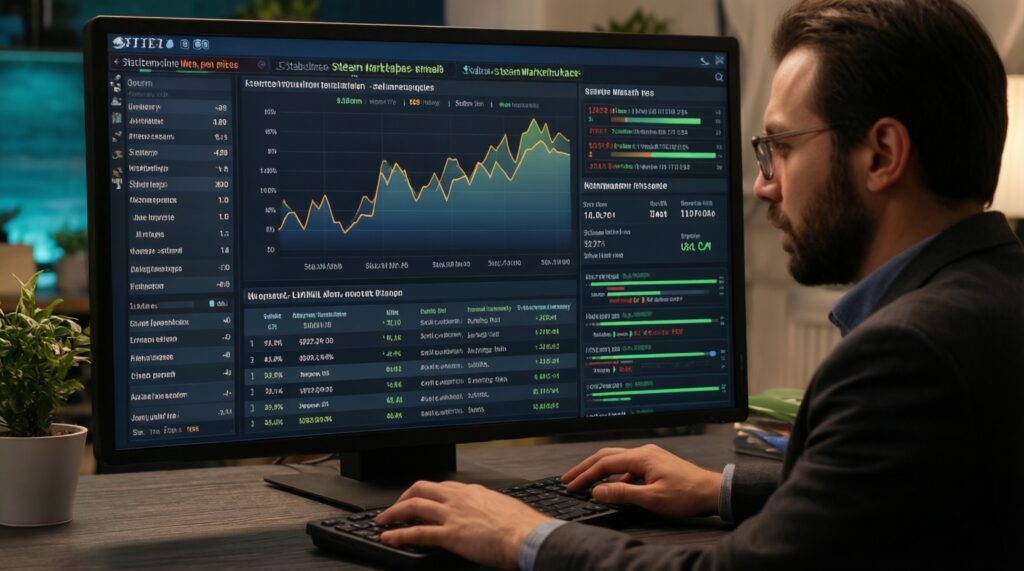
- Screen: choose items with consistent recent sales and manageable spreads.
- Validate: check steam market price trends for stabilization; avoid vertical pumps.
- Calculate: run fees + fast-sell scenario (your "steam market fees calculator" shortcut).
- Exit: list with a time limit; if not filled, cut to your steam inventory liquidity fast sell price and rotate.
Risk Controls: Position Sizing, Inventory Rotation, and Capital Preservation

- Every position has two exit prices: a target and a fast-sell fallback that still keeps losses controlled.
- No single item type dominates your inventory; rotate across at least two liquidity tiers.
- You can explain the trade in one sentence (cycle + entry reason + exit trigger); if not, skip it.
- You are not forced to sell: you have enough buffer for fees and a conservative repricing.
- You avoid buying into sudden spikes unless you have a pre-defined momentum rule.
- You re-check account/trade restrictions before building inventory (holds can destroy liquidity timing).
- You log each trade: buy price, intended sell price, actual sell price, time-to-sell, and what changed.
- You keep "dry powder" (uncommitted balance) to exploit oversupply dips instead of being fully invested.
Profit Strategies: Arbitrage, Sniping, and Flip Execution
- Ignoring fees in the edge estimate: a trade that looks profitable before fees often becomes negative after selling costs and a fast-sale cut.
- Confusing listings with real value: the cheapest current listing is not the market; sold history is the market.
- Overpaying for speed: "snipes" that require instant decisions often include hidden defects (bad liquidity, trend reversal, manipulative listings).
- Arbitrage without withdrawability planning: price gaps across venues are meaningless if you cannot move items or realize value where you need it.
- Chasing "best steam items to invest in" lists blindly: an item can be great for long-term holders and terrible for your time horizon and wallet constraints.
- Holding through regime change: when steam market price trends shift from range to breakdown, "just wait" can turn a flip into a long bag-hold.
- Concentration in low-liquidity rares: wide spreads and slow buyers amplify mistakes and lock capital.
- No exit timer: if you don't set a time limit, you'll rationalize holding indefinitely and miss better rotations.
Operational Toolkit: Pricing Tools, Bots, and Data Sources
Use tooling to reduce errors, not to outsource judgment. The right option depends on whether your bottleneck is pricing speed, trend visibility, or execution discipline.
- Manual spreadsheet (recommended baseline): best when you're building a personal steam market fees calculator model and want transparency on assumptions and net proceeds.
- Price-tracking and history views: best when your edge is reading steam market price trends and spotting cycle phases; always cross-check with actual sold activity.
- Listing-management helpers: best when you flip many small positions and need consistent repricing rules; avoid anything that violates platform rules.
- Third-party marketplaces (optional): best when you have a clear reason (liquidity, regional payment preference in Thailand, or item availability), and you've fully priced in extra fees and transfer constraints.
Common Trader Concerns - Brief Solutions
Is steam item trading for profit realistic if I can only check the market once per day?
Yes-focus on higher-liquidity items and use time-based exits rather than trying to snipe. Avoid strategies that require minute-by-minute repricing.
What's the simplest way to think like a steam market fees calculator without exact fee numbers?
Model fees as a single combined fraction f and test multiple conservative scenarios. Only take trades that remain profitable even under a harsher f and a fast-sell discount.
How do I identify the best steam items to invest in for my style?
Pick items that match your holding period and liquidity needs: consistent sales, manageable spread, and stable pricing behavior. Your "best" items are those you can reliably exit, not the ones with the best stories.
Which signal matters most in steam market price trends: current listings or sold history?
Sold history matters more because it reflects completed transactions. Listings help you judge competition and spread, but they can be misleading in thin markets.
How do I set a steam inventory liquidity fast sell price without panic selling?
Define it before you buy: a price that you expect to fill quickly based on recent sales and current depth. Use it as a rule-based exit, not an emotional reaction.
Should I do arbitrage between Steam and third-party markets?
Only if you understand transfer rules, selling costs on both sides, and how you'll realize value where you need it. If any step is uncertain, treat the apparent spread as non-tradable.