

Web3 esports wagering is esports betting where stakes, odds logic, and payouts are executed (fully or partly) by smart contracts, making settlement verifiable on-chain. It includes on-chain esports betting markets and DAO-managed pools, but not every crypto esports betting site qualifies. The fastest way to avoid mistakes is to validate oracle design, escrow flow, and governance controls before placing or building bets.
At-a-glance: on-chain wagering essentials
- "On-chain" should mean verifiable escrow + settlement, not just deposits in a token.
- Oracles decide outcomes; weak oracle design is the most common failure point.
- DAO governance can improve transparency, but it also introduces vote capture and upgrade risks.
- Token incentives can harden liquidity-or silently subsidize manipulation if poorly designed.
- Audit reports help, but operational controls (admin keys, upgrades, pauses) matter just as much.
Debunking myths about Web3 esports wagering
Myth 1: "If I can bet with a token, it's Web3." Many products labeled esports betting with crypto only use crypto for deposits/withdrawals while odds setting, custody, and payout decisions remain off-chain. A stricter definition of web3 esports betting requires that at least escrow and settlement are enforced by smart contracts you can verify on a block explorer.
Myth 2: "On-chain equals trustless and fair by default." Smart contracts reduce some trust, but you still trust the data source that declares who won (oracle), the upgrade/admin controls, and any off-chain components (frontends, relayers, KYC gates). "Transparent" means you can check the rules and payouts-not that manipulation is impossible.
Myth 3: "DAOs eliminate the house." DAOs can redistribute control over fees and treasury, but a DAO can still behave like an operator: it can change parameters, whitelist markets, or vote to upgrade contracts. Treat DAO governance as a different risk surface, not a guarantee of neutrality.
Boundaries of the term. A blockchain esports wagering platform may be (a) a protocol (contracts + oracle + liquidity), (b) an app built on a protocol, or (c) a custodial operator using blockchain rails. The more critical steps executed on-chain, the closer it is to true on-chain esports betting.
Architecture of on-chain betting protocols
Most protocols follow the same pipeline; mistakes happen when one stage is "hand-waved" off-chain without clear controls.
- Market creation: a match/event is defined (teams, start time, market type, cutoff rules).
- Pricing/odds model: fixed odds, AMM-style pricing, or order book matching determines payouts.
- Escrow: user stakes are locked in a contract (or pooled vault) under explicit conditions.
- Liquidity provisioning: LPs/treasury back payouts; limits and exposure caps reduce insolvency risk.
- Outcome reporting: an oracle posts final results (single source, multi-sig, or dispute-based).
- Settlement: contract releases funds according to the market rules; losers cannot block payouts.
- Fee routing: protocol/app fees move to treasury, LPs, referrers, or burn addresses.
DAO-driven prize pools and governance models
DAOs show up most often where communities want shared control over treasury, risk limits, or competitive incentives.
- Community prize pools: a DAO funds tournament prize boosts or "prediction pool" overlays tied to esports events.
- Liquidity stewardship: tokenholders vote on which leagues/markets get liquidity, caps, and fee tiers.
- Dispute resolution: a DAO (or elected council) arbitrates oracle disputes for edge-case match outcomes.
- Revenue allocation: governance sets how fees are split among LPs, treasury, and ecosystem grants.
- Market whitelisting: only approved events/feeds are allowed to reduce oracle and match-fixing exposure.
Smart contract mechanics: escrow, oracles, settlement
For intermediate users and builders, the "quick prevention" mindset is to map who can move funds, who can set outcomes, and what happens on failure paths (delays, disputes, cancellations).
Advantages you can verify quickly
- Deterministic payouts: once the outcome is finalized on-chain, settlement follows defined math.
- Visible escrow: you can inspect whether funds are truly locked and under what conditions they unlock.
- Auditability: market parameters (fees, caps, cutoff time) are observable, reducing "silent changes."
Limitations and common traps (plus fast mitigations)
- Oracle centralization: a single signer can misreport outcomes. Mitigation: prefer multi-sig, multi-source aggregation, and explicit dispute windows.
- Upgradeable contracts: upgrades can change payout logic after you stake. Mitigation: check proxy patterns, timelocks, and whether upgrades are constrained by governance.
- Ambiguous settlement rules: forfeits, remakes, roster swaps, or format changes can break naive markets. Mitigation: use markets with explicit edge-case policy and cancel/refund conditions.
- DoS on settlement: loops over many bettors can fail due to gas constraints. Mitigation: prefer pull-based claims (each winner claims) or batched settlement patterns.
Tokenomics, incentives, and anti-manipulation design
Token design is where many crypto esports betting products fail: incentives look attractive but create adversarial behavior. Typical mistakes and how to prevent them quickly:
- Liquidity mining that rewards volume over risk: wash betting becomes profitable. Prevent: reward based on time-weighted liquidity and net exposure, not raw turnover.
- Referral schemes without sybil resistance: bots farm bonuses. Prevent: cap rewards per identity cluster, add cooldowns, and require real economic cost (lockups) to earn.
- Thin markets with no max-bet logic: a single bet can bankrupt the pool. Prevent: enforce exposure limits per market and per account; auto-adjust odds with depth.
- "DAO = safe" token narrative: governance tokens get concentrated, enabling parameter capture. Prevent: timelocked changes, role separation (risk council vs treasury), and transparent vote quorum rules.
- Ignoring information asymmetry: insiders (scrims, roster news, match-fixing signals) dominate. Prevent: market delays, suspicious-activity limits, and stronger oracle/dispute procedures for contested matches.
Compliance, security audits, and fairness guarantees
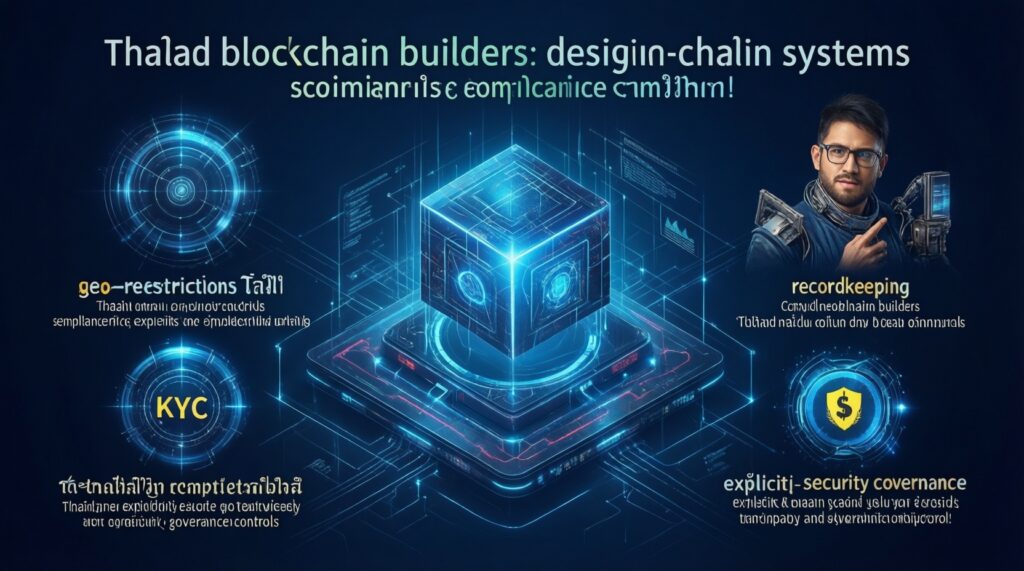
In Thailand context, treat "on-chain" as a technical property, not a legal permission. For builders, plan for compliance constraints early (geo-restrictions, KYC where required, recordkeeping) and make security controls explicit (upgrade governance, key management, incident response).
Mini-case: preventing the three fastest real-world failures
- Failure: oracle posts wrong result. Prevention: require a dispute window and a second confirmation source before finalization.
- Failure: admin upgrades mid-market. Prevention: freeze upgrades for active markets; only allow upgrades via timelock.
- Failure: settlement is too expensive to execute. Prevention: implement pull-based claims and allow delegated claiming.
Example settlement flow (pseudocode)
// Simplified pattern for a match winner market
createMarket(eventId, cutoffTime, oracle, feeBps)

bet(marketId, side, amount):
  require(now < cutoffTime)
  transferFrom(user, escrow, amount)
  recordPosition(user, side, amount)

reportOutcome(marketId, outcome):
  require(msg.sender == oracle)
  setPendingOutcome(outcome)
  startDisputeTimer()

finalize(marketId):
  require(disputeTimerExpired)
  lockOutcomeFinal()

claim(marketId):
  require(outcomeFinal)
  payout = computePayout(userPosition, totalPool, feeBps)
  transfer(escrow, user, payout)
Practical clarifications and recurring concerns
Is web3 esports betting always non-custodial?
No. A product can market itself as web3 esports betting while still custodying funds via a relayer or centralized wallet; verify whether escrow is a user-verifiable smart contract.
What makes a blockchain esports wagering platform "on-chain" in practice?
Escrow and settlement must be enforced by smart contracts, and the outcome publication process must be transparent. If outcomes and payouts can be changed off-chain, it's mostly a conventional operator with crypto rails.
Is esports betting with crypto safer than fiat esports betting?
Not automatically. Crypto reduces some payment friction, but oracle risk, contract upgrade risk, and wallet security become primary concerns.
Where do most losses come from in on-chain esports betting?
From poor oracle/dispute design, thin liquidity with weak max-bet limits, and users approving malicious contracts or phishing frontends.
Do DAOs guarantee transparent payouts?
DAOs can improve transparency in parameters and treasury flows, but payout correctness still depends on contract logic and oracle integrity.
How can I sanity-check a market before betting?
Check the contract address, upgradeability/timelock, oracle identity, dispute window rules, and the exact settlement policy for remakes/forfeits.