

RNG fairness is about whether a game's randomness is generated correctly and cannot be silently biased, while "provably fair" adds a public, cryptographic way for players to verify outcomes after each round. In practice, you verify fairness by checking commitments (hashes), seeds, and deterministic recomputation-especially in a provably fair crypto casino and in systems discussing loot box rng fairness.
Core Concepts Summary
- RNG = a process that outputs unpredictable values; fairness depends on correct implementation, unbiased distribution, and tamper resistance.
- Provably fair = the operator commits to a secret before play and reveals it after, so you can recompute the result.
- Verification is mechanical: compare hashes, recompute outcomes locally, and validate inputs (server seed, client seed, nonce).
- "Transparent" is not the same as "provably fair": audits and disclosures help, but cryptographic commitments are stronger.
- Loot boxes often rely on hidden server-side RNG; crypto casino provably fair games often expose verifiable inputs per round.
How RNG Works: Algorithms and Sources of Entropy
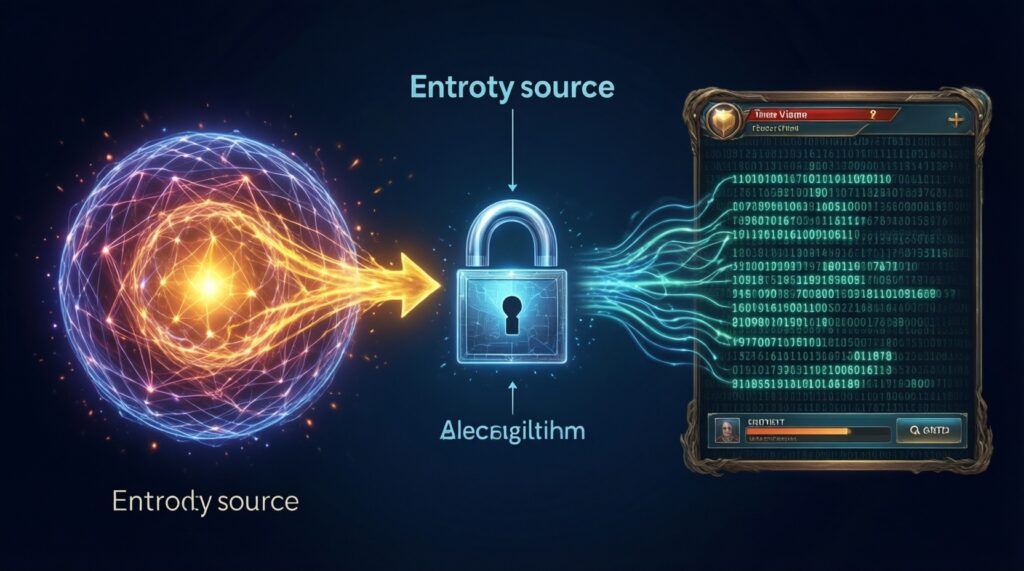
An RNG has two parts: an entropy source (unpredictable input like OS randomness) and an algorithm (a deterministic generator that expands that entropy into many random-looking outputs). Most games use a CSPRNG (cryptographically secure PRNG) provided by the OS or a vetted library, then map outputs onto game outcomes.
Fairness is not guaranteed by "using RNG" alone. Bias can be introduced by poor seeding, reusing seeds, predictable entropy, or incorrect mapping (for example, taking a random integer and applying modulo in a way that skews probabilities). In loot box systems, fairness also depends on how probabilities are configured and whether the server can adapt odds per user or per session.
Boundaries to keep in mind: RNG quality is about unpredictability and distribution; "fairness" additionally includes non-manipulation (the operator shouldn't be able to change results after seeing your action) and verifiability (you should be able to check what happened).
- Confirm the RNG is CSPRNG-backed (OS/library), not a homegrown PRNG with predictable seeding.
- Check how uniform random numbers are mapped to outcomes (avoid modulo bias and rounding artifacts).
- Separate "randomness quality" from "operator control": an honest CSPRNG can still be used unfairly.
Provably Fair: Underlying Cryptographic Mechanisms
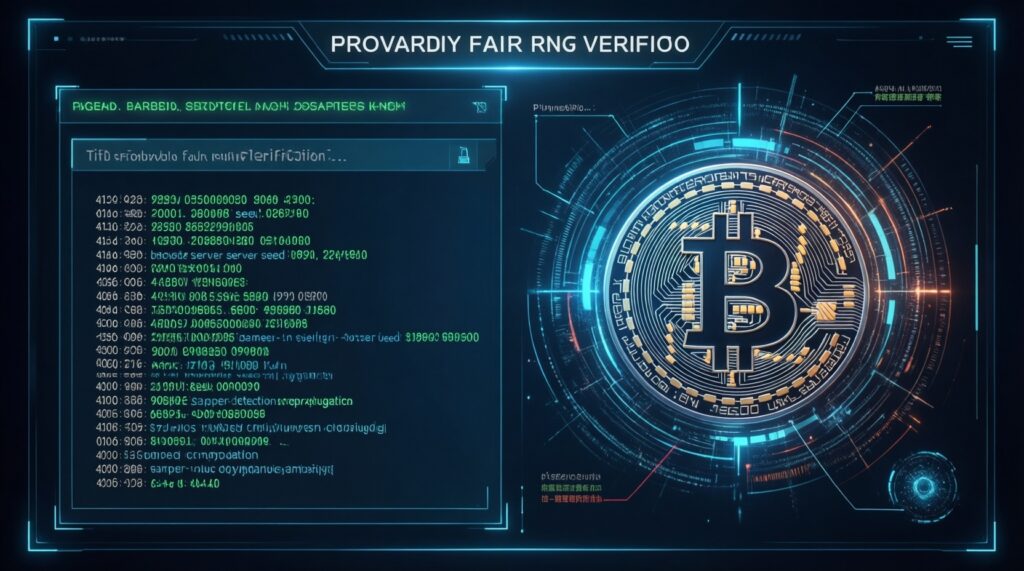
Provably fair systems make outcomes reproducible from published inputs and make tampering detectable via cryptographic commitments. This is the core of provably fair rng verification in many crypto products.
- Commitment: the operator chooses a secret
server_seedand publisheshash(server_seed)before play. - Player influence: the player provides a
client_seed(or it is generated client-side and shown). - Nonce/counter: each round increments
nonceso every bet is unique even with the same seeds. - Deterministic mix: the result is computed as
HMAC_SHA256(server_seed, client_seed + ":" + nonce)(or similar). - Outcome mapping: the digest is converted to a number and mapped to the game's range with a bias-safe method.
- Reveal: after the round (or after a session), the operator reveals
server_seed; you hash it and compare to the earlier commitment.
- Require "commit then reveal": hash first, secret later; not the other way around.
- Require a per-bet nonce and a deterministic function you can run locally.
- Require bias-safe mapping from hash output to game outcomes.
Design Patterns in Loot Boxes and Crypto Casinos
Implementation patterns differ because incentives and constraints differ. Loot boxes usually optimize for UX and economy control; provably fair crypto casino designs optimize for verifiability and user trust.
- Server-authoritative loot tables: probabilities live on the server; the client only displays results. This is common in loot box rng fairness discussions because verification is usually not available to players.
- Event-driven RNG: a "drop roll" happens at a specific server event (purchase/open), often with anti-fraud checks; outcomes can be affected by account state if not carefully designed.
- Session-seeded casino games: a server seed is committed, and each bet uses nonce increments; common in a provably fair crypto casino.
- Per-game modules: crypto casino provably fair games may share a single seed pipeline but have different outcome mapping (dice vs. roulette vs. cards).
- Hybrid transparency: some operators publish audits and RTP claims without per-bet verification; this is "audited" rather than "provably fair."
- Identify whether you can independently recompute each outcome (casino) or only trust server claims (loot boxes).
- Check if outcomes depend solely on seeds+nonce or also on hidden account/session parameters.
- Prefer designs where the player can set or rotate the client seed at will.
Verification Techniques: From Hash Commitments to ZK Proofs
Verification ranges from simple hash checks to advanced cryptographic proofs. The key is choosing techniques that match the threat model and what you, as a player, can realistically verify.
Player-side checks you can do today
- Commitment verification: compute
SHA256(server_seed_revealed)and match it to the pre-round commitment. - Deterministic recomputation: re-run the published algorithm (often HMAC-based) using
server_seed,client_seed, andnonce. - Range and bias sanity: ensure the mapping method avoids modulo bias (e.g., rejection sampling) when converting hash bits to an outcome range.
Stronger assurance techniques (usually operator-provided)
- Public randomness beacons: mixing in an external unpredictable value reduces the operator's ability to "grind" seeds offline.
- Signed logs and transparency reports: signed per-round records make post-hoc edits detectable even if you don't verify every bet.
- ZK proofs: zero-knowledge proofs can show the operator followed the algorithm without revealing the server seed immediately, but they are complex and rare in consumer gambling UX.
Minimal pseudocode for local recomputation (conceptual):
# Inputs you must have:
# committed_hash, revealed_server_seed, client_seed, nonce
assert SHA256(revealed_server_seed) == committed_hash
digest = HMAC_SHA256(key=revealed_server_seed, msg=client_seed + ":" + str(nonce))
# map digest to outcome with a bias-safe method defined by the game
outcome = map_digest_to_game(digest)- Verify commitment (hash match) before trusting any recomputation output.
- Use the exact function and encoding specified (string formats, separators, hex/base64) to avoid false mismatches.
- Don't stop at "hash matches": confirm the digest-to-outcome mapping is bias-safe and fully documented.
Threat Models: Attacks, Biases and Mitigations
"Provably fair" reduces certain abuses, but it does not eliminate all manipulation vectors. Focus on what the operator can still control and what you can detect.
- Seed grinding: the operator tries many server seeds offline and chooses one that benefits the house under likely client seeds. Mitigation: external randomness inputs, short seed lifetimes, and visible seed rotation.
- Nonce/account coupling: using a nonce tied to hidden state (or resetting it selectively) can make verification confusing or misleading. Mitigation: strictly monotonic, publicly shown nonce per bet.
- Outcome mapping bias: modulo bias or truncation can skew results even with perfect hashing. Mitigation: rejection sampling or equivalent unbiased mapping.
- Selective disclosure: showing provably fair only for some games or only after disputes. Mitigation: consistent per-bet data export and always-on verification endpoints.
- UX dark patterns: users don't verify because it's too hard. Mitigation: one-click export of seeds/nonces and deterministic reference implementations.
- Assume "provably fair" can still be unfair if mapping or nonce handling is flawed.
- Prefer systems that publish all inputs per bet and make seed rotation user-controlled.
- Look for external randomness or anti-grinding commitments if high stakes are involved.
Compliance, Transparency and Operator Responsibilities
Compliance and transparency are operational practices layered on top of cryptography. For players, the practical difference is whether the operator provides enough data to verify, and whether dispute resolution can rely on immutable records.
Mini-case: a casino publishes a "Fairness" page with (1) current server_seed_hash, (2) your configurable client_seed, (3) a bet history export including nonce per bet, and (4) a reference script. After you rotate seeds, the system locks the old commitment and reveals the old server_seed for past bets.
# Operational policy sketch:
publish(server_seed_hash_current)
allow_user_set(client_seed)
for each bet:
  record(bet_id, client_seed, nonce, server_seed_hash_current, game_params)
on seed_rotate:
  reveal(old_server_seed)
publish(hash(new_server_seed))- Operators should provide per-bet inputs (hash, seeds, nonce, game params) in an exportable format.
- Operators should publish a reference verifier and specify encodings and mapping rules precisely.
- Operators should support seed rotation with clear reveal timing and immutable bet history.
Player Self-Check Before You Trust a "Fairness" Claim
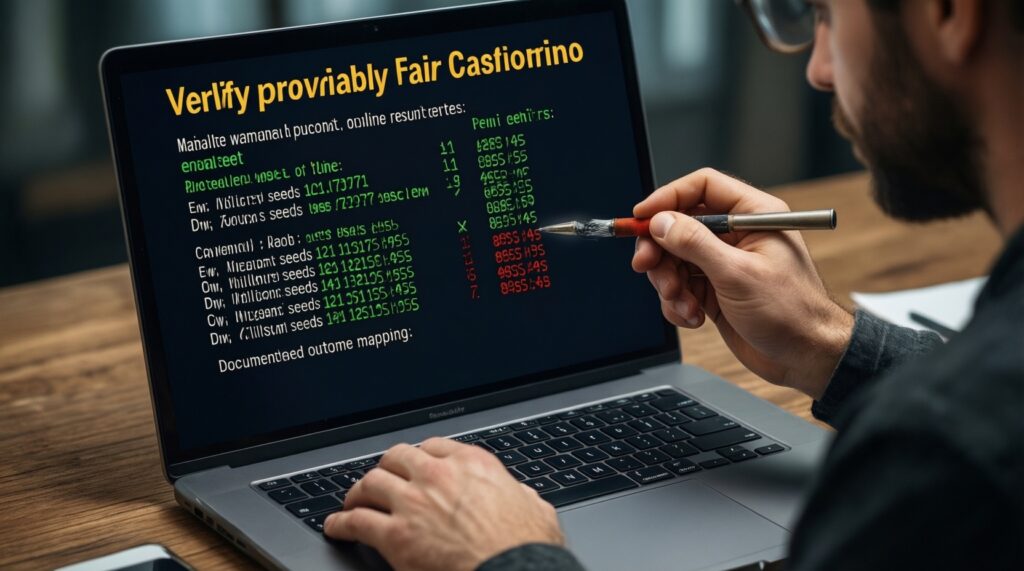
- I can reproduce at least one past outcome locally from revealed seed + my client seed + nonce.
- The committed hash was shown before the bet, and it matches the revealed server seed afterward.
- The rules for mapping hash output to outcomes are documented and avoid known bias patterns.
- I can export my full bet history inputs, not just see them on-screen.
Practical Verification Questions
What exactly should I verify in a provably fair crypto casino?
Verify the commitment (hash) matches the revealed server seed, then recompute the outcome using the published function with your client seed and the correct nonce.
How do I perform provably fair rng verification if the site only shows a "fairness badge"?
A badge is not verification. You need the pre-bet commitment, the revealed seed, the client seed, the nonce, and the mapping method; without these, you cannot independently verify.
Are "best provably fair casinos" simply the ones with the most games?
No. The best provably fair casinos are the ones that expose complete per-bet data, publish a reference verifier, and make seed rotation and history export straightforward.
Do crypto casino provably fair games guarantee I will see "expected" streaks?
No. Provably fair proves the result was computed as specified; it does not prevent unlucky streaks or prove favorable odds.
Can I verify loot box rng fairness the same way as a casino roll?
Usually not. Loot boxes rarely provide per-open commitments and reveals; you typically rely on platform disclosures, audits, and regulatory enforcement rather than per-transaction cryptographic verification.
What is the most common implementation mistake that breaks fairness?
Biased outcome mapping (e.g., modulo bias) and ambiguous encoding (different string/byte formats) are common. Both can make results skewed or unverifiable even if hashes look correct.
When should I rotate my client seed?
Rotate when you start a new session, after any suspicious behavior, or periodically to reduce predictability. Rotating is only useful if the operator reveals old server seeds tied to past commitments.