

Provably fair systems let you verify that a spin, roll, or case-opening outcome wasn't changed after you placed a bet. Before you wager on a provably fair crypto casino or provably fair skin gambling sites, confirm the site commits to a server seed (hash), uses your client seed, exposes a nonce, and provides a repeatable verification method you can run yourself.
Immediate verification checklist for provable fairness
- Find a visible server seed hash shown before betting, and a revealed server seed after rotating.
- Confirm you can set or edit your client seed (not only auto-generated).
- Ensure every bet has a unique nonce (incrementing counter) or round ID that is included in the calculation.
- Locate an on-page verification section or an exportable bet record with seeds + nonce + result.
- Recompute at least one past bet using an independent provably fair verification tool (not only the casino's widget).
- Check that seed rotation is supported and that old bets remain verifiable after rotation.
How provable fairness works in skin gambling and crypto casinos
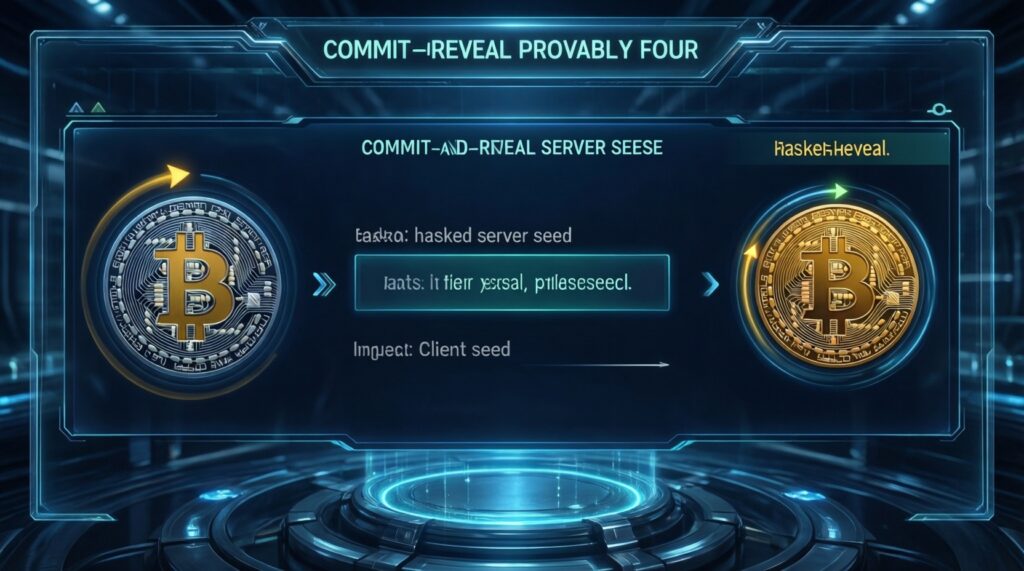
Most crypto casino provably fair games and case-opening mechanics use a commit-and-reveal flow: the operator commits to a hidden server seed by publishing its hash, you contribute a client seed, and a nonce ties the calculation to a single bet. After the server seed is revealed (usually on rotation), you can reproduce the same output offline.
This is worth doing when you:
- Play games where outcomes are derived from seeds (dice, limbo, roulette variants, plinko, cases).
- Notice unusually streaky results and want a sanity check you can reproduce.
- Compare claims across a "best provably fair casino" shortlist and need a consistent verification method.
Skip (or deprioritize) provable-fair checks when:
- The outcome depends on human actions (PvP trading/marketplace price) rather than an RNG result.
- The game uses external events (sports odds feeds) where provable fairness does not apply.
- You cannot access seeds/nonce/history-then there is nothing meaningful to verify.
Cryptographic building blocks: hashes, seeds, HMACs and RNGs
You don't need deep cryptography, but you do need the site to expose the right inputs and you need a way to recompute a hash/HMAC deterministically.
What you must be able to see per bet
- Server seed hash (commit): typically SHA-256(serverSeed) displayed before betting.
- Server seed (reveal): shown after rotation; must hash back to the earlier commit.
- Client seed: chosen by you (string).
- Nonce: integer that changes per bet (often starts at 0 or 1 and increments).
- Game parameters: e.g., number of rows in plinko, case ID, risk level-must be included or clearly defined.
Common constructions you'll see
- Hash commitments: SHA-256 is common for publishing the server seed hash.
- HMAC-based RNG: HMAC_SHA256(key=serverSeed, message=clientSeed + ":" + nonce) is a frequent pattern (message format varies).
- Byte-to-number mapping: converting HMAC output (hex) into a uniform random number range.
Minimal tools (safe, user-friendly)
- A trusted hash/HMAC calculator (offline app or reputable open-source utility).
- Access to your bet history export (copy seeds/nonce/result exactly).
- Optional: a small script environment you control (local Python/Node) if you want independent verification.
| Check / tool type | What it proves | What to watch for | Best use case |
|---|---|---|---|
| Built-in verifier (casino page) | Basic reproducibility if implemented honestly | Can hide message format details; could be wrong and still look "valid" | Quick first pass, then cross-check externally |
| Independent hash/HMAC calculator (offline) | Server seed matches the published hash; HMAC matches spec | You must know the exact message format and encoding | Verifying 1-5 sample bets confidently |
| Open-source verifier script (GitHub) | Full end-to-end reproduction for a game | Confirm it matches the casino's current algorithm/version | Repeated checks or community-audited games |
| Block explorer (on-chain randomness/contracts) | On-chain commitments and outcomes for smart-contract games | Many casinos are off-chain; "on-chain" claims may be marketing only | Smart-contract casinos, transparent contract state |
Audits, open-source contracts and reading verification reports
-
Confirm the commit is shown before you bet.
The server seed hash must be visible prior to any wager and must remain unchanged for the session/seed period.- If the hash changes mid-session without a clear seed-rotation event, treat it as unverifiable.
-
Locate the exact algorithm description.
Find the page that defines how client seed, server seed, nonce, and game parameters are combined (including separators, encoding, and byte slicing).- Be cautious if the site says "HMAC" but does not define message format.
-
Verify the reveal matches the earlier hash.
When the server seed is revealed (usually after rotation), compute SHA-256(serverSeed) and ensure it equals the committed hash shown earlier.- Do this for at least one full seed cycle (commit → bets → reveal).
-
Recompute a past bet from your history.
Use the disclosed server seed, your client seed, and the nonce for that bet to reproduce the random output and the final game result.- Start with a simple game (dice/limbo) before cases or multi-stage games.
-
Cross-check with an external verifier.
Use a separate provably fair verification tool (or your own local script) to avoid trusting the casino's own verifier UI.- If only the casino's tool "works," but you can't reproduce it independently, the system is not practically verifiable.
-
Assess audits or open-source artifacts (when offered).
If the platform claims an audit or provides open-source contract/code, check that it's current and that it covers the provably fair mechanism, not only general security.- If you cannot map the audited code/version to the live site behavior, treat the audit as informational, not proof.
Fast mode: 4-step bettor algorithm
- Before betting: screenshot/copy the server seed hash and your client seed setting page.
- Place 3 small bets: ensure nonces increment and each bet record is exportable.
- After rotation/reveal: hash the revealed server seed and match it to the earlier commit.
- Independently recompute 1 bet: reproduce the RNG output and confirm the displayed result matches.
Practical seed management: client/server interaction and replay risks
- Set a unique client seed per session; don't reuse an old seed string across multiple sites.
- Confirm the server seed hash is fixed until the server seed is revealed (seed rotation).
- Check that the nonce increases by exactly 1 per bet for the same server seed + client seed pair.
- Make sure changing your client seed resets or clearly re-scopes the nonce (the rule must be documented).
- Verify that game parameter changes (risk/rows/case type) do not silently reuse the same nonce in a way that breaks reproducibility.
- Export or copy the bet record immediately: client seed, nonce, server seed hash, bet timestamp/ID, and result.
- Watch for replay ambiguity: if two bets can share identical (client seed, server seed, nonce) inputs, verification becomes unreliable.
- Confirm you can still verify after cashout/withdrawal; the site should not hide seeds once you leave a game page.
Tools and step-by-step verifications every bettor can run
- Mistake: trusting only the casino's verifier widget. Always try at least one independent provably fair verification tool or offline calculator to reproduce the same intermediate value (hash/HMAC).
- Mistake: ignoring encoding and separators. "clientSeed:nonce" vs "clientSeed-nonce" changes everything; verify the exact message string and whether it's UTF-8.
- Mistake: verifying only the server seed hash. The commit can be valid while the mapping from HMAC output to the final result is biased or undocumented.
- Mistake: not confirming nonce scope. Some platforms have per-game nonces; others share a nonce across all games. If it's unclear, you can't reliably reproduce outcomes.
- Mistake: checking a single bet only. Verify at least two bets with different nonces under the same revealed server seed to rule out "one-off" display quirks.
- Mistake: misunderstanding multi-stage games. Cases, plinko, and some roulette variants may consume multiple random values per round; the verifier must show how many pulls and in what order.
- Mistake: copying seeds with hidden whitespace. Trailing spaces and invisible characters will break verification; paste into a plain-text editor first.
- Mistake: assuming all provably fair crypto casino implementations are identical. Each operator can define its own mapping rules; always read that site's spec even if you've verified others.
Operational warning signs: liquidity, edge manipulation and cashout traps
Provable fairness verifies the RNG process, not business practices. If any of the following dominate your risk, choose an alternative approach.
- Play only fixed-odds games with transparent rules when cashout is discretionary (manual approval) or delayed. This reduces dependence on liquidity and operator decisions.
- Prefer on-chain or publicly verifiable game layers when a platform claims "open-source" but provides no reproducible live verification. Use smart-contract-based games only if you can match the contract address to the UI you're using.
- Use mainstream regulated products for bankroll protection if the main concern is withdrawal reliability rather than RNG manipulation; provable fairness won't solve cashout traps.
- Reduce exposure with session limits and small test withdrawals when trying new provably fair skin gambling sites; operational risk often shows up in payment behavior first.
Quick clarifications for bettors
Does "provably fair" guarantee I will win?
No. It only means the outcome can be reproduced from published inputs; the house edge and variance still apply.
What's the minimum proof a provably fair crypto casino should provide?
A pre-bet server seed hash, a post-rotation server seed reveal, your client seed control, a per-bet nonce, and a documented method to reproduce results independently.
How do I spot a fake "best provably fair casino" claim?
If you can't export bet data with seeds/nonce or the algorithm isn't fully specified, you can't verify anything in practice.
Are provably fair skin gambling sites always fair for case openings?
Only if the case algorithm clearly shows how random bytes map to item probabilities and you can reproduce the draw for a specific case ID and nonce.
What should a provably fair verification tool output for a real check?
At minimum: matching server seed hash (commit check) and a reproducible intermediate value (hash/HMAC) that deterministically leads to the same result.
If the casino rotates server seeds often, is that good?
Frequent rotation can be fine, but only if each rotation includes a verifiable reveal and your old bets remain verifiable afterward.
Can the operator still cheat even with provable fairness?
They can't change an already-committed outcome without breaking verification, but they can still exploit non-RNG risks like withdrawal restrictions, limits, or unclear game parameter handling.