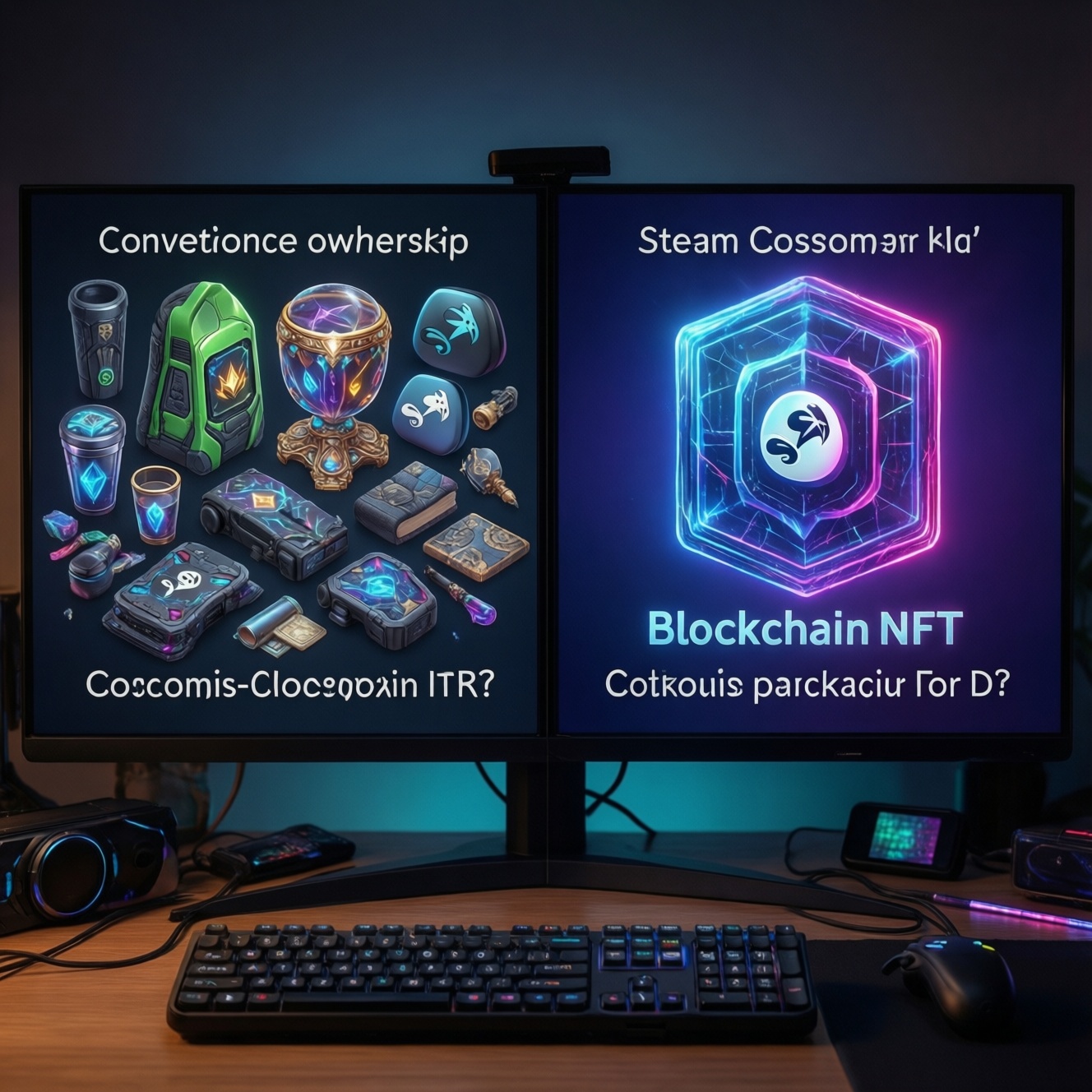
If your goal is the most reliable liquidity and the lowest operational hassle, Steam items usually win because demand is concentrated inside one ecosystem and trading flows are familiar. NFTs can offer stronger transferability and the closest thing to true ownership NFT, but you trade that for wallet risk, chain fees, and fragmented buyer pools.
Essential trade-offs at a glance
- Ownership model: Steam items are licensed access inside Valve's ecosystem; NFTs are token-held control of a transferable asset reference (token + metadata).
- Liquidity shape: Steam demand is centralized; NFT demand is fragmented across chains, games, and marketplaces.
- Total cost to trade: Steam costs are mostly marketplace commissions; NFTs add network fees, potential bridge costs, and wallet/custody overhead.
- Security burden: Steam reduces self-custody risk; NFTs shift risk to your wallet practices (seed phrase, approvals, phishing).
- Portability: NFTs can move outside a single platform; Steam inventory is designed to stay within Steam.
- Utility risk: An NFT can remain transferable even if in-game utility changes; Steam items typically retain value only where Steam trading remains viable.
How ownership is defined: blockchain vs. Steam ecosystem
Use these criteria to decide between NFT vs Steam items for your specific game and budget constraints:
- Control of transfer: Can you transfer to another person without the game/platform's permission, or only within platform rules?
- Custody type: Do you hold keys (self-custody), or does a platform account effectively custody the asset?
- What you actually "own": Token ownership vs. ownership of in-game utility, art, or licensing rights (often not the same).
- Revocability: Can an account ban, policy change, or delisting remove your ability to trade or use the item?
- Market depth: Is there one dominant venue (e.g., Steam inventory items marketplace) or many smaller venues (typical for NFTs)?
- Settlement finality: Steam trades settle per platform rules; NFT transfers are on-chain but can be undermined by scams, wrong network transfers, or compromised keys.
- Price discovery: Is pricing transparent with many comparable sales, or thin with large spreads and wash-trading risk?
- Recovery options: Can you recover access (account recovery, support), or is a lost seed phrase permanent loss?
- Practical utility: Does the item meaningfully affect gameplay or status, and is that utility stable across updates?
Legal and economic implications of tokenized ownership
"Ownership" in games is mostly contractual: licenses, terms, and platform enforcement. NFTs can strengthen control (transferability) but do not automatically grant IP rights or guaranteed in-game utility. Choose the structure that matches your risk tolerance and the way you plan to buy, hold, and sell.
| Option | Who it fits | Pros | Cons | When to choose |
|---|---|---|---|---|
| Steam market-tradable items (inventory skins, cards) | Budget-first traders; players who want straightforward resale inside Steam | Concentrated liquidity; simple UX; no wallet management; pricing comparables are usually easier to find | Platform-bound; subject to account restrictions and policy changes; limited off-platform portability | When you want the best chance of quick flips and lower operational risk |
| Steam items with external cash-out via third-party markets | Intermediate users who want fiat cash-out and accept extra counterparty risk | Broader buyer access than Steam-only; sometimes better cash pricing | Extra trust layer; withdrawal delays; dispute risk; potential policy/ToS friction depending on the venue | When Steam-only balance is limiting and you can manage third-party risks |
| On-chain game NFTs (self-custody wallet) | Users optimizing for portability and direct control | Transferable without platform login; composable with on-chain tooling; closer to "you hold it, you move it" control | Wallet/seed loss is permanent; approvals/phishing risk; chain fees and bridges can add friction; utility depends on the game honoring the token | When you prioritize control and can maintain strong security hygiene |
| Custodial NFT accounts (marketplace holds keys) | Budget users who want to buy NFT game items without managing keys | Easy onboarding; password recovery; fewer self-custody mistakes | Not full self-custody; withdrawal limitations; counterparty risk similar to platform custody | When you want NFT exposure but need guardrails and simpler UX |
| Semi-on-chain / off-chain NFTs (token points to mutable server data) | Collectors focused on brand/community more than strict technical guarantees | Often cheaper/faster; less UX friction; can integrate easily with web accounts | "Ownership" is weaker if metadata/utility is centrally editable; higher rug/delisting risk | When you value access/perks and accept that "tokenized" may not mean immutable |
| High-end provenance collectibles (rare Steam items or blue-chip NFTs) | Premium buyers willing to hold longer and manage verification costs | Status signaling; potential collector demand; scarcity narratives | Harder authentication work; higher scam targeting; liquidity can vanish in downturns | When you can afford illiquidity and will verify provenance rigorously |
Liquidity realities: marketplaces, fees, and buyer pools
Liquidity is mostly about where buyers already are. Steam concentrates buyers in one place; NFTs spread buyers across chains and each NFT gaming items marketplace has its own audience, listing rules, and fee stack (platform commission, creator royalties where enforced, and network fees).
- If you need fast resale with minimal steps, then prefer Steam-tradable items on the Steam inventory items marketplace and avoid assets that require external cash-out paths.
- If you are budget-first and making small trades, then avoid NFT routes that add multiple fee layers (network fee + marketplace fee + bridge fee); choose Steam or custodial NFTs with clear, predictable checkout.
- If you are premium-focused and can tolerate longer holding periods, then consider higher-quality NFTs or rare Steam collectibles where provenance and scarcity matter more than daily volume.
- If you plan to arbitrage across venues, then only do it where you can pre-calculate the full friction: spreads, withdrawal limits, and the time cost of moving assets.
- If you expect to trade during volatile updates (patches, bans, meta shifts), then prioritize the venue where you can exit quickly; thin NFT order books can gap hard when sentiment changes.
Mini case: "cheap buy, quick sell" vs. "portable hold" (cost components only)
- Steam quick flip: Your total friction is mainly the marketplace commission and the risk of being stuck with Steam wallet credit (unless you use an external cash-out venue).
- NFT portable hold: Your total friction includes marketplace fees plus network costs for listing, transferring, and (if needed) bridging; your biggest hidden cost is security work (hardware wallet, time spent verifying approvals, avoiding phishing).
Security, custody, and the cost of self-custody
- Decide your custody boundary: If you cannot securely store a seed phrase, do not use self-custody NFTs.
- Choose the lowest-risk path that meets your goal: Steam-only trading for simplicity; custodial NFTs for guided onboarding; self-custody only if you can run tight opsec.
- Validate the asset reference: Confirm the official contract/collection (NFT) or the correct item page and trade restrictions (Steam).
- Reduce approval risk (NFTs): Avoid "infinite approvals"; revoke allowances after trades; don't sign unknown messages.
- Plan recovery: Steam has account recovery; self-custody has none-document who can recover access in emergencies (without sharing the seed).
- Limit exposure per wallet/account: Use a "hot" wallet for trading and a separate storage wallet for longer holds; on Steam, use strong authentication and avoid API-key scams.
- Test with a small transaction first: Before moving higher-value items, do a minimal transfer/listing to verify the network, address, and process.
Interoperability and utility: cross-platform value
- Assuming an NFT automatically works across games: most games will not honor third-party assets without explicit integration.
- Equating token transferability with guaranteed in-game utility: a token can be transferable while the game nerfs, disables, or ignores it.
- Ignoring metadata mutability: "NFT" may point to assets that can change or disappear if hosted centrally.
- Overpaying for "future interoperability": treat promises as optional upside, not a baseline feature.
- Underestimating friction of bridges and networks: moving assets across chains can be the highest-risk step operationally.
- Forgetting region/payment constraints: access to certain marketplaces, payout rails, or KYC steps can change your real ability to sell from Thailand.
- Confusing community perks with property rights: Discord roles, access passes, and airdrops are revocable and policy-dependent.
- Neglecting exit liquidity: an asset's "portability" is irrelevant if there are no credible buyers where you can actually list.
Cost-benefit checklist for budget-conscious users
Best for low-friction trading and quick exits is usually Steam items when you're fine staying inside Steam's rules and liquidity. Best for portability and direct control is self-custody NFTs when you can absorb wallet security work and variable fees. If you want NFT exposure but are budget-first, custodial NFTs can be a practical middle ground.
Common practitioner questions about ownership and liquidity
What does "true ownership" mean in practice for game items?
It usually means you can transfer the asset without asking the game/platform for permission. With NFTs, you can often transfer the token, but the game still controls whether the token has in-game utility.
Are Steam items "not owned" at all?
They are typically a licensed, platform-enforced entitlement: you control them within Steam's ecosystem under its rules. That can be "good enough" if your goal is trading convenience and concentrated liquidity.
Where is liquidity usually better: Steam or NFTs?
Steam often has more concentrated buyer attention for Steam-native items. NFTs can be liquid for top collections, but many game NFTs have thin markets and wider spreads.
Is it safe to buy NFT game items from any marketplace?

No. Use the official collection/contract references and verify the listing source; scams often clone popular collections. If you cannot verify contracts and approvals, prefer simpler custody options.
What fees should I expect when trading NFTs compared to Steam?
Steam friction is mostly marketplace commission under platform rules. NFTs can add network fees, marketplace fees, and sometimes bridge costs, which can matter a lot for small-ticket trades.
Can I cash out Steam inventory items easily to fiat?
Steam itself primarily keeps value inside the Steam wallet. Fiat cash-out typically requires third-party venues, which adds counterparty, compliance, and policy risks.
What's the safest "budget-first" approach if I'm new to both?
Start with small-value trades in the most established venue you can operate confidently, and avoid self-custody until you can follow a strict security routine. For many users, that means starting with Steam items before experimenting with NFTs.