
In NFT gaming, "true ownership" usually means you control a transferable token in your wallet, not that you control the game's servers, balance, or long-term support. Trading can be real and permissionless at the token layer, while utility remains conditional on the developer and rules. Treat ownership as a bundle of rights: transfer, use, and redemption.
Practical Summary: What Ownership Means for Design, Trading and Risk
- Separate token control (wallet custody) from item utility (what the game lets it do).
- Before any NFT game item ownership trading, verify where item stats live: on-chain metadata vs a developer database.
- Use marketplaces and aggregators, but assume liquidity is uneven; plan entry/exit, royalties, and slippage.
- Interoperability is a promise, not a default; most items are portable only as a token, not as gameplay power.
- If mechanics resemble gambling, prioritize transparency: odds, randomness method, and payout limits; "NFT" does not remove house advantage.
- Developers can still restrict access via bans, rule updates, or server shutdowns unless the game is genuinely decentralized.
Debunking Myths About 'True Ownership' in NFT Gaming
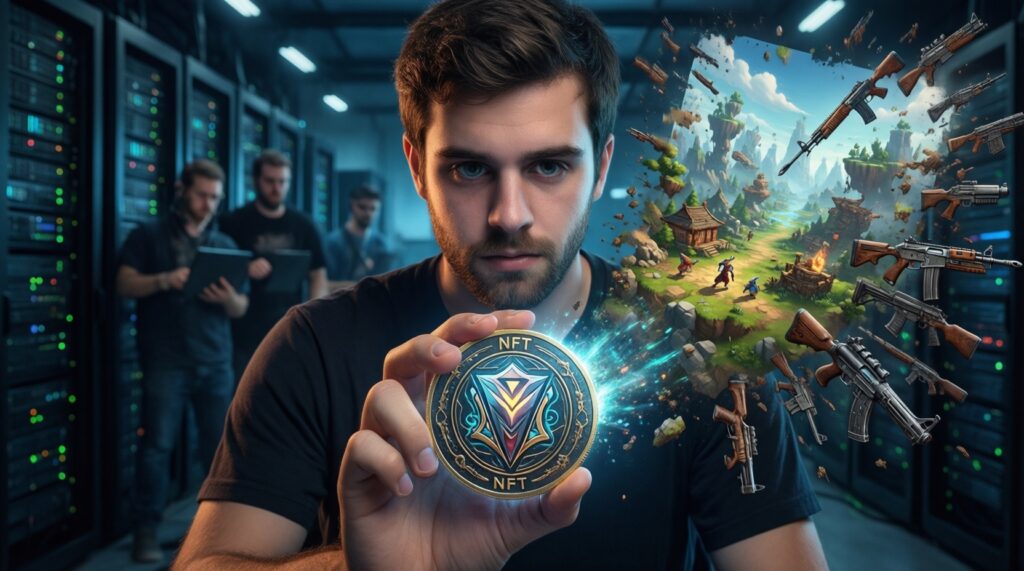
In discussions about NFT gaming true ownership, the most common myth is that owning an NFT guarantees permanent in-game value. In practice, the NFT proves you hold a token; it does not guarantee the developer will keep the game live, keep your item strong, or even recognize it in the client forever.
Another myth is that NFTs automatically make items "yours like property." Most games provide conditional usage: you can transfer the token, but the "use" right is enforced by code and policies controlled by the studio (or by a DAO only if governance is actually on-chain and binding).
A practical way to think about "ownership" is a bundle of permissions:
- Control: can you move the token without the developer's approval?
- Utility: will the game client grant the item's function today and after updates?
- Recoverability: what happens if you lose keys, get hacked, or violate rules?
Technical Foundations: On-Chain vs Off-Chain Control of Items
Most NFT games split "what you own" across on-chain tokens and off-chain game logic. Your actions should focus on identifying where the critical truths (stats, scarcity, upgrade history, eligibility) are enforced.
- Token standard: ERC-721/1155 (or chain equivalents) defines transferability, not gameplay.
- Metadata location: image and attributes may be on-chain, on IPFS/Arweave, or on a studio server; each changes persistence.
- Game state authority: many games store durability, power, and cooldowns off-chain for speed; the NFT becomes a pointer.
- Gating logic: the game client/server decides whether a wallet holding the NFT can enter a match, equip an item, or claim rewards.
- Upgrades and burns: "crafting" often means the contract can mint/burn tokens, but the recipe and odds may be off-chain.
- Admin keys: contracts may be upgradeable or pausable; read whether admins can change rules or freeze transfers.
| What you check | Mostly on-chain | Mostly off-chain |
|---|---|---|
| Can you transfer without permission? | Usually yes (wallet-to-wallet) | Sometimes restricted (whitelists, custodial accounts) |
| Do item stats persist if servers change? | More likely if stats are on-chain | Depends on studio database and policies |
| Can the developer rebalance value? | Harder, but still possible via game rules | Easy (server-side tuning, bans, rule edits) |
| How disputes are handled | Code is the primary arbiter | Support tickets and ToS enforcement |
Legal and Economic Reality of Tokenized Item Rights
Ownership language in marketing often exceeds what the legal and economic setup supports. In Thailand context, the practical question is not "is it property," but "what rights are actually enforceable and what risks are you taking when value depends on a private operator." Typical scenarios include:
- License to use: you hold the token, but the studio grants a revocable license to use it inside the game.
- Account-level enforcement: even with a self-custodied NFT, access can be blocked due to KYC rules, bans, or geo-restrictions.
- Revenue expectations: "earn" systems can create speculative demand; economically, prices often track reward emission and user growth more than rarity narratives.
- IP limitations: holding an NFT rarely grants rights to the game's trademarks, characters, or art beyond limited display.
- Counterparty risk: if utility depends on a studio-operated API, server, or oracle, you are exposed to outages and discontinuation.
Trading Mechanics: Liquidity, Markets, and Interoperability
For NFT game item ownership trading, focus on execution: where you trade, how you verify, and how you exit. "True ownership" helps most when the token is transferable across venues, but pricing still depends on game demand and ongoing utility.
What usually helps traders and players
- Multiple venues: you can often buy NFT game items marketplace listings across different sites, improving price discovery.
- Self-custody: you can move items to another wallet without asking the game (unless transfers are restricted).
- Composability: some assets can be used as collateral or integrated into other apps, depending on chain and contracts.
- Auditability: transfers and mints are visible on-chain, improving provenance checks.
What usually limits outcomes (and how to act)
- Thin liquidity: even on a popular NFT gaming trading platform, many collections have few real buyers; set exit rules (time, price, max loss) before entering.
- Utility lock-in: a token can be tradable while the "good version" of the item is non-transferable (soulbound upgrades, account-bound power).
- Interoperability myths: other games won't adopt your item's stats unless they intentionally build support; treat cross-game use as a bonus, not the base case.
- Fees and royalties: transaction costs and creator fees can change your break-even; estimate them before flipping.
Action checklist before you buy or list
- Confirm the contract address from the official game channels and compare with the marketplace listing.
- Check whether metadata and stats are immutable, and whether the contract is upgradeable/pausable.
- Validate utility: does the game currently recognize the NFT in-game, and are there announced rule changes?
- Review liquidity: recent sales frequency, spread between bids and asks, and concentration of holders.
- Plan custody: hardware wallet for high value, separate wallet for gameplay, revoke risky approvals.
Gambling-like Dynamics: Provable Fairness, House Edge and Compliance
NFTs can be added to games that feel like casinos (loot boxes, spins, raffles, upgrade chance). The presence of NFTs does not make these mechanics fair or compliant by default, including in NFT gambling games with NFTs.
- Myth: on-chain means provably fair. Reality: fairness depends on the randomness design (commit-reveal, VRF, etc.) and whether outcomes are actually auditable end-to-end.
- Myth: player-to-player trading removes the house advantage. Reality: the "house" can take value via fees, sink mechanics, or skewed reward tables.
- Myth: rarity guarantees profit. Reality: if expected value is negative due to fees and odds, secondary prices can still trend down over time.
- Myth: you can always cash out. Reality: withdrawal depends on market buyers, chain congestion, and sometimes platform/KYC rules.
- Operational risk: exploits, oracle manipulation, and contract bugs can invalidate outcomes even if tokens remain in your wallet.
Design Patterns: How Games Grant, Limit or Revoke Ownership
To evaluate "true ownership" quickly, map the game to one of these enforcement patterns. The key is whether gameplay power is derived from the NFT on-chain, or merely associated with it off-chain.
Mini-case: NFT as access key, stats as server truth
Many games treat the NFT as an access pass, while keeping balance and progression in a server database. You can trade the token, but the developer can still change the item's effective power.
// Pseudocode illustrating a common pattern
function canEquip(playerWallet, tokenId):
  if !chain.owns(playerWallet, tokenId): return false
  if server.isBanned(playerWallet): return false
  itemState = server.getItemState(tokenId)   // durability, level, season validity
  if itemState.isExpired: return false
return true- What you truly control: the ability to transfer tokenId to another wallet.
- What the studio controls: bans, seasons, stat formulas, expirations, and whether tokenId is recognized at all.
- Trader implication: price is mainly a bet on continued recognition and rule stability, not just scarcity.
Quick Clarifications on Common Ownership Confusions
Does "true ownership" mean the developer can't nerf my NFT item?
No. Even if the NFT is immutable, the game can change how it interprets the item's power or eligibility.
If I can transfer the NFT, do I automatically own the in-game account progress?
Not necessarily. Many games keep progress off-chain and tie it to an account; the NFT may transfer without the progress.
Can I always sell instantly after I buy?
No. Liquidity depends on active buyers and spreads; an NFT can be transferable but still hard to exit at a fair price.
Does interoperability mean I can use my sword NFT in any game?
No. Other games must implement explicit support; otherwise the NFT is only a token with metadata, not gameplay functionality.
Are NFT gambling-like mechanics automatically provably fair?
No. Provable fairness requires a verifiable randomness and settlement process, not just blockchain settlement for transfers.
Is a marketplace listing enough to confirm authenticity?
No. Always verify the collection contract address; impostor collections can look identical in UI.