

If your priority is "true ownership" and permissionless transfers, NFT game items win-at the cost of higher operational risk, fragmented liquidity, and harder dispute handling. If your priority is fast matching, familiar UX, and stable demand for popular titles, Steam items win-at the cost of platform custody and rule-based transfer limits. Choose by custody, liquidity venue, and risk tolerance.
Core Ownership and Trading Highlights
- NFT items are typically controlled by your wallet keys; Steam items are controlled by your Steam account under platform rules.
- NFT liquidity is often fragmented across chains/marketplaces; Steam liquidity concentrates around the Steam Community Market and major third-party venues.
- Disputes: on-chain trades are usually irreversible; Steam-side issues often depend on platform support and policy enforcement.
- For "trade-to-bet" flows, Steam skins are commonly integrated with third-party ecosystems; NFTs depend on the game's on-chain rails and partner coverage.
- Operational security is the deciding factor: wallet hygiene for NFTs vs account security and API-key handling for Steam ecosystems.
- Price discovery differs: NFTs rely on on-chain history and rarity logic; Steam relies on title popularity, float/pattern desirability, and marketplace depth.
On‑Chain Ownership vs Platform Custody
Use these criteria to decide between NFT game items and Steam items when you want to trade or bet with them.
- Custody model: self-custody wallet keys (NFT) vs custodial account access (Steam).
- Transfer permissions: permissionless transfers (NFT) vs platform-enforced restrictions, holds, and trade rules (Steam).
- Reversibility and finality: on-chain finality vs platform-mediated actions (chargebacks aren't typical on Steam, but account sanctions and policy actions exist).
- Interoperability: NFTs can move across marketplaces; Steam items are tightly coupled to Steam and the specific game inventory system.
- Market access: NFTs require wallet + gas + chain compatibility; Steam requires account standing, trade eligibility, and sometimes API-based integration for third parties.
- Dispute handling: NFT disputes are mostly "social + platform" (marketplace rules) rather than reversible settlement; Steam disputes depend on Valve policies and the venue's support.
- Security surface: wallet seed phrase/signing risks (NFT) vs phishing, session hijacks, and API-key/credential leakage (Steam).
- Game dependency: if the game shuts down or changes item utility, both can suffer-NFTs retain token existence; Steam items retain inventory entries but utility remains game-dependent.
Persona guidance: Retail trader (value hunting)
- If your edge is finding mispriced listings and you often search ซื้อไอเทม Steam ราคาถูก, Steam items can be easier to screen quickly because demand clusters around fewer venues.
- If you prefer early-stage narratives and you're comfortable with wallets, ซื้อ NFT ไอเทมเกม can fit-but only if you can evaluate contract risk, marketplace credibility, and game traction.
Persona guidance: Competitive gamer / bettor (fast turnover)

- If you care about quick conversion between "inventory → stake → cashout," Steam skins often fit better-especially if your main question is เทรดสกิน Steam ที่ไหนดี and you already understand trade rules/holds.
- NFT items work best when the game and betting/trading partners are tightly integrated and you can manage signing risks during high-frequency actions.
Persona guidance: Institutional allocator (process + compliance)
- NFTs can be operationally auditable on-chain, but require robust key management, travel-rule/AML considerations, and counterparty controls.
- Steam exposure can be operationally simpler for small pilots but is constrained by platform terms, account dependency, and vendor concentration risk.
Liquidity Dynamics: Marketplaces, Exchanges, and Brokers
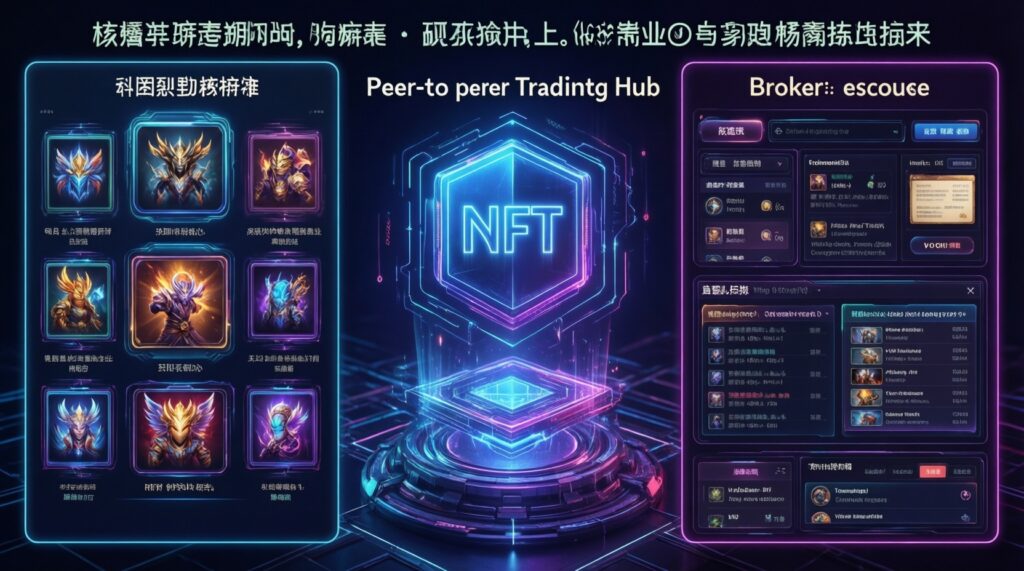
Liquidity is less about "NFT vs Steam" and more about the venue type you use. The same item can behave very differently depending on whether you route through an official marketplace, a peer-to-peer venue, or a broker/escrow. If your intent is เทรด NFT ไอเทมเกม, treat venue selection as part of the trade thesis.
| Вариант | Кому подходит | Плюсы | Минусы | Когда выбирать |
|---|---|---|---|---|
| On-chain NFT marketplace (native chain) | Wallet-native traders, on-chain analysts | Transparent history; broad routing; self-custody compatible | Irreversible mistakes; contract/signature risk; fragmented depth | When you need permissionless transfers and can assess smart-contract and collection risk |
| Game's official NFT market / launcher market | Players who prioritize game utility over pure speculation | Better alignment with in-game utility; fewer "fake" listings | Vendor lock-in; policy changes can reshape liquidity overnight | When item value is primarily driven by gameplay utility and official sinks/sources |
| Steam Community Market | Mainstream traders; players monetizing drops | Concentrated demand; familiar UX; high search visibility | Platform custody; withdrawals are not "cash" in many flows; rule constraints | When you want reliable matching and straightforward price discovery for popular items |
| Third-party Steam skin marketplace (cash-out oriented) | Traders optimizing for fiat/crypto off-ramps | More cash-out options; broader buyer set than a single in-app market | Counterparty and operational risk; requires careful API/trade-link hygiene | When your core question is ขายไอเทม Steam ได้ที่ไหน and you can vet venues and custody flow |
| P2P OTC with escrow / broker | High-value traders; illiquid rares | Custom terms; can reduce slippage on thin books | Trust/escrow risk; slower settlement; higher coordination cost | When order books are too thin and you need controlled execution |
| Betting/whitelisted wagering operator (inventory-based) | Bettors needing immediate stake conversion | Fast "deposit → wager" workflow; simple bankroll tracking | Venue risk; withdrawal friction; stricter KYC/limits may apply | When speed matters more than maximizing sale price, and you accept venue constraints |
Valuation Drivers: Scarcity, Utility, and Rarity Algorithms
Use scenario logic to pick the asset type and venue based on what actually moves price.
- If item value is mostly driven by in-game sinks, crafting, and competitive utility, then prefer official/primary markets (Steam or game-run NFT markets) where supply rules are most directly enforced.
- If your edge comes from rarity mechanics (patterns, floats, traits, editioning), then trade where metadata is consistently surfaced and verified; avoid venues that obscure trait/condition data.
- If you expect narrative-driven pumps (new season, influencer focus, roadmap headlines), then prioritize liquidity concentration (Steam Community Market for mainstream skins; dominant chain marketplace for the NFT collection) to reduce execution risk.
- If you must hedge downside with fast liquidation, then avoid thin NFT floors and illiquid rares; pick items with deep two-sided flow and many substitutable listings.
- If the game issuer can change drop rates or utility quickly, then price a "policy risk premium" and cap position sizes; the same applies to Steam items if a title's popularity collapses.
Security, Fraud Risk, and Dispute Resolution

Run this quick selection algorithm before choosing a venue for either NFTs or Steam items.
- Map custody: confirm whether you are signing (NFT) or granting access (Steam trade link/API). Prefer least-privilege flows.
- Verify the asset identity: for NFTs, confirm contract address and collection; for Steam, confirm exact item, condition/variant, and tradeability status.
- Check venue controls: look for clear dispute policies, support response paths, and transparent listing/fee rules (even if non-reversible).
- Inspect transaction path: avoid side channels (DM-only, off-platform invoices) unless escrowed and reputationally robust.
- Harden authentication: enable strong account security, isolate trading devices, and treat session cookies/API keys as sensitive.
- Do a small test cycle: deposit/withdraw minimal value to validate settlement, item delivery, and any holds/limits.
- Document everything: keep hashes, trade IDs, screenshots, and timestamps for support escalation and accounting.
Regulatory, Compliance, and Tax Considerations
Common selection mistakes in Thailand-context workflows (without assuming your personal tax status):
- Assuming "on-chain" automatically means compliant; KYC/AML can still apply at ramps, exchanges, and large venues.
- Mixing personal and trading wallets/accounts, making it hard to evidence cost basis and intent.
- Ignoring platform terms: Steam account actions and third-party integrations can lead to freezes that function like liquidity shocks.
- Treating betting deposits as "trades" for recordkeeping; wagering flows often need separate ledger categories.
- Underestimating cross-border counterparties: venue jurisdiction and enforcement options matter more than UI language.
- Failing to archive transaction proofs (on-chain explorers, receipts, trade confirmations) until after an incident.
- Assuming NFT royalties/market fees and Steam/third-party fees are equivalent; fee models differ and can change.
- Not accounting for FX/crypto conversion steps when you move value between THB, stablecoins, and platform balances.
Tactical Playbook: Trading, Speculation, and Betting Strategies
For most intermediate traders, Steam items tend to be best for fast turnover and broad, repeatable liquidity-especially if your workflow centers on "where to trade and cash out" rather than self-custody. NFT game items tend to be best for thesis-driven positions where on-chain ownership and transfer freedom matter more than friction. For bettors, choose the ecosystem that minimizes custody handoffs and operational mistakes while still allowing timely liquidation.
Trader & Bettor Quick Clarifications
Is NFT ownership "real" compared to Steam items?
NFTs are typically controlled by whoever holds the wallet keys, while Steam items are controlled under platform custody and terms. "Real" depends on whether you mean key control or practical utility inside the game ecosystem.
What does ซื้อ NFT ไอเทมเกม usually require operationally?
You need a compatible wallet, the correct network/chain setup, and a reliable way to verify the contract/collection before buying. The main risk is signing or sending to the wrong address with no easy reversal.
When does เทรด NFT ไอเทมเกม make more sense than Steam trading?
When transfers across venues matter, or when you want exposure to game-native token economics and on-chain provenance. It's weaker when you need concentrated liquidity and simple support escalation.
How do I approach ซื้อไอเทม Steam ราคาถูก without taking unnecessary risk?
Focus on items with consistent demand and avoid "too-good-to-be-true" off-platform offers. Prefer venues with clear delivery mechanics and keep your account security tight.
So, ขายไอเทม Steam ได้ที่ไหน if I want fewer moving parts?
The Steam Community Market is operationally simplest, but it can constrain how value is withdrawn. Third-party markets can enable cash-out routes but add counterparty and integration risk.
เทรดสกิน Steam ที่ไหนดี for frequent trading?
Choose venues with strong liquidity for your specific title, transparent fee rules, and predictable settlement mechanics. Avoid platforms that require broad permissions or unclear custody handoffs.
Are Steam skins or NFTs better for betting workflows?
Pick the ecosystem with the fewest custody transitions from inventory to wager and back. In practice, reliability of deposits/withdrawals and venue trust dominate "asset type" in betting use cases.