


Steam item arbitrage is the practice of buying a Steam item (often a skin) when it is temporarily mispriced and reselling it after price normalization, while staying net-profitable after fees, spread, and holding time. To do it safely, focus on liquid items, verify real sell-through, model worst-case fees, and time entries around predictable market stress windows.
Quick strategic summary
- Start with high-liquidity items where "cheap" is measurable (tight spreads, frequent sales), not just visually appealing skins.
- Profit is usually lost to fees + bid/ask spread; model them before you place any buy order.
- To buy undervalued Steam skins, use repeatable filters (volume, spread, stable history) and avoid one-off "too good" listings.
- Timing is a playbook: event-driven dips, post-drop normalization, and disciplined relisting cadence.
- Control downside with position sizing, diversification, and a pre-defined exit if the thesis breaks.
- Automation can help scanning and repricing, but keep it compliant and prioritize account security.
Market mechanics: how Steam pricing, fees and liquidity shape opportunities
This works best for intermediate traders who can interpret order books, understand spreads, and can wait out short hold periods. It is a form of steam item arbitrage where execution quality matters more than "calling the top."
- Where edge comes from: temporary imbalance between buy orders, lowest listings, and typical sale prices (liquidity + attention gaps).
- Where edge disappears: thin markets, hype-driven items, or anything with irregular sales and wide spreads.
- When not to do it: if you can't cover fees, if you need immediate cash-out, or if you're tempted by off-platform deals that bypass safe trading practices.
- Regional note (TH): plan around your timezone (ICT) for monitoring and relisting; also ensure your payment methods and account verification are stable to avoid purchase/market restrictions.
| Venue / method | Fees (what to check) | Typical turnaround | Pros | Cons / watch-outs |
|---|---|---|---|---|
| Steam Community Market | Steam fee + game-specific fee (varies by title) | Minutes to days (depends on liquidity) | High safety, built-in escrow, visible order book | Fees can erase small edges; funds stay in Steam wallet |
| Third-party marketplaces | Platform selling fee + withdrawal costs (varies) | Hours to weeks | Sometimes better pricing inefficiencies; potential cash-out | Counterparty/platform risk; KYC; API key and login security critical |
| P2P trading (direct trades) | Usually no "market fee," but implicit spread and risk | Unpredictable | Flexible bundles; can negotiate | Scams, impersonation, bad links; requires strict OPSEC |
Spotting undervalued skins: data sources, filters and red flags
For steam skin arbitrage, you need the ability to compare an item's current listing/buy-order gap against its recent trade reality, then validate that the "cheap" level can actually be exited.
What you need before you hunt
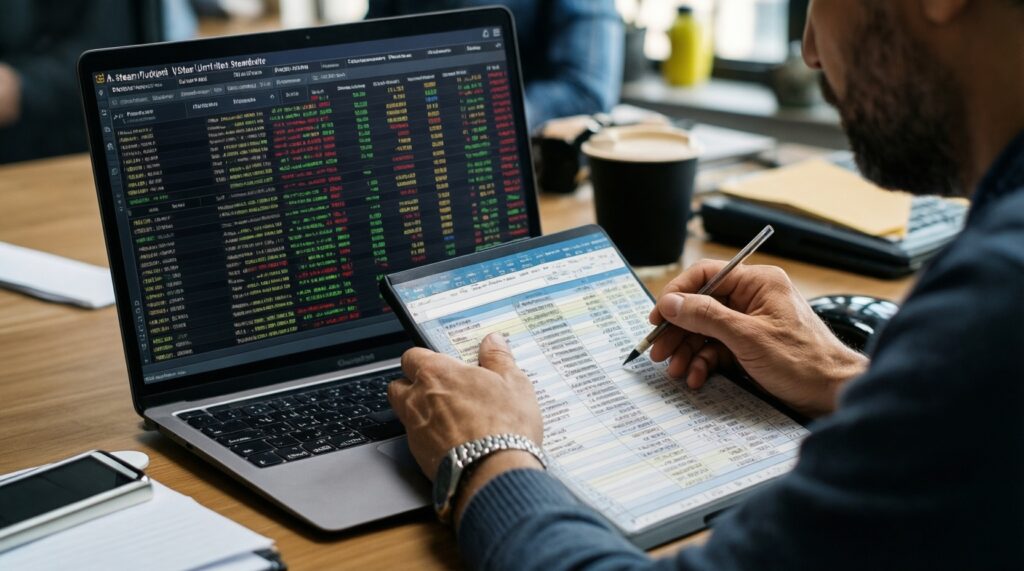
- Steam basics: Steam Guard enabled, trade confirmations working, no recent restrictions that limit market/trading.
- Market visibility: ability to view the item's listing history and current buy orders/sell listings (order book).
- Tracking workflow: a watchlist (spreadsheet is enough) with columns for buy price, expected net after fees, target sell price, and maximum hold time.
- Security hygiene: never share API keys, verify URLs, and confirm trade partner identities inside Steam (not via copied links).
Filters that find real "undervalued," not just "cheap"
- Liquidity filter: prefer items with frequent sales and multiple competing listings so you can exit without moving the market.
- Spread filter: skip items where the gap between lowest listing and highest buy order is so large that fees plus spread destroy profit.
- Consistency filter: favor items with a stable price band rather than sudden spikes/drops from hype.
- Exit realism: ensure your planned sell price sits where sales actually happen, not at a "wishful" price tier.
Red flags that usually mean "no trade"
- Only one oddly low listing in an otherwise illiquid market (often not repeatable).
- Price history that is mostly gaps or single prints (no reliable baseline).
- Items driven by short-lived social hype where the "fair price" is unknown.
- Off-platform messages pushing you to "verify" via a link or to "log in to confirm" a trade.
Valuation frameworks: modeling price, volatility and expected hold time
Use a simple, repeatable model: define your entry, your realistic exit, your all-in costs, and the maximum time you're willing to wait. The goal is not perfect prediction-it's avoiding trades where a small adverse move wipes out your edge.
-
Define the trade unit and the exit venue
Pick the exact skin variant/condition and decide where you will sell (Steam Market vs elsewhere). This prevents mixing prices that aren't actually interchangeable.
- Record item name, any quality/condition markers, and your intended selling venue.
-
Estimate net proceeds after fees (worst-case)
Before buying, compute the minimum sell price that still leaves profit after all applicable fees. If you can't estimate fees confidently, treat the trade as "no."
- Rule of thumb: if your edge is thin, fees and spread will likely consume it-require a clear buffer.
-
Anchor a realistic sell price using observed trades
Use recent sale levels (not only current listings) to set a target that is likely to fill. If the item rarely sells at your target, the trade is speculative, not arbitrage.
-
Model volatility with a simple "range test"
Stress-test your plan: if price drifts down modestly, do you still have an exit without a loss? If not, reduce size or skip.
- Example (illustrative): if you buy at 100 and need 120 to break even, a small dip makes the trade fragile.
-
Set an expected hold time and a hard timeout
Decide how long you'll wait for normalization. If it doesn't happen by your deadline, exit or re-evaluate with new information.
-
Choose execution: buy order vs instant buy
Buy orders improve entry but risk missing the move; instant buys secure fills but often overpay. Use buy orders when liquidity is high and timing is not critical.
Fast mode (3-5 step execution)
- Scan liquid items, then shortlist only those with tight spreads and frequent sales.
- Calculate worst-case net after fees; require a clear profit buffer.
- Place buy orders near fair value (or instant buy only if a time window is closing).
- Relist at a realistic, historically sellable price and review daily until exit or timeout.
- Log every trade (entry, fees assumption, exit, hold time) to refine your filters.
Timing your trades: event windows, meta shifts and optimal listing cadence
- Confirm you know the best time to buy steam skins for your specific item category (event-driven dips vs quiet periods), not just general "sales."
- Check whether the item's current move is driven by a temporary event (drop wave, update buzz) rather than a permanent shift.
- Validate that buy orders are present at multiple levels (a single top buy order can vanish).
- Reprice method: undercut minimally when liquidity is strong; re-evaluate if you're repeatedly pushed down by many new listings.
- List cadence: don't churn listings every few minutes; set scheduled checks (e.g., morning/evening ICT) and adjust only when the order book meaningfully changes.
- Before entering, predefine your "no regret" exit: take-profit level and timeout exit level.
- After listing, verify visibility and that your item is correctly categorized (wrong variant = no fills).
Risk and capital rules: position sizing, stop-losses and diversification
- Overconcentration: putting most funds into one skin because it "looks obviously undervalued." Diversify across several liquid items.
- No fee buffer: assuming fees are small; on thin edges, fees are the trade. Model worst-case net.
- Ignoring liquidity: entering a low-volume item and discovering you can't exit without cutting price aggressively.
- Chasing spikes: buying after a rapid move and calling it arbitrage; that's momentum speculation.
- Moving the goalposts: extending hold time indefinitely instead of respecting the timeout you set.
- Repricing too often: burning attention and making emotional decisions instead of following a cadence.
- Security lapses: clicking trade-related links, sharing screens with API keys visible, or trusting impersonator accounts.
- Tool overtrust: treating scanner signals as truth without verifying the order book and sales reality.
Automation and tooling: scanners, bots, and workflow integration
Automation is useful for monitoring and alerts, but prioritize compliance and account safety. If you use a steam market trading bot conceptually (for scanning/repricing ideas), keep actions within platform rules and avoid anything that requires risky credentials handling.
Practical options and when they fit
- Manual + spreadsheet watchlist - best for learning; forces you to understand spread, fees, and liquidity before scaling.
- Price alerts and watchlists (non-invasive) - useful when your edge comes from timing; you act only when thresholds are hit.
- Market scanners (read-only analytics) - good for discovering candidates quickly; always confirm in Steam before buying.
- Semi-automated repricing workflow - acceptable when you have many listings; set a fixed review cadence and rules so automation doesn't cause churn or bad fills.
Immediate execution checklist (one line): Pick 10 liquid items → filter by tight spread + real sales → compute worst-case net after fees → place disciplined buy orders → relist at historically sellable prices → exit on target or timeout.
Common practical stumbling blocks and concise fixes
Why does my "profitable" trade become unprofitable at checkout or on sale?
Fees and spread were not modeled conservatively. Recalculate using worst-case fees and require a buffer; if the edge disappears, skip the trade.
How do I know I'm not just catching a falling knife?
Check whether the order book is weakening (buy orders thinning) and whether the drop is event-driven. If you can't define a stable price band and a timeout exit, it's not a clean arbitrage setup.
What's the safest way to buy undervalued Steam skins without getting scammed?
Stay on-platform where possible, verify item details and price history, and never follow external "verification" links. Treat rushed DMs and impersonator profiles as automatic deal-breakers.
How many items should I hold at once for steam skin arbitrage?
Hold enough different liquid items to avoid single-item risk, but few enough to monitor properly. If you can't review your positions on a schedule, you're over-extended.
What's the best time to buy steam skins for a quick flip?

Buy during temporary supply surges and attention gaps, then sell after normalization-only if liquidity stays healthy. If volume dries up, prioritize capital preservation over waiting for a perfect price.
Should I use a steam market trading bot to automate everything?
Full automation increases security and compliance risk and can amplify small pricing mistakes. Prefer read-only scanners/alerts and a rule-based manual execution until you have consistent logs and controls.
Why do my listings not sell even though I'm the "lowest price"?
You may be comparing the wrong variant/condition, the market moved, or buyers are hitting buy orders instead of listings. Re-check the exact item match and the current buy-order wall before repricing.