

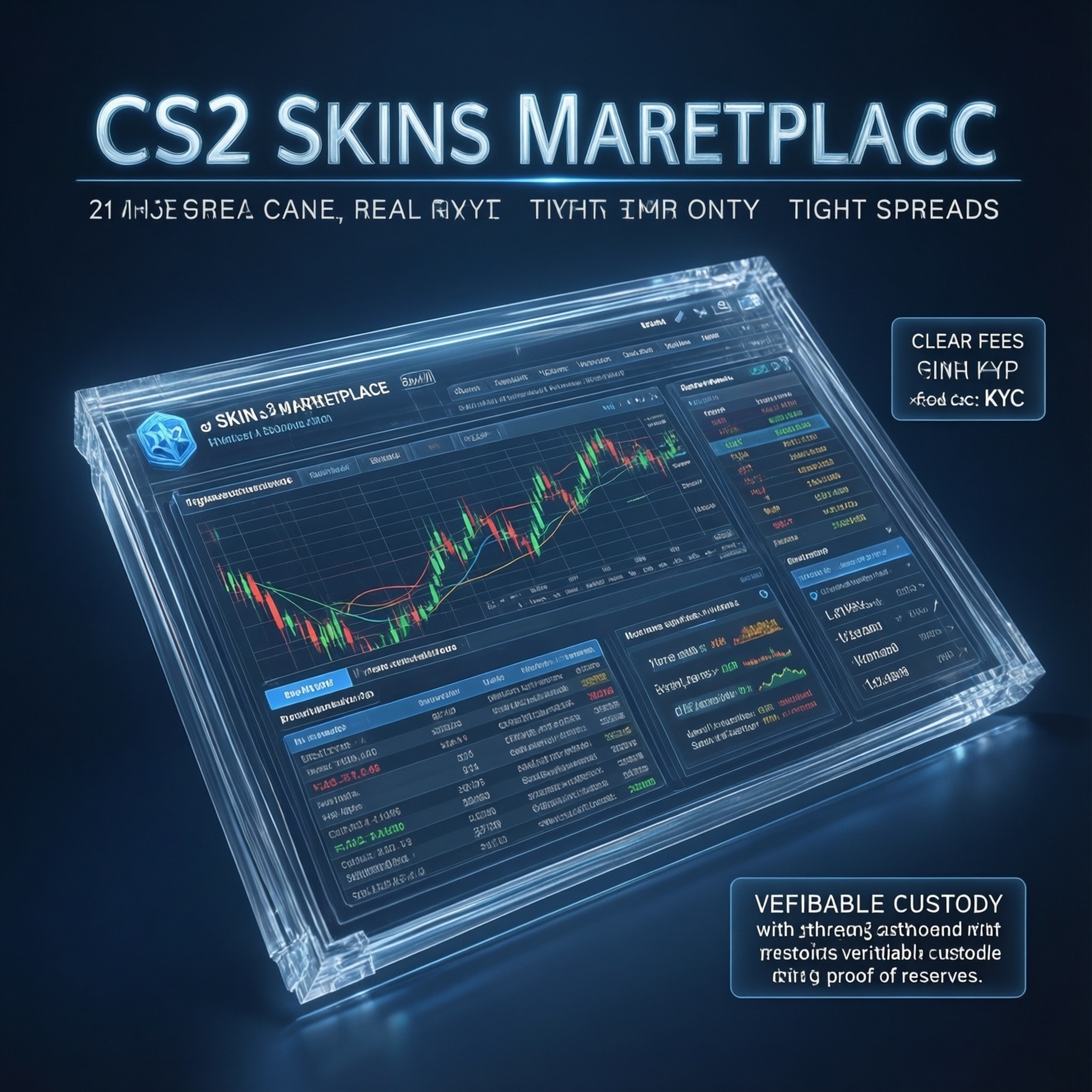
A credible CS2 skins/items marketplace is one where independent feedback aligns with observable market behavior: real trades, tight spreads, transparent fees, clear KYC rules, and verifiable custody (ideally proof of reserves). If you can't confirm liquidity, total costs, withdrawal reliability, and ownership evidence within a short audit, treat it as high-risk.
Snapshot: Core indicators to judge a skins/items marketplace
- Reputation signals are consistent across independent channels (not just the site's own testimonials).
- Liquidity is visible: active order books, stable pricing, and quick fills for common items.
- Total cost is predictable: trading fee + withdrawal + conversion spread are disclosed and match reality.
- KYC policy is explicit and enforced consistently; "no-KYC" claims don't hide blocked withdrawals.
- Custody is provable: segregated holdings, audits/attestations, or credible proof of reserves processes.
- Operations are resilient: clear dispute resolution, reversible mistakes handling, and limited chargeback exposure.
Assessing user reviews, reputation signals and real-world feedback
When people ask ตลาดเทรดสกิน CS2 น่าเชื่อถือไหม, the fastest signal is whether "public reality" matches "platform marketing." Credibility isn't the absence of complaints; it's whether complaints are specific, reproducible, and resolved with traceable outcomes (refund logs, ticket transcripts, status pages), rather than vague praise or copy-pasted negativity.
Use รีวิวเว็บเทรดสกิน CS2 as a starting point, not a verdict. Reviews are easy to manipulate, so treat them like leads for verification: find posts that include timestamps, item IDs, withdrawal method, and what support did. Prioritize reviewers who show both wins and losses; one-sided "perfect" accounts often indicate promotion.
Practical checks (pick 1-2 and confirm yourself):
- Cross-channel consistency: compare sentiment and recurring issues across community forums/Discords and public social threads. Look for identical phrasing patterns (astroturfing) and sudden review spikes (campaigns).
- Support reality test: ask a narrow question ("What is the exact withdrawal limit for Steam trade vs on-site balance?") and measure response clarity, not friendliness.
Measuring liquidity: order books, trade volume, bid-ask spread and market depth
Liquidity is the difference between "a price on a screen" and "a price you can actually trade at." In skins markets, liquidity shows up as how quickly you can buy/sell without large slippage, especially on popular CS2 items. Low liquidity amplifies risk: you get stuck, forced to discount, or pay hidden spread via bad fills.
- Order book shape: a healthy book has multiple levels on both sides, not a single thin wall that collapses after one trade.
- Bid-ask spread: compare best bid vs best ask for the same item. Wide spreads often mean you're paying an invisible fee.
- Market depth: estimate how much value can trade within a small price move. If a small sale crashes the price, depth is poor.
- Fill time: place a small test order near the best price and measure time-to-fill; repeated delays can indicate artificial listings.
- Price parity: compare platform prices to several independent references; persistent divergence suggests manipulation or trapped liquidity.
- Withdrawal friction: "liquid" markets still fail if you cannot withdraw quickly and predictably.
Practical tools/examples:
- Open the item's market page in two browsers (logged-in and logged-out) to detect "personalized" pricing or hidden fees in the UI.
- Run a "smallest safe trade" test: buy/sell a low-cost item to verify matching, settlement, and withdrawal end-to-end.
Fees and hidden costs: maker/taker, withdrawal, conversion and tax implications
"Cheap fees" claims can be true or misleading depending on where the platform earns. People searching เว็บเทรดสกิน CS2 ค่าธรรมเนียมถูก should evaluate total cost: not only maker/taker, but also withdrawal fees, conversion spreads, minimum withdrawal thresholds, and any forced in-platform balance steps.
Typical scenarios where hidden costs appear:
- "Low trading fee" but high spread: the platform earns via worse execution rather than an explicit fee.
- Withdrawal fee stacking: a flat withdrawal charge plus network/payment processor fee plus "handling."
- Currency conversion friction: THB deposits convert into USD/crypto balance at an unfavorable rate, then reconvert on cash-out.
- Promo/bonus lock-in: bonuses that require volume targets, restricting withdrawal until conditions are met.
- Fee-by-item class: popular skins priced competitively, niche items priced with higher margins and slower fills.
Fast verification:
- Before depositing, screenshot the fee page and compare it to the final checkout/withdrawal confirmation screens.
- Compute an "all-in round trip" on one item: buy → sell → withdraw, and compare expected vs realized outcome.
Quick practical checks (10-minute credibility audit)
- Transparency sweep: find the fee schedule, KYC policy, withdrawal limits, and dispute rules without logging in. If you can't find them, assume they change ad hoc.
- Liquidity spot-check: open 3 popular CS2 items and record best bid/ask and number of listings on the first few levels.
- Execution test: place a minimal trade and confirm settlement is immediate and reversible errors are handled through a ticket.
- Withdrawal test: attempt the smallest possible withdrawal method you plan to use (Steam trade / bank / crypto) and track time, fees, and unexpected prompts.
- Custody evidence: look for proof of reserves, attestations, or clear custody model; absence isn't instant fraud, but it increases required caution.
KYC, identity verification and the privacy-compliance balance
KYC is not automatically "good" or "bad"; it is a trade-off between compliance, fraud prevention, and user privacy. Queries like เว็บเทรดสกิน CS2 ที่ไม่ต้อง KYC usually signal a desire for speed and privacy, but "no KYC" can also mean higher scam/chargeback risk or sudden account locks when you attempt larger withdrawals.
Pros of clear KYC (when implemented predictably):
- Lower chargeback pressure: fewer stolen-payment deposits can reduce sudden freezes and clawbacks.
- Better dispute handling: identity-linked accounts can make arbitration and recovery more consistent.
- Higher limits: verified users often get faster withdrawals and fewer manual reviews.
Limitations and risks to manage:
- Data exposure: you are trusting the platform's security controls and retention practices.
- Selective enforcement: "KYC only on withdrawal" can become "KYC only when you win," which is a major red flag.
- Third-party processors: documents may be handled by vendors; verify who processes data and whether deletion is possible.
Proof of reserves, attestations and on‑chain/non‑custodial evidence
"Proof of reserves" is evidence that a platform can cover user balances with held assets. In skins marketplaces, this is tricky because custody can involve inventories, bots, escrow accounts, or on-chain assets if crypto is used. People searching เว็บเทรดสกิน CS2 proof of reserves should look for verifiable methods, not just a banner that says "funds are safe."
Common mistakes and myths to avoid:
- Myth: a wallet screenshot is proof. A screenshot proves nothing about liabilities or who controls the keys.
- Myth: "audited" means solvent. Attestations can be point-in-time and may not cover all obligations.
- Confusing reserves with segregation: even if assets exist, they may be co-mingled and re-used.
- No liability view: reserves without showing user obligations (liabilities) can be misleading.
- Non-custodial claims without mechanics: if the platform can block withdrawals or custody items via bots, it's effectively custodial for users.
Practical verification examples:
- Check whether the platform explains custody flow (where items/balances sit, who controls them, and when ownership transfers).
- Look for repeatable verification steps (e.g., user-specific inclusion proofs, signed statements, or clearly scoped attestations) rather than generic marketing text.
Operational security, dispute resolution, chargebacks and red flags
A marketplace can look legitimate yet fail operationally: poor account security, inconsistent support, and chargeback shocks often precede frozen withdrawals. Your goal is to see whether the platform has predictable processes when something goes wrong.
Mini-case (how to decide after a failed withdrawal):
if withdrawal_delayed > stated_SLA:
  open_ticket(withdrawal_id, timestamp, method)
  if support_requests_new_KYC_not_in_policy:
    stop_deposits()
    attempt_small_withdrawal_only()
  if platform_demands_extra_fees_not_disclosed:
    treat_as_red_flag()
  if repeated_generic_replies and no escalation path:
    exit_positions_when_possible()
Red flags checklist:
- Fees/policies change between FAQ and checkout screens.
- "Maintenance" appears only when you try to withdraw, repeatedly.
- Support refuses to reference a policy page or won't provide a case ID.
- Unsolicited DMs offering "manual faster withdrawal" or "special rates."
- Pressure to deposit more to "unlock" withdrawals.
Concise answers to typical credibility questions
How can I tell whether reviews are manipulated?
Prioritize reviews with verifiable details (timestamps, item names, withdrawal method, support transcript). If many reviews share the same phrasing or appear in a short burst, treat them as marketing until proven otherwise.
What liquidity signal matters most for intermediate traders?
Bid-ask spread plus fill time on popular items. If spreads are wide or fills are slow on common skins, niche items will be worse.
Is "เว็บเทรดสกิน CS2 ค่าธรรมเนียมถูก" a reliable promise?
Only if the platform discloses all-in costs and your test trade confirms them. Low headline fees can be offset by spread, conversion rates, or withdrawal charges.
Is "เว็บเทรดสกิน CS2 ที่ไม่ต้อง KYC" safer or riskier?
Neither by default; it shifts the risk profile. No-KYC platforms can be convenient, but sudden KYC-on-withdrawal or selective enforcement is a major credibility warning.
What counts as meaningful proof of reserves in practice?
Evidence that can be independently checked and is scoped (what assets, what liabilities, what date). A logo, screenshot, or vague "audited" claim is not enough.
What is the fastest way to answer "ตลาดเทรดสกิน CS2 น่าเชื่อถือไหม" for a new site?

Do a minimal end-to-end test: deposit the smallest amount, trade once, then withdraw using your intended method. If any step is blocked by undisclosed rules, stop.