


Esports odds are prices that translate a match outcome into an implied probability and payout; they are not predictions and they are not fixed truths. To bet safely, treat esports betting odds as risk quotes, verify market rules (maps, overtime, void conditions), and only stake amounts you can lose while focusing on value, not "sure wins."
Essential Concepts Snapshot
- Odds encode probability plus margin; the "true" chance is usually lower than the implied probability after removing vig.
- Esports moneyline odds price who wins the match/series; handicaps and totals price how they win and how much is scored.
- Handicaps in esports commonly mean map spreads or Asian-style lines that reduce push/void ambiguity.
- Esports totals betting depends heavily on rules: overtime inclusion, map pool, patch/meta, and format (Bo1 vs Bo3/Bo5).
- "Value" means positive expected value (EV), not high payout; odds movement can reflect news, not certainty.
- Safety basics: cap stake size, avoid chasing in-play swings, and use reputable operators with clear settlement rules.
Myths About Esports Odds That Mislead Bettors
Myth 1: Odds are a forecast. Odds are a market price. They incorporate public money, operator margin, and information timing. A line can be "right" and still lose; a line can be "wrong" and still win.
Myth 2: Bigger payout equals better bet. Longshots pay more because they win less often. Without an edge, higher odds usually increase variance, not profitability.
Myth 3: You can compare odds across markets without reading rules. In esports, settlement details (map counted, overtime counted, stand-ins, walkovers, replayed maps, series format changes) can flip a bet from win to void to loss. Safety step: read market terms before staking.
Myth 4: "Best" operators always offer the same thing. Even among the best esports betting sites, markets differ (match winner vs map winner, regulation-only vs including overtime, round totals vs map totals). Treat each market as a different product.
Odds formats and implied probability (quick conversion)
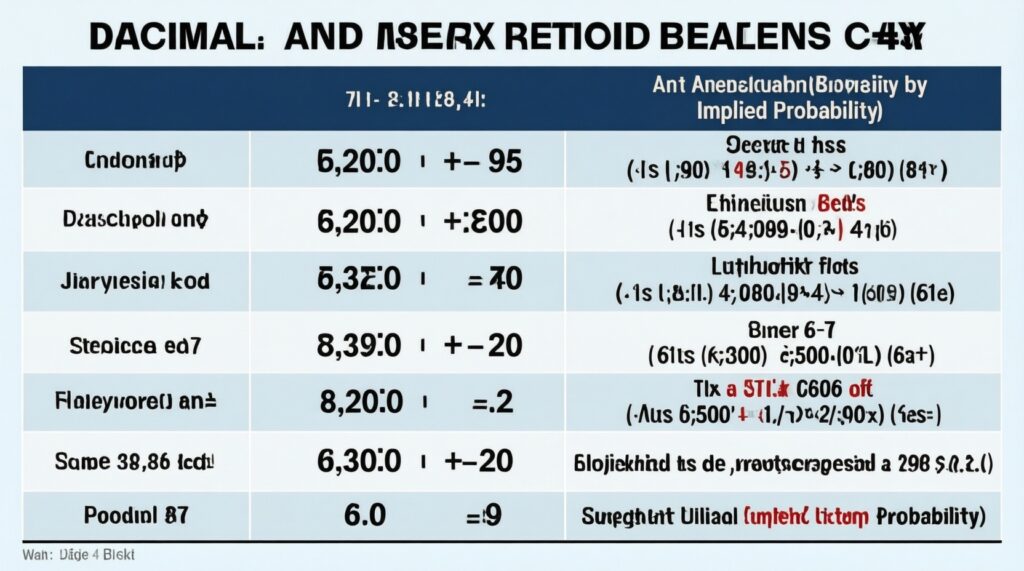
| Format | Example odds | Implied probability formula | Implied probability (example) | Conversion note |
|---|---|---|---|---|
| Decimal | 1.80 | p = 1 / odds | 1/1.80 ≈ 0.556 (55.6%) | Simple: stake × odds = return (incl. stake) |
| American (negative) | -150 | p = |A| / (|A| + 100) | 150/(150+100) = 0.600 (60%) | Favorite; you risk 150 to win 100 |
| American (positive) | +200 | p = 100 / (A + 100) | 100/(200+100) ≈ 0.333 (33.3%) | Underdog; you win 200 per 100 risked |
| Fractional | 5/4 | p = denominator / (numerator + denominator) | 4/(5+4) ≈ 0.444 (44.4%) | Profit = stake × (5/4); return adds stake |
How Moneylines Reflect Win Probability in Esports
Moneyline is the simplest market: pick who wins (match or series). Esports moneyline odds convert to implied probability, but the market price usually includes margin and reacts to roster news, map veto expectations, and format changes.
- Define the settlement unit. "Match winner" in Bo3 is different from "Map 1 winner." Confirm what you're buying.
- Convert odds to implied probability. Use the table formulas; treat this as the market's baseline, not your model.
- Account for margin (vig) conceptually. If both sides imply more than 100% combined, the excess is operator margin; your "fair" probabilities must sum to 100%.
- Check information timing risk. Esports lines can move sharply on stand-ins, role swaps, or patch notes. Safety step: avoid betting before reliable lineups are confirmed.
- Respect format sensitivity. Bo1s are higher variance; moneylines in Bo1 are more volatile than in Bo5.
- Limit exposure to correlated outcomes. If you already bet a team moneyline, additional props tied to the same win condition increase variance.
Understanding Handicaps: Asian Lines and Map Spreads
Esports handicap betting prices a margin rather than the outright win. In esports this is often a map spread (e.g., -1.5 maps) or a round/kill spread depending on the title and market offering. Asian-style lines can include half-wins/half-losses or push protection depending on the operator.
Typical scenarios where handicaps are used:
- Strong favorite, low moneyline payout. Instead of paying a steep price to win, a -1.5 map spread may offer a more balanced risk/reward.
- Close matchup with asymmetric map pool. If one team is likely to drop a specific map, a +1.5 underdog spread can reduce "one-map swing" risk.
- Bo5 finals with stamina/tilt dynamics. Spreads help express "wins comfortably" vs "wins eventually."
- Games with frequent overtime/close rounds. Round spreads become fragile if overtime handling differs; safety step: confirm whether overtime rounds count toward spread/totals.
- When you have a clear edge on veto outcomes. If your read is "Team A wins 2-0 often," a -1.5 maps bet aligns better than moneyline.
Totals and Over/Under: Modeling Match Scoring
Esports totals betting (over/under) depends on what is being totaled: maps, rounds, kills, objectives, or match duration. Totals are powerful because you can be right about pace/structure even if you are wrong about the winner, but they are sensitive to rule definitions and meta shifts.
Advantages of totals when used safely
- Winner-agnostic angles. You can target tempo (fast stomps vs long maps) without picking the side.
- Better fit for stylistic reads. Draft tendencies, objective priority, and risk appetite often show up in totals.
- Natural hedging against side bets. Example: small under with a favorite spread can offset scenarios where the favorite wins quickly.
Limitations and safety constraints to respect
- Settlement ambiguity. Confirm inclusion of overtime, technical pauses, remakes, or map replays.
- Patch/meta regime changes. Totals derived from old meta can break immediately after updates.
- Small-sample traps. A few recent long games can bias your expectation; totals require stable context (opponents, format, patch).
- In-play volatility. Live totals can swing on a single objective; use smaller stakes in-play.
Identifying Value: Expected Value, Edge, and Bankroll Impact
"Value betting" means you believe the true probability is higher than the market implies. The safe way is to quantify your estimate, compare it to odds, and size stakes conservatively to survive variance.
- Mistake: Confusing confidence with edge. Feeling sure is not the same as having a probability advantage.
- Mistake: Ignoring margin and line shopping. Small differences in price matter; compare across the best esports betting sites you can access legally in Thailand to reduce hidden cost.
- Mistake: Overbetting after a "good read." Even positive-EV bets lose often; stake sizing should protect your bankroll from streaks.
- Mistake: Treating correlated bets as independent. Moneyline + favorite spread + underdog under can unintentionally stack the same risk.
- Mistake: Assuming line movement proves you were right. Odds can move because limits changed or news broke-neither guarantees EV.
Minimal EV framing (no advanced modeling required): if your probability p is greater than implied probability from the odds, the bet may have value. If not, pass.
Practical Bet Construction and Live-Betting Adjustments
Mini-case (pre-match + in-play) that prioritizes safety constraints:
- Pre-match check. Confirm series format (Bo3), settlement rules (overtime included), and lineups (no stand-ins). If any are uncertain, skip or reduce stake.
- Pick the market that matches your thesis. If your thesis is "Team A likely wins 2-0 due to veto advantage," prefer a map handicap (-1.5) over a short moneyline.
- Set a risk cap. Decide a fixed maximum stake for the match; do not add more than this cap in-play.
- In-play adjustment rule (simple). Only consider adding if the reason is structural (draft/veto confirmed, tempo confirmed), not emotional (tilt after losing a round).
if (rules_confirmed && lineups_confirmed) {
  implied_p = 1 / decimal_odds
  if (my_p > implied_p + safety_buffer) place_small_bet()
}
if (live_betting) {
  if (new_info_is_structural && total_exposure <= cap) consider_add_small()
  else do_nothing()
}
Quick Clarifications on Common Doubts
Are esports betting odds the same as a team's real chance to win?
No. Odds reflect a market price that includes operator margin and public positioning; your job is to estimate a fair probability and compare.
What's the practical difference between esports moneyline odds and a map handicap?
Moneyline prices "who wins," while a handicap prices "by how much" (e.g., -1.5 maps). Handicaps can offer better payouts but require the win to be decisive.
Is esports handicap betting safer than moneyline?

Not inherently. It can reduce or increase risk depending on the line; spreads often increase variance because close wins can still lose the handicap.
What should I verify before placing esports totals betting?
Confirm what counts toward the total (overtime, map replays, regulation-only rules) and the match format. Totals are highly sensitive to these definitions.
How do I identify value without a complex model?
Convert the odds to implied probability and compare it to your best estimate. If you cannot justify your estimate beyond vibes, skipping is the safest option.
Do the best esports betting sites always have the best odds?
No. Reputable sites may differ by market type, limits, and settlement clarity; "best" should include rules transparency and reliability, not only price.