

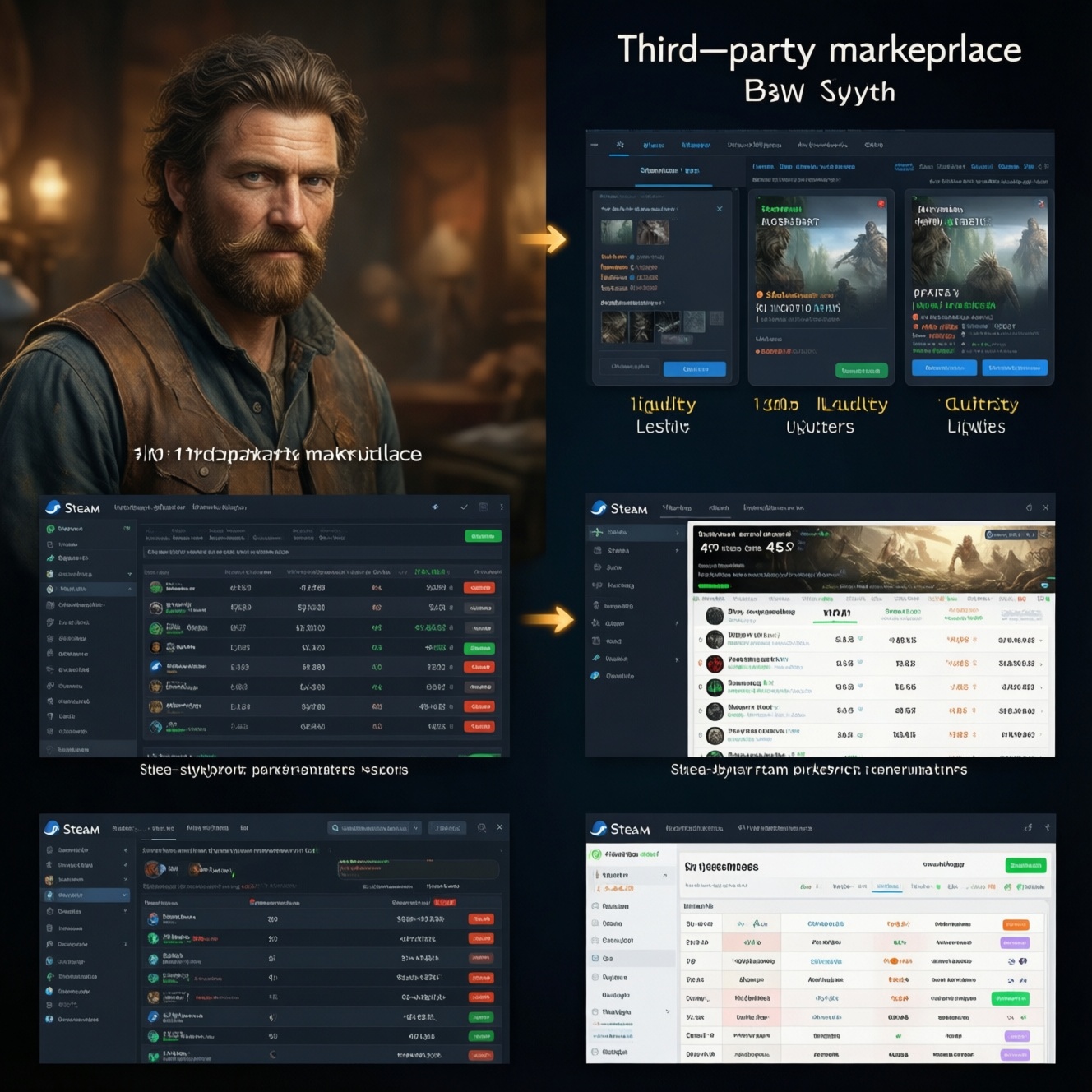
If your goal is real arbitrage profit rather than just item collecting, Steam is usually best for fast recycling of balance inside the ecosystem, while third-party marketplaces are usually better for cash-based spreads and sourcing discounts. The "best" choice depends on fees, liquidity for your specific skins, and your tolerance for account and payment risk.
Arbitrage Snapshot: concise comparative summary
- Steam-first fits traders who want predictable liquidity and low operational friction, but profits are trapped as Steam balance.
- Third-party-first fits traders targeting cash-out and wider price dispersion, but you take more counterparty and payment risk.
- Best workflow for many intermediates: source off-Steam, then sell where that exact item has the strongest bid depth (often Steam for fast turnover).
- Steam marketplace fees and pricing often compress spreads; you win on volume/velocity more than on huge per-item margin.
- steam skin trading risks and scams concentrate around off-platform deals, impersonation, API key compromise, and chargeback/dispute paths.
Market Mechanics: how Steam's ecosystem functions versus third-party marketplaces
Use these criteria to decide where your edge is most realistic for steam skin arbitrage. The right venue is the one that matches your capital type (Steam balance vs cash), your speed needs, and the specific items you trade.
- Settlement type: Steam settles into Steam Wallet; third-party venues usually settle into site balance and may offer cash-out rails (each with its own rules).
- Market access: Steam is one closed venue; third-party markets fragment liquidity across multiple order books.
- Price discovery: Steam prices often anchor the ecosystem; third-party prices can deviate more, especially during hype or supply shocks.
- Inventory mobility: Steam trading restrictions (trade holds/locks) can slow cross-venue movement; third-party deposit/withdraw flows add time and operational steps.
- Order types and tooling: Steam supports listings and buy orders; third-party venues vary (some are listing-only, some support bids, some have bulk tools).
- Counterparty model: Steam is platform-mediated; third-party venues can be platform-mediated, P2P, or a hybrid-each changes your fraud surface.
- Regional payment rails: In Thailand context, check whether your preferred cash methods are supported, and whether FX conversion silently changes your edge.
- Item-specific liquidity: A "good" venue differs by item class (high-volume commodity skins vs niche collectibles).
Casual hobbyist (low time, small inventory)
- Prefer Steam when you plan to reinvest in games/items and want fewer moving parts.
- Use third-party only when you have a clear reason to buy cs2 skins cheap third party marketplace and you can safely withdraw/transfer without rushing.
Semi-pro flipper (repeatable edge, weekly volume)
- Exploit fragmentation: track the same item across venues, then route inventory to the venue with the best "sell-through" speed.
- Build a shortlist of "core skins" with consistent turnover; arbitrage works better with repeatable items than one-off wins.
Compliance officer mindset (risk-minimizing trader)
- Prefer venues with clear dispute handling, transparent custody, and predictable withdrawal rules.
- Document every transfer and trade hold timing; avoid any workflow that depends on informal DMs or "middleman" promises.
Pricing and Fee Structures: computing margins, commissions and hidden costs
Arbitrage fails more often from miscounted friction than from "bad prices." Model costs as a pipeline: funding → buy → transfer/hold → sell → withdraw. When comparing Steam vs the best third party steam skin marketplace for your use case, include fee stacking, FX spread, withdrawal fees, and the value of time locked in holds.
| Variant | Who it fits | Pros | Cons | When to choose |
|---|---|---|---|---|
| Steam buy order → Steam relist (same venue flip) | Casual hobbyist; velocity-focused flipper | Simple workflow; strong native demand; minimal transfer complexity | Steam-only proceeds; spreads often tighter after platform fees | When you want fast turnover and are fine recycling value inside Steam |
| Third-party buy (discount) → Steam sell (liquidity harvest) | Semi-pro flipper | Often better sourcing; can exploit Steam's broad buyer base | Transfer delays/holds can erase timing edge; extra operational steps | When you can consistently buy cs2 skins cheap third party marketplace and the item sells quickly on Steam |
| Steam buy → Third-party sell (cash-out route) | Cash-out motivated traders | Turns Steam balance into off-platform value (subject to rules) | Usually hard to beat fees + withdrawal friction; additional account/payment risk | When your priority is cashing out and you have a tested withdrawal path |
| Third-party cross-market flip (A → B) | Semi-pro flipper with tooling | Maximizes fragmentation edge; flexible routing | Complex reconciliation; higher exposure to platform outages and rule changes | When you can monitor multiple order books and standardize your execution |
| P2P deal sourcing → platform sale | Advanced negotiators (not beginners) | Potentially best entry prices if negotiated safely | Highest scam surface; disputes are hardest to resolve | Only when you can manage identity verification, escrow-like protections, and strict opsec |
| Longer-hold "event" positioning (buy before demand spikes) | Traders comfortable with inventory risk | Doesn't require constant flipping; can outperform if timing is right | Not pure arbitrage; price can mean-revert; capital lock-up risk | When you have a thesis and can tolerate being wrong without forced selling |
Casual hobbyist: quick margin sanity check
- Write down your all-in buy cost (including deposit/FX effects if any).
- Estimate net sale proceeds after the venue's fee model (this is where steam marketplace fees and pricing matters most).
- Require a buffer for "time cost" (trade holds, transfer delays) so one delay doesn't turn the trade negative.
Semi-pro flipper: margin model you can reuse
- Expected margin per day = (net proceeds − all-in cost) / expected holding time in days.
- Prefer trades with repeatable execution over "hero flips." A smaller edge with high confidence scales better.
- Maintain a "fees & friction sheet" per venue and update it whenever policies or payout methods change.
Compliance officer mindset: hidden-cost checklist
- Withdrawal limits, manual review triggers, and KYC steps that can freeze funds temporarily.
- Chargeback/dispute windows on funding methods.
- FX conversion at deposit and again at withdrawal (double conversion risk).
- Non-transparent pricing: "lowest price" that is unreachable due to stock rules, delays, or item condition differences.
Liquidity and Volume Dynamics: turnover, listing depth and inventory risk
Liquidity is your real edge filter. The best arbitrage candidate is the skin that moves predictably at the size you trade. Use "if..., then..." rules to prevent getting stuck in slow inventory while chasing theoretical spreads.
- If an item has many active listings but slow sales, then treat it as inventory-risky and only buy at a deeper discount (or skip).
- If the Steam side shows strong buy-order support near the current ask, then "third-party buy → Steam sell" is more robust than "Steam buy → third-party sell."
- If your edge depends on selling within hours, then avoid items likely to be delayed by holds/transfers and stick to fast-settling workflows.
- If you're scaling size, then prioritize items with deep demand at multiple price levels; thin markets punish large listings with slippage.
- If you see a price gap that is "too clean," then assume the gap is explained by liquidity, withdrawal friction, or risk premium until proven otherwise.
Casual hobbyist: avoid getting stuck
- Pick skins you personally wouldn't mind holding if the flip fails.
- Favor high-turnover items; one bad slow sale can wipe out several small wins.
Semi-pro flipper: build a liquidity playbook
- Maintain a watchlist split into: fast commodities, mid-liquidity staples, speculative illiquid.
- Set maximum inventory days per bucket; rotate capital into faster buckets when spreads compress.
Compliance officer mindset: operational liquidity risk
- Model "liquidity" as both market depth and transfer reliability; either one failing can trap value.
- Avoid concentration: don't let one venue or one item become a single point of failure.
Compliance, Account Risk and Enforcement: TOS, bans and escrow impacts
Account health is a trading asset. You're choosing not just a marketplace, but a risk profile: enforcement sensitivity, custody model, and how disputes are handled. Treat steam skin trading risks and scams as a process problem you can reduce with a consistent decision checklist.
- Map your flow: list every step where a third party touches value (login, API key, trade link, deposit bot, withdrawal address).
- Minimize credential exposure: never "verify" by logging in via random links; keep Steam API key hygiene tight.
- Check hold/escrow conditions: confirm whether your account status triggers trade holds that break time-sensitive arbitrage.
- Prefer transparent custody: know whether the marketplace is custodial (holds items) or P2P; each changes fraud and recovery options.
- Stress-test disputes: read the venue's dispute and reversal policy; assume payment methods can be reversed in some scenarios.
- Limit blast radius: cap your per-venue exposure; scale only after successful deposits and withdrawals over time.
- Decide your red lines: if the workflow requires off-platform DMs, "special operators," or rushed approvals, don't proceed.
Casual hobbyist: safest default
- Use Steam for most activity; treat third-party as optional and only after you understand the withdrawal and security model.
Semi-pro flipper: controlled risk-taking
- Run "test cycles": small deposit → buy → sell → withdraw, then gradually increase size.
- Standardize opsec: bookmarks only, device security, and a routine for reviewing trade confirmations.
Compliance officer mindset: governance basics
- Keep a transaction log (dates, item IDs, counterparties/venues, amounts) to support account reviews and tax reporting later.
- Prefer venues with clear identity verification and auditability, even if the raw spread looks smaller.
Operational Playbook: sourcing, listing cadence, automation and scaling limits
Most intermediates lose money not from bad ideas, but from execution errors. Use this list as a "do not do" filter before you decide Steam vs the best third party steam skin marketplace for your trading style.
- Ignoring timing: entering a trade that only works if the item sells immediately, while holds/withdrawals make that impossible.
- Chasing the cheapest listing: buying an outlier price without checking whether it's real, withdrawable, or already gone.
- Over-automating too early: scripts/bots amplify mistakes; automate only after a manual workflow is profitable and stable.
- Not using buy orders (when available): paying the ask repeatedly instead of letting sellers come to you.
- Listing without a cadence: random relists create noise; schedule relists around predictable demand windows you observe.
- Over-concentration: too much capital in one item or one venue increases the impact of a single policy change.
- Fee blindness: forgetting that fees apply at the moment of sale (net proceeds), not at the moment you feel "in profit."
- Unsafe sourcing: responding to DMs, clicking lookalike domains, or trusting "admins"-a common root of steam skin trading risks and scams.
- Scaling without exit tests: increasing size before you've proven that withdrawals work reliably in your region and payment method.
Casual hobbyist: low-maintenance routine
- Trade only a small set of liquid skins.
- Prefer simple Steam workflows unless you have a strong third-party discount with a proven transfer path.
- Re-check steam marketplace fees and pricing assumptions whenever you change items or game categories.
Semi-pro flipper: repeatability over excitement

- Maintain a sourcing pipeline (alerts/watchlists) for when you can buy cs2 skins cheap third party marketplace reliably.
- Route selling to the venue that gives the best combination of speed and net proceeds, not just headline price.
- Keep a "failed trade journal" to identify which assumptions break most often (holds, liquidity, withdrawals, disputes).
Compliance officer mindset: scaling limits you should respect
- Set per-venue and per-item exposure caps.
- Require documentation for each cash-out pathway before increasing trade size.
- Avoid any workflow that depends on circumventing platform rules; enforcement risk is not diversifiable the way price risk is.
Exit Paths and Financial Treatment: cashing out, chargebacks, reporting and taxation
For traders who mainly want to keep value inside Steam, Steam-first flows are typically the most straightforward. For traders who need cash-out, third-party routes are often more suitable if you can manage disputes, reversals, and process controls. For risk-led decision makers, choose the path with the clearest audit trail and the least reliance on reversible payments.
Trader Scenarios: targeted answers for common dilemmas
I want to try steam skin arbitrage with minimal risk-where should I start?
Start with Steam-only buy orders and relists on liquid items to learn pricing behavior without transfer and withdrawal complexity. Add third-party sourcing only after you can calculate net proceeds reliably.
How do I evaluate steam marketplace fees and pricing without guessing?
Compute your trade using net sale proceeds, not the displayed listing price. If the net after fees doesn't exceed your all-in cost with a buffer for delays, skip the trade.
Is it realistic to buy cs2 skins cheap third party marketplace and instantly flip on Steam?

It can work when the item is highly liquid and transfer/hold timing doesn't break the plan. If you can't predict the time-to-sell and time-to-transfer, treat it as a speculative trade, not arbitrage.
What should "best third party steam skin marketplace" mean for my decision?
It should mean the venue that reliably supports your funding and withdrawal methods, has consistent liquidity for your items, and has clear rules for disputes. The best venue for one skin category can be a bad venue for another.
What are the most common steam skin trading risks and scams I should actively defend against?
Impersonation, phishing links, stolen API keys, and "too-good-to-be-true" P2P offers are common. Reduce exposure by using bookmarks, verifying domains, and avoiding off-platform rushed deals.
I'm in Thailand-what's the biggest practical mistake when choosing Steam vs third-party?
Assuming cash-out will be smooth without testing your specific payment rail and FX effects. Always run small end-to-end tests before scaling.