Stable tokenomics for Web3 games comes from controlling inflation (how fast supply and selling pressure grow), sizing sinks to match player activity, and using predictable emissions with enforceable supply controls. Most failures in a play to earn game economy are preventable: track net emission, close exploit loops, and tune sinks dynamically so rewards never outpace sustainable demand.
Core tokenomics concepts every Web3 game must master
- Inflation is not just "more tokens": it is net sellable supply added per day versus real, repeatable demand.
- Token sinks for blockchain games must scale with activity; fixed sinks collapse when DAU spikes.
- A token emission schedule crypto game needs a clear, auditable minting rule that can be throttled under stress.
- Supply controls (burns, lockups, vesting, caps) are governance and risk tools, not a substitute for weak sinks.
- Incentives must reward behaviors the game can afford; farmable loops create "infinite ROI" and drain the economy.
Inflation dynamics: sources, measurement, and player impact
In web3 game tokenomics, inflation means the economy is producing more liquid, sellable tokens than the system can absorb without price and retention damage. It is caused by minting (rewards), unlocks (vesting/lockups expiring), and "soft minting" via redemptions that convert off-chain points into on-chain tokens.
Measure inflation as net emission, not total mint. A practical definition is:
NetEmission(t) = MintedToPlayers(t) + UnlockedToLiquid(t) − Burned(t) − LockedOrStaked(t)
Player impact is mostly behavioral: if expected future supply growth is high, rational players accelerate selling and reduce long-term engagement. This is why tokenomics design for blockchain games must quantify how much of each reward becomes liquid and how quickly.
- Compute NetEmission daily and split it by source: rewards, unlocks, redemptions.
- Separate "earned" from "liquid": track time-to-liquidity for every reward path.
- Define a throttle trigger (e.g., if NetEmission rises while sinks stay flat, cut rewards).
- Model player segments: farmers vs. spenders vs. collectors; inflation affects them differently.
Designing effective token sinks that scale with growth
Token sinks are mechanisms that remove tokens from circulation or convert them into long-lived value (burn, lock, or durable utility). For token sinks for blockchain games to work under growth, they must be (a) elastic with usage, (b) hard to bypass, and (c) tied to core loops, not optional side shops.
- Progression sinks: upgrades, crafting, rerolls, repairs; price them as a function of power level (cost grows with progression).
- Time sinks with escrow: stake/lock tokens to access modes, tournaments, or higher drop tiers; release only if rules are followed.
- Consumable sinks: energy, entry tickets, boosts; must be required for the highest-yield activities.
- Social/creator sinks: guild fees, naming, cosmetics with periodic renewal; avoid one-time purchases only.
- Risk sinks: optional high-variance actions (fusion, enhancement) where a portion is burned or locked regardless of outcome.
Scaling rule of thumb (expressed as a mechanic, not a promise): make the expected sink per active user increase when emission per active user increases. One simple control law:
sink_price_multiplier = clamp(1.0, 2.0,
  current_emission_per_DAU / target_emission_per_DAU)

effective_sink_cost = base_cost * sink_price_multiplier
- Bind top-yield rewards to an entry cost (ticket/energy) that cannot be skipped.
- Make sink pricing progression-aware (power level, tier, MMR, or chapter).
- Prefer recurring sinks (renewals, maintenance) over only one-off purchases.
- Design sinks so "best ROI" play cannot avoid them (no parallel free route).
Emission schedules and minting mechanics: models and trade-offs
A token emission schedule crypto game defines when tokens are minted and under what conditions they become liquid. In practice, emissions are not just a chart; they are a set of enforceable rules in contracts and servers that determine farmability and sell pressure.
Typical usage scenarios:
- Seasonal rewards for ranked ladders: mint at season end; add claim windows and anti-sybil checks.
- Quest/achievement payouts: emit for unique progress (one-time) to avoid infinite loops.
- Match-based rewards: emit per match with caps and diminishing returns to reduce bot farming.
- Liquidity incentives: emit to LP stakers; must be bounded and paired with lockups to avoid mercenary capital.
- Creator/guild programs: emit from a fixed pool with transparent scoring, not open-ended referrals.
Common trade-offs:
- Fixed schedule is predictable but can over-emit during low demand.
- Demand-adaptive schedule is stable but requires trustworthy on-chain/off-chain signals.
- High early emissions boost growth but attract farmers; you must pair with strong sinks and lockups.
- Choose emission triggers that represent scarce effort (unique progress) rather than repeatable grind.
- Implement per-account and per-device caps with diminishing returns on repeat actions.
- Delay liquidity (vesting/claim cooldown) to reduce instant sell pressure.
- Document the minting rule as a testable spec (inputs, outputs, caps, throttles).
Supply control tools: burns, lockups, vesting, and dynamic caps

Supply controls are constraints around how much can become liquid and when. They mitigate shocks, but they cannot fix a fundamentally unbalanced play to earn game economy where rewards scale faster than sustainable spending or utility.
Benefits when used correctly
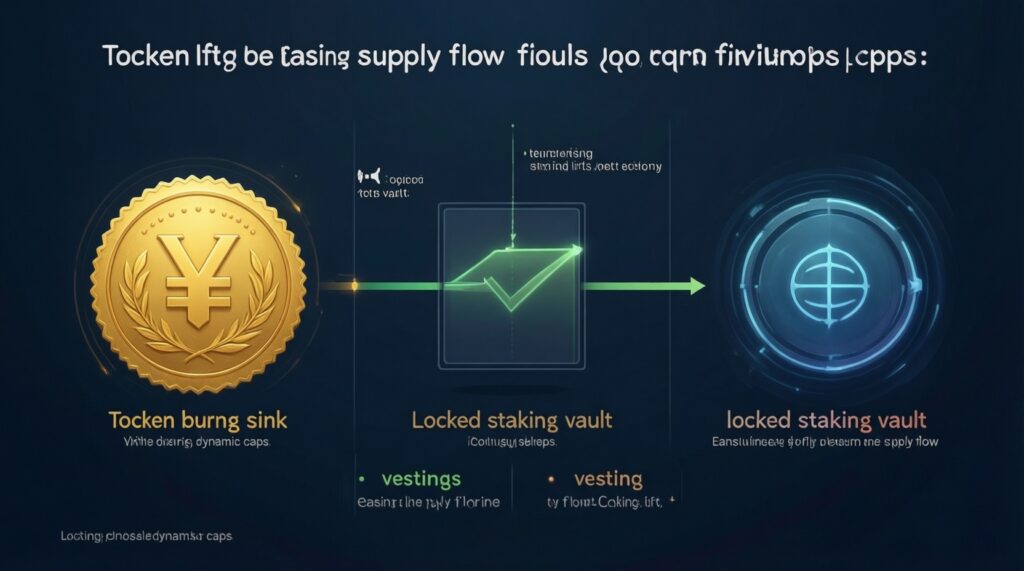
- Burns create permanent removal and simplify accounting (burn is irreversible sink).
- Lockups/staking reduce circulating supply and align time horizons (players commit to access value).
- Vesting smooths unlocks for team/investors and prevents sudden liquidity cliffs.
- Dynamic caps (daily mint limit, per-mode budget) provide emergency brakes.
Limitations and failure modes
- Burn theater: burning while simultaneously over-minting; net emission still rises.
- Lockup leakage: players borrow against locked tokens or use liquid proxies, restoring sell pressure.
- Vesting cliffs: large unlock events become predictable dump days if not smoothed.
- Caps without fairness: hard caps can cause "race to claim" and botting unless allocation is normalized.
- Track net emission after burns/locks; do not celebrate gross burn numbers.
- Stagger unlocks (continuous vesting) and publish a clear unlock calendar for internal planning.
- Add per-mode emission budgets to prevent one activity from dominating mint output.
- Test lockups against proxy liquidity (wrappers, lending, off-chain IOUs) and close obvious leaks.
Incentive design: aligning player behavior and preventing exploits
Most economy collapses are incentive bugs, not market surprises. If a loop has positive expected value with negligible risk and time, it will be botted and scaled. In tokenomics design for blockchain games, every reward rule must assume adversarial optimization.
- Myth: "More rewards increases retention." Mistake: emitting to buy activity; you attract farmers and churn accelerates when ROI drops.
- Mispricing sinks: sinks priced in token terms while token price is volatile; real-world cost swings break balance.
- Infinite crafting loops: players mint token, buy inputs, craft, resell, repeat with positive margin.
- Sybil-friendly payouts: per-account rewards without identity friction; farms split across wallets.
- Single dominant strategy: one mode yields best rewards/hour; all traffic funnels there, destabilizing emissions.
Quick prevention rule (economy safety check):
for each loop L:
  EV(L) = expected_tokens_out - expected_tokens_in
  if EV(L) > 0 and L is repeatable at scale:
    add friction (cooldowns/caps), add risk, or raise sink cost
- Run an "EV audit" on every repeatable loop before launch and after each patch.
- Normalize rewards by scarce inputs (time-gated energy, ticket budgets, matchmaking tiers).
- Design anti-sybil constraints: rate limits, device signals, progression gates, proof-of-play.
- Ensure no mode dominates rewards/hour; enforce per-mode budgets and diminishing returns.
Operational monitoring: KPIs, dashboards, and experiment design
Economy stability is an operations discipline: you detect drift early, then adjust emission and sinks with controlled experiments. A minimal dashboard should connect on-chain supply movement with in-game behavior so you can tell whether a change reduced farming or just suppressed legitimate play.
| Metric | How to compute (practical) | Watch for (directional threshold) | Typical fix |
|---|---|---|---|
| Net emission per DAU | (Minted + Unlocked − Burned − NewlyLocked) / DAU | Sustained rise while DAU flat or falling | Reduce reward rates; raise scalable sinks; add caps |
| Sell pressure proxy | Tokens transferred to known CEX hot wallets + DEX swap volume (internal tags) | Spikes after events/unlocks | Smooth unlocks; add claim cooldown; add utility sinks around events |
| Sink coverage ratio | Total tokens sunk / Total tokens minted (same period) | Downtrend after content update | Attach sinks to new content; price by progression; add renewals |
| Reward concentration | Share of rewards earned by top X% wallets (internal percentile) | Uptrend (whales/bots capturing emissions) | Diminishing returns; per-mode budgets; anti-sybil gating |
Mini control-loop example (server-side policy that feeds contract parameters or reward tables):
daily_job():
  target = TARGET_NET_EMISSION_PER_DAU
  current = net_emission_per_DAU(last_24h)

  if current > target * 1.10:
    reward_multiplier *= 0.95
    sink_multiplier   *= 1.05
  elif current < target * 0.90:
    reward_multiplier *= 1.02
    sink_multiplier   *= 0.98

  reward_multiplier = clamp(0.50, 1.20, reward_multiplier)
  sink_multiplier   = clamp(0.80, 2.00, sink_multiplier)
- Instrument every mint, burn, lock, unlock with consistent tags (mode, source, player segment).
- Review NetEmission/DAU and sink coverage weekly; react to trends, not single-day noise.
- Ship economy changes as experiments (holdout cohorts) to separate causality from market moves.
- Predefine emergency brakes: per-mode budgets, claim cooldowns, and reward multipliers.
- Can you compute NetEmission and NetEmission/DAU from your logs in under 10 minutes?
- Does every top-yield activity have a non-bypassable sink (ticket/energy/entry cost)?
- Have you proven that no repeatable loop has positive EV at scale after fees and sinks?
- Do you have throttles (caps/multipliers) that can be changed safely without redeploying core contracts?
Practical clarifications and implementation edge cases
Is inflation always bad in a Web3 game?
No; the problem is uncontrolled net sellable supply growth. Early emissions can work if liquidity is delayed and sinks scale with activity.
What's the fastest way to detect an economy exploit?
Watch for sudden increases in NetEmission/DAU and reward concentration in a single mode. Pair that with abnormal session patterns (short cycles, high repetition) to confirm botting or a positive-EV loop.
Should sinks be burns or lockups?
Use burns for permanent removal tied to irreversible actions (crafting/consumption). Use lockups when you need commitment and time alignment (access, tournaments, higher tiers).
How do we prevent "race to claim" when emissions are capped?
Allocate rewards proportionally (share-based) over a window rather than first-come-first-served. Add claim cooldowns and rate limits to reduce bot advantage.
How do we price sinks when token price is volatile?
Anchor costs to in-game progression variables (tier, power score) and adjust via multipliers, not manual price chasing. Avoid direct fiat pegs unless you can enforce them reliably in the user flow.
What breaks most token emission schedules in practice?
Unlock cliffs and farmable triggers (repeatable actions that mint) break them. If an action is repeatable, assume it will be automated and scaled.
Do we need on-chain governance to tune the economy?
Not for day-to-day stability; you need safe operational knobs (reward/sink multipliers, per-mode budgets) with transparent change logs. Governance is better reserved for parameter bounds and major policy shifts.