


In play to earn tokenomics, inflation destroys a Web3 game economy when token emissions grow faster than players' willingness to hold, spend, or lock the token. The result is falling prices, shrinking rewards in fiat terms, and a "farm-and-dump" loop. You prevent this by shaping reward curves, adding credible sinks, modeling behavior, and stress-testing emissions before scaling.
Core Mechanics That Drive Token Inflation
- High, flat emissions that don't taper as the player base matures.
- Rewards paid mostly in liquid tokens instead of time-locked or utility-restricted value.
- Weak sinks (cosmetics-only, optional, or priced in fiat) that don't scale with activity.
- Progression loops that encourage multi-account farming and short sessions for maximum payout.
- Liquidity constraints (thin pools) that turn normal sell pressure into sharp price drops.
- Governance delays that make policy changes arrive after the economy already repriced.
Designing Reward Curves: Balancing Emission Schedules
Best fit: you are building or relaunching web3 game tokenomics and can still change reward math, lock rules, and mission pacing without breaking user trust.
Do not use as your only fix when: your economy is already in a severe sell spiral and most rewards are liquid; lowering emissions alone can trigger player churn unless you simultaneously improve sinks and perceived value.
Use this table to choose an emission shape. The numbers are illustrative examples to help you reason about outcomes (not market forecasts).
| Emission model | How it's implemented | Typical player response | Inflation risk | Example schedule (daily) |
|---|---|---|---|---|
| Flat emissions | Same tokens/day regardless of supply, price, or maturity | Optimizes farming; dumping becomes rational | High | 100,000 tokens/day for 180 days |
| Halving / step-down | Emissions cut on predefined milestones | Rush before cuts; then consolidation | Medium | 100,000 → 50,000 on Day 91 |
| Decay curve | Emissions follow a taper function (e.g., exponential) | Less "deadline farming"; smoother expectations | Medium-Low | 100,000 × (0.99)^day |
| Activity-capped rewards | Rewards depend on capped "useful actions," not raw time | Focuses on quality sessions; fewer bots | Low (if caps are strict) | Max 3 rewardable dungeons/day/account |
| Adaptive emissions | Policy adjusts based on on-chain indicators (supply velocity, sink ratio) | Less predictable, but more resilient | Lowest (with good governance) | Target: sinks ≥ 70% of emissions weekly |
Failure mode to watch: A play to earn game economy that pays "per minute" with minimal caps tends to converge to farming behavior. Fix by switching to "per meaningful action," adding account-level cooldowns, and making part of rewards non-transferable until used in-game.
Monetary Policy Tools: Sinks, Burns and Vesting Strategies
To control p2e token inflation safely, you need access to both game and on-chain controls. Prepare these before changing payouts:
- Token contract controls: ability to adjust emission parameters (or reward distributor), and clearly defined admin/governance permissions with timelocks.
- Reward distribution layer: a server-side or on-chain accounting module that can enforce caps, cooldowns, and anti-abuse rules without retroactively changing balances.
- Sink catalogue: at least 5-10 spend paths tied to core progression (not only cosmetics), with prices denominated in the token (or partially) so sinks scale with activity.
- Burn/treasury logic: define what portion is burned vs. routed to a treasury for future incentives; document it for players to reduce "stealth tax" accusations.
- Vesting/locking primitives: staking, escrow, or "claim later" mechanics; clear unlock rules and penalties for early exit if you use them.
- Analytics access: dashboards for emission, sink usage, active wallets, and sell pressure proxies (e.g., net exchange outflow if applicable).
- Communication assets: patch notes template, in-game mail, and a public policy page explaining why changes happen and how they protect long-term value.
Pattern-based case study (common): A project adds a burn that only triggers when players buy optional skins. Indicator: burn volume stays low while emissions stay high. Fix: attach token costs to unavoidable progression gates (crafting, stamina refills, entry fees with rebates) and ensure sinks are convenient, not "special events only."
Modeling Player Behavior Under Inflationary Pressure
-
Map the full token loop (sources → holders → sinks → exits)
Write down every way tokens enter circulation (rewards, grants), where they sit (wallets, staking), how they leave (burn, fees), and how they hit the market (DEX, OTC). If you can't draw the loop, you can't control it.
- Quantitative indicator: weekly emissions vs. weekly sink consumption.
- Tactical solution: stop adding new reward sources until the loop is complete and measurable.
-
Segment players by intent: earners, spenders, speculators, social
Assume each segment optimizes differently. Earners maximize payout/time; spenders optimize progression; speculators optimize liquidity and volatility; social players optimize fun and status.
- Quantitative indicator: % of wallets that claim rewards and sell within 24-72 hours (your "dump propensity proxy").
- Tactical solution: increase the share of rewards that become more valuable when spent in-game (boosts, crafting inputs, gated access).
-
Define "rational farming" and make it unprofitable at scale
Model the best-known farming route and assume it becomes the dominant strategy. If one loop yields the highest tokens/hour, bots and multi-accounts will find it.
- Quantitative indicator: top 10% accounts earning share vs. playtime share.
- Tactical solution: hard caps per account/day, diminishing returns after N runs, and rewards tied to scarce in-game resources rather than pure time.
-
Use a simple "sink coverage ratio" to decide policy
Compute: sink coverage ratio = tokens spent or locked by players ÷ tokens emitted per week. When coverage is persistently below your target, inflation pressure compounds.
- Quantitative indicator: coverage ratio trend (e.g., target ≥ 0.7, warning zone 0.4-0.7, critical < 0.4).
- Tactical solution: raise sink utility first, then reduce emissions, then adjust lock share-sequenced to minimize churn.
-
Run "price shock" and "churn shock" thought experiments
Assume token price drops by 50% or daily active users drop by 30% and re-check whether rewards remain sustainable and whether sinks still feel fair. This is where many web3 game economy designs break.
- Quantitative indicator: reward value per active user under shocks (in token terms and in expected utility terms).
- Tactical solution: shift more value to non-monetary progression and to time-locked rewards during shocks.
Fast-track mode: 15-minute inflation triage
- Compute weekly emissions and weekly sinks and set a minimum sink coverage target for the next 2 weeks.
- Cap the top farming route (daily limits + diminishing returns) to stop runaway issuance.
- Convert part of rewards to locked or utility-bound value (delayed claim, staking boosts, crafting credits).
- Launch 2-3 mandatory progression sinks with token pricing that scales with activity.
- Publish a policy timeline (what changes now vs. next patch) to reduce panic selling.
Economic Simulations: Metrics, Dashboards and Stress Tests
- Emissions, sinks, and net issuance are visible daily and weekly (not "end of season only").
- Sink coverage ratio is tracked by player segment (new vs. veteran, whale vs. non-whale).
- Top earning strategies are identified; you can simulate the effect of caps before deploying.
- Multi-account signals are monitored (device fingerprinting or behavior clustering where lawful and appropriate).
- Liquidity/market depth assumptions are documented; you don't assume infinite liquidity for rewards.
- Shock tests are run for: DAU drop, token price drop, and sudden influx of farmers after a marketing campaign.
- Retention impact is estimated for each policy lever (emission cut, lock increase, sink price change).
- Patch safety checks confirm no retroactive changes to earned balances (avoid trust collapse).
- Rollback plan exists if a sink misprices and blocks progression.
Governance Levers and Protocol Upgrades to Control Supply
- Changing emissions without adding sinks: players feel poorer and leave; net sell pressure often stays.
- Overusing burns as a marketing story: burns that don't scale with activity become irrelevant under growth.
- Making sinks optional and inconvenient: if the optimal path is "never spend," sinks won't stabilize the economy.
- No caps on the best loop: one route dominates and becomes the de facto printing press.
- Excessive lock-ups without utility: forced vesting with no in-game benefit pushes players to quit or avoid earning.
- Governance without timelocks: fast parameter changes can look like manipulation and trigger exits.
- Timelocks that are too long: policy arrives late; the market reprices before fixes land.
- Ignoring off-chain marketplaces: if items can be farmed and sold, token inflation may shift into item inflation.
- Under-communicating policy goals: unclear rules amplify fear, which accelerates dumping.
Immediate Mitigations and a Long-Term Stabilization Playbook
Choose the approach based on how far the economy has drifted and how much trust you can spend in the short term:
-
Emergency emission brake + targeted compensation (when sell pressure is acute)
Temporarily reduce the most-abused reward streams and compensate engaged players with non-transferable progression value. Use strict time bounds and publish what returns when indicators recover.
-
Utility-first redesign (when the token lacks reasons to be held)
Add sinks tied to core progression, convenience, and competitive play, then re-balance rewards around those sinks. This is the most durable fix for play to earn game economy loops that became pure extraction.
-
Seasonal resets with predictable policy (when you need fresh expectations)
Run seasons with pre-announced emission curves, reward caps, and sink events; keep "legacy" holders whole via cosmetic/status carryover rather than unlimited token carryover.
-
Split reward assets (when one token is doing too many jobs)
Separate governance/value accrual from high-velocity reward payouts (e.g., reward points or soulbound credits). This can stabilize play to earn tokenomics without removing incentives to play.
Inflation Scenarios - Concise Responses
What is the fastest sign that p2e token inflation is starting?
When emissions grow while sink usage stays flat and more players sell shortly after claiming rewards. The economy becomes dominated by "claim → sell" rather than "earn → spend → progress."
Should I fix inflation mainly by cutting rewards?
Only if sinks and utility are already strong. Otherwise, cutting rewards often accelerates churn and leaves sell pressure unchanged because remaining farmers still optimize for dumping.
How do I prevent bots and multi-accounts from becoming the main issuer?
Cap rewardable actions per account, add diminishing returns on repeated loops, and tie rewards to scarce in-game resources. Monitor concentration: if a small cohort earns a large share, tighten gates.
Which sinks work best in web3 game tokenomics?
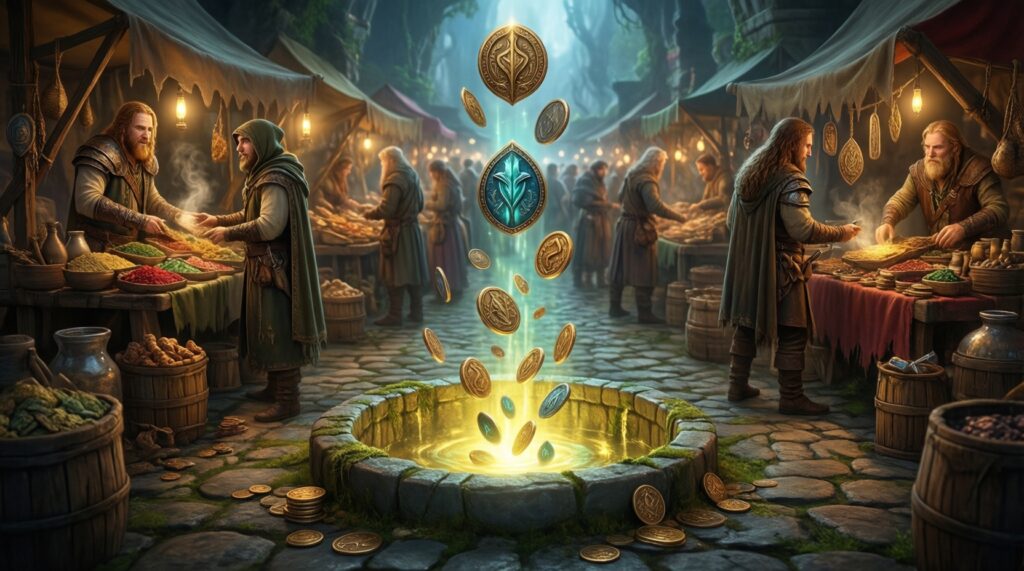
Sinks linked to unavoidable progression and convenience generally scale better than cosmetics-only sinks. Prices should be token-denominated (or partially) so sink strength grows with activity.
Can burns alone stabilize a web3 game economy?
Not reliably. Burns help only when they scale with usage and don't reduce gameplay fairness; most economies need a mix of sinks, locks, and emission shaping.
How do I communicate inflation fixes without triggering panic selling?
Publish clear indicators you're targeting (emissions, sink coverage), time-box emergency changes, and explain player impact in-game. Predictability reduces fear-driven exits in a play to earn game economy.
When should I consider separating the reward token from the value token?
When the same token must both reward high-frequency activity and act as a long-term store of value. Separation reduces forced selling while keeping the game's incentive loop intact.
Author: ชลธิชา วัฒนาพร