


Casino-style mechanics in games are progression and monetization patterns that borrow from gambling psychology in video games: variable rewards, repeated stakes, near-misses, and loss framing that keep players cycling through actions. They are not just about loot boxes; they also shape XP curves, timers, streaks, and offers-especially in casino mechanics in mobile games.
Core Concepts: Gambling Psychology Applied to Progression
- Variable outcomes drive repetition: uncertainty can make the same action feel newly rewarding, even when the underlying progression is slow.
- Progress can be reframed as staking: time, currency, energy, or rank becomes the "bet" placed before each attempt.
- UI cues can act like a casino layer: lights, "almost" animations, and timed prompts amplify perceived momentum.
- Monetization can be embedded into progression: game progression systems monetization often works best when it shortens uncertainty or reduces perceived losses.
- Risk is measurable: you can detect harmful reinforcement by tracking repeated failures, spend concentration, and post-event churn.
Variable Reward Schedules and Their Impact on Player Motivation
Variable reward schedules mean players do not receive rewards on every attempt, and the size/quality/timing of rewards changes unpredictably. In casino-style mechanics in games, this uncertainty is paired with a fast "try again" loop, making persistence feel rational because the next attempt could be the one.
In progression systems, the "reward" is not only a drop. It can be a crit roll, upgrade success, matchmaking outcome, gacha pull, chest tier, or a milestone that sometimes arrives early. This framing is central to gambling psychology in video games because it shifts motivation from "I'm advancing" to "I'm due" (a perception, not a guarantee).
Boundary: variable rewards are not inherently harmful. They become risky when (a) attempts are frictionless and frequent, (b) the player is repeatedly "set back" or stalled, and (c) paid shortcuts are positioned as the relief valve.
- Define the schedule layer: Is uncertainty in drop rate, upgrade success, matchmaking, timed chests, or event outcomes?
- Separate progression from excitement: A stable baseline (guaranteed XP, pity counters, deterministic crafting) reduces compulsive repetition while preserving surprise.
- Cap re-roll velocity: cooldowns, daily limits, or meaningful session endpoints reduce high-frequency "spin" behavior without killing engagement.
Metric / experiment suggestion: Track attempt velocity (attempts per active minute) before and after adding any uncertainty. A/B test adding a small deterministic "floor" reward per attempt; watch for changes in session length, frustration signals (rage quits), and next-day retention.
- Audit where uncertainty enters the loop and how often a player can retry.
- Add at least one deterministic progress rail (pity, tokens, guaranteed XP).
- Measure attempt velocity and failure streaks after each tuning change.
Progression Loops that Mirror Betting Structures

Progression mirrors betting when the player repeatedly pays a cost (time/energy/currency/rank) for a chance at a better outcome. The structure looks like stake → reveal → reinforcement → re-stake, which is why casino mechanics in mobile games often feel "always one more run."
- Energy-gated retries: spend energy to "take a shot," then wait or pay to continue.
- Upgrade gamble: invest materials for a success chance; failure destroys progress or degrades items.
- Streak ladders: repeated wins increase multipliers; one loss resets the run (high emotional volatility).
- Limited-time event tickets: scarce entries create urgency; outcomes are uncertain and socially comparable.
- Ranked risk cycles: queue again to recover points; losses feel like "wasted" prior effort.
- Chest roulette progression: the "real" advancement is gated behind random chest tiers rather than gameplay mastery.
Metric / experiment suggestion: Build a funnel from "stake event" (energy spent / ticket used / materials consumed) to "re-stake within 60 seconds." A spike in immediate re-stakes after losses is a strong signal that the loop behaves like betting.
- List the explicit stakes players pay per attempt (including time and rank).
- Identify any resets or degradations that amplify "must recover" behavior.
- Instrument re-stake-within-60s and compare after wins vs losses.
Psychological Triggers: Near-Misses, Intermittent Reinforcement, and Loss Aversion
These triggers are applied in moments where the game can intensify emotion without changing actual value. They are common across loot boxes gambling mechanics and non-loot systems (combat, crafting, events) because they shape perceived closeness and urgency.
- Near-miss reveals: the reward animation shows the desired outcome "almost" landing, or the UI highlights what you "barely missed."
- Intermittent reinforcement pacing: a few early wins teach the loop; later outcomes become more variable to maintain chasing.
- Loss framing on timers: "Offer expires," "streak will be lost," "energy capped," "unclaimed rewards" prompts action to avoid loss.
- Progress rollback penalties: upgrade failure destroys items, drops rank, or resets a run, making recovery feel urgent.
- Social comparison pressure: leaderboards and guild contribution meters convert uncertainty into obligation.
Metric / experiment suggestion: For any near-miss UI, compare post-reveal retries and spend between players exposed to near-miss framing vs a neutral reveal. If neutral reveals keep long-term retention while reducing frantic retries, you have evidence the near-miss was doing the coercive work.
- Remove or soften near-miss presentation in one test cell (neutral reveal variant).
- Audit every timer prompt: is it informing or threatening a loss?
- Track retries/spend within 5 minutes after a near-miss or failure event.
Monetization Patterns Borrowed from Casino Cues and UX
Monetization borrowed from casino cues typically sells one of three things: more attempts, better odds, or reduced emotional pain. In game progression systems monetization, the highest-risk patterns are those that monetize escape from frustration the design itself creates.
- Pros (why teams use them):
- They create clear, repeatable purchase moments tied to a loop (energy refills, boosters, re-rolls).
- They simplify value communication: pay to try again, pay to improve odds, pay to protect a streak.
- They scale across segments: non-spenders play slowly; spenders compress time and variance.
- Limitations (where they backfire):
- They can convert skill progression into variance-chasing, weakening mastery motivation.
- They raise compliance and store-review risk when they resemble loot boxes gambling mechanics too closely.
- They often increase "hot-state" spending (impulsive) that correlates with regret and later churn.
Metric / experiment suggestion: Segment purchases into advancement buys (clear deterministic progress) vs variance buys (re-rolls, extra pulls, odds boosts). If variance buys dominate among short-tenure users, the system may be extracting value before delivering satisfaction.
- Classify offers by what they sell: attempts, odds, protection, or deterministic progress.
- Limit how often the store appears immediately after a loss or failure streak.
- Track variance-buy share by tenure (D0-D7 vs longer-term cohorts).
Design Constraints, Ethical Trade-offs, and Regulatory Signals
Teams often rationalize casino mechanics in mobile games as "just engagement." The real design constraint is sustainability: systems that rely on emotional spikes can degrade trust, increase churn after spending, and attract regulatory scrutiny depending on jurisdiction and implementation.
- Myth: "Random rewards are fine if they're cosmetic." Miss: cosmetic scarcity + near-miss + paid retries can still function as gambling-like reinforcement.
- Mistake: Using failure penalties (breakage, rank loss) to sell protection items without offering a reasonable skill-based path.
- Myth: "Pity timers solve everything." Miss: if the loop still encourages high-frequency pulls with aggressive prompts, harm risk remains.
- Mistake: Dark-pattern store timing (immediate post-loss offers) that monetizes frustration.
- Myth: "Players can stop anytime." Miss: design can intentionally remove stopping cues (no clean endpoints, constant limited-time urgency).
Metric / experiment suggestion: Add a "cool-down" UX in one cohort: delay monetized prompts for a short window after losses and provide a clear session end screen. Compare refund requests, support tickets, and churn after first purchase against control.
- Ensure every punitive mechanic has a non-paid, skill-based recovery route.
- Reduce post-loss monetization prompts; add clearer stopping points.
- Monitor post-first-purchase churn and regret signals (refunds, angry CS tags).
Metrics and Methods for Detecting Harmful Reinforcement Patterns
A practical detection approach is to treat each loop like an instrumented "spin": identify the stake, the reveal, and the re-stake. Then test whether negative outcomes increase immediate repetition and monetization more than positive outcomes do.
Mini-case: You added a flashy near-miss reveal to a chest system. Retention stayed flat, but spend per payer rose. You suspect the increase is driven by frustration-chasing rather than satisfaction.
# Pseudocode: near-miss / loss-chasing signal
for each player_day:
  attempts = count(events where type == "stake")
  losses = count(reveals where outcome in ["fail","low_tier"])
  near_misses = count(reveals where tag == "near_miss")
  restake_60s = count(stake events within 60s after a loss or near_miss)
  spend_5m = sum(purchases within 5m after a loss or near_miss)

# Red flags (compare vs baseline or control cohort)
# 1) restake_60s after loss >> restake_60s after win
# 2) spend_5m spikes after near_miss
# 3) high restake_60s correlates with higher next-day churn
Short algorithm to verify the result (your check):
- Define the event window: choose a fixed post-reveal window (e.g., 60s for re-stake, 5m for spend) and use it consistently.
- Compute deltas: compare loss vs win for re-stake rate; near-miss vs neutral reveal for spend and retries.
- Validate against harm proxies: correlate high re-stake velocity with regret/churn signals (refunds, CS complaints, abrupt session ends) rather than only revenue.
- Confirm with an A/B neutralization: remove near-miss framing or add deterministic progress in a test cell; verify that improvements persist over multiple cohorts.
- Instrument stake → reveal → re-stake as a single analyzable loop.
- Report deltas for loss vs win and near-miss vs neutral reveals.
- Require at least one harm proxy alongside monetization lifts before shipping.
Main-content self-check (quick)
- Can a player make meaningful progress without paying to reduce variance or undo penalties?
- Do losses trigger more immediate retries and store exposure than wins do?
- Is near-miss framing necessary for clarity, or primarily for compulsion?
- Are there clean stopping cues (session end, daily cap messaging) that do not feel threatening?
Practical Clarifications for Designers and Analysts
Are casino-style mechanics in games only about loot boxes?
No. Loot boxes gambling mechanics are one visible form, but similar reinforcement can be embedded in upgrades, streaks, energy loops, and timed offers.
What is the simplest sign that a progression loop resembles betting?
A repeated "stake" (energy/currency/rank/time) followed by an uncertain reveal, where a loss increases the urge or ability to immediately re-stake.
How can I reduce harm without removing randomness?
Add deterministic progress floors (tokens, pity counters, guaranteed XP) and reduce near-miss theatrics. Then ensure players have stopping points that don't feel like punishment.
Which metric should I start with if instrumentation is limited?
Measure re-stake-within-60-seconds after losses vs wins. It's a compact proxy for loss-chasing behavior tied to gambling psychology in video games.
Do casino mechanics in mobile games always increase revenue?
They can raise short-term spend, but may also increase regret-driven churn and support load. You need cohort-based validation, not just an ARPDAU spike.
How do I test whether near-misses are doing coercive work?
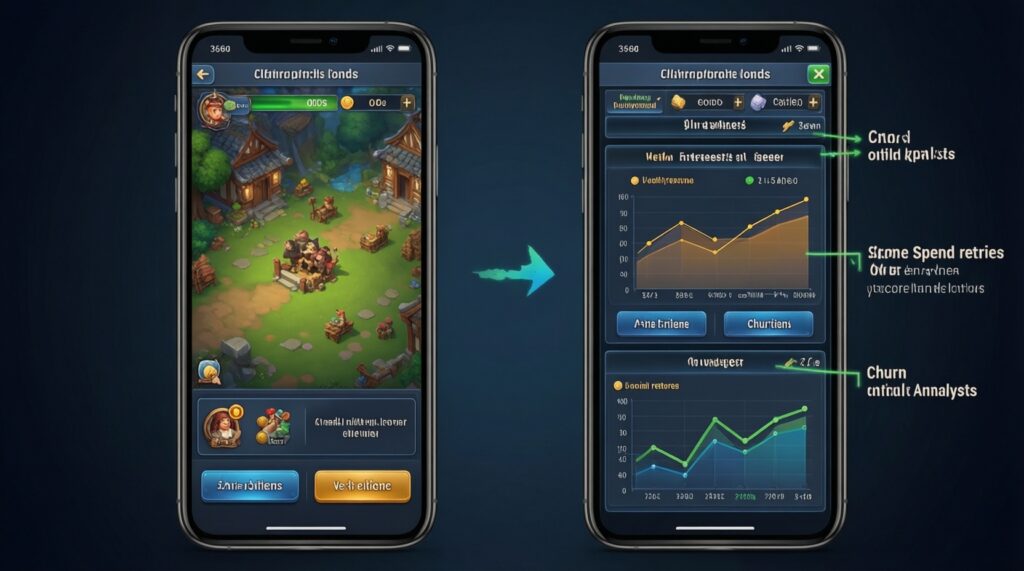
Run an A/B test with a neutral reveal that removes "almost won" cues while keeping odds identical. Compare retries/spend after reveals and downstream churn.