

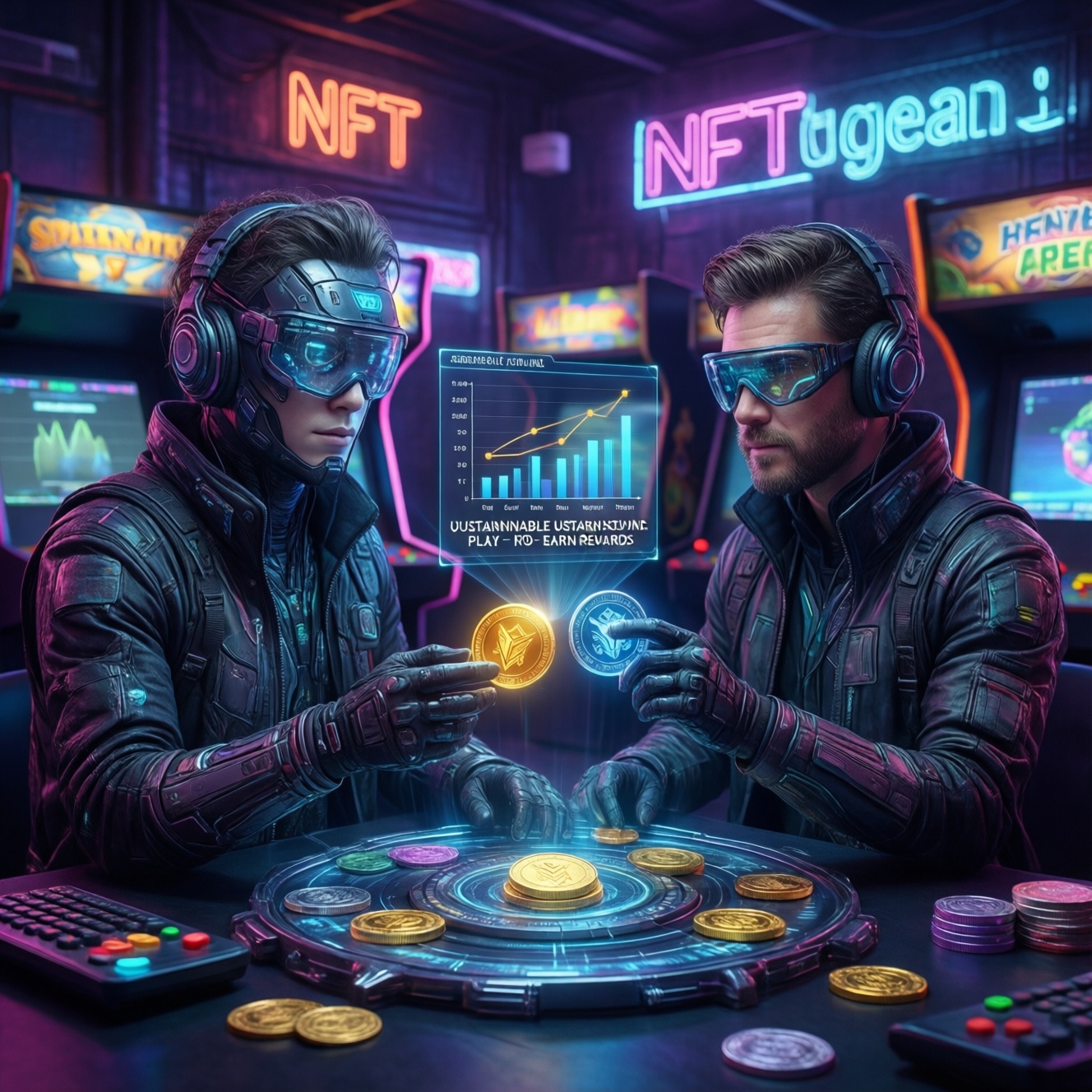
Web3 crypto games are games that integrate blockchain assets (tokens or NFTs) so players can own, trade, or earn value through gameplay. Play-to-earn crypto games pay rewards via a token system, but outcomes depend on crypto game tokenomics and demand from real players, not hype. Sustainability red flags show up when rewards rely mainly on new buyers.
Core Concepts at a Glance
- Web3 is a tech layer, not a genre: a game can be fun (or not) regardless of on-chain features.
- Play-to-earn is a payout model: rewards come from fees, inflation, treasury spend, or secondary-market trading.
- Tokenomics is behavioral design: supply schedules, sinks, and utility determine whether incentives align with long-term play.
- Most failures are economic: weak sinks + high emissions + mercenary farmers = fast price decay.
- Sustainability is observable: look for steady user demand, balanced sinks, and non-speculative reasons to play.
- Security is product risk: bridge reliance, admin keys, and upgradeable contracts can override "ownership".
Debunking Common Myths About Web3 Gaming
Myth 1: "All web3 crypto games are play-to-earn." Many web3 crypto games only use wallets for identity, marketplaces, or cosmetic ownership. Play-to-earn is optional and often limited to specific modes, seasons, or competitive ladders.
Myth 2: "If it's on-chain, it's automatically fair and transparent." On-chain settlement can be transparent, but fairness usually depends on off-chain game logic, admin controls, oracle inputs, and how upgrades are governed.
Myth 3: "The best play to earn games are simply the ones with the highest token price." Token price is not gameplay quality. A healthier signal is whether the game retains players without constant reward boosts or aggressive acquisition campaigns.
Boundary you can use: A "Web3 game" typically means player-held assets (tokens/NFTs) plus verifiable ownership or transferability. It does not guarantee profit, nor does it replace game design fundamentals like balance, progression, and anti-cheat.
How Play-to-Earn Models Actually Work
In play to earn crypto games, value moves between players, the game treasury, and external markets. Rewards are not created "from gameplay"; they are funded by a mix of emissions (inflation), fees, and demand for in-game utility.
- Player actions create outputs: wins, quests, crafting, time spent, or contribution (UGC, esports, guild tasks).
- The system issues rewards: tokens, NFTs, points convertible to tokens, or revenue-share claims.
- Tokens/NFTs get used or sold: upgrades, crafting, entry fees, cosmetics, rentals, or secondary market trading.
- Sinks remove value: burn mechanics, durability repair, crafting costs, taxes, or tournament fees.
- Market demand sets the floor: if utility demand is weak, emissions dominate and prices fall.
- Anti-farm controls matter: bot resistance, skill-based caps, time-gating, and Sybil protection change who captures rewards.
Mini-scenarios: when players actually use P2E
- Competitive grinder: focuses on ranked ladders and extracts value from skill-based rewards and tournaments rather than daily emissions.
- Crafter/market maker: earns by arbitrage and crafting margins; cares most about sinks, fees, and item demand stability.
- Guild manager: rents assets to scholars; needs reliable rental contracts, low exploit risk, and predictable maintenance costs.
- Casual collector: treats NFTs as cosmetics/progression badges; wants low friction and low volatility, not maximum payout.
Tokenomics: Design Choices, Incentives and Hidden Failure Modes
Crypto game tokenomics defines who gets paid, when, and for what. The same surface feature (a token) can behave like a loyalty point, a commodity input, a governance share, or a speculative chip-often all at once, which creates conflict.
| P2E variant | Main token flows | Typical player behavior | What "healthy" tends to look like | Common failure mode |
|---|---|---|---|---|
| High-emission daily rewards | Inflation → players → sell to market | Farming, multi-accounting, fast exit | Strong sinks + strict anti-Sybil + clear utility demand | Price spiral when sellers outnumber utility buyers |
| Skill-based tournaments | Entry fees + sponsorship → prize pool | Competitive play, specialization | Transparent rules, anti-cheat, stable matchmaking | Whale dominance or cheating destroys trust |
| Crafting economy (token as ingredient) | Players buy token → spend/burn in crafting | Trading, crafting loops, long sessions | Multiple sinks, balanced drop rates, item demand | Sink imbalance causes either scarcity wall or inflation flood |
| NFT rentals / scholarships | Revenue share between owner and player | Operational optimization, scale-up via managers | Clear rental terms, automation, exploit resistance | Policy changes or exploits wipe rental profitability |
| Revenue share / buyback (limited) | Game revenue → treasury → distributions/buybacks | Longer holding horizons, governance interest | Transparent accounting, conservative promises, legal clarity | Unsustainable guarantees or opaque treasury handling |
Where tokenomics choices show up in real design (typical scenarios)
- Dual-token setups: one volatile governance token and one in-game utility token; risk appears when utility token emissions become the main "income".
- Progression paywalls: tokens required for upgrades, stamina, or crafting; works only if players value the gameplay enough to pay consistently.
- Marketplace fees and taxes: fees can fund tournaments, dev ops, or burns; too high and liquidity dies, too low and sinks are weak.
- Season resets: resets can maintain demand for crafting and entry fees; done poorly, they feel like forced churn and trigger exits.
- Governance voting: can align community decisions; fails when whales can pass proposals that extract value from everyone else.
Sustainability Red Flags: Economic and User Metrics

"Sustainable play to earn games" usually share one trait: players show up for gameplay, and earning is a bonus. You can't prove sustainability from a whitepaper alone; you infer it from incentives and observable behavior over time.
Economic red flags you can spot early
- Rewards funded mainly by new buyers: heavy emphasis on "early" entry, referral chains, or constant asset sales.
- One dominant sink: if a single mechanic is the only reason to hold/spend, demand collapses when meta changes.
- Unbounded emissions: reward rate scales with accounts, not with scarce competitive slots or revenue.
- Hard-to-audit treasury: unclear custody, unclear rules for spending, or discretionary "market support".
- Price-dependent fun: the game is only "worth playing" when token price is rising.
User and product red flags (often ignored)
- Low retention without incentives: if rewards are reduced and the player base vanishes, utility demand is weak.
- Bot-friendly loops: repetitive tasks with predictable outputs and no meaningful skill checks.
- Content treadmill: constant new assets required to stay relevant, with old assets rapidly obsoleted.
- Liquidity illusion: many listed items but few real buyers; wide spreads and thin depth.
Mini-scenarios: choosing a "sustainable" pattern by situation
- If you are a time-limited player: prefer skill-based ladders or capped tournaments over daily emission grinds.
- If you are a guild: prioritize stable sinks, rental tooling, and anti-cheat; avoid economies where profit depends on constant onboarding.
- If you are a creator/streamer: favor games with spectator-friendly modes and non-custodial prizes rather than speculative "APY" style rewards.
Security, Governance and On‑Chain Asset Challenges
Most losses in Web3 gaming come from operational risk: smart contract mistakes, bridge incidents, compromised admin keys, and governance capture. "You own your assets" is only as strong as the weakest control plane in the stack.
- Bridge dependence: cross-chain bridges add extra trust assumptions; if the bridge fails, assets can be frozen or de-pegged.
- Upgradeable contracts without safeguards: upgrades can fix bugs, but also enable rug-like parameter changes if governance is weak.
- Centralized admin keys: emergency powers can be necessary, yet they must be time-locked, multi-sig controlled, and transparent.
- Oracle and off-chain logic risk: match results, RNG, and matchmaking are often off-chain; manipulation may not be visible on-chain.
- NFT metadata fragility: if images/stats are stored off-chain, "ownership" may not include permanent integrity of the asset representation.
Practical Evaluation Checklist for Players and Developers
Use this short process to evaluate web3 crypto games without relying on marketing claims about the best play to earn games. It's designed to catch weak crypto game tokenomics and identify whether the design can plausibly produce sustainable play to earn games.
6-step evaluation flow (player or dev)
- Define the core fun loop: write one sentence describing why someone would play with rewards set to zero.
- Map token sources: list every way tokens enter circulation (emissions, treasury grants, rewards, airdrops).
- Map token sinks: list every way tokens are removed or locked (burns, crafting, fees, staking with real utility).
- Identify the marginal buyer: who buys tokens/NFTs after launch-competitors, crafters, collectors, speculators?
- Stress-test incentives: ask what happens if token price drops, if user growth stalls, and if bots appear.
- Check trust surfaces: bridges, admin keys, upgrade rights, custody, and governance concentration.
Mini-case: quick token flow sketch you can copy
Scenario: You're evaluating a new "play to earn crypto games" title with daily quests and a crafting market.
- Write down: Daily quests mint UtilityToken.
- Write down: Crafting consumes UtilityToken + materials to mint ItemsNFT.
- Ask: Why do players want ItemsNFT (power, cosmetics, tournament entry, status), and is that desire stable without speculation?
- Decide: if the only strong reason is "sell ItemsNFT to new players", treat it as a high-risk loop.
Concise Answers to Likely Practical Questions
Are web3 crypto games the same as gambling?
No. Some designs resemble wagering (randomized outcomes with paid entry), but many are standard games with tradable assets. Evaluate the mechanics: paid chance + cash-out pathways increases gambling-like risk and compliance concerns.
Can play-to-earn crypto games be profitable for most players?
Usually not consistently. In most economies, a minority captures most rewards due to skill, time, capital, or automation advantages. Treat earnings as uncertain and cyclical, not a salary.
How do I tell whether a game is among the best play to earn games for me?
Match the model to your constraints: skill-based tournaments for competitive players, crafting economies for traders, rentals for managers. If your plan relies on constant token appreciation, it's not a robust strategy.
What is the single biggest crypto game tokenomics red flag?
When emissions are the primary reason to play and there are weak sinks. That structure needs perpetual new demand to avoid sell pressure overwhelming utility.
What makes sustainable play to earn games more plausible?
Gameplay-driven retention plus multiple sinks tied to long-term utility. Also look for capped or performance-based rewards, and transparent control of upgrades, admin powers, and treasury actions.
Do I really own my items if they are NFTs?
You own the token, but gameplay rights can still be controlled by the developer (servers, balance changes, bans, metadata hosting). Ownership is strongest when assets are usable across time without relying on a single centralized switch.
Is it safer if the game is on a major chain?
It can reduce some infrastructure risk, but smart contract design, admin controls, and bridges still dominate practical safety. Review the full stack, not just the chain brand.