


An in-game economy is the system that creates, distributes, and prices in-game currency and items through player actions and game rules. "Real value" emerges when supply is constrained, demand is persistent, and scarcity is enforced by time, access, or risk-especially when a virtual items marketplace lets players trade rather than only buy from the game.
Concise Framework for How Virtual Markets Operate
- Value is engineered: game economy design sets faucets (sources) and sinks (removals) that shape prices and progression.
- Supply is rule-driven: drop rates, crafting inputs, cooldowns, and account binds determine how much exists and who can sell it.
- Demand is behavior-driven: status, efficiency, collection, and social pressure create repeat buyers.
- Scarcity must be enforceable: time gates and access locks work only if exploits, bots, and dupes are controlled.
- Markets need friction controls: fees, trade limits, and price bands reduce manipulation without killing liquidity.
- "Real value" requires transferability: player-to-player trade makes price discovery possible; purely NPC stores do not.
Common Misconceptions About In-Game Value
Myths that distort decisions
- Myth: "Digital items are infinite, so they can't be valuable." In practice, supply is limited by rules: time, access, and risk. Artificial scarcity can be as binding as physical scarcity when enforcement is strong.
- Myth: "If players pay, it's automatically pay-to-win." Monetization can fund cosmetics, convenience, or controlled power that remains bounded by sinks and counters.
- Myth: "A blockchain makes value real." Ownership tech does not create demand; gameplay utility and social meaning do.
- Myth: "More rewards always increase retention." Over-supplying accelerates inflation and shortens goals, which can reduce long-term engagement.
A virtual economy is the broader system of production, consumption, and exchange inside a game world. It includes primary markets (game-to-player: drops, stores, battle passes) and secondary markets (player-to-player trade, auctions, gifting). Value is "real" in the economic sense when players reliably trade time, attention, or money for outcomes they consistently prefer.
Boundaries matter: economies can be closed (no player trading), semi-open (limited trades, bind-on-equip), or open (robust player trade and price discovery). Each boundary changes how quickly scarcity breaks and how much policing is required.
Actionable takeaway: Write down what "value" means in your game (power, status, collection, or convenience), then verify that the economy has at least one enforceable scarcity lever for it.
Fundamentals of Virtual Supply and Currency
Myths before mechanics
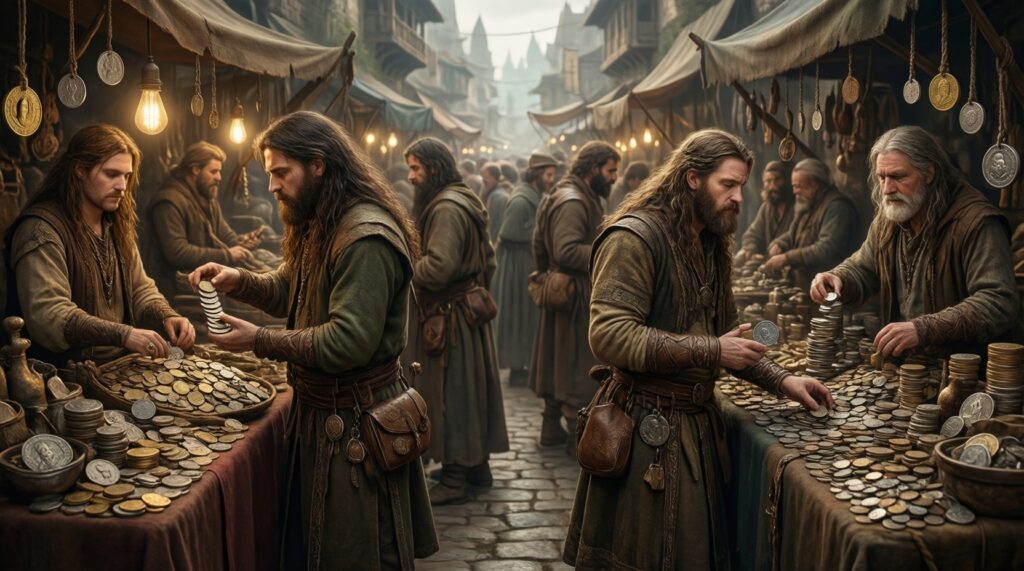
Myth: "A single currency keeps things simple." One currency often becomes overloaded (crafting, upgrades, trade, events), making balancing harder. Multiple currencies can reduce chaos, but add UX complexity and abuse vectors.
Core mechanics that determine supply
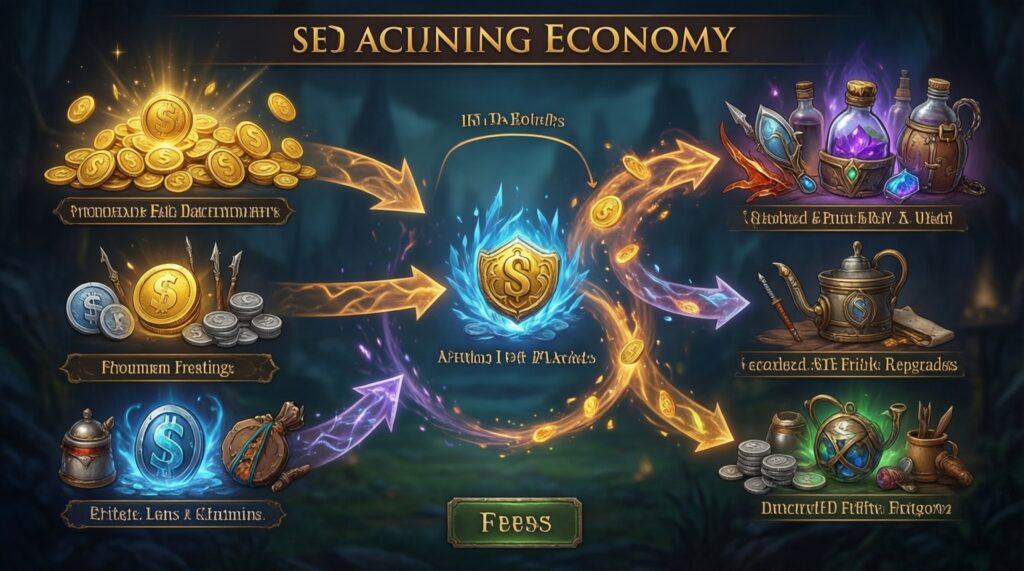
- Faucets: quests, dailies, mob drops, login rewards, gacha pulls, event mail-everything that creates items or in-game currency.
- Sinks: upgrade costs, durability/repair, crafting consumption, rerolls, auction fees, travel costs-everything that destroys currency or items.
- Conversion rules: exchange rates between currencies, tokenization (e.g., shards → item), crafting trees, and salvage loops.
- Trade permissions: bind-on-pickup, bind-on-equip, gifting limits, minimum level to trade, escrow/holding periods.
- Market frictions: listing fees, taxes, price floors/ceilings, limited listings, cooldowns, region-based markets.
- Supply caps by time: stamina/energy (common in mobile), weekly raid lockouts (common in MMOs), limited-time events.
Actionable takeaway: For each faucet, define its matching sink; if you can't name one, you are likely minting inflation.
Demand Drivers: Player Behavior and Game Design
Myths that misread demand
Myth: "Demand comes from rational min-maxing only." In most games, demand is equally driven by identity, social belonging, and fear of missing out-especially in live-service mobile and MMO communities in TH where guild culture is strong.
Where demand typically concentrates (scenarios)
- Power spikes: raid-ready gear, enhancement materials, meta units (MMOs and gacha). Demand peaks right before competitive content resets.
- Time-saving: XP boosts, skip tickets, crafting accelerators (mobile). Players pay to reduce repetition more than to "win instantly."
- Status and cosmetics: rare skins, mounts, housing décor (MMOs). Value rises when visibility is high and matching sets exist.
- Collection completion: limited banners, seasonal drops, battle pass exclusives. Scarcity + completeness psychology sustains demand.
- Speculation: player trading plus patch notes create "buy before buff" behavior (seen in many titles with auctions).
- Social obligations: guild donations, raid consumables, event participation requirements.
Actionable takeaway: Map your top 3 demand drivers to specific loops (combat, social, customization) and ensure each loop has a non-pay path that still feels purposeful.
Scarcity Mechanics: Rarity, Time, and Access
Myths that cause scarcity to backfire
Myth: "Lower drop rates automatically increase value." If scarcity feels unfair (opaque odds, no pity, no substitutes), players disengage or move to RMT/botting, damaging the virtual items marketplace and trust.
Scarcity tools (and what they're good at)
- Rarity tiers: clear player expectations; works well for cosmetics and collection, risky for core progression if gaps are too large.
- Time gates: stamina, lockouts, crafting timers; easiest to implement, but invites alt-account farming and botting if rewards are tradable.
- Access gates: skill checks, rank, region, quest prerequisites; improves perceived fairness but raises onboarding friction.
- Risk gates: item loss, PvP zones, crafting failure; strong price discovery, but can create toxic griefing loops if unmoderated.
- Information gates: hidden recipes, rotating vendors; boosts exploration but can feel arbitrary without hints.
Trade-offs to watch (limits and failure modes)
- Enforcement cost: scarcity is only real if dupes, bots, and exploits are controlled; otherwise "rare" becomes common overnight.
- Perception risk: players accept scarcity more when rules are legible (clear sources, clear caps, clear substitutes).
- Market manipulation: low liquidity enables hoarding; fees and listing limits reduce abuse but can also reduce trading.
- Content cadence dependency: if new supply arrives faster than new sinks, prices crash and older content becomes irrelevant.
Actionable takeaway: Choose one primary scarcity lever per item category (power, cosmetic, convenience) and document how players can verify it in-game.
Real-World Economic Impacts and Monetization
Myths that create avoidable risk
Myth: "If trading exists, RMT is inevitable and unsolvable." RMT pressure can be reduced with better sinks, anti-bot design, trade constraints, and attractive official alternatives that do not break competitive integrity.
Typical mistakes (and why they matter)
- Selling currency without sinks: monetizing raw in-game currency can trigger fast inflation and make non-payers feel priced out.
- Letting premium and tradeable power overlap: if the strongest items are both purchasable and freely tradable, whales can dominate secondary markets and crowd out organic play.
- Ignoring bot ROI: predictable time gates + tradable rewards make automation profitable; bots become your largest "supplier."
- Overusing limited-time exclusives: scarcity fatigue reduces trust; players stop believing items are special.
- No separation between earning and spending loops: if one activity prints value and also consumes it, players find degenerate loops and stall the economy.
Implementation approaches compared (ease vs risk)
| Approach | What it looks like | Ease to implement | Main risks | Best fit |
|---|---|---|---|---|
| Closed economy | No player trading; NPC shops only | High | Weak price discovery; limited social economy; content must supply goals | Story-driven or short-session mobile |
| Controlled P2P trading | Trading with binds, caps, taxes, restrictions | Medium | Complex rules; edge-case abuse; requires monitoring | Most live-service MMOs and ARPGs |
| Auction house / exchange | Central market with listings and fees | Medium | Price manipulation; bot-driven supply; liquidity shocks after patches | Games that want strong player-driven pricing |
| Externalized ownership (e.g., blockchain titles) | Items transferable outside the game client | Low to Medium | Speculation dominates; regulatory and fraud concerns; gameplay demand may be secondary | Niche audiences; strong need for interoperability |
Actionable takeaway: If you need fast deployment with low operational risk, start closed or controlled P2P; add an auction house only after you have sinks, logging, and anti-bot controls.
Measuring and Modeling Value: Metrics and Analytics
Myths that block good measurement
Myth: "If prices rise, the economy is healthy." Rising prices can signal inflation, but they can also reflect content demand spikes. You need to separate supply changes (faucets) from preference changes (demand) to diagnose correctly.
A practical mini-case: detecting inflation vs content-driven demand
Example: an MMO adds a new raid tier. Auction prices for upgrade materials jump. To decide whether this is inflation or legitimate demand, track currency creation, currency destruction, and the share of active traders interacting with those materials (not just average price).
# Daily economy checks (pseudo)
minted_gold = sum(reward_gold + vendor_sale_gold)
burned_gold = sum(upgrade_fees + repair + auction_tax + fast_travel)
net_gold = minted_gold - burned_gold

material_supply = drops + crafted - consumed_in_upgrades
active_traders = count_unique_players(listings or purchases)

if net_gold > 0 and prices_up_across_many_categories:
    flag("broad inflation: add sinks or reduce faucets")
elif prices_up_in_one_category and material_supply_down and active_traders_up:
    flag("content demand spike: consider temporary supply relief or substitutes")
else:
    flag("monitor: possible manipulation or bot supply")
Actionable takeaway: Always pair a price chart with (1) net currency change and (2) category-level supply/consumption, otherwise you will "fix" the wrong problem.
Practical Answers for Persistent Doubts
What makes a virtual economy different from a real-world economy?
Rules can be rewritten instantly (drop rates, sinks, trade limits), so policy changes are faster and more disruptive. Enforcement against bots/exploits is also a core "institution," not a background detail.
Does an in-game currency need to be tradeable to have value?
No-currency can be valuable as a time-saver inside a closed economy. Tradeability mainly adds price discovery and makes a player-driven market possible.
Is scarcity always good for engagement?
No-scarcity works when it's understandable and fair. When it feels arbitrary, players either churn or seek shortcuts (bots, RMT), which undermines the economy.
Which is safer: auction house or direct player trading?
An auction house is easier to monitor and tax, but attracts manipulation. Direct trading reduces centralized price signaling but can increase scams unless UI and limits are strong.
How do I reduce bot impact without killing the virtual items marketplace?
Make the highest-value outputs require varied inputs (not one farm spot), add meaningful sinks, and restrict trade on bottable items (binds, delays, caps) while keeping cosmetics and QoL more freely tradable.
Can game economy design prevent pay-to-win completely?
It can strongly limit it by bounding power, providing counters, and separating paid convenience from competitive advantage. Perception matters: transparent rules and viable non-pay paths are critical.