

To คำนวณ EV ลูทบ็อกซ์ (expected value), multiply each item's drop probability by its realistic sell value, sum the results, then subtract all costs (box price, fees, taxes, and spread). If net EV stays negative after conservative assumptions, treat it as entertainment-not a value purchase-and set strict spend limits.
EV Snapshot: Quick Metrics to Check First
- Net EV per box: (sum of probability × net sell value) − box price
- Break-even top-drop probability: probability needed for the rare item to cover losses elsewhere
- Liquidity check: can you actually sell items at your assumed ราคาตลาดไอเทมลูทบ็อกซ์?
- Fee load: marketplace fees, cash-out fees, and any taxes that reduce realized value
- Downside size: typical outcome if you miss the rare tier for N boxes
- Stop-loss: a fixed maximum number of boxes or budget you will not exceed
Understanding Expected Value in Lootbox Economics
Expected value (EV) is a long-run average, not a promise for the next opening. It's useful when you want a repeatable decision rule for "คุ้มเปิดลูทบ็อกซ์ไหม" using คำนวณความน่าจะเป็นกาชา and market resale values.
- Good fit: you can access drop rates, you can sell items, and you're comparing multiple boxes/events.
- Not worth doing: rates are unknown/opaque, items are account-bound, or you cannot reliably convert items to cash/credits.
- Safety note: EV does not reduce risk; it only clarifies it. Use budgets and stop-loss rules regardless of EV.
Gathering Reliable Drop Rates and Market Prices
You need two inputs: (1) probabilities per reward tier, and (2) realistic sell prices after costs. If you plan to use a เครื่องคำนวณ EV กาชา, you still must verify these inputs; the calculator cannot fix bad assumptions.
- Drop rates: official in-game disclosure, event notes, or platform policy pages (avoid "community estimates" unless you can validate sample size and method).
- Market pricing: recent completed sales, not listing prices. If you only have listings, use a conservative discounted price.
- Net value components: marketplace fee %, withdrawal fee, currency conversion spread, and typical undercut needed to sell quickly.
- Sellability: average time-to-sell and daily volume for each tier (thin markets inflate your realized losses).
Prep checklist before you start calculating
- Confirm the lootbox price and whether bulk bundles change per-box cost.
- Collect the full drop table (all tiers), not just the jackpot item.
- Record three price points per tier: quick-sell, normal, and optimistic.
- Write down every fee and restriction that affects cash-out or trading.
- Set a maximum budget and a hard stop (boxes or money) before any opening.
Constructing an EV Calculator: Step-by-Step
-
Define outcomes (tiers) and probabilities
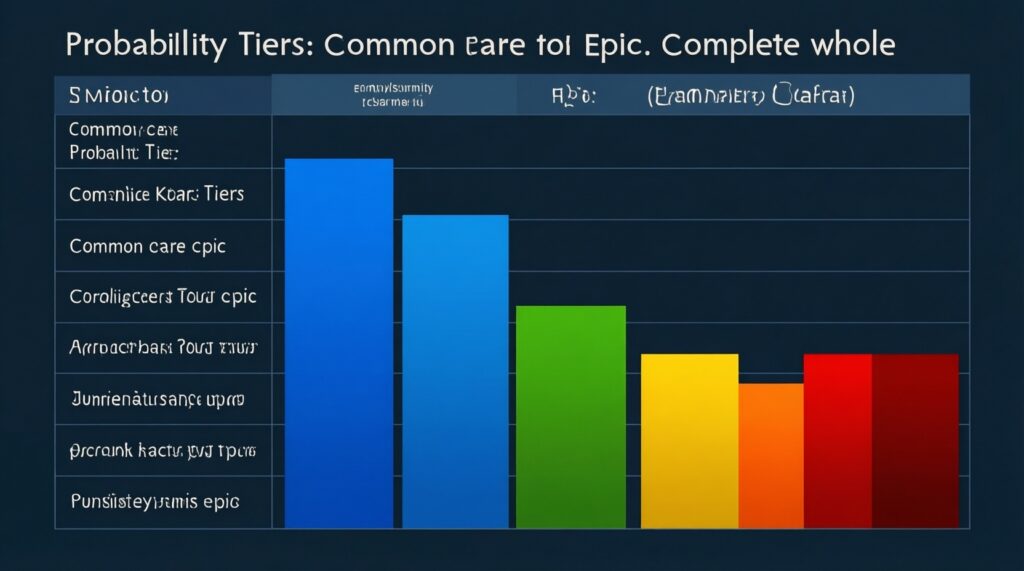
Create a list of mutually exclusive outcomes (e.g., Common/Rare/Epic) with probabilities that sum to 1. If you only have per-item rates, aggregate them into tiers or keep per-item rows.
- Tip: If probabilities don't sum to 1 due to rounding, normalize them (divide each by the total).
-
Estimate realistic sell value per outcome
Use completed sales when possible. Convert each outcome to an expected resale value using a conservative assumption for ราคาตลาดไอเทมลูทบ็อกซ์ (quick-sell is safer than "highest listing").
-
Convert gross price to net proceeds
Apply fees/spread to each outcome: NetValue = Price × (1 − fee%) − fixed fees. Do this per tier because high-value items often suffer higher absolute slippage.
-
Compute gross EV and net EV
Compute GrossEV = Σ(pᵢ × Priceᵢ) and NetEV = Σ(pᵢ × NetValueᵢ) − BoxCost. NetEV is the decision metric.
-
Validate with a quick "sanity scenario"
Simulate a small batch (e.g., 10-50 boxes on paper) using typical outcomes (mostly common drops) and check if the implied loss matches intuition. If not, your probabilities or pricing assumptions are likely wrong.
Worked example (single rare tier + common tier)
Assume one lootbox costs 100 (same currency as market prices). Outcomes: Rare item drops with probability 1%, otherwise Common items.
- Rare: p = 0.01, market price = 6,000
- Common: p = 0.99, market price = 30
- Fees/spread: 15% total (simple percentage for illustration)
Net values: Rare = 6,000 × 0.85 = 5,100; Common = 30 × 0.85 = 25.5
Expected net proceeds = (0.01 × 5,100) + (0.99 × 25.5) = 51 + 25.245 = 76.245
Net EV = 76.245 − 100 = −23.755 per box (negative even before considering slow sales).
Sensitivity table (how small changes flip EV)
This table varies the rare drop probability and rare market price while keeping: box cost = 100, common net value = 25.5, fees = 15%, common probability = (1 − p).
| Rare p | Rare market price | Rare net value (×0.85) | Expected net proceeds | Net EV (per box) |
|---|---|---|---|---|
| 0.5% | 6,000 | 5,100 | (0.005×5,100)+(0.995×25.5)=50.873 | −49.127 |
| 1.0% | 6,000 | 5,100 | 76.245 | −23.755 |
| 2.0% | 6,000 | 5,100 | (0.02×5,100)+(0.98×25.5)=126.99 | +26.99 |
| 1.0% | 8,000 | 6,800 | (0.01×6,800)+(0.99×25.5)=93.245 | −6.755 |
| 1.0% | 10,000 | 8,500 | (0.01×8,500)+(0.99×25.5)=110.245 | +10.245 |
Adjusting for Fees, Taxes, and Market Spread
- Use completed sales when possible; if not, discount listings to a quick-sell price.
- Apply marketplace fees and any cash-out fees to every tier, not only the rare item.
- Include currency conversion spread if you buy boxes in one currency and sell in another.
- Account for undercut pressure: the realized price is often lower than your first target listing.
- Adjust for tax treatment applicable to your situation (if any). If unsure, do not assume "zero".
- Reduce value for slow-moving items (time cost + higher chance prices fall before sale).
- Handle bound/untradeable drops as zero resale value (or exclude them from EV-to-cash logic entirely).
- Re-check that probabilities sum to 1 after any tier aggregation.
Scenario Analysis: Risk, Variance, and Time Horizon
- Confusing EV with typical outcome: a positive EV can still mean long losing streaks are common.
- Overweighting the jackpot: tiny probability items dominate EV math but rarely show up in small samples.
- Ignoring variance: two boxes can have the same EV, but one has far higher downside volatility.
- Using listing prices: optimistic pricing is the most common way EV becomes "fake positive".
- Not modeling time horizon: if you can only open a few boxes, EV is less informative than worst-case planning.
- Assuming instant liquidity: if selling takes days, your opportunity cost and price risk increase.
- Mixing probabilities from different pools: event banners and permanent pools can have different drop tables.
- Chasing losses: increasing spend after bad outcomes breaks any rational evaluation method.
Decision Rules and a Practical Pre-Open Checklist
Use a rule that matches your risk tolerance. EV is only one input; your goal is a controlled decision, not a justification to spend more.
Compact pre-open checklist (accept/reject thresholds)
| What to enter | How to compute | Accept when | Reject when |
|---|---|---|---|
| Box cost (all-in) | Include discounts + payment fees | Cost is fixed and known | Cost varies or has hidden fees |
| Drop rates per tier | Make sure total = 1 | Official or verifiable | Unknown/contradictory |
| Net sell value per tier | Price × (1−fees) − fixed costs | Based on completed sales | Based on wishful listings |
| Net EV per box | Σ(p×net value) − cost | Conservative: clearly positive after worst-case pricing | Negative or only positive under optimistic pricing |
| Stop-loss limit | Max budget or max boxes | Written down and realistic | No limit or "until I win" |
Rule option 1: Conservative buyer (value-first)

- Proceed only if net EV is positive under quick-sell prices and after all fees.
- Stop-loss: hard cap (e.g., a fixed budget) and stop immediately when reached.
Rule option 2: Balanced (EV + downside control)
- Proceed if net EV is near break-even or better, and you can tolerate the expected worst streak for your planned number of boxes.
- Stop-loss: stop if you hit your cap or if market prices drop materially from your assumed baseline.
Rule option 3: Collector (utility-first, not resale-first)
- Convert drops into "personal value" (how much you'd pay directly for the item) instead of resale price.
- Proceed only if your personal value EV is acceptable and your spend is pre-committed.
Rule option 4: Strict no-resale environment
- If items are bound or selling is unreliable, do not treat openings as an investment.
- Use a fixed entertainment budget and ignore EV-to-cash calculations.
Common Uncertainties and Quick Answers
Is a "positive EV" lootbox guaranteed profit?
No. EV is a long-run average; short runs can lose heavily due to variance and rare jackpots.
How do I handle unknown or undisclosed drop rates?
Don't compute EV-to-cash from guesses. Treat it as entertainment spending, or only proceed when verifiable rates exist.
Which price should I use for ราคาตลาดไอเทมลูทบ็อกซ์?
Use completed sales or quick-sell prices net of fees. Listing prices are often too optimistic for EV decisions.
Can I rely on a เครื่องคำนวณ EV กาชา without checking inputs?
No. The calculator is only arithmetic; wrong probabilities or prices produce confidently wrong EV.
What's the simplest way to คำนวณความน่าจะเป็นกาชา for tiers?
Use official tier rates if available; otherwise aggregate item-level rates into tiers and ensure the total probability equals 1.
When answering "คุ้มเปิดลูทบ็อกซ์ไหม", what matters most besides EV?
Liquidity and risk limits. If you can't sell quickly or you won't follow a stop-loss, EV won't protect you.