

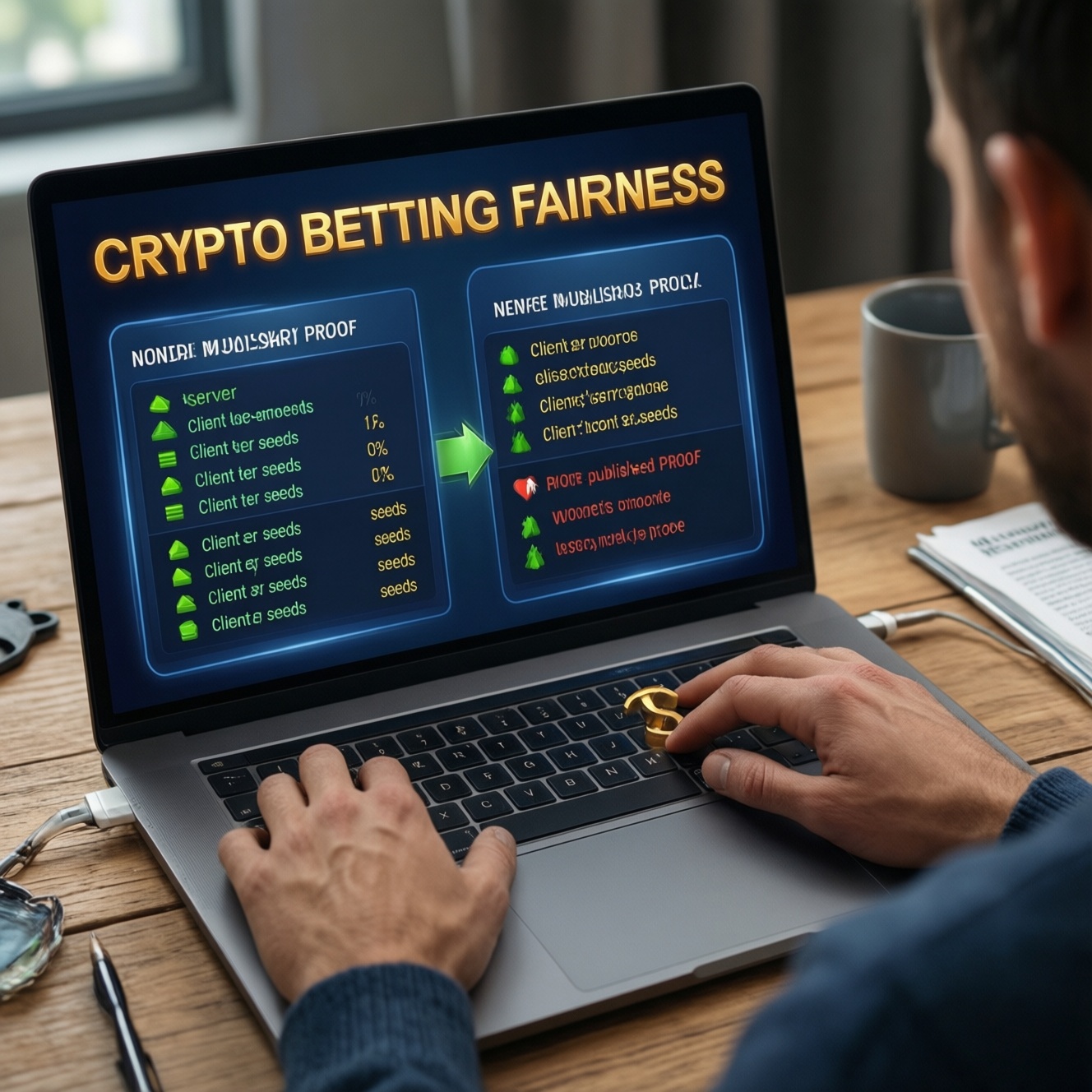
Provably Fair is a cryptographic method used mainly in crypto betting to let you verify that a game outcome was generated from fixed inputs (server seed, client seed, nonce) rather than changed after you bet. You don't "trust the casino"; you recompute the result yourself and compare it to the published proof, even on low-power devices.
Concise overview: Provably Fair for crypto betting
- Provably Fair คืออะไร: a verifiable randomness protocol using hashes/HMAC so outcomes can be independently recomputed.
- Typical proof objects: server seed hash (committed before play), revealed server seed (after), your client seed, and a nonce per bet.
- วิธีตรวจสอบ Provably Fair is deterministic: compute HMAC/Hash → map to a number/card/stop → match the displayed outcome.
- Works best in คาสิโนคริปโต Provably Fair because crypto wallets and immutable logs make disclosure and auditing simpler.
- "Provably fair" proves generation of the outcome, not payouts, limits, KYC policies, or whether a เว็บคาสิโนคริปโตที่เชื่อถือได้ Provably Fair will honor withdrawals.
Cryptographic foundations: hashes, HMACs and randomness sources
Provably Fair is built on commit-reveal. The casino commits to a hidden value (the server seed) by publishing its hash first. Because hashes are one-way, the casino can't feasibly find a different seed later that matches the same hash, so the commitment is binding in practice.
To produce each result, the system combines the server seed with player-controlled or session-controlled values (client seed and nonce) using a deterministic function (often HMAC with SHA-256). HMAC is useful because it behaves like a keyed hash: the server seed acts like a secret key, while the message includes client seed and nonce.
The "randomness" is not magical entropy at the moment of the bet; it's the unpredictability of the hidden server seed before reveal, plus the inability to change it after the commit. That boundary matters: Provably Fair is about auditability and tamper-evidence, not about being a true random beacon.
The protocol breakdown: server seed, client seed and nonce roles

- Server seed (secret until reveal): generated by the operator; kept private during play; revealed later for verification.
- Server seed hash (public commitment): published before bets are resolved; you can store it to ensure it doesn't change.
- Client seed (player influence): set by you (or auto-generated) to prevent the operator from fully controlling the input space. You can change it periodically.
- Nonce (counter): increments per bet/round so each outcome is unique even with the same seeds; prevents replaying the same output.
- Deterministic function: typically
HMAC_SHA256(server_seed, client_seed + ":" + nonce)(exact concatenation rules must match the site). - Mapping step: converts the hash/HMAC output into a game-specific outcome (dice roll, card order, slot stops). This mapping must be documented to be verifiable.
How to verify a result: step-by-step manual validation
These are the most common verification scenarios you'll see in crypto gambling, including สล็อตออนไลน์ Provably Fair คริปโต implementations. The steps are the same: confirm the commitment, recompute the digest, then apply the same mapping the game uses.
-
After a session ends (server seed reveal): you receive the server seed and can check
SHA256(server_seed) == published_server_seed_hashfor that session. - Per-bet verification (nonce-based): for any bet number N, compute the digest using the same nonce N shown in the bet record and check that it reproduces the displayed roll/card/slot result.
- Dispute a single round: export the bet record (server seed, client seed, nonce, game id) and recompute offline; this is the practical "receipts" use-case.
- Audit a streak: verify a sequence of nonces (e.g., a whole page of bets) to confirm no single outcome was selectively altered.
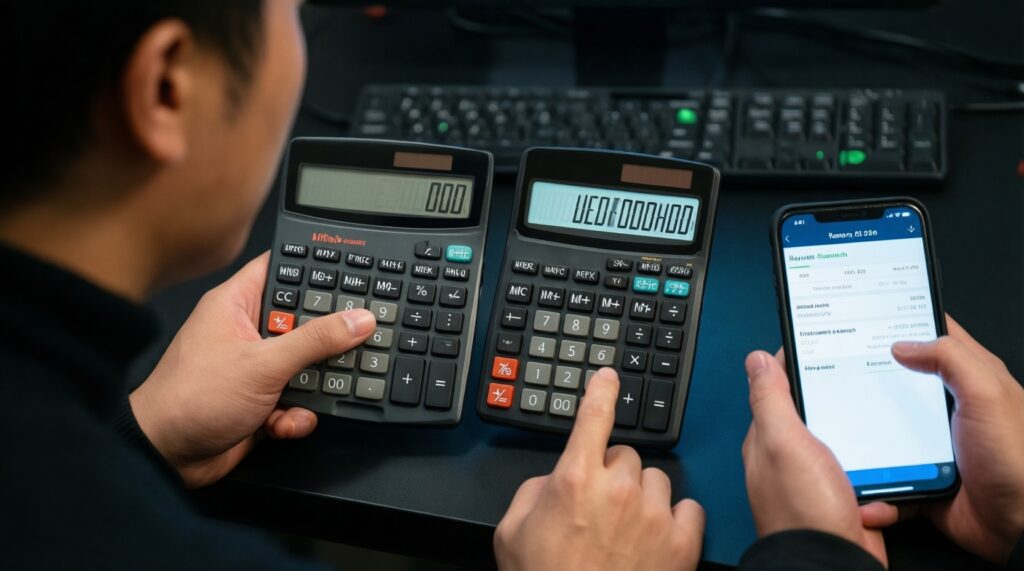
- Low-resource alternative validation: if you can't run scripts, use (a) a trusted local hash utility, (b) an offline HMAC calculator app, or (c) a second device to cross-check the same inputs. You still verify deterministically-just with lighter tooling.
Compact pseudo-code (site-agnostic)
# Inputs from the bet record:
serverSeed      # revealed after session
serverSeedHash  # committed before play
clientSeed
nonce           # integer

# 1) Verify commitment
assert SHA256(serverSeed) == serverSeedHash

# 2) Compute digest (exact message format depends on the casino)
msg = clientSeed + ":" + str(nonce)
digest = HMAC_SHA256(key=serverSeed, message=msg)   # hex string

# 3) Map digest to outcome (example: take first 4 bytes as integer)
x = hex_to_uint32(digest[0:8])
# outcome mapping is game-specific; must match the operator's published rules
Command-line examples (limited resources)
# Check commitment (example using sha256sum; Linux/macOS with coreutils)
printf '%s' 'SERVER_SEED_HERE' | sha256sum

# If you only have a phone:
# - Use an offline SHA-256 tool to hash the revealed server seed.
# - Use an offline HMAC-SHA256 calculator for (key=server seed, message="clientseed:nonce").
Common game implementations: dice, shuffled decks and slots
Where Provably Fair is straightforward
- Dice / crash-style rolls: digest → uniform number → compare to threshold; easiest to publish and verify.
- Card shuffles: digest stream → deterministic shuffle (e.g., Fisher-Yates using sequential bytes); verifiable if the full procedure is documented.
- Slots: digest → reel stop positions (or symbol indices). Verifiability depends on whether the mapping from digest to stops is fully disclosed.
What it guarantees vs what it does not
- Guarantees: given the disclosed seeds + nonce + rules, the outcome is reproducible and cannot be quietly edited after the commitment.
- Does not guarantee: fair RTP, transparent bonus rules, equal limits for all players, instant withdrawals, or that the operator won't change the rules in a future session.
Real-world limitations: attack vectors and trust assumptions
- Hidden rule complexity: if the mapping from digest to outcome is vague, you can verify a hash but not the claimed "fairness" of the mapping.
- Client seed that isn't truly yours: auto-generated client seeds are fine, but you should be able to set/change them; otherwise the operator controls more of the input space.
- Nonce confusion: if nonces reset unexpectedly or aren't shown per bet, audits become fragile and selective disclosure risks increase.
- Timing of commitment: the server seed hash must be committed before betting outcomes are determined; "revealed later" alone is not sufficient without a prior commitment you can reference.
- Verification UX traps: copy/paste whitespace, different encodings (UTF-8 vs others), or mismatched separators (":" vs "|") can make valid proofs look invalid.
Operational integration: wallets, provable logs and UX considerations
In a crypto stack, Provably Fair works best when each bet record is easy to export and tie to a transaction, session id, or immutable log. That's why players often look specifically for เว็บคาสิโนคริปโตที่เชื่อถือได้ Provably Fair: not only the algorithm, but also the operational transparency around it.
Mini integration pattern (operator-side)
# Session setup
serverSeed = secure_random()
commit = SHA256(serverSeed)
publish(commit)              # visible before bets

# Player sets clientSeed (or system suggests one)
# For each bet:
nonce += 1
digest = HMAC_SHA256(serverSeed, clientSeed + ":" + nonce)
result = map_digest_to_game(digest)
store_bet_record(commit, clientSeed, nonce, result)

# Session end / rotation
reveal(serverSeed)           # enables player verification
Low-resource alternatives for players
- Minimal-device workflow: save the server seed hash at session start (screenshot or note), then verify SHA-256 when the seed is revealed.
- Use two-tool verification: one offline SHA-256 calculator + one offline HMAC-SHA256 calculator; no coding required.
- Cross-check with a friend/device: run the same inputs on another phone/laptop; deterministic agreement is the key property.
- Ask for export: prefer casinos that let you copy a full bet record (seeds, nonce, game rules link) in one place; this is often the difference between "claims" and verifiable proof in a คาสิโนคริปโต Provably Fair environment.
Self-check checklist (do this after any suspicious round)
- Confirm the revealed server seed hashes to the previously published server seed hash (same session).
- Recompute HMAC/Hash using the exact client seed, nonce, and separator/encoding the casino specifies.
- Apply the published mapping rules (dice/card/slot) and compare the computed outcome to the displayed one.
- Verify at least a small sequence of nonces (not only one bet) to rule out selective tampering.
- If tools are limited, repeat the same calculation using a second offline utility or device to eliminate app/typing errors.
Common player concerns and short answers
Is Provably Fair the same as "licensed" or "regulated"?
No. Provably Fair only proves the outcome generation process for a round; licensing relates to legal oversight, dispute processes, and operational compliance.
Can a casino still cheat with Provably Fair?
They can't easily change a committed server seed without detection, but they can still use unclear mapping rules, poor UX transparency, or unfair payout structures outside the provable layer.
Why should I change my client seed?
Changing client seed reduces the operator's ability to predict or steer outcomes across a long session and helps you ensure unique input combinations.
What if my verification result doesn't match?
First check formatting details: nonce value, separators, uppercase/lowercase hex, and whitespace. If it still fails, export the bet record and re-run on a second tool/device before escalating.
Does Provably Fair guarantee fair RTP for slots?
No. It can prove that the displayed stop result came from the disclosed inputs, but RTP depends on the paytable and mapping design.
Is it hard to do วิธีตรวจสอบ Provably Fair without coding?
Not necessarily. With the server seed, server seed hash, client seed, and nonce, you can verify using offline SHA-256 and HMAC tools; coding just makes bulk audits faster.
What should I look for in a เว็บคาสิโนคริปโตที่เชื่อถือได้ Provably Fair page?
Clear documentation of the exact message format, hashing/HMAC algorithm, mapping rules, and an exportable per-bet record showing seeds and nonces.