
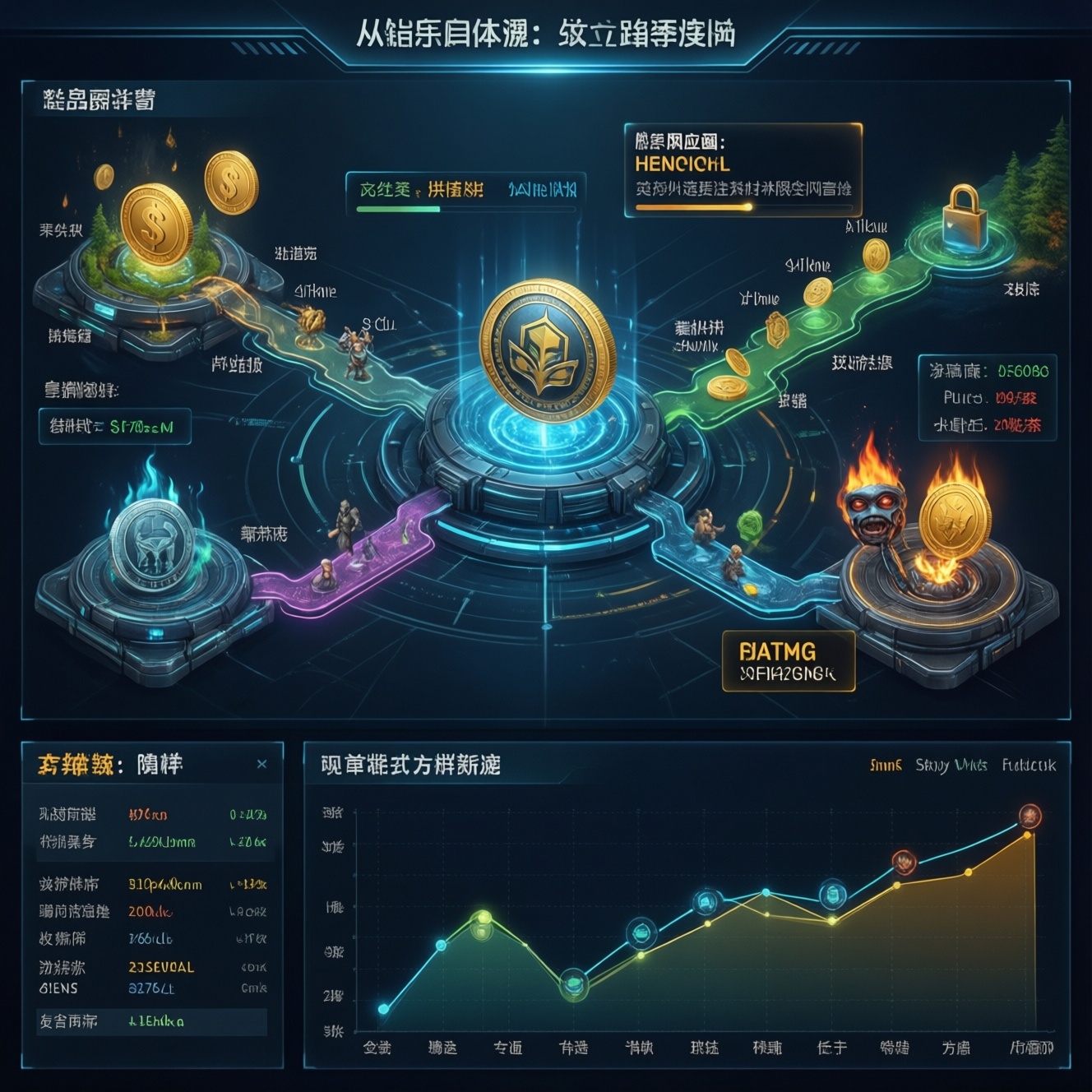
Web3 game tokenomics is the practical design of how tokens enter the economy (supply/emission), how players spend them (sinks/utilities), and how value is removed or constrained (burn/lock) so the in-game market stays playable and sustainable. If you can trace token flows end-to-end and adjust them with clear rules, you can prevent runaway inflation and exploit-driven collapse.
Essentials: token supply, flows and sustainability
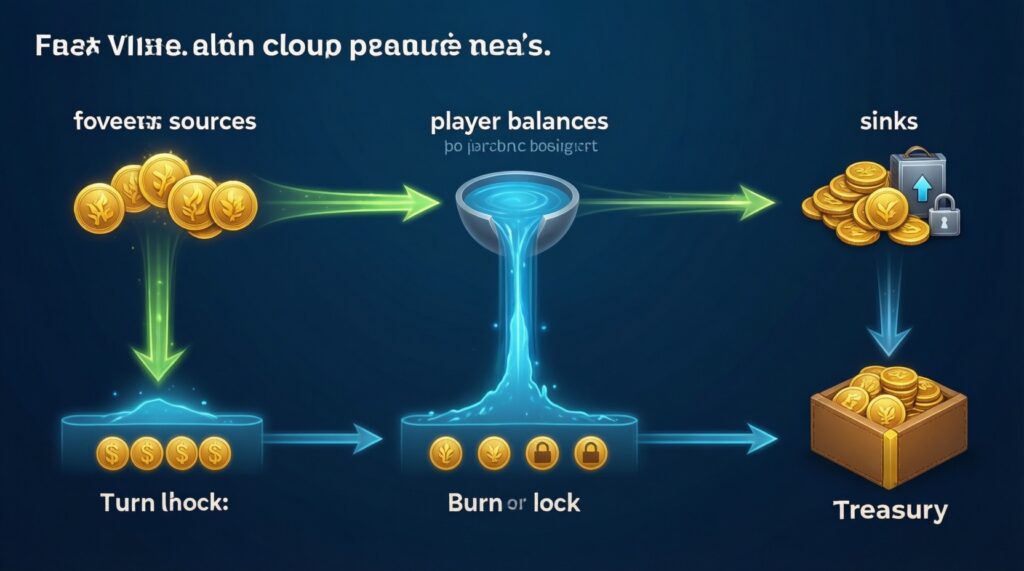
- Write one clear flow map: sources → player balances → sinks → burn/lock → treasury; if you cannot trace a token's destination, you cannot stabilize it.
- Separate player rewards (emission) from progression value (utility); sustainable economies pay for time, not for extraction.
- Use sinks first, burn second: sinks shape behavior; burn shapes scarcity and expectations.
- Design emissions and vesting as throttles, not promises; keep levers for live-ops intervention.
- Prevent exploits by making rewards skill/choice-dependent and limiting risk-free loops.
- Track a small KPI set weekly and act: net issuance, sink coverage, velocity proxies, and concentration.
Types of supply: fixed, inflationary and algorithmic issuance
Token supply in Web3 games is the rule-set that determines how many tokens exist (cap or no cap) and how new tokens are created (emission). When people ask "Tokenomics เกม Web3 คืออะไร", this is the core: supply rules plus spending/removal rules that shape player incentives.
Fixed supply means a hard cap: the system can distribute tokens from a predefined pool, but cannot mint more. This is simple to reason about, but it pushes pressure onto sinks and distribution fairness because rewards must be reallocated from somewhere.
Inflationary supply means tokens can be minted continuously (or in phases). This supports ongoing rewards, but the economy must absorb inflation through sinks, utility demand, or reduced emission over time.
Algorithmic issuance changes emission based on measurable conditions (activity, price bands, sink usage, season outcomes). It is powerful for sustainability, but it increases complexity and can be gamed unless you design anti-manipulation safeguards.
Designing emission schedules and vesting for player economies
Emission is how rewards enter player wallets; vesting is how quickly allocated tokens become sellable or usable. Treat both as operational controls for วิธีออกแบบ Tokenomics เกม Web3, not as marketing outputs.
- Define reward surfaces: list every action that can mint tokens (quests, PvP, crafting orders, referrals, tournaments).
- Pick emission granularity: per-match, per-day, or per-season. Coarser schedules are harder to exploit and easier to rebalance.
- Set a "budget per segment": allocate emission buckets for new players, midgame, endgame, and competitive play to avoid whales farming beginner loops.
- Use diminishing returns: cap or curve rewards by time, repeats, or account risk signals so bots cannot scale linearly.
- Align vesting with retention: fast vesting for earned gameplay rewards can be fine, but long vesting is better for team/investor allocations to reduce sell pressure shocks.
- Gate higher payouts behind choices: require meaningful trade-offs (entry fees, durability loss, risk zones) so "free money" loops do not exist.
- Reserve live-ops levers: season multipliers, emission toggles per mode, and emergency throttles with transparent rules.
Demand mechanisms: sinks, utilities and experience-driven consumption
Sinks and utilities create demand: players spend tokens because doing so improves their experience. A sink that feels like a tax reduces fun; a sink that feels like agency increases engagement.
- Progression sinks: upgrades, crafting, rerolls, skill respecs, guild tech-spending tied to clear power or convenience.
- Risk sinks: entry fees for high-reward content, wager-style tournaments, territory battles-spending tied to uncertain outcomes.
- Maintenance sinks: repairs, durability, energy refills-use carefully to avoid "pay to continue" frustration.
- Social/status utility: cosmetics, naming, guild banners, housing-high willingness to pay without destabilizing combat balance.
- Market utilities: listing fees, crafting commissions, escrow/settlement costs-great for controlling secondary market spam and wash trading.
Mini-scenarios you can implement this sprint
- Crafting loop: emit tokens from quests; require tokens + materials for crafting; add a listing fee sink on the marketplace; optionally burn a small part of the fee to counter inflation.
- Competitive loop: players pay an entry fee sink; winners receive a portion funded from the sink pool (not minting); mint only a small seasonal bonus to keep the mode attractive.
- Guild loop: guild upgrades consume tokens into a treasury lock; upgrades unlock utility (extra slots, buffs) so spending feels like progress, not punishment.
Burn mechanics vs. permanent lock: effects on scarcity and incentives
Burn permanently reduces circulating supply; permanent lock removes tokens from circulation while keeping them retrievable only under specific rules. Use burn to reinforce scarcity narratives; use lock to create long-term commitment and governance-aligned incentives.
| Mechanism | What happens to tokens | Best used for | Main risk |
|---|---|---|---|
| Burn | Destroyed; cannot return | Countering chronic inflation; tying consumption to permanence (e.g., item minting) | Overburn can cause reward collapse or "deflationary hoarding" where players stop spending |
| Permanent lock | Unavailable to trade; may unlock via rules (time, achievements, governance) | Staking-for-access; long-term alignment; reducing short-term sell pressure | Complexity and "hidden circulating supply" if unlock rules are unclear |
Advantages you can rely on (when tuned)
- Burn strengthens scarcity expectations and can stabilize long-run supply if demand exists.
- Lock reduces circulating supply without destroying value, supporting commitment mechanics (access tiers, governance voting).
- Both can be attached to player-chosen actions (crafting, upgrades, tournament entry), making demand behavior-driven.
Limitations that frequently break economies
- Burn does not create demand by itself; without compelling utility, it becomes cosmetic accounting.
- Lock can become perceived as a trap if benefits are weak or unlock rules change mid-season.
- Either mechanism can be farmed if you allow risk-free cycling (earn → spend → recover) with no friction or caps.
Maintaining long-term balance: feedback loops, inflation control and anti-exploit measures
Most failures come from missing feedback loops. You need rules that automatically slow emission when sinks are weak, and rules that detect and penalize exploit patterns before they dominate the economy.
- Myth: "Burn fixes inflation." Reality: burns help only if players willingly spend; prioritize utility and sinks first.
- Common mistake: rewarding the easiest repeatable action. Make the highest emissions require scarce inputs, risk, or skill-based performance.
- Common mistake: one token for everything. If a single token is both reward and upgrade currency, price shocks hit progression; consider separating reward token and soft currency, or enforce strong sinks.
- Exploit gap: multi-account farming. Add non-intrusive friction (cooldowns, progressive caps, sybil signals) and shift rewards toward competitive or cooperative content.
- Live-ops failure: no rollback plan. Prepare emergency switches: reduce emission per mode, increase selected sinks, pause a broken faucet, and communicate criteria.
Measurement and governance: KPIs, on-chain analytics and economic intervention tools
You do not need dozens of metrics. You need a repeatable weekly routine and a few levers. If you sell or buy บริการวิเคราะห์ Tokenomics และเศรษฐกิจในเกม Web3, ask for a dashboard that ties each KPI to a concrete action, plus an explanation of assumptions.
A compact KPI routine (weekly)
- Net issuance: minted to players minus burned/locked minus fees to treasury (track by game mode).
- Sink coverage: which sinks absorb spending and whether they are voluntary (fun) or forced (friction).
- Concentration signals: is supply accumulating in a small set of wallets or guilds (and why).
- Exploit watchlist: abnormal reward per hour, repeated identical routes, suspicious wallet clusters.
Mini-pseudocode: emission throttle tied to sink usage
// Inputs are measured over a rolling window (e.g., last 7 days)
sink_ratio = tokens_spent_in_sinks / tokens_minted_to_players

if sink_ratio < target_ratio_low:
  emission_multiplier = max(min_mult, emission_multiplier - step_down)
else if sink_ratio > target_ratio_high:
  emission_multiplier = min(max_mult, emission_multiplier + step_up)

// Apply per game mode to avoid one mode subsidizing another
reward = base_reward(mode) * emission_multiplier
If you are evaluating เครื่องมือวิเคราะห์ Token Supply Sink Burn สำหรับเกม Web3, prioritize: (1) faucet/sink attribution by feature, (2) cohort views (new vs veteran), and (3) alerts that map directly to levers you can change in live-ops.
For teams budgeting external help, frame requests clearly: scope (audit vs redesign vs live-ops support), token set (reward/governance/NFT pricing), and deliverables (flow map, parameter ranges, intervention playbook). That is what makes ที่ปรึกษา Tokenomics เกม Web3 ราคา comparable across providers.
Practical clarifications for common implementation dilemmas
Should a Web3 game use one token or multiple tokens?
Use one token only if you can enforce strong sinks and keep progression stable under price swings. Many teams separate a reward token from an in-game spending currency to protect gameplay balance.
Where should token burning happen to feel fair to players?
Attach burn to voluntary, value-creating actions like crafting, upgrades, or tournament entry. Avoid burning on basic "must-pay-to-play" friction because it feels punitive.
How do I stop bots from farming emissions without harming real players?
Move meaningful rewards toward skill, risk, and social coordination, then add diminishing returns on repetitive routes. Detect clusters and cap emissions progressively rather than using hard bans as the first tool.
Is locking better than vesting for controlling sell pressure?
They solve different problems: vesting controls when allocated tokens become liquid; locking incentivizes behavior (stake-for-access) and can be optional. Use vesting for allocations and locking for gameplay alignment.
What is the fastest way to test whether sinks are strong enough?
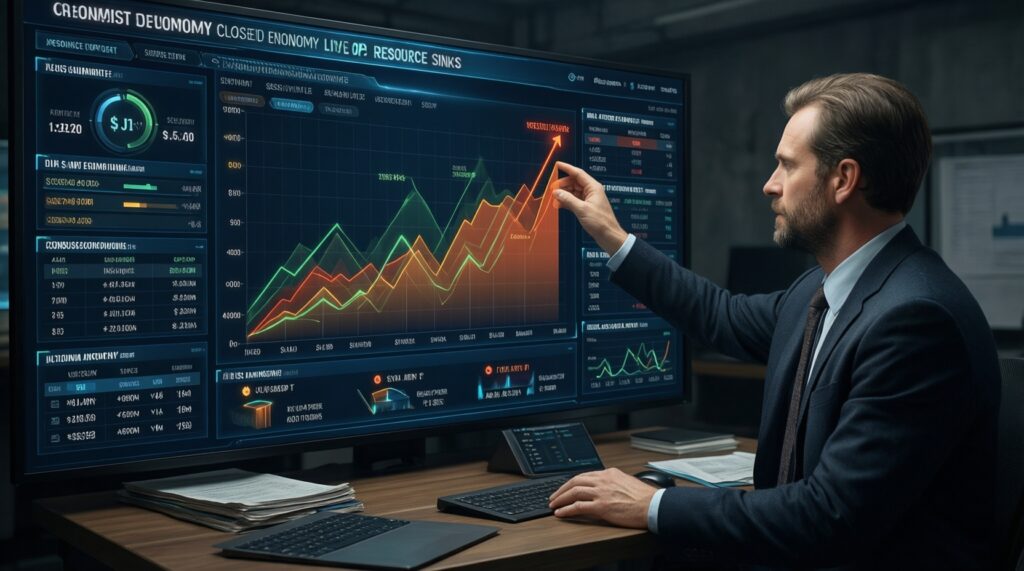
Run a closed economy simulation with your expected player loops and check whether net issuance trends upward. If you cannot model it, start with a live-ops season where you can rapidly adjust emission and one or two major sinks.
When should the team intervene in the economy during a season?
Intervene when net issuance diverges persistently or when one exploit loop dominates rewards. Pre-define thresholds and actions so changes feel like rules, not panic.
What deliverables should I request from a tokenomics review?
Ask for a flow diagram, a list of faucets/sinks with tuning ranges, a risk register (exploits, inflation, concentration), and an intervention playbook. These are more actionable than a narrative report.