

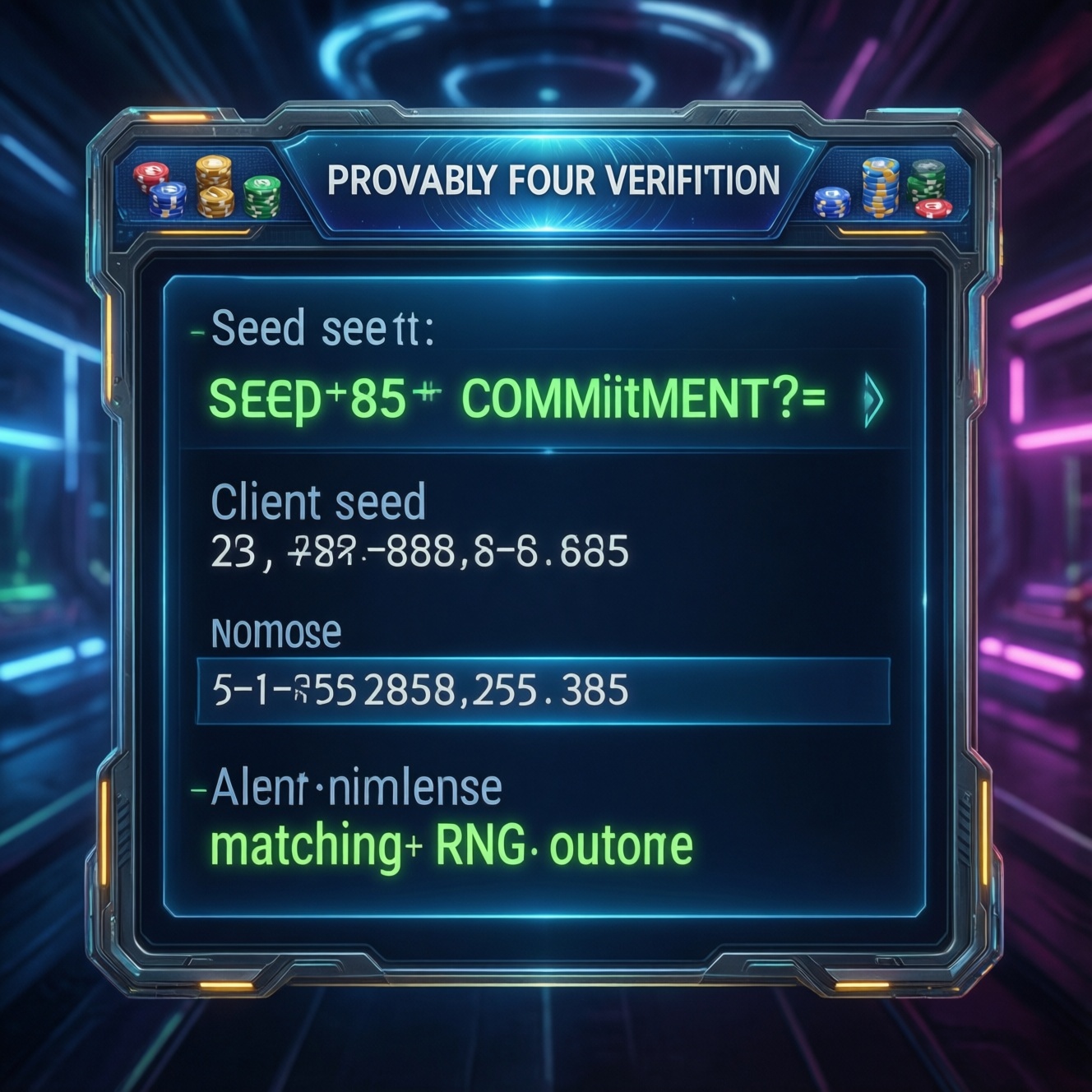
In web3 crypto casino games, "provably fair" means each game outcome can be independently verified using public cryptographic data (typically a server seed hash commitment plus a client seed and nonce) so the operator can't change results after seeing your bet. You verify it by re-creating the RNG result locally and matching the published outcome.
Core concepts at a glance
- Commit-reveal: the casino commits to a hidden server seed by publishing its hash before you play.
- Inputs: outcome is derived from server seed + client seed + nonce (and sometimes game id/round id).
- Deterministic RNG: the same inputs always produce the same roll, card, or spin result.
- Verification: after reveal, you recompute hashes locally and confirm the result matches the game transcript.
- Scope: provable fairness covers outcome integrity, not payouts, solvency, or withdrawal behavior.
- Reality check: a "best provably fair casino" is the one that makes verification easy, documents the exact algorithm, and exposes complete round data.
What 'provably fair' means in cryptographic terms
A provably fair crypto casino provides a verifiable proof that the random-looking outcome you received was generated from fixed inputs that were not alterable after your wager. The core idea is pre-commitment: the casino publishes a hash of its secret server seed before play, locking it in cryptographically.
After the round (or after a seed rotation), the casino reveals the server seed. You then hash that revealed seed and check it matches the earlier commitment. If it matches, the casino did not swap the server seed after seeing your client seed or your bet.
Important boundaries: provably fair does not mean "player-favorable," "positive EV," or "regulated." It simply means the math trail from seeds to outcome can be reproduced. In a provably fair crypto casino, the proof is only as good as the transparency of the algorithm and the completeness of the disclosed round data.
Cryptographic primitives behind provable fairness
- Cryptographic hash (e.g., SHA-256): used to publish a server seed commitment (hash) that is infeasible to reverse, but easy to verify after reveal.
- Server seed: a secret chosen by the casino; it must remain hidden until after it is safely committed via hash.
- Client seed: a value chosen by the player (or wallet/session) to prevent the casino from unilaterally controlling the input space.
- Nonce: an incrementing counter per bet/round to ensure each wager produces a unique outcome even with the same seeds.
- Deterministic RNG construction: commonly a hash/HMAC over (server seed, client seed, nonce) that is then mapped to a uniform number range.
- Canonical encoding: strict rules for concatenation/serialization (separators, byte order, hex/base64) so every verifier reproduces identical bytes.
How provably fair protocols are implemented in casino games
In practice, provably fair gambling games differ mainly in how they map a hash stream into game-specific outcomes. Typical implementations you'll see in web3 crypto casino games include:
- Dice / roll-under: hash output is converted into a number like 0.00-99.99; the win condition compares your target to that roll.
- Crash: hash-derived value is transformed into a "multiplier" curve (the exact formula must be documented for verification to be meaningful).
- Plinko / mines: a sequence of bits or small integers is drawn from the hash stream to determine left/right drops or mine positions.
- Roulette-style wheels: hash output is reduced modulo the number of slots; implementations must handle modulo bias (or use rejection sampling).
- Cards (blackjack/poker variants): repeated draws from the hash stream shuffle a virtual deck; the shuffle method (e.g., Fisher-Yates) and draw function must be specified.
These scenarios can be provably fair only if the casino provides (a) the initial commitment, (b) the revealed server seed, (c) your client seed, (d) the nonce/round id, and (e) the exact mapping algorithm used for that game mode.
Step-by-step verification for players: practical checks
- Find the round transcript: locate the page/log showing server seed hash (commitment), client seed, nonce, and the displayed outcome.
- Confirm the commitment matches the reveal: after the server seed is revealed, hash it and ensure it equals the previously published server seed hash.
- Recompute the RNG payload: use the documented function (often SHA-256 or HMAC-SHA256) over (server seed, client seed, nonce).
- Re-map to the game outcome: apply the published conversion (e.g., to 0-99.99, a crash multiplier formula, or a card shuffle).
- Compare: your recomputed outcome must match the casino's outcome for that exact nonce.
Command/console-style verification patterns (what to look for)
- SHA-256 commitment check: the casino shows a serverSeedHash before play; after reveal you compute SHA-256(serverSeed) and match the hex digest.
- HMAC-based RNG: some sites use HMAC-SHA256 with server seed as the key and a message like clientSeed:nonce. If the casino doesn't specify which is key vs message, verification is ambiguous.
- Nonce continuity: verify the nonce increments by 1 per bet within the same seed pair; gaps without explanation can hide unlogged rounds.
Practical checklist to verify a provably fair casino quickly
- They clearly publish server seed hash before you bet, not only after.
- They let you set/change client seed and show it in the round record.
- They expose nonce and keep it consistent and monotonic.
- They document the exact algorithm (hash/HMAC choice, encoding, separators, mapping).
- They provide a verifier you can replicate (ideally open-source or simple enough to reproduce independently).
If your goal is to verify provably fair casino claims, you should be able to reproduce outcomes with your own script or a standard crypto toolchain. If the site only offers a "trust our verifier" button with no algorithm details, you cannot independently verify it.
Limitations, attack vectors and what proofs don't cover

- Algorithm opacity: a verifier is meaningless if the mapping from hash to outcome is undocumented or can be changed without notice.
- Selective disclosure: omitting nonces/rounds (or allowing "voided" bets without a cryptographic trail) can hide unfavorable history while keeping individual proofs intact.
- Client seed control theater: if the client seed is auto-generated and cannot be audited or changed before betting, player influence may be superficial.
- Modulo bias and flawed mapping: reducing a hash to a small range incorrectly can skew probabilities even though the process is "verifiable."
- Proof ≠ integrity of everything: provably fair gambling games do not prove payout correctness, fee transparency, custody/solvency, geoblocking compliance, or withdrawal reliability.
Regulatory and operational implications for operators
Operationally, "provably fair" is a reproducible specification, not a marketing badge. Operators should treat it like an API contract: stable, versioned, and auditable. A practical approach is to publish a seed lifecycle policy (generation, rotation, storage, reveal timing) and an algorithm spec that can be verified offline.
Minimal spec operators can publish (mini-template)
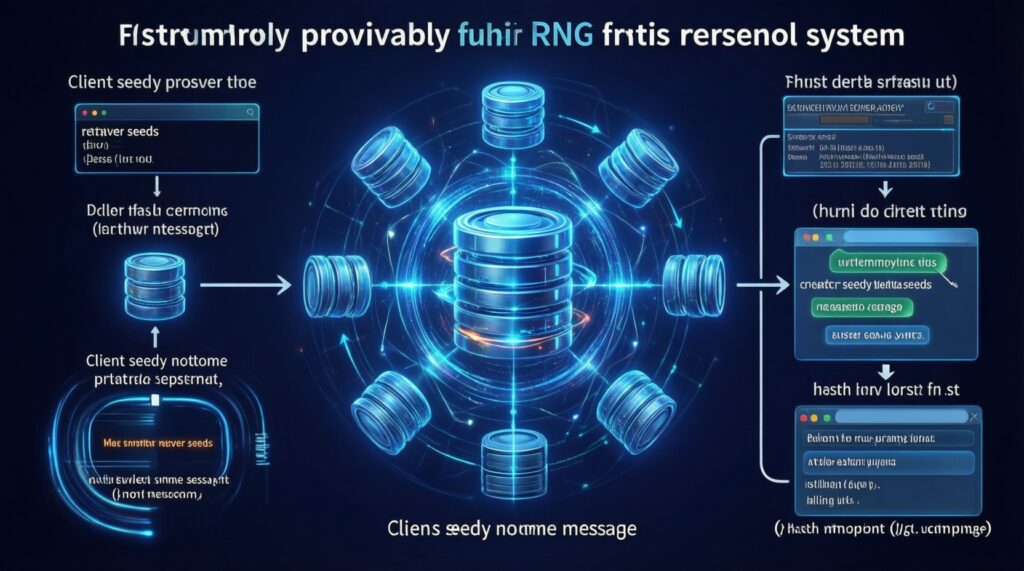
- Seed lifecycle: when server seeds are generated, how often they rotate, and when they are revealed.
- RNG function: exact primitive (SHA-256 vs HMAC-SHA256), plus canonical string/byte encoding.
- Message format: for example: message = clientSeed + ":" + nonce (explicit separators).
- Mapping rules: exact conversion from hash bytes to the game outcome, including bias handling.
- Data retention: how long round transcripts remain accessible for third-party audits and player disputes.
Mini-pseudocode that matches what players must be able to reproduce
commitment = SHA256(serverSeed)  // published before betting

payload = HMAC_SHA256(key=serverSeed, message=(clientSeed + ":" + nonce))

// Example mapping concept (site must specify exact rules):
// roll = to_uniform(payload) -> [0, 1) then scale to game range
This is also why "best provably fair casino" is usually the one that exposes versioned specs and historical transcripts: it reduces disputes and supports independent checks without requiring trust in internal tooling.
Common verification questions players ask
What should I see on the site to confirm it is a provably fair crypto casino?
You should see a server seed hash published before play, then the server seed revealed later, plus your client seed and a nonce per bet. Without all four, the proof chain is incomplete.
How do I verify provably fair casino results without using their built-in verifier?
Use the published algorithm to hash/HMAC the (server seed, client seed, nonce) and re-map the output to the game's outcome. If the site doesn't document encoding and mapping, independent verification isn't possible.
Do web3 crypto casino games become fairer just because they are on-chain?
Not automatically. On-chain settlement can improve transparency, but provable fairness still depends on how randomness inputs are committed, revealed, and mapped to outcomes.
Can provably fair gambling games still be rigged?
They can be biased by flawed mapping, missing rounds, or rule changes even if each shown round verifies. Provably fair mainly prevents changing an already-committed server seed after the fact.
Why does the nonce matter when verifying?
The nonce ensures each bet has a unique RNG input. If the nonce is missing or inconsistent, you can't reliably reproduce the exact round outcome.
Is "provably fair" the same as audited RNG or licensed casino RNG?
No. Audits and licensing address broader controls and compliance, while provably fair addresses per-round reproducibility from disclosed cryptographic inputs.
What's the fastest way to compare casinos claiming to be the best provably fair casino?

Check whether they publish a complete algorithm spec, allow client seed control, expose nonce and round data, and support offline reproduction. The easiest-to-reproduce system is usually the most trustworthy.