


The future of gamer gambling combines AI-driven agents that trade, price, and arbitrage virtual items; blockchain rails that settle wagers transparently; and loot systems that mint composable rewards with adaptive scarcity. Practically, this means building safer economies, auditable odds, and controllable incentives-while managing bot abuse, custody risk, compliance exposure, and player harm across AI gambling bots, on-chain betting platforms, and loot-based monetization.
Executive summary: core innovations and risks
- AI trading bots can stabilize or destabilize item markets depending on throttles, inventory caps, and anti-collusion rules.
- On-chain betting improves auditability, but shifts risk to custody design, oracle integrity, and smart-contract security.
- Crypto casino betting inside games needs explicit segregation of game progression from wagering to reduce harm and compliance friction.
- Blockchain sports betting is operationally an oracle + escrow + settlement problem; latency and disputes are product features, not edge cases.
- Loot box mechanics gambling becomes harder to justify when rarity is dynamic; clear disclosures and caps must be engineered, not merely written.
- Success is measured by economy health, fraud pressure, and player safety, not only revenue.
How AI trading bots transform in-game economies
In this context, AI trading bots are automated agents that buy, sell, craft, or swap in-game assets (items, skins, tokens, crafting inputs) to optimize a target function such as profit, inventory completion, or price stability. They are not just UI macros; they use signals (order books, drop rates, player demand, patch notes, social trends) to act continuously and at scale.
Boundaries matter. A market-making bot that posts bids/asks to reduce spread is different from an exploit bot that farms drops or manipulates matchmaking to generate tradable rewards. When discussing AI gambling bots, the key boundary is whether the agent's edge comes from legitimate market information (allowed) or from extracting value by violating gameplay constraints (disallowed).
Practically, treat bots as participants in the economy with explicit permissions, quotas, and identity. If you can't describe what a bot is allowed to do in one sentence and enforce it server-side, you don't have a bot policy-you have a future incident.
On-chain betting: infrastructure, custody, and provable fairness
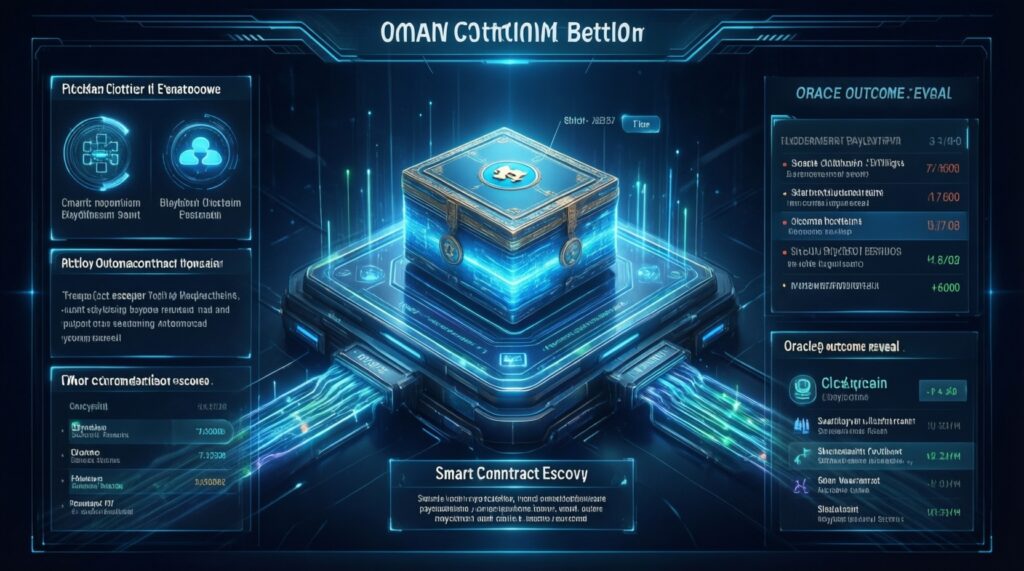
On-chain betting platforms settle a wager using a smart contract: funds are escrowed, outcomes are resolved via an oracle or deterministic game logic, and payouts are executed programmatically. The value proposition is verifiability, but the cost is that mistakes become irreversible deployments.
- Wager creation: player picks market (match outcome, item duel, tournament bracket), stake, and constraints (min/max odds, expiry).
- Escrow and accounting: contract locks funds (native token or stablecoin) and records exposure per market.
- Odds and risk: either fixed odds (AMM/LP based) or pooled parimutuel; both require limits per account and per event.
- Outcome resolution: oracle posts result (e.g., esports match ID) or game-server signs an outcome message; disputes need a path (timeouts, multi-sig, arbitration, or rollback policy).
- Provable fairness: for RNG-based games, commit-reveal or verifiable randomness is used so neither house nor player can bias the roll after staking.
- Payout and fees: contract pays winners; operator fees and affiliate splits must be transparent and capped to avoid hidden house edges.
- Custody model: non-custodial (player wallet signs) reduces operator custody risk but increases UX friction; custodial wallets improve UX but raise security/compliance burden.
Mini-scenarios before you ship policy
- Esports wager with delayed oracle: payouts are locked for hours; players treat it as "stuck funds." Build status states (pending, disputed, resolved) and communicate them in-client.
- In-game duel wager: the game server is the oracle. If your server key is compromised, the attacker can print payouts. Use key rotation, rate limits, and multi-sig attestation for high-stake matches.
- Cross-game liquidity: players bring tokens from outside. Your AML/KYC obligations (where applicable) become operational requirements: deposit limits, chain analytics, and fraud queues.
Next-gen loot mechanics: dynamic rarity, composability, and player value

Next-gen loot systems move from static tables to programmable supply, where "rarity" can react to the economy, player behavior, or season goals. Composability means a reward can be used across contexts (cosmetic + crafting ingredient + tournament entry), which amplifies both value and abuse potential.
- Dynamic scarcity events: drop rates adjust when supply exceeds targets (or when prices crash), requiring hard caps and audit logs to avoid stealth manipulation claims.
- Craft-to-mint loops: players combine items into a new asset; bot farms will target the cheapest input route unless you add sinks, cooldowns, and anti-sybil rules.
- Seasonal "burn to upgrade": upgrades require destroying old items, supporting price floors but creating pressure for compulsive spending if not capped.
- Composable utility: the same item unlocks content and becomes a tradeable asset; design must ensure gameplay isn't pay-to-win via secondary markets.
- Player-tailored bundles: AI recommends packs; this is where loot box mechanics gambling concerns peak-recommendations can become personalized reinforcement schedules if unchecked.
Regulatory, ethical, and economic impacts on players and operators
- Operational upsides: auditable settlement, reduced chargebacks versus card rails, programmable limits, and clearer reconciliation for operator finance.
- Economy upsides: better liquidity discovery, more resilient pricing if market makers are constrained, and faster detection of manipulation via on-chain traces.
- Product upsides: transparent fairness narratives are easier to substantiate when RNG and payouts are verifiable.
- Player harm risks: increased access, faster wagering loops, and social amplification can worsen problematic behavior; you need engineered friction (cooldowns, loss limits, self-exclusion) that works across devices.
- Compliance risks: "crypto casino betting" and "blockchain sports betting" may trigger gambling regulation, age gating, licensing, and advertising constraints depending on jurisdiction; plan for geo-fencing and policy enforcement at the account layer.
- Security risks: smart-contract bugs, oracle manipulation, private-key compromise, and MEV/front-running can convert a fair design into an unfair outcome.
- Market integrity risks: AI trading bots can collude, wash-trade, or corner supply; the more composable the asset, the bigger the incentive to manipulate.
Design patterns for integrating AI agents with game systems
- Myth: "Bots are just players at scale." In practice, bots need separate rate limits, inventory caps, and stricter identity/attestation, or they dominate every profitable loop.
- Mistake: optimizing only for profit. Train/score bots on economy health metrics (spread, volatility bands, sink/source balance) rather than pure ROI, or you'll create adversarial economies.
- Mistake: trusting client-side signals. Any loot, trade, or wager signal must be validated server-side; assume the client will simulate outcomes to cherry-pick favorable states.
- Myth: "On-chain equals fair." Fairness depends on randomness and oracles; publish an auditable flow and log commit/reveal steps, not marketing claims.
- Mistake: no circuit breakers. Add kill-switches: pause markets, freeze settlement, and roll to manual review when anomaly thresholds trigger.
- Mistake: ignoring bot-to-bot interactions. Two "benign" agents can create feedback loops (pump-and-dump, liquidity cliffs); test with multi-agent simulations.
From prototype to live product: deployment, metrics, and iteration
Mini-case: you want a wagerable in-game duel, with settlement on-chain and AI monitoring for abuse. Ship in three slices: (1) off-chain ledger prototype, (2) limited on-chain pilot with caps, (3) broader rollout with automated risk controls.
Integration checkpoints (build order)
- Define the unit of truth: game server decides the duel outcome; chain contract only escrows and pays out.
- Design the state machine: CREATED → FUNDED → IN_MATCH → RESULT_SUBMITTED → (DISPUTED) → SETTLED/REFUNDED.
- Attach policy early: per-user wager caps, cooldowns, geo restrictions, age gating, and self-exclusion flags must block at wager creation.
- Instrument everything: economy metrics + fraud signals + player safety indicators, before you optimize conversion.
Example pseudo-flow (server + contract boundary)
// Server (authoritative game outcome)
result = runDuel(playerA, playerB)
sig = sign(serverKey, hash(matchId, result, stake, expiry))

// Contract (settlement)
require(now <= expiry)
require(verifySig(serverPubKey, sig))
require(state == FUNDED)
if result == A_WINS: pay(playerA)
else if result == B_WINS: pay(playerB)
else: refundBoth()
What to measure in the first two weeks
- Economy health: spread on key items, price volatility bands, source/sink balance, concentration of holdings by top accounts.
- Bot pressure: share of trades/wagers by automated actors, anomaly scores, repeated counterparty pairs, time-to-ban vs recidivism.
- Settlement reliability: pending time, dispute rate, refund rate, oracle latency distribution, failed transactions by root cause.
- Player safety: opt-in limit usage, self-exclusion activations, rapid-loss sessions flagged for intervention, support ticket themes.
Practical concerns developers and operators ask
How do we differentiate AI gambling bots from legitimate automation?
Define allowed actions (rate, scope, endpoints) and enforce them server-side with bot identity, quotas, and attestations. If an agent gains advantage by bypassing gameplay constraints, treat it as prohibited automation regardless of "AI" branding.
What is the simplest safe architecture for on-chain betting platforms inside a game?
Keep the game server authoritative for outcomes and use the contract only for escrow and payout. Add timeouts, dispute states, and a pause mechanism so operational incidents don't become irreversible losses.
Does crypto casino betting require provably fair RNG?
If the wager outcome depends on randomness, you need an auditable randomness process (for example commit-reveal) and tamper-evident logs. Without that, you'll spend more time on fairness disputes than on product iteration.
How do we handle oracle risk in blockchain sports betting?
Use redundant data sources, explicit event identifiers, and a dispute window with clear rules. Treat oracle latency and corrections as first-class UX states, not backend exceptions.
When do loot box mechanics gambling concerns become a product blocker?
When you personalize offers, increase purchase frequency, or make progression depend on chance, risk rises sharply. Mitigate with transparent odds disclosures, spending limits, cooldowns, and non-random earn paths.
What are the first circuit breakers we should implement?
Pause markets on anomaly thresholds, cap per-user exposure, freeze settlement when oracle signatures deviate, and force manual review for rapid-repeat wagers. Circuit breakers should be testable and triggerable without a full redeploy.