


Responsible gambling for gamers means treating wagering like a bounded side-activity: you pre-commit to money and time caps, recognize tilt early, and interrupt trigger loops before they escalate. Use platform controls and simple tracking to set gambling limits, protect your play identity (rank, stream, ego), and know when to pause or use gambling self exclusion.
Core Responsible-Gambling Principles for Gamers
- Pre-commit: decide stake, session length, and stop rules before you open an app or stream.
- Separate "skill mode" (ranked/competitive) from "chance mode" (bets/slots) so tilt can't spill over.
- Use responsible gambling tools first, willpower second (limits, cool-offs, reality checks, blocklists).
- Interrupt triggers early with short, repeatable interventions (time-outs, environment changes, accountability).
- Track outcomes at the session level (time, spend, emotional state), not just wins/losses.
- Escalate to problem gambling help when you can't follow your own rules consistently.
Setting Practical Betting and Session Limits
Best for: players who already gamble occasionally (sports, esports markets, online casino responsible gambling features), streamers who feel pressure to "keep it exciting," and competitive gamers who notice tilt after losses.
Not ideal right now: if you're chasing losses, hiding gambling from others, borrowing money to play, or repeatedly breaking limits. In those cases, jump straight to stronger controls (cool-off or gambling self exclusion) and reach out for problem gambling help.
- Pick one "money limit" and one "time limit" (e.g., a fixed session budget and a hard stop time). Keep both small enough that breaking them feels obviously wrong.
- Define stop rules: stop after a preset loss cap, after a preset win cap, or after a number of bets/spins-whichever comes first.
- Make limits friction-based: don't store payment details, avoid one-click deposits, and keep your "top up" method slow.
- Align limits with your gaming schedule: never bet during ranked queues, scrims, or tournament prep; keep gambling sessions separate from competitive play blocks.
Identifying and Managing Tilt in Competitive Play
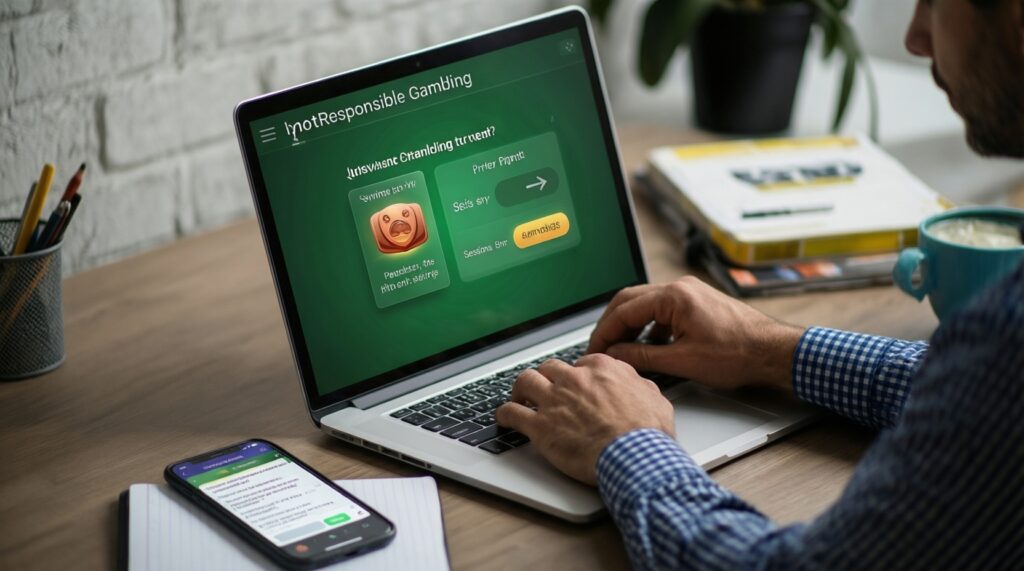
What you'll need to manage tilt reliably:
- Access to platform controls: deposit limits, session limits, cool-off, reality checks, and notification settings (these are core responsible gambling tools).
- A quick note system: phone notes, a private Discord channel, or a simple spreadsheet to log sessions.
- A reset routine you can do in under 2 minutes (walk, water, breathing, hands-off keyboard/phone).
- An accountability touchpoint: a friend/mod, partner, or a self-message pinned in chat/notes.
- Optional safety layer: a website/app blocker for gambling domains during your gaming hours.
Behavioral Triggers: Recognition and Early Interventions
-
Map your top triggers (two minutes, no theory)
Write down 3-5 moments that usually come right before you gamble: after a ranked loss, during stream boredom, after a microtransaction purchase, late-night scrolling, or when you see a "big win" clip.
- Include esports-related triggers (team loses, bad beat, chat taunts, "revenge bet" urge).
- Include context triggers (tired, hungry, alone, alcohol, late-night).
-
Label the tilt signal you feel first
Pick your earliest reliable sign: faster clicks, raising stakes, reopening the app after closing, checking odds between matches, or thinking "I need to get it back now." Early signals are where interventions work.
-
Install a 90-second "interrupt" before any deposit or stake increase
When the urge hits, pause for 90 seconds and do a single reset action (stand up, water, slow breathing). This delay breaks autopilot and prevents escalation.
- If you're streaming: switch to a short "BRB" scene and mute alerts.
- If you're in queue: cancel queue once; re-queue only after the reset.
-
Use pre-committed limits as a gate, not a suggestion
Apply your platform limits so you can't exceed them in the moment. If you can override the limit instantly, it's not a safety tool-tighten it.
- Set gambling limits for deposits and time, plus a loss cap rule you follow manually.
- Turn on reality checks so sessions can't drift unnoticed.
-
Escalate to stronger barriers when you break rules twice
If you exceed limits or hide activity twice in a short span, move up one level: cool-off for days/weeks, block sites during gaming hours, or use gambling self exclusion for the platforms you use.
- If you feel unable to stop despite consequences, seek problem gambling help promptly.
Fast-track mode: 3-minute algorithm
- Before play: set a money cap + time cap + one stop rule (loss cap or max bets).
- At first tilt sign: 90-second interrupt + leave the app/tab.
- If you want to deposit/increase stakes: re-check limits; if it breaks a rule, stop.
- If you broke a rule twice: activate cool-off or gambling self exclusion.
- Log the session in one line: time, spend, trigger, what you'll change next time.
Designing Personalized Monitoring and Feedback Systems
Use this checklist to verify your system is working (or to debug it):
- I can state my exact limits from memory (money, time, stop rule) before opening any gambling app/site.
- I have platform-enforced limits enabled (not just "mental limits").
- I can name my earliest tilt signal and I act on it within 2 minutes.
- I separate gambling from ranked/competitive sessions (no overlap windows).
- I log every session the same day (time, spend, trigger, outcome, mood).
- I review logs weekly and adjust one variable (time window, stake size, or triggers).
- I have at least one friction barrier (no saved cards, delayed deposits, blockers during gaming hours).
- I have an escalation rule (cool-off or gambling self exclusion) that I actually use after repeated slips.
- I can go two weeks without gambling without feeling withdrawal-like agitation.
Tech Tools and Platform Features That Reduce Harm
Common mistakes that quietly defeat online casino responsible gambling controls and similar platform features:
- Setting limits too high "just in case," then treating them as permission to spend up to the ceiling.
- Relying on a single control (only deposit limits) while ignoring time limits and reality checks.
- Leaving push notifications and promo emails on, which re-trigger urges after you've cooled off.
- Keeping payment methods saved, enabling instant deposits during tilt.
- Using multiple sites/apps so limits on one platform don't matter overall.
- Mixing gambling with stream incentives (donations, "one more spin for chat"), which amplifies social pressure.
- Trying to "win back" microtransaction spending by gambling (different systems, same chasing loop).
- Ignoring device-level blockers because "I can just turn them off"-choose tools with friction (PIN, admin lock, trusted person).
- Skipping cool-offs because they feel extreme; a short cool-off is often the safest early move.
Recovery Strategies After Loss Streaks and Problematic Sessions
Use an alternative that matches the situation and your control level:
- Cooldown + debrief (best after a single bad session): stop immediately, take a short walk, then write a 3-line recap (trigger, rule broken, one fix). Use this when you can still follow limits most of the time.
- Hard separation week (best when gaming performance is suffering): no gambling during all gaming blocks; move gambling to a single, pre-scheduled window or remove it entirely for the week. Use this when tilt is spilling into ranked play.
- Friction upgrade (best when you keep "overriding yourself"): remove saved cards, enable stricter limits, add blockers, disable promos, and reduce access across devices. Use this when you keep re-opening apps automatically.
- Exclusion + support (best when you feel out of control): activate gambling self exclusion on the services you use and seek problem gambling help through local support channels or a clinician. Use this when you're chasing losses, lying about play, or can't stop despite negative consequences.
Common Player Questions on Limits, Tilt, and Triggers
What's the simplest way to set gambling limits that I'll actually follow?
Use platform-enforced deposit and session limits, then add one manual stop rule (loss cap or max bets). If you can exceed your limit instantly, it's not a limit-lower it or add friction.
How do I know if I'm on tilt versus just having a bad run?
Tilt shows up as behavior changes: faster decisions, higher stakes, rule-bending, or chasing. A bad run is outcomes; tilt is how you react.
Are responsible gambling tools enough if I'm streaming and chat pressures me?
They help, but you also need a stream policy (no "one more" prompts) and a BRB reset routine. Social pressure is a trigger, so design around it.
When should I use gambling self exclusion instead of just lowering limits?
Use it when you repeatedly break limits, hide gambling, or feel unable to stop once you start. Exclusion creates the strongest barrier when self-control is unreliable.
What's a quick intervention when I feel the urge between matches?
Cancel queue once, do a 90-second interrupt, then decide again. If the urge persists, end the session and switch to a non-gambling activity.
How do I ask for problem gambling help without overreacting?
If gambling is affecting sleep, money, relationships, or you can't follow your own rules, asking for help is proportionate. Start with a confidential support line or a clinician and bring your session notes.