


Provably fair is a cryptographic method a provably fair crypto casino uses to let you verify that each game result was generated from pre-committed inputs (seeds) and not altered after the fact. It supports provably fair verification of specific rounds, but it does not prove the casino is "honest" overall, nor does it prevent bad rules, biased settings, or weak crypto casino RNG verification.
Common Myths About Provably Fair
- Myth: Provably fair means the casino can't cheat at all. It only proves the round outcome matches the disclosed seeds and algorithm; it doesn't cover deposits, withdrawals, KYC, limits, or support behavior.
- Myth: If a site says "provably fair," every game is verifiable. Many platforms mix provably fair casino games (dice/crash/mines) with third-party slots where you can't validate RNG per spin.
- Myth: You must "trust the RNG." The point is you don't-verification is based on hashes/HMAC, but only if the casino publishes the method and lets you reveal seeds properly.
- Myth: A verified round guarantees good odds. Verification confirms integrity of a result, not whether the payout table, RTP configuration, or max win caps are favorable.
- Myth: A single verified round proves fairness long-term. You should verify multiple rounds and confirm the nonce/round counter increments correctly; one pass can hide intermittent issues.
Debunking Misconceptions: What Provably Fair Actually Guarantees
"Provably fair" is best understood as tamper-evidence for individual rounds. The casino commits to a secret value (server seed) by publishing its hash before you play; later it reveals the seed so you can recompute the outcome and confirm nothing changed after your bet.
This is narrower than "licensed fairness" and different from "audited RNG." A provably fair system can be perfectly implemented while the product is still unattractive (high house edge, strict limits, unclear bonus rules) or risky (poor security, withholding withdrawals).
The most common user mistake is treating provably fair as a brand label rather than a repeatable verification process. If you cannot reproduce results yourself (or with an open tool that matches a published formula), you're not actually doing provably fair verification.
Core Mechanism: Seeds, Hashes and Random Number Generation
Most implementations rely on three ingredients that produce a deterministic, checkable random stream:
- Server seed (secret first, revealed later). The casino generates it and shows only its hash up front, e.g.
SHA256(serverSeed) = 9f2c...a81b. - Client seed (chosen by you). You set it in the UI; it should be editable any time. Example:
clientSeed = user-7f3b1. - Nonce / round counter. Increments each bet to prevent reusing the same output. Example:
nonce = 1042. - Mixing function (usually HMAC). A typical pattern is
HMAC_SHA256(serverSeed, clientSeed:nonce)to derive bytes. - Mapping to an outcome. Bytes are converted into a float or integer range (e.g., 0-99.99) according to a published formula.
- Reveal step. After you rotate seeds or at session end, the casino reveals
serverSeedso you can recompute each round.
Cryptography Under the Hood: HMAC, SHA and Verifiable RNG
In practice, crypto casino RNG verification shows up in a few recurring designs:
- Commit-reveal with SHA-256. The casino publishes
SHA256(serverSeed)before play, then later revealsserverSeedto prove the commitment matched. - HMAC-based stream generation. The casino uses
HMAC_SHA256(or similar) to generate deterministic "random" bytes fromserverSeed(key) andclientSeed:nonce(message). - Nonce expansion for multi-step games. Mines/Plinko/keno may use
nonceplus an index/cursor to derive multiple draws per bet. - Multiple hashes per round. Some games hash in "blocks" (e.g.,
HMACoutput #0, #1, #2...) to get enough bytes for an outcome. - Public verification tools. A good implementation provides the formula and either an open-source verifier or enough documentation for you to reproduce it independently.
Hands-On Verification: Step-by-Step Guide to Check a Result
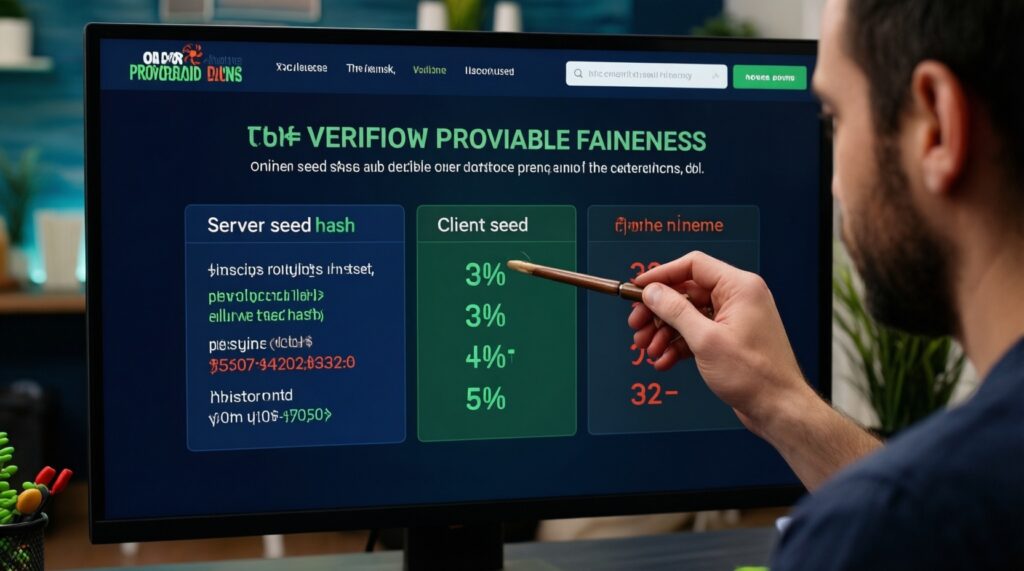
When a site claims provable fairness, you should be able to validate a round without guessing. Use this workflow for provably fair verification:
- Before betting: record the displayed server seed hash, your client seed, and confirm nonce starts at a known value (often 0 or 1).
- Place a bet: note the bet ID/round ID, nonce value used, and the shown result.
- After seed reveal: obtain the revealed server seed for that hash and the exact algorithm description (HMAC/SHA variant, concatenation format, byte-to-number mapping).
- Recompute: calculate the digest (e.g.,
HMAC_SHA256(serverSeed, clientSeed + ":" + nonce)). - Derive the outcome: apply the documented conversion to replicate the exact roll/crash point/mine layout.
- Validate the commitment: hash the revealed server seed and confirm it equals the original published hash.
Quick prevention checklist (common mistakes that break verification even on honest sites):
- Wrong delimiter/format.
clientSeed:noncevsclientSeed-noncevs JSON; one character changes everything. - Nonce mismatch. Some platforms increment nonce per bet, others per "action" (e.g., double/gamble). Confirm what increments it.
- Silent client seed changes. If the UI resets client seed on refresh/login, your recomputation won't match.
- Unclear byte slicing. Which bytes are used, in what order (hex vs raw bytes), and how many "rounds" of hashing are performed.
- Rounding rules not specified. Crash and dice often require explicit rounding/truncation rules; missing this yields near-misses.
Real-World Limits: Where Provably Fair Can Be Bypassed
- Verification only applies to covered games. A platform can market "provably fair" while the majority of its catalog is not verifiable (common with aggregator slots).
- Opaque algorithms. If the mapping from hash output to results is undocumented, the casino can choose a biased transformation while still "revealing seeds."
- Seed rotation that hides history. If you can't access past server seeds / hashes for sessions, you can't re-check older rounds reliably.
- Client seed not truly user-controlled. If the casino generates client seeds or prevents changing them, you lose an important check against server-side manipulation strategies.
- Selective disclosure UX. Some sites bury seed reveal behind settings, time limits, or per-game pages-users don't verify, so errors persist.
- "Fair result" but predatory rules. A verified roll can still be paired with unfavorable bet limits, confusing bonuses, or aggressive anti-withdrawal flags; provable fairness doesn't cover those.
Decision Checklist: How to Vet a Crypto Casino's RNG Claims
Use this practical filter before trusting "best provably fair casinos" lists or starting serious play. It's designed to catch the fastest failure modes in crypto casino RNG verification.
- Can you export everything needed? Server seed hash (pre-bet), revealed server seed (post), client seed, nonce, game ID, and round ID.
- Is the algorithm fully specified? Exact hash/HMAC function, string format, nonce rules, byte slicing, and outcome mapping.
- Is the verifier independent? Prefer cases where you can reproduce in your own script, not only through a casino-hosted widget.
- Are nonces consistent? Verify at least a few consecutive rounds; nonce should increment predictably without skips you can't explain.
- Are provably fair casino games clearly labeled? If verification applies only to certain in-house games, it should be obvious which ones.
Mini-check example (pseudo-steps you can mirror in any language):
- Input:
serverSeed,serverSeedHash,clientSeed,nonce. - Check commitment: compute
SHA256(serverSeed)and confirm it equalsserverSeedHash. - Compute digest:
digest = HMAC_SHA256(key=serverSeed, message=clientSeed + ":" + nonce). - Convert digest to result using the casino's published mapping; compare with the displayed round outcome.
Common Concerns and Clarifications
Is provably fair the same as "audited RNG"?
No. Provably fair verification lets you reproduce specific outcomes from seeds and an algorithm; "audited RNG" usually refers to third-party testing of a system's randomness properties and controls.
Do I need to verify every bet?
You don't have to, but you should verify a sample regularly and always after changing seeds. If one round fails to reproduce, stop and investigate before continuing.
Why did my recomputed result not match the casino's?
The usual causes are nonce mismatch, wrong message formatting, or missing rounding/mapping details. If the casino cannot explain the exact format and mapping, treat it as non-verifiable.
Can a provably fair crypto casino still manipulate outcomes?
If implemented correctly, it can't change an already-committed round without being detected. It can still choose unfavorable rules, hide game parameters, or limit verification to a small subset of games.
Are third-party slots provably fair?

Typically not in the same way as in-house provably fair casino games. You may get provider certificates, but you usually can't reproduce each spin from disclosed seeds.
What should I look for in "best provably fair casinos" claims?
Look for full algorithm documentation, easy seed control, accessible history (hashes and revealed seeds), and the ability to do crypto casino RNG verification without relying on a casino-only tool.