


Near-miss and chasing losses are two predictable psychological loops that make random-reward games (gacha, loot boxes, slots) feel skill-based and urgent, even when outcomes are probabilistic. If you can label the pattern early, you can stop the "one more try" spiral with simple limits, friction, and post-loss rules-before it turns into budget collapse.
Quick Reality Checks on Near‑Miss and Chasing Phenomena
- A near-miss is not "almost winning"; it is a design-shaped outcome that feels close enough to trigger persistence.
- Chasing losses is not "recovering"; it is a mindset shift where your goal becomes undoing pain, not making a good decision.
- Feeling closer after repeated pulls/spins is a perception error; random systems do not become "due" because you tried more.
- Speed, streak messaging, and limited-time framing amplify impulsive spending more than the reward itself.
- If you need a special win to "get back to even," you are already evaluating risk through a loss lens.
- Simple friction (cooldowns, budgets, removing stored cards) often beats willpower alone.
Common Myths About Near‑Miss Effects in Loot and Gacha Systems
People often ask "Near miss คืออะไร การพนัน" because it shows up in both gambling and game monetization: a near-miss is an outcome engineered or presented to look like you were close (one symbol off, one fragment short, one rarity tier below), which increases motivation to keep trying. In gacha and loot boxes, it commonly appears as "almost got the SSR," "one more shard," or "missed pity by a hair" framing.
Myth 1: "Near-miss means my strategy is improving." In random-reward systems, near-miss feedback is not valid skill feedback; it's emotional feedback. Myth 2: "I'm learning the pattern." Most of these systems are independent draws or have hidden parameters; your brain is learning the presentation, not the probability.
Myth 3: "I'm close, so stopping wastes the progress." That is a sunk-cost trap: what you already spent is unrecoverable, and the next purchase should be judged as if it were the first-based on value and budget. Myth 4: "If I keep going, I can guarantee I won't lose." Chasing turns uncertainty into urgency, not certainty.
Mechanics Behind Near‑Miss: Cognitive Biases and Brain Responses
- Counterfactual thinking: your mind simulates the "almost" win ("If the last card flipped differently..."), making the near-miss feel actionable.
- Availability and salience: flashy animations, "close calls," and highlight reels are easier to recall than the many ordinary losses.
- Variable-ratio reinforcement: unpredictable rewards strengthen persistence; adding near-miss cues increases engagement without increasing true odds.
- Illusion of control: letting you "choose," "tap," "time," or "open" creates ownership, even when the outcome is predetermined or fully random.
- Loss framing and urgency: limited banners, expiring tokens, and countdowns convert deliberation into reflex.
- Normalization through social proof: community posts of rare pulls make outcomes feel more common than they are.
When people search "กลไกสุ่มกาชา ลูทบ็อกซ์ จิตวิทยา ทำให้เสียเงิน," they are usually noticing that the emotional intensity is disproportionate to the item's practical value. The mechanism is not magic; it's a predictable interaction between randomness, attention capture, and human pattern-detection.
How Chasing Losses Warps Risk Assessment and Betting Patterns
"Chasing losses" is the shift from playing/spending for enjoyment or planned value to spending to erase a negative feeling. That is why "Chasing losses คืออะไร วิธีหยุดไล่ตามเงินที่เสีย" is a practical question: the moment you want to get back to even, your risk tolerance often spikes.
- Post-loss doubling: after a bad streak, you increase pack size, buy larger bundles, or move to pricier banners "to recover faster."
- Time compression: you shorten decision cycles ("just one more multi") and reduce reflection between purchases.
- Budget role reversal: the budget becomes a target to exceed ("I already spent this much, so what's a bit more?") rather than a boundary.
- Probability neglect: you focus on the emotional need to fix the loss, not the independent chance of the next pull/spin.
- Selective accounting: you count wins as proof of competence but treat losses as temporary obstacles that must be repaid.
Game Design Elements That Intentionally or Unintentionally Encourage Chasing
Not every system is malicious, but certain patterns reliably increase chasing because they heighten urgency and reduce friction. If your goal is harm reduction-player-side or design-side-these are the levers to watch.
Design patterns that tend to intensify the loop

- Near-miss presentation: "almost" animations, slow reveals, tease-and-deny sequences, shard systems that repeatedly stop just short.
- Escalation ladders: step-up banners, "complete the set," or "one more to unlock bonus" offers after spending.
- Stored payment and one-tap purchase: minimal checkout friction turns emotion into a transaction.
- Time pressure: expiring banners, daily resets, limited packs that appear after a loss.
- Social amplification: global announcements, influencer-style pull clips, "luck" narratives.
Protective design choices and practical constraints
- Transparent logs: clear history of spending and outcomes, visible in the same screen as purchase.
- Cooling-off by default: optional (or platform-level) delays after a spend spike or repeated failures.
- Meaningful caps: spending limits, session limits, or opt-in maximums that are hard to change instantly.
- Neutral feedback: reduce "almost" theatrics; avoid copy that implies skill or destiny.
- Value alternatives: direct purchase paths that do not rely on randomness for key progression.
Behavioral Signals and Metrics Indicating Escalating Harm
- Spend acceleration: purchases become more frequent within a session, especially after losses or near-misses.
- Rationalization scripts: "I just need one hit to fix it," "I'm due," "stopping now wastes what I paid."
- Secretive behavior: hiding receipts, switching to top-ups/gift cards to avoid seeing totals.
- Scope creep: moving from "small fun" to "must keep up," including borrowing, delaying bills, or using credit.
- Mood dependency: playing/spending mainly when stressed, angry, or numb-then regretting immediately after.
If you recognize these signals, treat them as operational alarms, not moral failure. The fastest prevention is to change the environment and rules, not to argue with the impulse mid-spike.
Practical Interventions for Players and Designers to Prevent Collapse
Use a simple "pre-commit + friction + post-loss protocol." This is the same principle behind people searching "วิธีเลิกเล่นสล็อต ออนไลน์ ไม่ให้หมดตัว": you don't negotiate with a hot state; you make the next spend mechanically harder and the stop condition automatic.
Player-side checklist (do this before you open the game)
- Set a fixed entertainment budget for the week/month and keep it separate from accounts used for bills.
- Remove stored cards from app stores; use manual top-ups with a preset amount.
- Write one stop rule: "After any loss-streak feeling, I stop for 24 hours."
- Turn off push notifications that create urgency (limited packs, last chance banners).
- Tell one trusted person your limit to reduce secrecy and renegotiation.
Designer/PM checklist (reduce chasing without killing engagement)
- Add an always-visible spend summary for the last 7/30 days on the purchase screen.
- Offer optional cooldowns and limit-setting that cannot be increased immediately.
- De-emphasize near-miss theatrics (avoid "one step away" language and slow-roll reveals).
- Provide deterministic alternatives for essential progression items.
Mini-case: a 60-second rule that blocks chasing
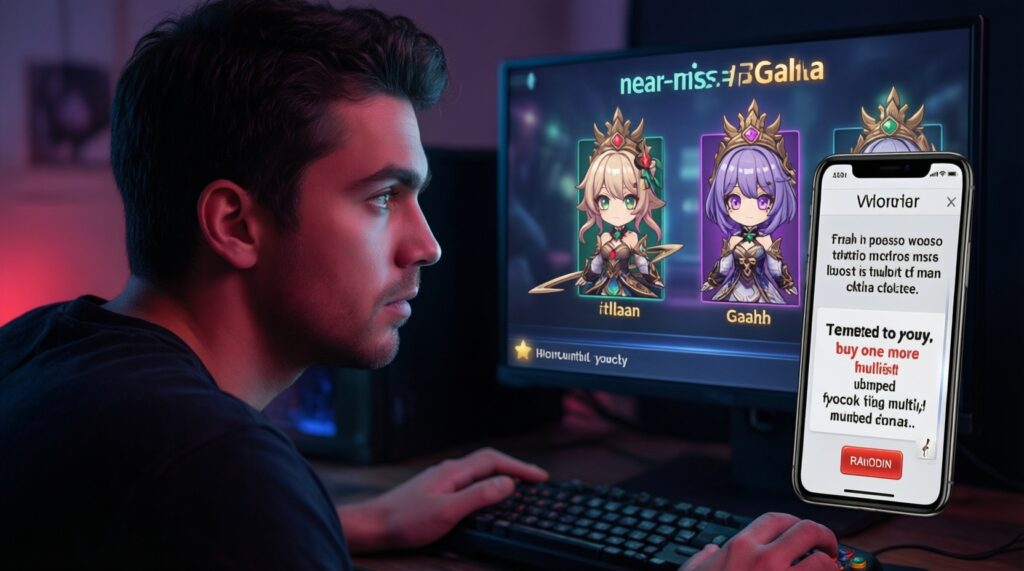
Scenario: a player misses a desired rarity, feels a near-miss, and wants "one more multi" to recover. Implement a rule that triggers automatically after a spend spike or emotional loss cue.
# Personal rule (can be a note, shortcut, or app timer)
IF I feel "almost got it" OR I think "I'm due" OR I want to "get back to even":
    STOP purchase flow
    WAIT 60 seconds (timer)
    READ my limit note (budget + stop rule)
    IF still want to buy:
        only buy the pre-planned amount
    ELSE:
        close game for 10 minutes
If this still fails repeatedly, it's time to seek structured help; many people look up "โปรแกรมบำบัดติดพนัน ออนไลน์ ปรึกษานักจิตวิทยา ราคา" because guided support adds accountability, coping skills, and relapse planning when self-rules keep getting overridden.
Concise Answers to Practitioners' and Players' Top Concerns
Is a near-miss proof the next pull is more likely to win?
No. A near-miss is a feeling of proximity, not a probability increase, unless the system explicitly changes odds (and you can verify the rule).
How do I know I'm chasing losses rather than just continuing for fun?
If your main goal becomes "recovering" money/time already spent, and you feel urgency or irritation when stopping, you're chasing.
What's the fastest way to interrupt a chasing episode in the moment?
Add friction immediately: remove payment access, set a short timer, and enforce a 24-hour pause after any "get back to even" thought.
Does pity/guarantee eliminate chasing behavior?
It can reduce uncertainty but can also create "finish the bar" pressure. Treat it as a planned purchase decision, not a rescue mission.
Can designers reduce harm without removing loot boxes entirely?
Yes. Make spending totals visible, add cooldowns and hard-to-change limits, and avoid near-miss theatrics and time-pressure offers after losses.
When should I involve a professional instead of self-limits?
If you hide spending, borrow money, can't follow your own stop rules, or your mood depends on playing, structured support is appropriate.
Are gacha and loot boxes the same as gambling psychologically?
They share key reinforcement mechanics and can trigger similar near-miss and chasing loops, even when the in-game rewards are non-cash.