


Loot boxes are paid or earned containers that use RNG to select rewards from a defined pool using published or implied probabilities. To judge them, focus on the exact pool composition, how loot box drop rates are applied (per roll, conditional, or time-limited), and compute expected value adjusted for usefulness-not hype. Then validate outcomes with a short sampling-and-fit check.
Quick reference: RNG terms, formulas and metrics
- RNG (random number generator): Software that maps a random-looking number to an item based on weights/probabilities.
- Seed: Initial state of the RNG; changing the seed changes the sequence.
- Entropy source: Where unpredictability comes from (e.g., timing jitter, OS randomness, hardware).
- Weight vs probability: If items have weights wi, then P(i)=wi/Σw (within the active pool).
- Expected value (EV): EV=Σ P(i)×V(i), where V(i) is your value for item i (not the shop price).
- Chance of at least one success in n tries: 1-(1-p)n (only when each try is independent with constant p).
- Variance/risk: Two boxes can share EV but feel different; higher variance means longer losing streaks are more likely.
Widespread myths about loot boxes and why they persist
Myth 1: "RNG means every item is equally likely." Most loot boxes use weighted selection (common items dominate), plus multiple layers (rarity roll → item roll). The "random" part is the draw, not the fairness of the weights.
Myth 2: "If I keep opening, I'm due." Unless there is an explicit pity counter, streaks do not "balance out" in the short run. Independence means past misses do not increase your next-hit probability.
Myth 3: "Advertised rates fully describe outcomes." Published percentages may apply only to a rarity tier, a featured subset, or a specific region/build. Without the full pool, the rate is incomplete for valuation and for any loot box odds calculator.
Myth 4: "The best loot boxes value is the one with the biggest headline jackpot." Value depends on your utility (duplicates, cosmetics you don't want, account progression). A lower-jackpot box can be higher EV for you if the mid-tier items are actually useful.
How RNG engines actually work: algorithms, seeds and entropy sources
- Two-stage design is common: roll a rarity/tier first, then roll an item inside that tier (each stage can have different weights).
- PRNG vs true randomness: Games typically use a pseudo-random generator (PRNG). It's deterministic given the seed, but unpredictable to players if seeded well.
- Seeding and reseeding: Seeds may be set on session start, on each purchase, or periodically; poor seeding can cause detectable patterns.
- Entropy sources: Modern servers may use OS-provided randomness; client-side RNG is more exposed to manipulation and replay attacks.
- Mapping a number to an item: a uniform random u∈[0,1) is mapped across cumulative probability intervals.
- Stateful modifiers: pity, streak-breakers, "featured guarantee," or dynamic pools turn a simple independent model into a conditional one.
// Weighted choice (single pool)
u = Uniform(0, 1)
cum = 0
for item in items:
  cum += item.weight / totalWeight
  if u < cum: return item
Drop rates demystified: advertised rates, conditional probabilities and hidden pools
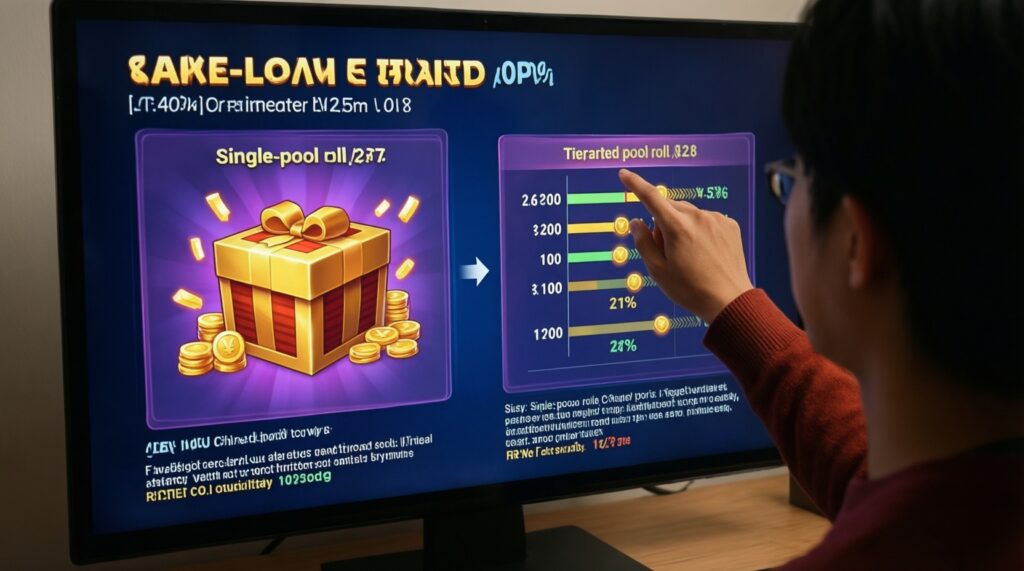
"Drop rate" can mean different things. Before you buy loot boxes or compare events, identify which of these scenarios applies:
- Per-box, single-pool roll: one roll selects one item from one pool; published odds (if complete) are easiest to interpret.
- Tiered probabilities: e.g., 90% common / 9% rare / 1% legendary, then an internal roll within the tier. The real probability of a specific legendary is 1% × P(item | legendary).
- Featured subset inside a tier: "1% legendary" but only some legendaries are "featured"; featured odds are conditional, not automatic.
- Duplicate protection / pity: probabilities change depending on your history (collection state or streak length), so the "static" rate is not your true rate over time.
- Hidden pools via eligibility: some items appear only after you reach a level, finish a questline, or own prerequisite items; the pool you roll from may differ per account.
- Time-sliced pools: event windows rotate items; "same box name" can still mean different underlying composition.
Practical takeaway: treat loot box drop rates as a function P(item | your state, time, rules), not a single number.
Player-centric valuation: expected value, utility adjustments and risk preferences
EV is the clean baseline, but a good decision model also accounts for usefulness, duplicates, and your tolerance for streaks. This is how to compare "jackpot" marketing with what you actually get.
Compute a personal EV that matches your account
- Assign utility-based values: set V(i) to what the item is worth to you (progression gain, cosmetic preference, resale/crafting if applicable), not the store list price.
- Discount duplicates: if duplicates convert to dust/shards, use the conversion value; if duplicates are dead, set V=0.
- Model conditional systems: for pity/guarantees, compute EV over a cycle (e.g., over N opens) rather than per open with constant p.
- Compare EV to price: if cost is C, then "value ratio" can be approximated as EV/C (useful for ranking best loot boxes value among options).
Adjust for risk and decision quality (not just EV)
- Variance matters: high-variance boxes can feel worse even with similar EV; long miss streaks are normal under independence.
- Set a hard cap: decide a maximum spend or max opens before starting; this prevents chasing losses.
- Use "at least one" math carefully: 1-(1-p)n only applies when each trial is independent and p stays constant.
- Prefer transparency over vibes: a box with fully specified pools is easier to evaluate than one that forces guesswork and makes any loot box odds calculator speculative.
Developer perspective: monetization design, fairness audits and regulatory traps
- Ambiguous disclosure: publishing a tier rate but hiding within-tier composition creates user backlash and makes audits harder.
- Non-stationary odds without clarity: dynamic pools, personalization, and pity systems need clear player-facing explanations to avoid "rigged" accusations.
- Client-side RNG risk: it's easier to reverse-engineer or manipulate; server-authoritative rolls are safer for integrity.
- Untracked changes: hotfixing weights without versioning and logs prevents reliable fairness review and incident response.
- Bad telemetry interpretation: small samples can look "unfair" by chance; teams should use pre-defined tests and thresholds, not cherry-picked anecdotes.
- Regulatory exposure: mechanics that resemble gambling (especially paid acquisition and chance outcomes) increase scrutiny; teams should treat documentation, disclosures, and age gating as core features, not afterthoughts.
Practical audit checklist with comparative table of sample drop-rate scenarios
Use this quick algorithm to check whether observed outcomes are broadly consistent with claimed rates, and to compare options before you buy loot boxes. It won't "prove" fairness, but it catches obvious mismatches and helps you reason about value.
Short player-side verification algorithm (sampling + fit)
- Write down the claim: specify the rate you are testing (e.g., "Legendary rate per open is p=0.01") and whether pity/guarantees exist.
- Collect a clean sample: record results for a fixed window (same box version/event, same account state if possible). Track counts per tier/item, not just "good/bad".
- Compute expected counts: for each outcome i, E(i)=n×p(i). If only tier rates are known, test tiers, not individual items.
- Compare observed vs expected: look for large, repeated deviations across multiple sessions. Single streaks are normal; persistent bias is the red flag.
- Check for conditional rules: if outcomes shift after misses/wins, you're likely in a pity or stateful system-switch to cycle-based evaluation.
- Decide using EV + constraints: run a simple EV with your utilities, then apply a spend cap and stop rule.
Comparative table: sample scenarios and EV skeleton
| Scenario | What is published | Common hidden/conditional twist | How to compute EV correctly | Common evaluation mistake |
|---|---|---|---|---|
| Single pool (weighted items) | Full item list with per-item probabilities | Pool changes by time window | EV = Σ P(item) × V(item) | Using old probabilities after an event rotation |
| Two-stage tiers (rarity → item) | Tier rates (e.g., P(legendary)) | Within-tier weights not disclosed | EV = Σ tiers P(tier) × Σ items P(item|tier) × V(item) | Assuming each legendary is equally likely |
| Featured banner inside a tier | Tier rate + "featured" callout | Featured is only a fraction of the tier | P(featured item) = P(tier) × P(featured|tier) × P(item|featured) | Reading "featured" as "guaranteed on hit" |
| Pity / guarantee system | Sometimes a max-opens guarantee is disclosed | Soft pity ramps odds gradually; rules are opaque | Compute EV over a cycle of opens using the rule table (state-based probabilities) | Applying 1-(1-p)^n with a changing p |
| Duplicate protection | Often described as "no duplicates until complete" | Applies only to a subset; converts others to shards | Use account-state pool; set V(duplicate)=conversion value | Ignoring that your pool shrinks and EV can increase over time |
// Minimal EV worksheet (you can paste into any notes app)
EV = 0
for each outcome i:
  EV += P(i) * V(i)   // V(i) is your utility, duplicates discounted
value_ratio = EV / cost_per_box
Concise answers to recurring questions from players and designers
Are loot boxes always "rigged" if I hit long losing streaks?
No. With independent RNG, long streaks happen naturally; "rigged" requires evidence of systematic deviation or conditional rules not disclosed.
What's the minimum I need to evaluate loot box drop rates?
You need the active pool definition and how probabilities are applied (single pool, tiered, featured, pity). Without that, any conclusion is partly guesswork.
Can a loot box odds calculator tell me the exact chance to get a specific item?
Only if it has correct inputs: per-item probabilities or tier + within-tier weights plus any pity/guarantee rules. If the pool is hidden or stateful, it can only estimate.
Is it rational to buy loot boxes for a specific rare item?
It can be, but only if your computed EV/utility and your budget cap justify the risk. If there's a direct purchase path, compare against that deterministic alternative.
How do I decide which is the best loot boxes value across events?

Compute a personal EV for each event using the current pool and your utilities, then rank by EV per cost while considering variance and stop rules.
Do published rates guarantee fairness across a small number of opens?
No. Published rates describe long-run behavior under the stated rules; short-run samples can deviate widely even when the system is fair.
What's one red flag that drop rates might be conditional?

If your results visibly shift after a miss streak (or after you obtain a top item), the system may include pity, streak breakers, or pool changes.