

Esports odds are built by turning match predictions into prices, then adjusting them for bookmaker margin, market demand, and live information. Models start with estimated win probabilities (from ratings, stats, and context), convert them into esports bookmaker odds, and then move those prices as bets arrive and new data hits-creating occasional value betting esports spots when the market overreacts.
Core mechanics behind esports odds generation
- Bookmakers begin with a baseline probability model, then translate probabilities into esports betting odds plus margin.
- Different sports-style pricing models are used, but esports adds patch changes, map pools, and roster volatility.
- Odds move not only because teams change, but because money flows and public bias change the risk profile.
- "Fair" odds are rarely shown; the displayed price is usually a risk-managed price.
- Value appears when your probability differs from the book's implied probability after margin.
Bookmaker pricing models applied to esports
In esports, odds-making is a pipeline: (1) estimate probabilities, (2) apply margin, (3) manage exposure by moving lines, and (4) update continuously with new information. The "model" is not just a formula; it is a set of rules for how probabilities and prices react to uncertainty, volume, and time-to-start.
Most operators blend automated pre-match pricing with human oversight for edge cases (late stand-ins, map veto surprises, suspicious volume). This is why two books can show different esports betting odds for the same match even when they use similar underlying statistics.
Practically, your job as a bettor is to identify which model behavior you are facing (sharp/market-making vs. copy/retail risk-managed) and adapt your approach, including doing an esports odds comparison across books.
Comparison of common pricing approaches

| Model type | How it typically sets the opener | Strengths | Weaknesses | Typical use case |
|---|---|---|---|---|
| Rating-based (Elo/Glicko-style) | Team ratings + adjustments (maps, roster, recency) | Fast, consistent; good baseline for many matches | Can lag behind meta/patch shifts; struggles with rare lineups | Pre-match moneyline openers |
| Statistical feature model (regression/ML) | Features from team/player stats to estimate win probability | Captures more context; can model matchups and maps | Garbage-in-garbage-out; feature leakage and overfitting risk | Map markets, totals, props (where available) |
| Market-making / sharp-following | Opener close to an internal number, then quickly follows sharp action | Efficient closing lines; reduces liability vs. informed bettors | Less mispricing; value windows are shorter | Higher-volume leagues; major tournaments |
| Copy / odds-feed replication | Mirrors a source bookmaker/exchange with a markup | Cheap to operate; decent coverage breadth | Latency and stale prices; can mis-handle roster/news | Smaller books, long-tail events |
| Risk-managed retail | Starts from a baseline then tilts lines to balance exposure | Protects the book; reacts to public money | Can drift from "true" probability under one-sided public action | Popular teams, headline matches |
Mini-workflow: identify the bookmaker behavior in 5 minutes
- Check 3-5 books: are prices clustered or dispersed (quick esports odds comparison)?
- Watch the first moves after limits increase: do lines snap toward one "leader"?
- Note if favorites shorten when public teams are involved without new info.
- Track how quickly in-play prices respond to obvious events (pauses, map picks).
Quantitative inputs: data sources and feature engineering
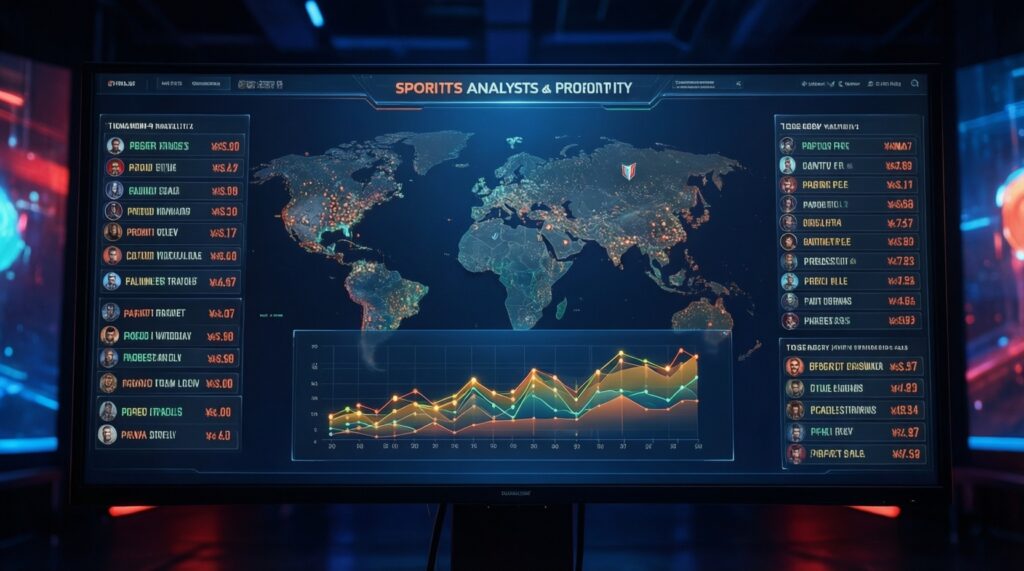
Books convert esports match information into features, then into probabilities. Because esports is patch- and map-dependent, the feature set matters as much as the algorithm.
- Team strength signals: rating systems, recent results weighted by opponent strength and recency.
- Map/side context: map pool, map-specific win rates, veto tendencies, side bias where relevant.
- Roster stability: stand-ins, role swaps, new IGL/captain effects, time since roster change.
- Schedule and fatigue: back-to-back matches, travel, time zone, long series lengths.
- Meta and patch indicators: patch version, hero/agent priority shifts, pick/ban trends.
- Event conditions: online vs. LAN, region, ping, format (Bo1/Bo3/Bo5).
Mini-scenario: building your own quick probability check
- Start with a baseline: "Team A is slightly stronger" (rating gap) rather than a narrative.
- Adjust for the one or two biggest esports-specific factors (e.g., map pool mismatch; stand-in).
- Write a simple internal number:
p_estfor Team A win (even a rough % in your notes). - Compare
p_estto the book's implied probability (see formula below) to detect potential value.
How public bias and market flows skew prices
Even with solid models, prices move because the bookmaker is managing risk against incoming bets. Public bias tends to be predictable in esports: popular orgs, recent highlights, and "star player" narratives attract action, especially near match start.
Typical situations where prices drift
- Brand-name favorites: lines shorten because casual money stacks on the logo, not the matchup.
- Recency bias: a team that just stomped is overbet; a team that just threw is underbet.
- Patch shock: the market overreacts to a new patch without enough matches to calibrate.
- Stand-in news timing: early books move fast; slower books lag and may be stale for minutes.
- Format misunderstanding: Bo1 variance gets priced like Bo3 by less careful bettors.
- Liquidity pockets: small leagues can swing heavily from a few large bets.
Mini-scenarios: how to use flow instead of fighting it
- If a public favorite is getting steamed late: consider waiting for a better underdog price, but only if no new info explains the move.
- If a niche match has thin liquidity: prioritize books with faster updates; stale esports bookmaker odds can be void-risky or quickly corrected.
- If you suspect narrative-driven action: look for derivative markets (map 1, handicap) where bias can be stronger or weaker depending on the book.
Calculating margin, implied probability and value
To evaluate odds you need two numbers: the bookmaker's implied probability and your estimated probability. The gap between them (after accounting for margin) is where value betting esports decisions live.
Core formulas (simple and sufficient)
- Decimal odds to implied probability:
p_imp = 1 / odds - Two-way overround (margin proxy):
overround = (1/odds_A) + (1/odds_B) - Fair probabilities (rough normalization):
p_fair_A = (1/odds_A) / overroundand same for B - Expected value check: bet if
p_est * odds - 1 > 0
Where this approach helps (practical advantages)
- Turns "feels like value" into a repeatable decision rule for esports betting odds.
- Lets you compare books objectively during an esports odds comparison.
- Highlights when "best esports betting sites" for a league are simply the ones running lower effective margins on your target markets.
Where it breaks (limits you must respect)
- Your
p_estcan be wrong due to hidden info (scrim form, illness, internal issues). - Margins vary by market (moneyline vs. props), so "value" can disappear after normalization.
- Closing-line efficiency is higher in top-tier events; edge windows tend to be smaller and shorter.
Live pricing: latency, feeds and in-play model adjustments
Live odds are a race between event information and price updates. Books rely on official data feeds, stream tracking, and internal timers; latency and interruption handling are the difference between sharp in-play markets and chaotic ones.
Common errors and myths in in-play esports pricing
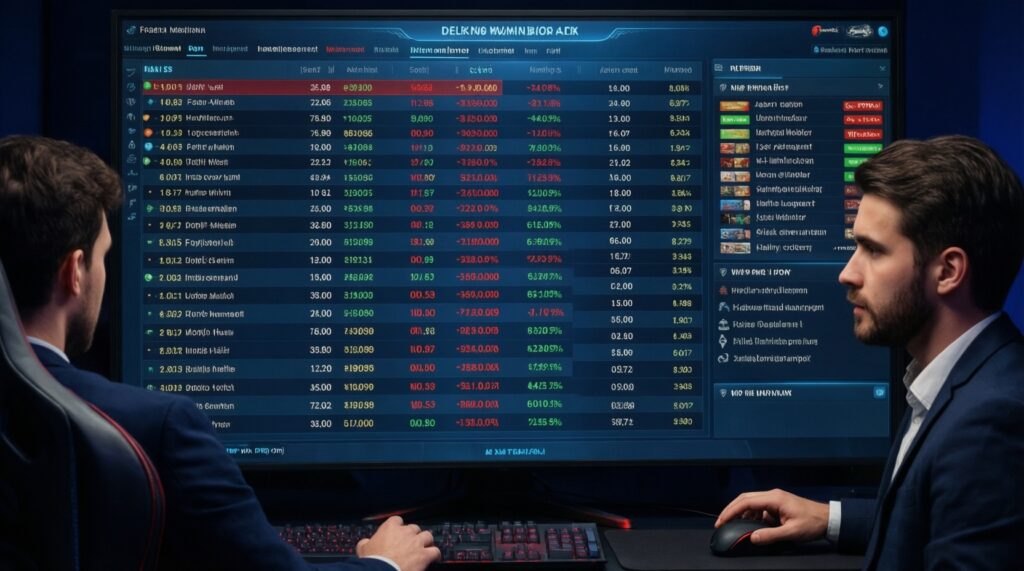
- Myth: live odds always reflect the stream instantly. Reality: feeds and delays can differ; books may suspend markets during uncertain states.
- Error: ignoring pause/technical timeouts. Models can misread momentum; pricing may be conservative or frozen.
- Error: treating every kill/objective equally. Context matters (economy in CS, buybacks/ult economy in Dota-like dynamics).
- Myth: stale live odds are "free money." Reality: many books void or limit if they detect latency abuse; also prices can snap before you place.
- Error: overbetting small edges live. Execution risk (suspensions, re-pricing) can wipe theoretical value.
Mini-workflow: safer live betting decision gate
- Confirm data reliability: is the market frequently suspended or jumpy?
- Only act when you can describe the reason in one sentence (e.g., "map pick strongly favors CT-side and economy trend confirms").
- Prefer books with consistent in-play rules and faster updates; test with small stakes first.
Practical case studies: spotting value in CS:GO and Dota 2
These mini-cases show how value can appear when your matchup read differs from a risk-managed price. The goal is not to predict perfectly, but to systematically compare your probability to implied probability across multiple books.
Case A (CS-style): map pool mismatch hidden by brand bias
- Observation: Team A is a popular brand; Team B has strong win rate on likely maps.
- Hypothesis: public money shortens Team A's price close to start.
- Action: wait for late drift, then take Team B at the best number found via esports odds comparison.
# pseudo-steps
p_est_B = base_rating_B
p_est_B += map_pool_edge
p_est_B -= roster_uncertainty_penalty

p_imp_B = 1 / odds_B
if (p_est_B * odds_B - 1) > 0:
    bet_B()
Case B (Dota 2-style): patch + draft tendencies create mispricing
- Observation: new patch favors tempo lineups; Team C's captain drafts that style consistently.
- Market issue: books price mostly from historical ratings; early patch games are noisy.
- Action: target map 1 or series markets depending on whether the edge is draft-dependent or endurance-dependent.
Case C (cross-title): locating the best number across books
- Take the same selection and check at least 3 operators; esports bookmaker odds can differ meaningfully due to different risk rules.
- If two books disagree, don't average them-investigate why (limits, timing, news).
- Over time, your "best esports betting sites" list should be league-specific (some books are strong on majors, weak on smaller regions).
Practical clarifications bettors ask most often
Why do esports betting odds move even when no news drops?
Because money flow changes the bookmaker's exposure and they re-price to manage risk. In smaller leagues, a few bets can move the line noticeably.
Are the best esports betting sites always the ones with the highest odds?
No. Consistency of limits, speed of updates, and how often a book shows stale numbers matter as much as the headline price.
How do I do a clean esports odds comparison without overthinking it?
Compare the same market type (moneyline vs. map vs. handicap) at the same time window. Record the best price available and whether it persists or instantly snaps back.
What is value betting esports in one sentence?
It is betting when your estimated win probability implies a better payoff than the bookmaker's implied probability after margin.
How can I tell if esports bookmaker odds include a lot of margin?
Convert both sides to implied probabilities and add them; the excess over 1.00 is the overround. Higher overround means worse pricing for the bettor.
Do live odds give more value than pre-match?
Sometimes, but execution risk is higher due to suspensions and latency. You need a clear informational edge, not just a quick click.
Why do two books show different odds for the same match?
They may use different openers, copy different sources, or manage risk differently based on their customer base and liabilities.