
Game token risk mainly comes from thin liquidity, manipulation-prone trading activity, and tokenomics that unlock supply faster than real in-game demand. To evaluate fast and safely, you need to check liquidity/market depth, look for wash trading and coordinated pumps, then scan supply, emissions, and vesting to forecast sell pressure. This guide provides a practical checklist.
Quick Risk Snapshot for Game Tokens
- Liquidity risk: shallow pools and sparse order books can turn small sells into large drawdowns (common in ความเสี่ยงโทเค็นเกม สภาพคล่องต่ำ scenarios).
- Manipulation risk: volume spikes without distribution, repeated self-trades, and clustered wallets can indicate coordinated activity.
- Tokenomics risk: high emissions + near-term unlocks can overwhelm organic demand even if the game looks "active."
- Centralization risk: admin keys, upgradeable contracts, or concentrated treasuries can change rules after you enter.
- Execution risk: slippage, MEV, and low market depth can break your entry/exit plan.
| What to check (fast) | Healthy-ish signal | Red flag (risk-aware) | Where to verify (typical) |
|---|---|---|---|
| 24h volume vs. unique traders | Volume aligns with many distinct traders | High volume with few wallets or repetitive patterns | DEX analytics + explorer transfers |
| Liquidity & depth | Meaningful depth around mid-price | Thin liquidity; small trades move price heavily | Order book (CEX) / pool reserves (DEX) |
| Supply schedule | Unlocks are gradual and communicated | Large, near-term unlocks; unclear vesting | Docs, vesting contracts, token trackers |
| Holder concentration | Distribution not dominated by a few wallets | Top wallets can crash price with one sell | Explorer "holders" tab |
| Admin / upgradeability | Multisig + timelock + audited upgrade path | Single key can mint/freeze/upgrade instantly | Contract read functions, verified source |
Understanding Token Liquidity in Game Economies
This section is for intermediate traders who already know how to place DEX/CEX orders and want to avoid being trapped by illiquid game tokens. It's especially relevant when you're deciding ซื้อโทเค็นเกมที่ไหนดี (CEX vs DEX) and you need predictable exits.
- Good fit: you can read pool reserves/order books, estimate slippage, and size positions accordingly.
- Don't do it when: you cannot verify liquidity sources (fake liquidity, temporary incentives), cannot tolerate wide slippage, or you must be able to exit quickly (thin markets can gap down).
Fast on-chain indicators:
- DEX pool reserves: check the pair's reserves and recent changes; sudden liquidity removals are a warning.
- Transfer activity: scan recent token transfers for large movements to exchanges/pools that could precede dumps.
Recognizing Signs of Price Manipulation and Wash Trading
To apply วิธีเช็กภาวะปั่นราคาโทเค็นเกม reliably, you need access to basic market data and an explorer. You're looking for patterns that suggest price/volume is being manufactured rather than discovered.
What you need (minimum toolkit)
- Block explorer for the chain (to inspect holders, transfers, and contract code if verified).
- DEX/CEX market data (candles, trades, order book/depth if available).
- Wallet labeling (optional) via analytics tools to cluster likely related addresses.
Two concrete checks you can run quickly
- Trade pattern scan: look for repeated same-size trades at regular intervals, or alternating buy/sell between a small set of wallets (common wash-trade signature).
- Volume-to-price sanity: if reported volume is huge but price barely moves and holder count doesn't change, suspect internal recycling of volume.
Rapid Tokenomics Checklist: Supply, Emissions, and Vesting
If your goal is วิธีดู Tokenomics แบบเร็ว, focus on what changes circulating supply and who can sell. Tokenomics is less about glossy pie charts and more about timing, unlock authority, and emissions pressure.
Risk limits before you start (read first)
- Assume docs can be incomplete: treat marketing tokenomics as untrusted until confirmed on-chain or by immutable contracts.
- Expect regime changes: games often change reward rates; model a "rewards go up" and "rewards go down" scenario.
- Circulating supply can jump: unlocks, bridge mints, or treasury moves can change supply fast.
- Don't anchor on price: token price can be held up temporarily even while unlocks accumulate sell pressure.
-
Confirm the token you're analyzing (contract + chain).
Match the contract address from an official channel to the explorer, verify decimals/symbol, and confirm you're not looking at a copycat.- Check "verified contract" status and whether the token is upgradeable.
-
Map current supply: total vs circulating vs unlocked.
Identify what is already liquid today versus what can become liquid soon (team, investors, treasury, rewards).- On-chain hint: treasury and vesting wallets are usually among top holders; inspect their outgoing transfers.
-
Locate emissions: play-to-earn rewards, staking, and liquidity incentives.
Find how new tokens enter circulation (per block/per day schedules, reward multipliers, or admin-adjustable rates). If emissions are adjustable, treat it as governance/centralization risk too. -
Check vesting and unlock mechanics (who can sell and when).
Determine whether locks are enforced by smart contracts or merely promised. Prefer timelocked/vesting contracts with transparent schedules.- Quick check: search for "vesting", "timelock", "token distributor" contracts linked from official docs, then confirm transactions exist.
-
Identify concentration and "dump capacity".
Look at top holders and estimate whether a few wallets can overwhelm daily volume/liquidity. Concentration magnifies both liquidity risk and manipulation risk. -
Connect token utility to sustainable demand (not just rewards).
Separate "must-buy" demand (fees, crafting sinks, access) from "optional/speculative" demand. If the main use is farming rewards, emissions tend to dominate price action.
Assessing Market Depth: Order Books, Pools, and Slippage
Use this checklist to validate whether the market can absorb your trade size without large slippage, especially when deciding ซื้อโทเค็นเกมที่ไหนดี and comparing a CEX order book versus a DEX pool.
- Check pool liquidity (DEX) or order book depth (CEX) around current price, not just "24h volume."
- Estimate slippage at your intended size; if your expected slippage is already uncomfortable, your exit will be worse in stress.
- Look for liquidity concentration: if most liquidity sits far from mid-price, small moves can cascade.
- Inspect recent large trades: note how far price moved and how quickly it reverted.
- Watch for liquidity pull events on DEX pools (sudden reserve drops can signal impending volatility).
- Compare DEX vs CEX pricing: persistent large gaps can imply withdrawal limits, market segmentation, or manipulation.
- Check route risk on DEX aggregators: multi-hop routes can add extra slippage and failure points.
- Confirm trading status constraints (CEX): deposit/withdraw enabled, network congestion, and any token-specific restrictions.
Governance, Centralization, and Admin Key Risks
These are common mistakes traders make when evaluating game tokens-especially when the question is โทเค็นเกมคืออะไร ลงทุนดีไหม and the decision is made on gameplay hype rather than control surfaces.
- Ignoring upgradeability: an upgradeable token or game contract can change logic after you enter.
- Assuming "DAO" equals decentralization: governance tokens can be distributed, but voting power may still be concentrated.
- Not checking mint authority: if a role can mint or expand supply, emissions risk is unbounded.
- Missing pause/freeze controls: transfers can be halted, trapping liquidity or blocking exits.
- Overlooking treasury dominance: a treasury that controls most tokens can become the market.
- Trusting vesting promises without on-chain enforcement: cliff unlocks can surprise the market.
- Neglecting bridge risk: wrapped versions may have different controls and supply constraints than the "native" token.
- Using the wrong contract: trading a copycat or wrong chain deployment due to poor address verification.
Mitigation Strategies: Monitoring, Tools, and Response Playbook
Choose the mitigation approach that matches your risk tolerance and the token's structure. This is most important in thin markets where ความเสี่ยงโทเค็นเกม สภาพคล่องต่ำ can make exits unpredictable.
Option 1: Trade only where you can exit (venue selection)
- Use a venue with stronger depth for your size (often a major CEX), but verify deposit/withdraw status before entering.
- If using DEX, prefer pairs with stable and persistent liquidity (not only short-term incentives).
Option 2: Size and execution controls (reduce slippage and regret)
- Split entries/exits into smaller clips; avoid market orders in thin books.
- Set a maximum acceptable slippage and walk away if the market cannot fill you safely.
Option 3: Ongoing monitoring (early warning)
- Create alerts for large transfers from top holders/treasury/vesting wallets to exchanges or pools.
- Monitor sudden liquidity changes in primary pools and abrupt shifts in volume composition (few wallets dominating trades).
Option 4: Predefined response plan (what you do when signals flip)
- If manipulation signals increase (wash-like patterns, clustered counterparties), reduce exposure rather than "average down."
- If unlock/emission outlook worsens (new incentives, schedule changes), reassess thesis and consider exiting into strength, not into panic.
Practical Questions Traders Ask About Token Risk
How do I answer "โทเค็นเกมคืออะไร ลงทุนดีไหม" without hype?
Treat it as a risk question: can the token sustain demand without emissions, and can you exit reliably given liquidity and centralization controls. If either is unclear, assume higher risk and size down.
ซื้อโทเค็นเกมที่ไหนดี: DEX or CEX?
Choose the venue with reliable depth and operational access (deposits/withdrawals, network stability). If the DEX pool is thin or liquidity is incentive-driven, your exit risk rises sharply.
What's the fastest "วิธีดู Tokenomics แบบเร็ว" that actually helps trading?
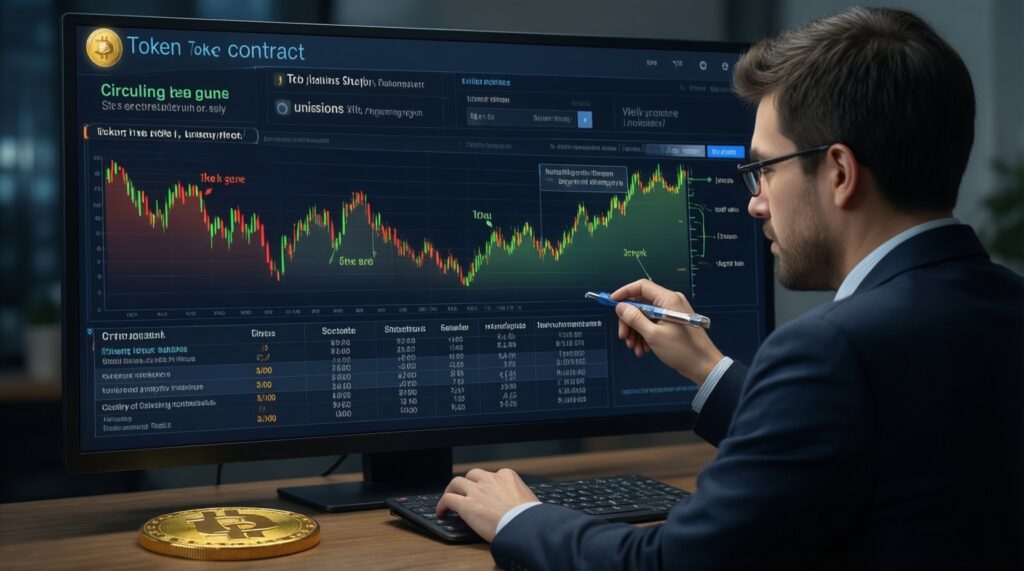
Verify contract, then focus on circulating supply changes: emissions, upcoming unlocks, and holder concentration. Ignore decorative allocations until you confirm sell authority and timing.
What are the clearest signs of "ความเสี่ยงโทเค็นเกม สภาพคล่องต่ำ"?
Large price moves from small trades, wide spreads, and depth that disappears quickly. If you can't exit your planned size with controlled slippage, treat the token as illiquid.
วิธีเช็กภาวะปั่นราคาโทเค็นเกม in under 10 minutes?
Look for repeated trade sizes/timing, volume concentrated in few wallets, and inconsistent volume-to-holder growth. Cross-check with explorer transfers for circular flows between the same addresses.
Does high "24h volume" guarantee safety?
No. Volume can be wash-traded or concentrated among insiders; you need unique traders, distribution changes, and real market depth to trust it.
If tokenomics looks bad but the chart is strong, what should I do?
Assume the chart can lag fundamentals in manipulated or illiquid markets. Reduce position size, tighten execution rules, and wait for confirmation via supply/unlock and liquidity behavior.