

Esports betting 101 comes down to choosing the right market (ML, Map, Handicap, or Props) and converting odds into implied probability before you risk money. Use consistent rules: confirm match format, map pool, roster status, and settlement terms on your เว็บพนันอีสปอร์ต, then size stakes conservatively and avoid markets you can't verify.
Quick betting essentials checklist
- Confirm the game, league, and match format (Bo1/Bo3/Bo5) before any เดิมพันอีสปอร์ต.
- Check roster news (stand-ins, role swaps) and patch/version context.
- Know the market's settlement rule (match, map, rounds, or specific player/team props).
- Convert odds to implied probability and compare with your estimate (don't bet on "feel").
- Prefer markets with clear data points (recent maps, veto tendencies, side/starting advantages).
- Use a fixed staking rule and pre-set stop conditions (tilt control).
Market overview: how esports betting markets are structured
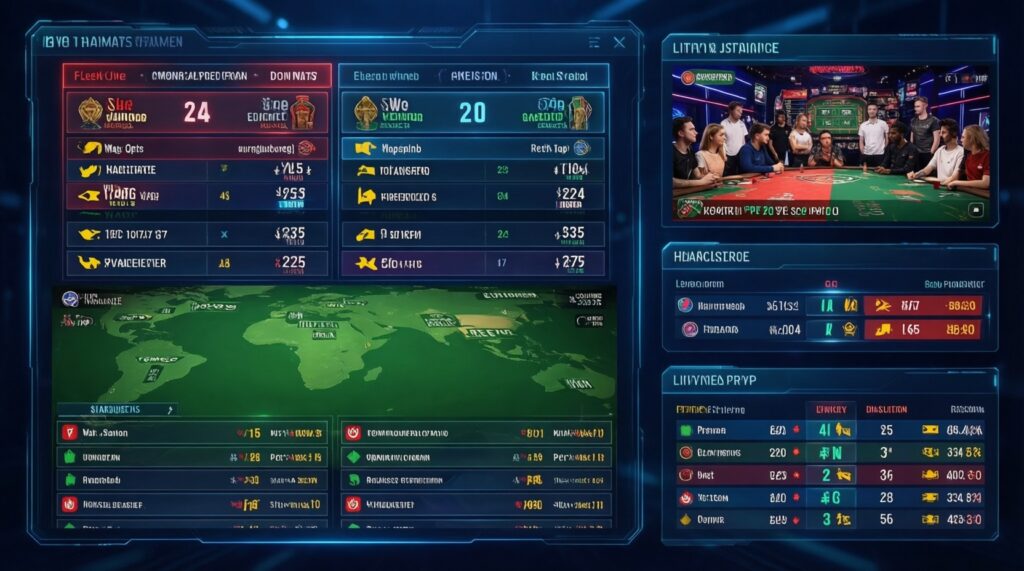
Most esports books group markets by what gets settled: the match result (Moneyline/Match), an individual map result (Map bets), a margin line (Handicap), or a specific measurable event (Props). These can be priced pre-match and sometimes live; the key difference is how much variance each market carries and how sensitive it is to format and map-veto information.
Who this fits best
- Intermediate viewers who follow a specific title and understand formats and map pools.
- Bettors who can estimate win probability and accept short-term variance.
When you should skip betting

- You cannot confirm the format, map pool, or roster status.
- You are relying on highlights, reputation, or community hype instead of recent match context.
- Settlement rules are unclear (postponements, substitutions, default wins, map changes).
Moneyline (Match) bets - rules, edge cases, and settlement
Moneyline (often "Match Winner") settles on who wins the match/series, not a specific map. If you've asked "เดิมพัน ML อีสปอร์ต คืออะไร", it's the simplest market: pick Team A or Team B to win the match under the listed format.
What you need before placing an ML bet
- An account with a licensed operator in your jurisdiction and access to the event page (rules/settlement section).
- Match format confirmation (Bo1 vs Bo3 is a major pricing driver).
- Roster and starting lineup status (stand-ins can swing true probability).
- Your own probability estimate (even a rough range) and the implied probability from odds.
Common edge cases to check in the rules
- Postponements: Some books void if not played within a time window; others keep action.
- Default wins (forfeit): May count as settled or may void, depending on house rules.
- Roster changes: Typically still action unless the event is cancelled, but house rules vary.
- Map count corrections: Admin reversals can affect map markets more than ML, but verify.
Map bets and map pools - when to pick maps vs. matches

Map markets let you target a team's strength on a specific map or in a specific game state. They can offer clearer edges when veto patterns are predictable, but they can also be invalidated by last-minute veto surprises or format misunderstandings.
Preparation mini-checklist (before you follow the steps)
- Confirm the series format and whether the veto is public, simulated, or not shown.
- List each team's recent map picks/bans and comfort maps (avoid outdated samples).
- Identify likely first map based on side selection and historical veto tendencies.
- Check whether the market is "Map 1 winner" vs "Any map winner" vs "Correct map score".
- Read the settlement line: does overtime count, are admin restarts treated normally?
-
Choose the correct map market (Map 1, Map 2, or map handicap)
Start with the simplest settlement you can validate: "Map 1 winner" is usually easier to model than exact series score. Only move to exotic map props when you can explain exactly how the bet wins or loses.
- Use Map 1 when you have a strong read on opening veto/pick tendencies.
- Use Map 2+ only if you can justify how the series is likely to reach that map.
-
Translate veto expectations into a probability range
Assign a probability for the team winning the target map given it is played. Then adjust for uncertainty: if the map is only "likely", reduce your confidence or skip.
- If the map is not guaranteed, your true edge is smaller than it looks.
- If a team's "best map" is heavily banned by opponents, don't price it as if it will appear.
-
Compare your probability to odds and decide stake size
Convert odds to implied probability, compare to your estimate, and only bet if the gap is meaningful for your risk tolerance. Keep stakes consistent (fixed units) to avoid overreacting to variance.
-
Re-check market conditions right before placing
Validate the match has not changed (start time, map pool updates, roster swaps). For live markets, ensure you understand whether the book is using delayed streams and how suspensions work.
Handicap betting - calculating lines, vigorish, and expected value
Handicap markets settle on a margin: maps, rounds, or sometimes kills/objectives depending on the title. If you've wondered "เดิมพันแฮนดิแคปอีสปอร์ต คืออะไร", it's a spread that makes a favorite "give" a head start and an underdog "receive" one, changing payouts.
3-step worked example (safe, format-first)
- Identify the unit and the line
Example: "Team A -1.5 maps" in a Bo3 means Team A must win 2-0 to cover; a 2-1 win loses the handicap bet. - Convert the price to implied probability
If the odds imply a higher probability than you believe is realistic (given veto and team style), you pass. - Account for vigorish (the book's margin)
Compare both sides of the handicap: if both prices imply more than 100% combined probability, that "extra" is the vig; you need a bigger edge to justify a bet.
Result-check checklist (use after you decide on a handicap)
- Line unit matches the competition format (maps vs rounds; Bo1 vs Bo3 changes everything).
- You can state the exact winning conditions in one sentence (no ambiguity).
- Favorite's win condition is plausible given comeback/throw frequency and closing ability.
- Underdog's cover condition is plausible given map pool and likely veto outcome.
- You checked both sides' prices to understand vig (don't evaluate one side in isolation).
- Settlement rules cover forfeits, restarts, and map replays.
- Your edge remains if the "expected map" doesn't appear (or you skip the bet).
- Your stake fits your unit plan; no doubling after losses.
Prop bets in esports - popular markets and pricing logic
Props (proposition bets) focus on a measurable stat: first map pistol winner, total rounds, first blood, total kills, player performance lines, and similar. They can be mispriced when the book's model lags behind role changes, patch effects, or slow/fast playstyle shifts.
3-step worked example (keep it verifiable)
- Define the stat and scope
Example: "Total rounds over X on Map 1" depends on regulation rules and whether overtime counts in settlement. - Link it to match dynamics
Estimate whether the teams' pace, defense/offense strength, and map style tends to produce long or short maps-without assuming a specific final score. - Stress-test against a different game script
If one team stomps early, does your prop still have a path? If not, your stake should be smaller or you should avoid it.
Frequent mistakes to avoid
- Betting props without reading the settlement definition (overtime, remakes, paused maps).
- Assuming a player prop is stable despite role swaps, stand-ins, or new in-game leaders.
- Ignoring correlation (stacking many props that all rely on the same script, like a 2-0 stomp).
- Overvaluing small samples (one tournament) and undervaluing opponent strength and map context.
- Chasing "fun" longshots with unclear modeling just because the payout is large.
- Not checking whether the prop is for Map 1 only vs entire match.
- Misreading totals when pace changes after a patch or meta shift.
Quick risk checklist for props
- Is the stat officially tracked and consistently reported for this event?
- Is the scope clear (map vs match, regulation vs including overtime)?
- Would a pause/remake materially affect the prop's fairness under house rules?
- Are you accidentally doubling exposure by also betting ML/handicap based on the same narrative?
Reading odds: decimal, fractional, American and implied probability
For วิธีอ่านออดส์เดิมพันอีสปอร์ต, treat every odds format as a different wrapper for the same idea: implied probability. Converting odds lets you compare markets fairly and avoid paying too much for "confidence".
| Format | Example odds | Implied probability (how to compute) | Simple return example |
|---|---|---|---|
| Decimal | 2.00 | 1 / 2.00 = 0.50 | Stake 100 returns 200 (profit 100) |
| Fractional | 1/1 | Denominator / (Numerator + Denominator) = 1 / (1+1) = 0.50 | Stake 100 profits 100 (returns 200) |
| American (plus) | +100 | 100 / (100 + 100) = 0.50 | Stake 100 profits 100 (returns 200) |
| American (minus) | -200 | 200 / (200 + 100) ≈ 0.6667 | Stake 200 profits 100 (returns 300) |
When different formats are useful
- Decimal odds: Best for quick comparisons across markets and straightforward payout math.
- American odds: Useful if your book displays risk-to-win clearly (especially for favorites with minus prices).
- Fractional odds: Handy when thinking in "profit relative to stake" terms, but convert to probability for decision-making.
- Implied probability view: Best for evaluating value; it forces you to quantify your own estimate before betting.
Targeted clarifications and concise answers
What is the safest first market for an intermediate bettor?
Moneyline is usually easiest to verify and settle because it depends only on the match winner. Start there until you can reliably model map-veto outcomes and margin lines.
Does "Map winner" mean the same as "Match winner"?
No. Map winner settles on a specific map result, while match winner settles on the series result under the listed format.
How do I know if a handicap is maps or rounds?
The market name should specify the unit (maps/rounds). If it's not explicit in the bet slip or rules, don't place the bet.
Are props worse value than ML or handicap?
Not automatically. Props can be good when you can validate the stat definition and connect it to stable team tendencies, but they're easier to misprice and easier to misunderstand.
How do I convert odds into implied probability quickly?
For decimal odds, use 1 divided by the odds. For American odds, use the standard plus/minus formulas shown in the table and compare the result to your own estimate.
What should I check on a เว็บพนันอีสปอร์ต before betting?
Check settlement rules for postponements/forfeits, confirm the match format and map pool, and verify the market scope (map vs match, regulation vs overtime). If any of these are unclear, skip.