

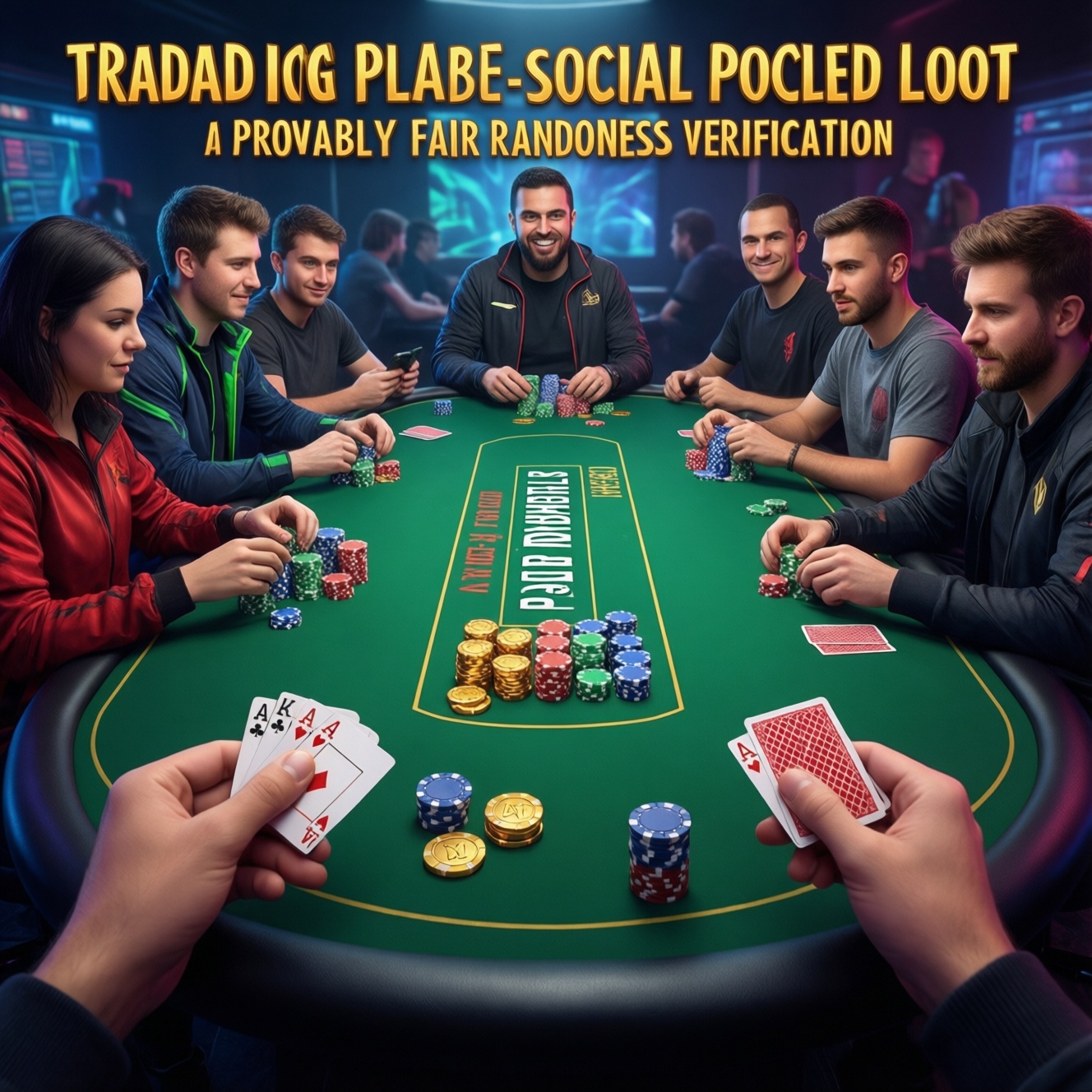
Gaming and gambling are converging through on-chain loot, provably fair verification, and social betting-turning play sessions into value-bearing, auditable, and community-driven wagering loops. For intermediate teams in Thailand, the practical future is not "full casino in a game," but modular mechanics: verifiable randomness, tradable items with constraints, and pooled bets with strong safeguards.
Core insights on the convergence of gaming and gambling
- On-chain loot is not automatically "true ownership"; control depends on upgradeability, custody, and marketplace rules.
- Provably fair คาสิโน works when users can independently verify randomness inputs and outputs, not when it's only a marketing label.
- Token economics often fail due to weak sinks, uncontrolled inflation, and misaligned incentives between players, whales, and operators.
- เว็บพนันโซเชียลเดิมพัน patterns spread risk and acquisition through communities, but amplify collusion and responsible-gaming challenges.
- Cross-border compliance is a product design constraint: payments, KYC/AML, and promotion mechanics can trigger gambling classification.
- Low-resource teams can ship credible verification and safer markets using minimal primitives (commit-reveal, capped supplies, restricted transfers).
Debunking myths about on-chain loot and true ownership
Myth: "If an item is on-chain, players own it fully." In practice, "ownership" is a bundle of rights: the ability to transfer, use in-game, redeem rewards, and access metadata. A token can be transferable yet useless if the game server rejects it, or if metadata is mutable.
Definition (useful boundary): On-chain loot is a digital item whose state (ownership and sometimes attributes) is represented on a blockchain, typically via NFTs or semi-fungible tokens. True ownership exists only to the extent that (1) transfers cannot be arbitrarily blocked, (2) item rules are stable, and (3) the game honors the token without discretionary revocation.
Myth: "On-chain means trustless." Most hybrid products still rely on off-chain servers for matchmaking, balance, and anti-cheat. If an admin key can upgrade contracts or rewrite metadata, users are effectively trusting operators-just in a different place.
Low-resource alternative: If full on-chain execution is unrealistic, publish a transparent item registry + immutable mint rules, keep gameplay off-chain, and make revocation rules explicit (e.g., only for fraud) with a public audit trail.
| Approach | What users can verify | Typical trust assumptions | Low-resource fit |
|---|---|---|---|
| Fully on-chain loot + on-chain game logic | Ownership, attributes, and rule execution | Blockchain security; contract correctness | Low (cost/complexity) |
| On-chain ownership + off-chain gameplay | Transfers and supply caps | Game server honors tokens; upgrade keys | High (practical baseline) |
| Off-chain items + public audit logs | Limited (logs, policies) | Operator integrity; log completeness | Very high (fastest) |
How provably fair mechanisms operate - cryptography, proofs, and limits
Myth: "Provably fair means the casino can't cheat." It means the outcome can be verified against disclosed randomness inputs. If the operator can change the rules, pick inputs after seeing user actions, or hide critical parameters, the guarantee collapses.
- Commit: The operator generates a secret (server seed) and publishes only its hash before bets/spins start.
- Client contribution: The player provides a client seed (or it's generated in the client and shown to the player) to reduce operator control.
- Nonce/round index: Each bet increments a counter so outcomes can't be replayed or selectively disclosed.
- Deterministic RNG: A function (often HMAC-based) combines seeds + nonce to produce a number mapped into game outcomes.
- Reveal: After the session (or at defined intervals), the operator reveals the server seed; anyone can hash it to confirm it matches the earlier commitment.
- Verify: Users or third parties recompute the outcome for each bet and confirm the mapping rules.
Limits to call out: provably fair does not automatically prove (a) fair RTP/house edge, (b) honest payout processing, (c) absence of insider control over withdrawals. This is why "คาสิโนคริปโตออนไลน์ + provable fairness" still needs operational controls.
Low-resource alternative: If you can't implement full verification UX, publish a simple verifier page and a concise spec (seed format, hashing algorithm, outcome mapping). Make the mapping stable and versioned so audits remain meaningful.
Economics of on-chain loot: token models, scarcity, and secondary markets
Myth: "Scarcity alone creates value." In games that resemble เกมบล็อกเชนเดิมพัน, value comes from utility, sinks, and credible constraints on supply-not from slogans about "limited editions."
- Seasonal drops with hard caps: Limited mints per season, with sinks (crafting, upgrades, entry fees) that remove items/tokens from circulation.
- Crafting trees: Burn common items to craft rarer items; this stabilizes economies and reduces runaway inflation.
- Ticketed events: Players spend tokens to enter tournaments; rewards are funded by entry pools, not by unlimited emissions.
- Secondary market royalties (careful): Useful for creator funding, but can be bypassed depending on marketplace; design assuming royalties are optional, not guaranteed.
- Bound or semi-bound items: Some rewards are non-transferable (or time-locked) to reduce speculation and regulatory exposure while keeping progression meaningful.
- Off-chain matching, on-chain settlement: Trades are matched cheaply off-chain, then settled on-chain in batches-often the best cost/performance compromise.
Low-resource alternative: Start with a single in-game currency plus one NFT class (e.g., "passes") rather than a multi-token stack. Fewer assets means fewer exploits, simpler analytics, and clearer compliance review.
Social betting architectures: pools, peer markets, and incentive design
Myth: "Social betting is just marketing." Architecturally, it changes risk distribution, discovery, and fraud surfaces. Many products labeled เกมพนันออนไลน์แนวใหม่ succeed or fail based on pool rules and incentives, not UI.
Advantages that operators and developers can leverage
- Network-driven liquidity: Friends and communities form pools faster than open markets in early stages.
- Shared risk: Pools smooth variance for casual users, improving retention without changing core odds.
- Transparent stake attribution: On-chain or ledger-based accounting can clarify who contributed what and how payouts were computed.
- Composable features: Referrals, group quests, and leaderboards integrate naturally with pooled stakes.
Constraints you must design around

- Collusion and signaling: Friends can coordinate to manipulate peer markets; you need limits, monitoring, and dispute handling.
- Coercion risk: Social pressure can worsen harm; add opt-outs, cooling-off, and muted invitations.
- Custody complexity: If the platform holds funds for pools, you inherit heavier security and compliance obligations.
- Edge-case fairness: Late joins, early exits, partial fills, and refunds need deterministic rules to avoid "operator discretion" accusations.
Low-resource alternative: Implement "social modes" without pooled custody: users place their own bets, then a shared scoreboard ranks group performance. You get community effects with fewer fund-handling risks.
Cross-border regulation and compliance implications for hybrid products
Myth: "If it's a game with tokens, it's not gambling." Classification often depends on consideration (payment), chance, and prize/value. Hybrid designs can trigger gambling rules even when wrapped in game progression.
- Assuming NFTs avoid gambling definitions: If items are purchasable and redeemable/sellable for value, regulators may treat them as prizes with monetary value.
- Mixing promotions with wagering: Leaderboards, bonuses, and loot drops tied to staking can be seen as inducements-document eligibility, terms, and limits.
- Ignoring payment rails: Stablecoins and crypto on-ramps can trigger AML/KYC duties and cross-border servicing risks, especially for a คาสิโนคริปโตออนไลน์-style flow.
- Overstating fairness claims: Marketing "provably fair" without a verifier and stable rules can be considered misleading.
- Under-scoping age and harm controls: If minors can access wagering-like mechanics, the risk multiplies (platform bans, enforcement, reputational damage).
- No segregation between gameplay and wagering: Keep clear boundaries: what is cosmetic, what is competitive, what is wagered, and what is withdrawable.
Low-resource alternative: If licensing and compliance capacity is limited, ship a "non-custodial, non-withdrawable" mode first (no cashout, no secondary market), and treat it as a prototype while you validate demand and legal posture.
Technical and operational risks: security, oracles, and user protection
Myth: "Blockchain removes the need for trust and customer support." In reality, you add new failure modes: compromised admin keys, oracle manipulation, MEV/front-running, chain congestion, and irreversible transfers.
Mini-case: commit-reveal done cheaply, and how it still fails
Budget teams often implement commit-reveal for provably fair คาสิโน but forget that users need stable mapping rules and non-discretionary settlement. Below is a minimal pseudocode sketch plus the common failure points to test.
// Commit phase (before bets)
serverSeed = RandomBytes(32)
commitment = SHA256(serverSeed)
Publish(commitment)

// Per bet
clientSeed = userProvided
nonce = betIndex
roll = HMAC_SHA256(serverSeed, clientSeed || ":" || nonce)
outcome = MapToGame(roll) // MUST be versioned and public

// Reveal phase (after session)
Publish(serverSeed) // Users verify SHA256(serverSeed) == commitment
- Failure point: Operator changes
MapToGame()after outcomes are known. Mitigation: version the mapping and pin it to a public hash. - Failure point: Client seed is silently overwritten by the server. Mitigation: display it prominently and include it in receipts/logs.
- Failure point: Bets are selectively voided when unfavorable. Mitigation: deterministic void rules; publish bet receipts before reveal.
- Failure point: Withdrawal/payout remains discretionary. Mitigation: clear SLA, queue transparency, and automated limits/alerts.
Practical questions practitioners commonly raise
Does on-chain loot automatically mean players can cash out?

No. Cashout depends on whether transfers to marketplaces are allowed and whether there is real-world value and liquidity. Many teams deliberately restrict transfers to reduce abuse and compliance exposure.
What is the minimum credible implementation for provably fair?
Commit-reveal with published hashing rules, a stable outcome-mapping spec, and a public verifier. Without independent verification, "provably fair" is only a claim.
Are social betting products always custodial?
No. You can run social competition with individual bets and shared leaderboards, avoiding pooled custody. Custody starts when you hold or control pooled funds.
How do token economies usually break in blockchain betting games?
Inflation outpaces sinks, rewards are funded by emissions rather than fees, and speculators dominate utility users. Start with fewer assets and explicit sinks.
Is a crypto casino automatically cross-border by design?
Often yes in practice, because wallets and on-ramps are global. You still need jurisdiction-aware access control, payment compliance, and promotion rules.
What should be logged for dispute resolution in hybrid gaming-gambling systems?
Bet receipts (inputs, nonce, commitment), outcome mapping version, settlement decision, and payout status. Logs must be tamper-evident and retrievable.
What is the safest "limited resources" roadmap to test demand?
Prototype non-custodial gameplay first, add transparent auditing (verifier/logs), then introduce limited-stakes or pooled features only after security and compliance capacity is proven.