


Steam item flipping means buying in-demand items when supply is temporarily high (often during events or sales) and selling later when demand recovers. Done safely, it's a repeatable process: pick liquid items, account for Steam fees, set disciplined buy/sell rules, and review results after each cycle to improve timing.
Core Profit Drivers for Steam Item Flipping
- Liquidity first: prioritize items that sell quickly at predictable price steps.
- Fee-aware spreads: only enter trades where the post-fee margin is still worth the risk.
- Event timing: plan around predictable spikes in supply and attention (your edge for ฟลิปไอเทม Steam ช่วงเซล).
- Consistent sizing: cap exposure per item to avoid getting stuck in a single drop.
- Clear exit rules: decide "sell conditions" before you buy.
- Clean execution: avoid off-platform deals; use Steam Market mechanics to reduce scam risk.
Market Dynamics During Steam Events and Sales
This approach fits intermediate users who already understand Steam Market listings, wallet constraints, and how to read recent sales. It works best when you can monitor prices during high-activity windows and you prefer many small, repeatable trades over rare "jackpot" wins.
| Behavior | During events/sales | Regular market days | What it means for flipping |
|---|---|---|---|
| Supply | Often spikes (more listings, more undercutting) | More stable | Better entries if you have strict buy rules |
| Volatility | Higher (faster swings, wider spreads) | Lower | More opportunity, but exits must be planned |
| Liquidity | Can be high, but noisy | Predictable | Stick to items with consistent sales history |
| Price discovery | Chaotic (rapid repricing) | Clearer reference points | Use recent sales, not listed prices, for decisions |
| Risk of catching a falling price | Higher | Moderate | Buy in tranches; avoid all-in entries |
When you should NOT do it
- If you rely on off-platform trades, "middlemen," or DMs for deals (high scam exposure).
- If you can't wait out a holding period and need guaranteed short-term liquidity.
- If you haven't mapped fees and you're guessing profitability (common reason ซื้อขายไอเทม Steam ทำกำไร fails).
- If you're trading items with thin volume where one seller can move the price.
Sourcing: Identifying High-ROI Items and Timing
You don't need special access, but you do need a repeatable workflow and a safe tooling setup. Treat sourcing like product research: filter for liquidity, spread, and "event sensitivity." This is the practical core of วิธีทำกำไรจาก Steam Market.
What you need before you start
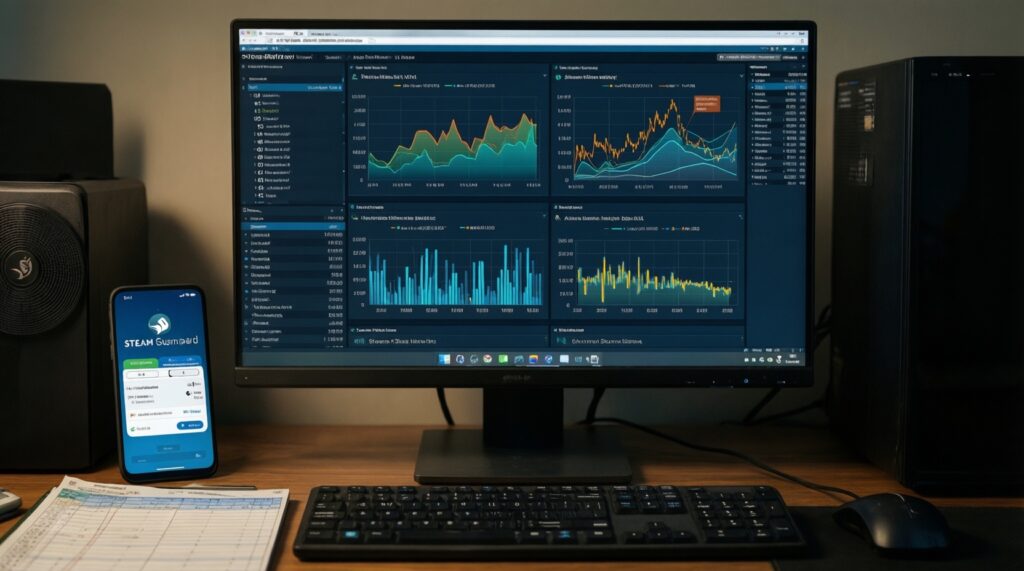
- Steam account security: Steam Guard Mobile Authenticator enabled; recovery options up to date.
- Working capital: Steam Wallet balance sized for multiple small positions (not one big bet).
- Market visibility: ability to view item price history and recent sales in Steam Community Market.
- Tracking sheet: a simple spreadsheet with columns for buy price, expected sell price, fees, and net profit.
- Watchlist: 10-30 items you understand (start narrow; expand only after you can predict behavior).
How to shortlist candidates safely
- Start with liquid categories: focus on items that reliably trade (e.g., popular game cosmetics) instead of obscure collectibles.
- Prefer stable demand: items tied to active player bases usually recover better after an event supply spike.
- Check the "recent sales" pattern: ignore hype listings; confirm that real transactions are happening at your target band.
- Avoid fragile pricing: skip items where a few listings dominate the visible order book.
Pricing Strategies: Buy, Hold, and Sell Signals
The safest flipping strategy is rules-based. Your job is to enter only when the net (after fees) outcome makes sense, then exit without "hoping." If you specifically do ลงทุนสกิน Steam ซื้อถูกขายแพง, treat it like inventory management, not gambling.
-
Define your net target before buying
Calculate the minimum sell price that leaves profit after Steam fees. If the market doesn't offer that edge, skip the trade.
- Use recent sold prices as your reality check, not the lowest current listing.
- If you can't explain why the item should rebound post-event, don't buy it.
-
Set an entry band and buy in small tranches
Instead of one entry, split your buy into several smaller purchases. This reduces the chance you buy everything right before another leg down.
- Only add size when the market stabilizes (sales continue and undercutting slows).
- Stop adding if the "new low" keeps printing with heavy volume.
-
Use "recent sales" to confirm liquidity
Before entering, verify that completed sales are happening frequently enough that you can exit without discounting heavily.
- High listing counts alone are not liquidity; completed sales are.
-
Place sell listings where buyers actually transact
List near proven transaction levels rather than trying to be the highest. A slightly lower, realistic listing often beats waiting and missing the recovery window.
- If you're practicing เทคนิคซื้อขายสกิน CS2 Steam Market, treat each skin as its own micro-market; don't assume all skins rebound equally.
-
Use time-based exits to avoid dead inventory
If your catalyst was "event supply shock," don't hold indefinitely. Decide a maximum holding window; if it doesn't recover, exit and recycle capital into better setups.
-
Keep a downside plan (stop-loss by rule, not emotion)
If the market breaks your original thesis (e.g., demand dries up or a new supply source appears), sell to preserve capital. Small controlled losses are part of the system.
Fast-track mode: 4-step loop
- Pick 10 liquid items with consistent recent sales and narrow, fee-adjusted spreads.
- Buy in 2-4 tranches only inside your pre-defined entry band during event-driven undercutting.
- Sell into recovery by listing near proven sold levels, not optimistic listings.
- Log every trade (net after fees), then cut slow movers and replace them on the watchlist.
Risk Management: Inventory, Fees, and Price Drops
Use this checklist after each buying session and before you list for sale. It's designed to prevent the most common "looked profitable, wasn't" outcomes.
- I computed expected net profit after Steam fees for each item, not gross spread.
- I avoided concentrating my wallet in a single item or a single game ecosystem.
- I confirmed there are recent completed sales at or near my planned exit zone.
- I have a written exit rule: target, maximum holding window, and a downside trigger.
- I did not buy based on hype posts, DMs, or off-platform "special prices."
- I checked for signs of structural change (new case/drop, rule change, or sudden sustained oversupply).
- I kept spare wallet capacity for fees, relisting, and opportunistic entries.
- I reviewed whether my items are exposed to a single upcoming event that could flood supply again.
Automation and Tools: Bots, Trackers, and Spreadsheets
Automation should reduce mistakes, not increase risk. Prefer simple tracking you understand over "black box" flipping promises. If a tool requires logging into suspicious sites or sharing API keys without clarity, skip it.
Common mistakes to avoid

- Over-automating entries: auto-buy rules can fill during fast drops without confirming sales velocity.
- Tracking listed prices only: ignoring completed sales leads to false confidence.
- Forgetting fees in the sheet: the trade looks green until you compute net proceeds.
- Chasing top gainers: you often buy late, then become exit liquidity for earlier buyers.
- Using untrusted third-party "login" pages: increases account takeover risk; keep everything in Steam's official flows.
- Too many watchlist items: you lose context; stick to fewer items you can predict.
- Not documenting rationale: without a note (why you bought), you can't learn from outcomes.
Post-Event Analysis: Metrics to Improve Next Cycle
When an event ends, your edge comes from review. Keep it simple and actionable: what worked, what trapped capital, and what rules need tightening.
Alternatives when flipping isn't the best fit
- Steady listing strategy: list fewer, higher-conviction items and accept slower turnover when you can't monitor intraday volatility.
- Budget-constrained micro-flips: focus on small, highly liquid items where you can recycle capital frequently with limited downside.
- Skill-based earning in-game: if market conditions are unstable, earning items through gameplay may beat forcing trades.
- Wait for clearer catalysts: if the market is drifting without an event-driven reason, staying in cash can be the best "trade."
Practical Concerns and Straightforward Answers
Is Steam item flipping allowed?
Using the Steam Community Market to buy and resell items is generally part of normal market use. Avoid off-platform cash deals, impersonators, and anything that pressures you to move outside Steam's official systems.
What's the most reliable signal to use: listings or sales?
Prioritize recent completed sales because they show where buyers actually transact. Listings are intentions; sales are proof.
How do I avoid getting stuck holding items after a sale ends?
Use a maximum holding window and a downside trigger decided before entry. If the recovery doesn't happen on schedule, exit and redeploy capital.
Should I flip many items or specialize?

Specialize first: fewer items, deeper understanding, cleaner execution. Expand only after your spreadsheet shows consistent net results after fees.
Do I need third-party bots or extensions?
No-start with Steam's built-in data plus a spreadsheet. Add tools only if they save time without adding account-security risk.
Why did my "profitable" trade become a loss?
Common causes are fee blind spots, buying into a continuing downtrend, or relying on listed prices instead of sold prices. Tighten entry bands and require sales confirmation.