


Drop rate is the published chance that a loot box or gacha pull yields a specific item, while RNG is the randomization process that decides each result. Read both as per-attempt probabilities, not a promise of "soon." To stay safe, translate rates into expected costs, watch for pity/hidden rules, and treat "near-miss" feelings as a design effect.
Essential probability summary
- Per-pull chance is not "due soon": each pull can be independent unless the game states otherwise.
- Low rates can still produce streaks (good or bad) without anything being "wrong."
- "Near-miss" cues (almost got it) don't increase your odds; they increase your urge to continue.
- Published odds may be conditional (banner-only pool, after pity, first-time bonus) rather than global.
- Observed results need enough samples; small logs are noisy and will mislead you.
- Best safety move: set a hard budget and stop at the limit, regardless of streaks.
How drop rates and RNG mechanics actually work
When players ask อัตราดรอป ลูทบ็อกซ์ คืออะไร, the precise answer is: it's a probability model for outcomes in a defined pool, usually expressed as a percentage per opening/pull. It may apply to a specific banner, a specific rarity tier, or a specific item inside a tier.
RNG (random number generation) is the mechanism that converts that model into an outcome for each attempt. In practice, the server typically draws a random value, maps it to ranges (weights), and returns the item. Whether pulls are independent or stateful depends on additional rules like pity counters or step-up banners.
Key boundaries: drop rate describes chance, not time; RNG describes selection, not fairness. A "fair" system can still feel unfair because probability naturally produces long streaks.
Interpreting published probabilities: what the numbers mean
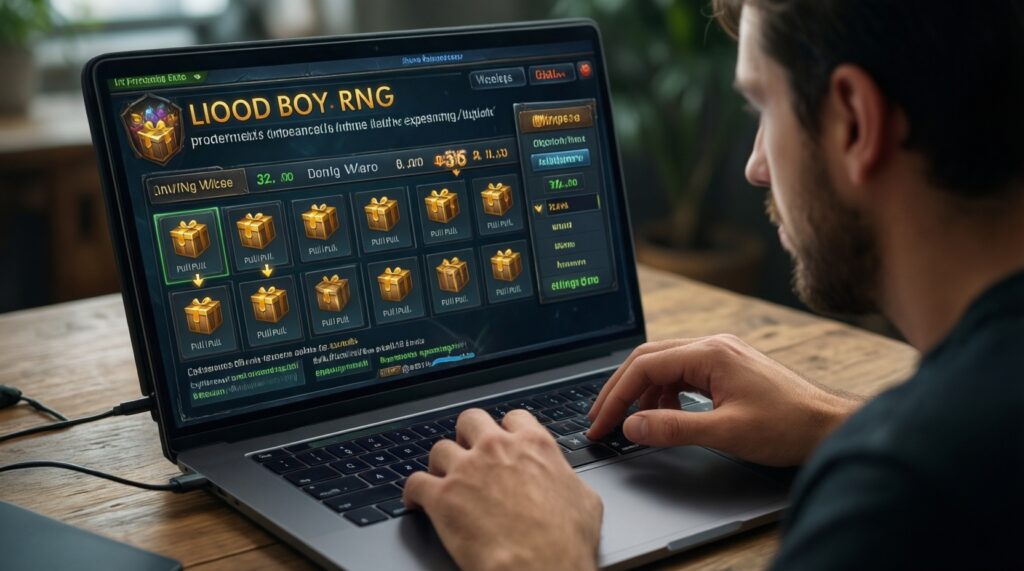
If you're trying to answer RNG ลูทบ็อกซ์ คำนวณโอกาสได้อย่างไร, treat the published rate as a per-attempt parameter, then convert it into questions you can actually act on (like "chance after N pulls" and "expected spend to reach my target").
- Check the scope: is the rate for the whole pool, a rarity tier, or a featured item only?
- Confirm the unit: per single pull, per 10-pull, per box, or per "set" (step-up)?
- Assume independence only if stated: if there's pity/guarantees, independence is false after certain thresholds.
- Separate "chance of any SSR" vs "chance of the specific SSR": many games advertise the former and bury the latter.
- Translate to "at least one success" after N tries: for independent pulls with success rate p, the probability of getting at least one success in N pulls is 1 − (1 − p)N.
- Translate to expected attempts: for independent pulls, the expected number of pulls until the first success is roughly 1/p (a planning heuristic, not a guarantee).
Worked example (simple and practical)
Suppose a featured item is listed at p = 0.5% per pull (0.005), with no pity mentioned. Your chance to get at least one copy within N = 100 pulls is 1 − (1 − 0.005)100. This is still not certainty; it's a way to budget expectations rather than "feeling close."
| Goal | Theoretical calculation (from published rate) | Observed calculation (from your log) | What it can and cannot tell you |
|---|---|---|---|
| Chance after N pulls | Use 1 − (1 − p)N if pulls are independent | Count sessions where you succeeded by pull N ÷ total sessions | Theory predicts; observation validates only if you have enough independent sessions |
| Per-pull rate estimate | p from the published table | Successes ÷ total pulls (over large samples) | Small samples fluctuate; a short streak does not refute the stated rate |
| "It should happen soon" feeling | Not a valid output of probability | Not measurable as a real advantage | That feeling is bias/UX, not increased odds |
| Impact of pity/guarantee | Needs the stated pity rules (stateful model) | Track outcomes vs pity counter value | You can detect thresholds, but hidden rules are hard to prove without large data |
Statistical pitfalls: near‑miss illusion, streaks and bias
"Near-miss" design is the core of the "almost got it" trap: the game shows you signals that resemble progress (close calls, exciting animations, duplicates) even when the probability model hasn't improved.
- Near-miss illusion: dramatic reveals or "almost" animations create a sense of being close, but don't change the next pull's probability.
- Gambler's fallacy: after many failures, believing success is "due" even under independent RNG.
- Hot-hand belief: after a lucky hit, believing you're on a "good seed" and should keep pulling.
- Selective memory: remembering the rare wins vividly and discounting the long neutral/losing stretches.
- Denominator neglect: focusing on "I got 2 SSRs" while ignoring that it took hundreds of pulls.
Empirical methods: collecting data and testing claimed rates

When you want เปิดกาชาให้คุ้ม วิธีดูเรทดรอป, your best tool is a clean log. The goal is not to "beat RNG," but to reduce self-deception and spot rule-based systems (pity, step-up guarantees) that change optimal spending.
How to collect usable data (practical logging rules)
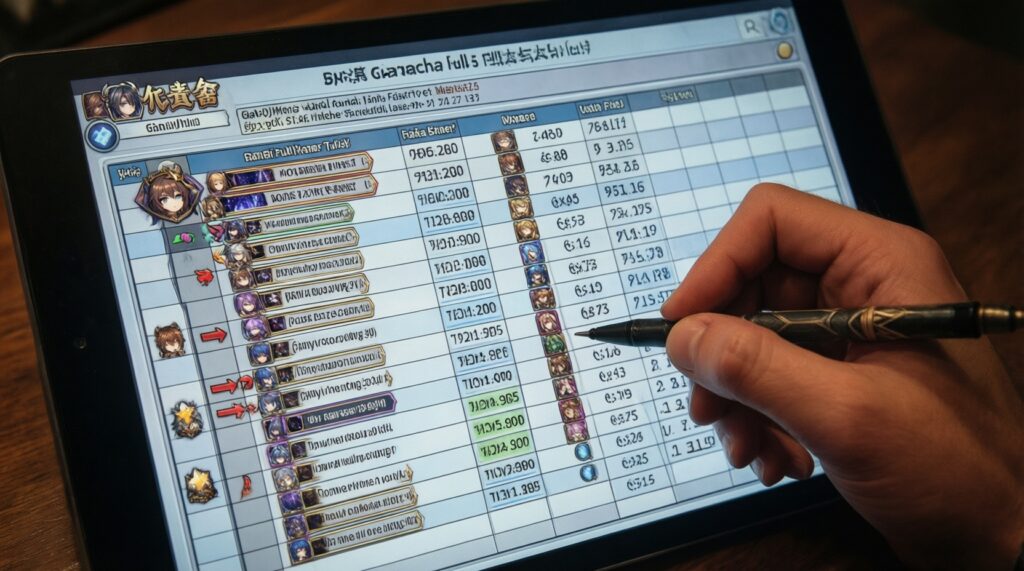
- Record every pull: date/time, banner, single vs 10-pull, item result, and pity counter value (if visible).
- Keep banners separate; mixing pools destroys the meaning of your estimated rate.
- Define success precisely (e.g., "featured unit," not "any SSR").
- Don't stop logging right after you get lucky; that biases your dataset.
A simple experiment outline (to test what you can)
- Hypothesis: the featured unit rate is constant per pull until pity triggers (or "no pity exists").
- Method: log pulls across multiple sessions; group results by pity counter ranges (e.g., 1-20, 21-40, etc.) if the counter is visible.
- Check: compare success frequency across groups; a visible jump suggests a soft cap/pity-like behavior.
- Limit: if the counter is hidden or the pool changes dynamically, you may not be able to confirm the true mechanism from personal data alone.
Game design controls: pity systems, soft caps and hidden weights
Players looking for เกมกาชา เรทดรอปสูง เติมคุ้มที่สุด often miss that "high rate" can be less important than the control system around it. These mechanisms can improve predictability, but they can also be presented in ways that confuse budgeting.
- Pity (hard guarantee): a guaranteed high-rarity or featured item at a fixed pull count; good for budgeting, but only if you can afford to reach it.
- Soft cap (increasing odds): rates rise after a threshold; it reduces extreme bad luck but encourages "just a bit more" spending.
- Step-up/ladder banners: odds or rewards change by step; the "headline" rate might not reflect the effective cost of the target.
- Shared pools and dilution: "SSR rate" can be stable while the featured-item probability drops as the pool grows.
- Hidden weights: different items in the same rarity can have different probabilities; you only know if the game discloses item-level rates.
- Duplicate mechanics: needing multiple copies converts a single probability into a much larger budgeting problem.
Practical rules to avoid loot‑box gambling traps
If you're comparing deals like แพ็กเกจกาชา แนะนำ ซื้อแบบไหนคุ้ม, evaluate packages against your target probability and your stopping rule, not against emotions created by streaks or "near-miss" reveals.
Mini-case: budgeting with a hard stop
You want one featured item. You choose a maximum spend that you can lose without stress, convert it into pulls, and stop when you hit either (a) the item or (b) the limit-whichever comes first. This prevents "chasing" after a near-miss or a losing streak.
Decision pseudo-logic you can actually follow
set budget_limit_pulls = X
set stop = false
for pull in 1..budget_limit_pulls:
  result = open()
  log(result, pull, banner, pity_counter)
  if result == target_item:
    stop = true
    break
if stop == false:
  do not buy more packs today (cooldown)
Self-check checklist before you buy more pulls
- Can I clearly state the specific item rate (not just "SSR rate") for this banner?
- Do I know whether a pity/soft cap exists and whether I can afford to reach it?
- Am I increasing spend because I feel "close" (near-miss), rather than because the rules changed my odds?
- Is my decision consistent with a pre-set pull limit that I will keep even after bad streaks?
Player doubts and technical clarifications
Does a 10-pull have better odds than 10 single pulls?
Only if the game states a bonus (e.g., one guaranteed rarity). Otherwise, 10 independent pulls are equivalent regardless of packaging.
If I failed many times, am I "due" for a win?
Not under independent RNG. Without a stated pity/soft cap, your next pull's probability is the same as before.
What does "near-miss" change in my real probability?
Nothing. It's a presentation technique that affects motivation, not the underlying drop rate.
Can I prove the published rate is fake with my personal results?
Usually not from small samples. Variance is large; you need a large, clean dataset and consistent conditions (same banner and rules).
Is "high drop rate" always the best value gacha?
No. Guarantees, pool dilution, and duplicates can make a higher headline rate worse value for the specific item you want.
How do I choose the most "worth it" package?
Pick the option that minimizes cost to reach your stopping condition (target or pity) within your budget. Ignore bundles that mainly add pulls after your limit.