

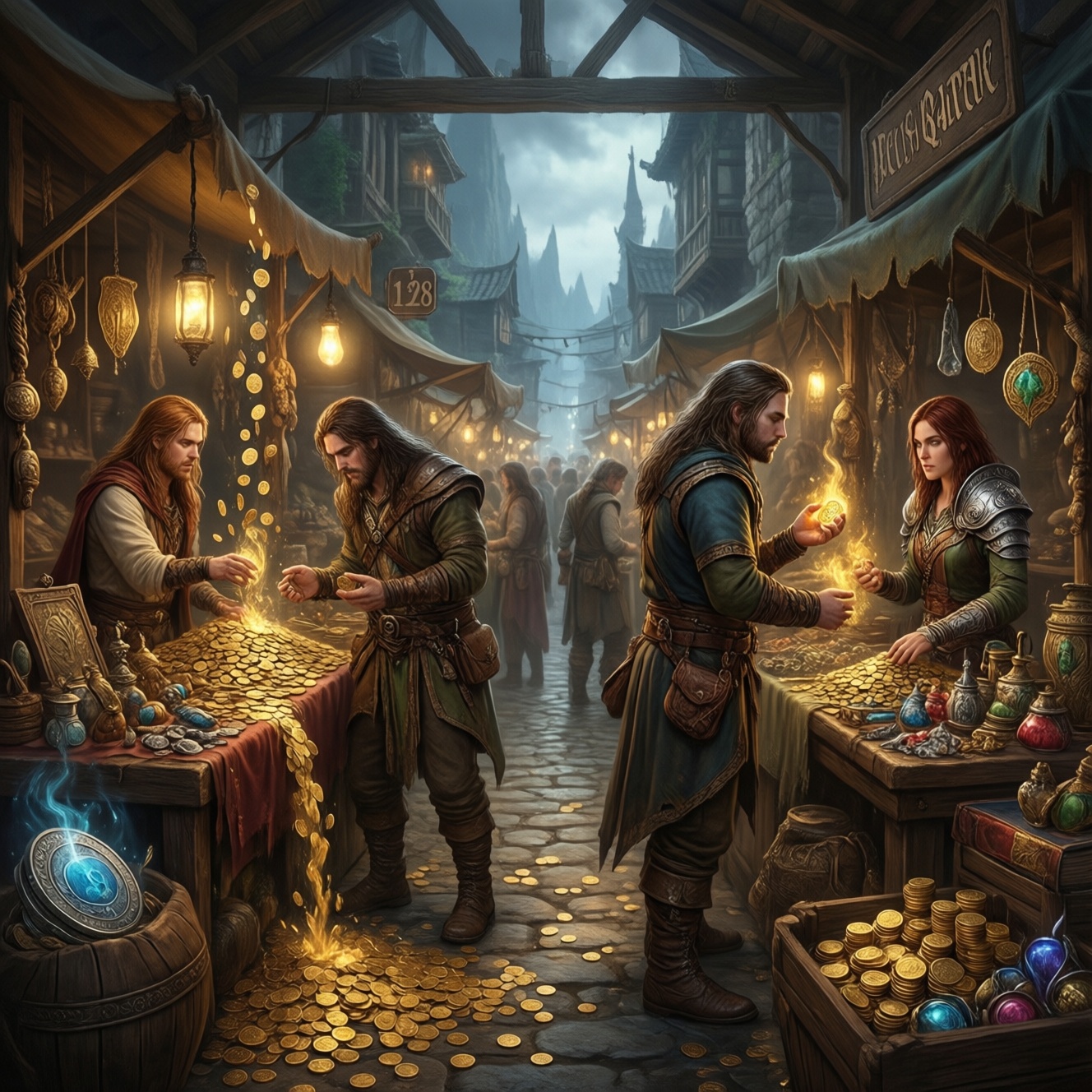
An in-game economy is the system that creates, moves, and removes virtual money and items between players and game systems, shaping prices, scarcity, and progression. When currency enters faster than it leaves, purchasing power drops (inflation). When item supply is constrained, markets seize up. Developers rebalance safely using controlled sinks, supply levers, and monitoring.
Snapshot: How Virtual Currency Circulates
- Currency enters via rewards (quests, drops, daily bonuses), sales (cash shop), and conversions (tokens → gold).
- Currency leaves through sinks (taxes/fees, crafting, repairs, upgrades, gacha pulls, durability loss).
- Prices rise when currency supply grows faster than sink capacity, even if item drop rates stay constant.
- Scarcity happens when supply is capped, bottlenecked, or "time-gated," not only when something is "rare."
- Player behavior (hoarding, flipping, cartel pricing) amplifies imbalance and can create sudden shortages.
- Safe rebalancing uses gradual changes, clear communication, and anti-abuse controls-never overnight shocks.
Common Myths About Virtual Inflation
Myth: Inflation means you "printed too much money," and the fix is simply cutting rewards. In practice, inflation in a game is usually a mismatch between sources (how currency is created) and sinks (how currency is destroyed), plus how quickly wealth concentrates in top players.
Myth: "Rare items" automatically stabilize an economy. If those items can be endlessly farmed or botted, or if demand is mandatory (best-in-slot progression), "rarity" becomes a volatility driver, not a stabilizer.
Boundary: Not every price increase is inflation. If one meta weapon spikes because of a patch note, that's a demand shock. A broad rise across many categories (consumables, materials, services) is the closer match to inflation.
For players asking เศรษฐกิจในเกม คืออะไร, treat it as a measurable system: balances, flows, incentives, and constraints-similar to real economies, but fully rule-bound by the developer.
Mechanics of Currency Creation and Removal
Myth: A single "gold reward" knob controls everything. Real control is multi-channel: you need to map every faucet and every drain, including event spikes and edge cases.
- Identify currency faucets: quest payouts, mob drops, sell-to-NPC value, login streaks, event mails, battle pass tiers.
- Separate primary vs. secondary creation: "new money" (system-issued) vs. player-to-player transfers (auction house trades).
- Catalog sinks by elasticity: mandatory sinks (repairs, travel) vs. optional sinks (cosmetics, convenience, gambling/gacha).
- Price the sinks to match wealth distribution: flat fees punish new players; progressive or tiered fees target high-balance players more safely.
- Guard against abuse: bot loops, alt-funneling, exploit routes that convert time → currency too efficiently.
- Plan for seasonal spikes: limited events and compensation packages often inject large one-off currency.
If your team is asking ระบบเศรษฐกิจในเกม เงินเฟ้อ แก้ยังไง, start by graphing currency net injection (created minus destroyed) per day and per cohort (new vs. endgame).
Roots of Item Scarcity and Detecting Shortages
Myth: Shortage only comes from low drop rates. In many games, scarcity is caused by structural bottlenecks: binding rules, crafting dependencies, time gates, or listing friction.
- Hard caps and time gates: weekly raid lockouts or limited attempts restrict supply even if demand is constant.
- Binding constraints: bind-on-pickup or account-bound materials reduce market circulation and create localized shortages.
- Input bottlenecks: a common craft requires one "rare" reagent; that reagent becomes the choke point for the whole category.
- Market friction: high listing fees, limited slots, or slow search tools reduce listings and mimic scarcity.
- Patch-driven demand spikes: new recipes, buffs, or progression steps suddenly increase consumption.
Indicator you can measure: "Days of supply" proxy = (current listings) ÷ (average daily purchases). If it collapses after a patch, you likely created a shortage even without changing drop rates.
When players ask ไอเทมหายากในเกม ซื้อขายที่ไหน, the safe answer is: use the official auction house/marketplace and in-game trade channels, because off-platform trading increases fraud risk and can destabilize supply via botting and real-money incentives.
Player Behavior, Hoarding and Secondary Markets
Myth: Players behave "rationally" and prices always converge. In reality, hoarding, fear of missing out, and coordination in guilds can create artificial scarcity and price manipulation.
What this behavior can improve
- Liquidity discovery: traders help find fair prices faster than fixed NPC pricing.
- Specialization: crafters and gatherers build stable supply chains that reduce volatility over time.
- Risk absorption: speculators hold inventory between patches, smoothing short-term shocks (sometimes).
Where it breaks or becomes unsafe
- Hoarding cascades: if a patch hints at a buff, players stockpile and drain listings overnight.
- Cartel pricing: coordinated groups set floors/ceilings, especially in thin markets.
- RMT pressure: demand for ซื้อไอเทมในเกม ราคาถูก often pushes players toward scams or policy violations; it also incentivizes bots that overfarm currency and distort prices.
- Top-heavy wealth: rich players can outbid everyone, creating a "progression paywall" even without pay-to-win design intent.
For เติมเงินเกม ซื้อเงินในเกม ราคาดีที่สุด, the safest guidance is: only use official top-up channels and publisher-approved stores. "Cheapest" third-party currency frequently means stolen accounts, chargebacks, bans, or irreversible loss.
Developer Tools to Rebalance Supply and Demand
Myth: The fastest fix is a big nerf or wiping currency. Large shocks destroy trust, trigger panic buying, and often push more players into gray markets.
- Prefer gradual sink tuning over cutting all rewards: adjust fees, upgrade costs, and convenience sinks in small steps and watch cohort impacts.
- Use targeted sinks: luxury cosmetics, high-end reforging, vanity housing-these remove currency from wealthy players without blocking newcomers.
- Increase supply without flooding currency: boost item drop rates or crafting yields rather than increasing raw gold payouts.
- Add substitution paths: allow multiple materials for a recipe (A or B), so one bottleneck cannot freeze a whole market.
- Throttle abuse vectors: anti-bot detection, diminishing returns on repetitive farming loops, trade limits for brand-new accounts.
- Communicate constraints: publish what changes and why; unclear patches create rumors and hoarding spikes.
Limitation to accept: You cannot fully prevent speculation in a player-driven market; you can only reduce the payoff of manipulation and keep "must-have" items from being monopolized.
Metrics and Playbooks for Tracking Economic Drift
Myth: "Average price" is enough. Averages hide thin listings and whale-driven trades. Track distribution, liquidity, and velocity, then apply safe, reversible changes.
Minimal dashboard (practical and measurable)
- Net currency injection: total created − total destroyed per day (and per level bracket).
- Currency velocity: total player-to-player trade volume ÷ total currency held (proxy for hoarding vs. spending).
- Market liquidity: active listings count and sell-through rate (sold ÷ listed) for key categories.
- Scarcity proxy: listings ÷ daily purchases for bottleneck materials.
- Wealth concentration: share of currency held by top percentile cohorts (trend, not a single snapshot).
Mini playbook (safe iteration example)
- Detect: net injection stays positive while liquidity drops (fewer listings) and bottleneck "days of supply" falls.
- Hypothesis: players are hoarding currency and a key reagent due to patch expectations; crafting demand is mandatory.
- Intervention A (low risk): add an alternate reagent path and slightly increase reagent supply from varied activities (not one farm spot).
- Intervention B (targeted sink): introduce an optional high-end vanity sink priced for endgame balances.
- Verify: within the next cycles, expect listings and sell-through to recover before broad price levels stabilize.
// Simple alert rules (pseudo)
if (NetInjection7d > 0) and (LiquidityIndex7d down) and (DaysOfSupply[bottleneck] < threshold)
  trigger "Shortage + inflation risk"
  recommend: alternate recipe + supply spread + targeted luxury sink
Concise Troubleshooting and Quick Solutions
How do I tell inflation from a one-item price spike?
Inflation shows up as broad price increases across many categories alongside sustained positive net currency injection. A one-item spike is usually a patch/meta demand shock or a temporary shortage.
What is the safest first step to fix in-game inflation?
Start with measuring net currency injection and adding or tuning targeted sinks that scale with wealth. Avoid large reward nerfs that punish new players and encourage hoarding.
Why do "rare" items become impossible to buy even when drop rates look fine?
Binding rules, time gates, and mandatory crafting inputs can choke circulation. Watch listings and sell-through; scarcity often comes from market friction or bottlenecks, not only drop chance.
Is buying cheaper items or currency from third parties safe?

No. Requests like ซื้อไอเทมในเกม ราคาถูก and เติมเงินเกม ซื้อเงินในเกม ราคาดีที่สุด commonly lead to scams, chargebacks, or bans, and they incentivize botting that destabilizes the economy.
Where should players trade rare items safely?
Use official auction houses and in-game trade systems; that's the safest answer to ไอเทมหายากในเกม ซื้อขายที่ไหน. Off-platform trades increase fraud risk and reduce the developer's ability to enforce fairness.
What change usually backfires during a shortage?
Sudden, large nerfs or emergency price caps. They reduce supply incentives, trigger panic hoarding, and often push trade into untracked channels.