

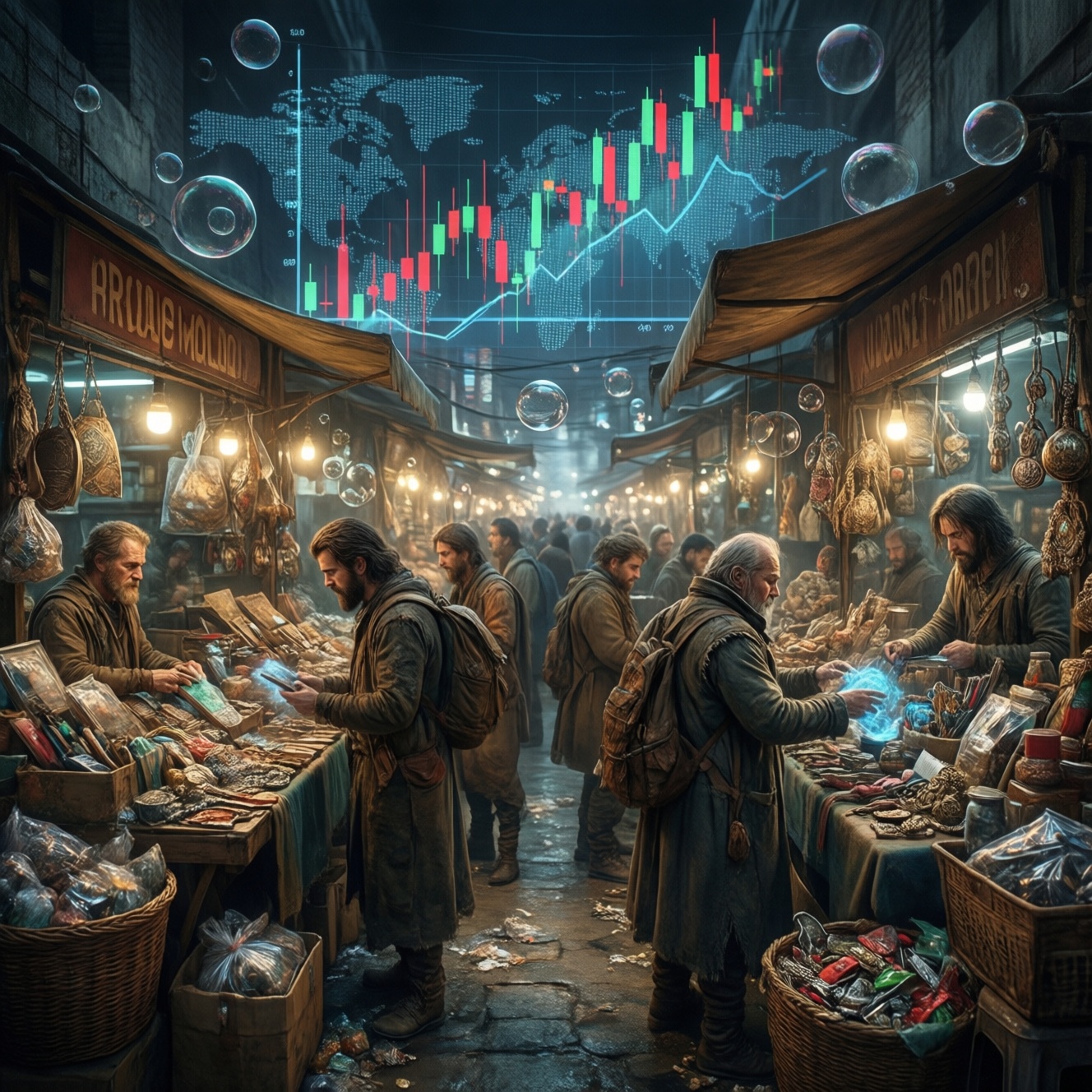
In-game economies mirror real markets because players respond to incentives: they seek profit, avoid loss, exploit arbitrage, and react to perceived scarcity. When currency enters faster than it leaves, prices rise (in game economy inflation). When supply is constrained, players hoard. When information is imperfect, speculation forms bubbles-especially in any in game item marketplace.
Snapshot: Why virtual markets reflect real economic forces
- Players optimize against rules, not designer intent-so loopholes become "products."
- Inflation is usually a sink problem (currency leaves too slowly), not just "too much loot."
- Scarcity is both engineered (drop tables, caps) and emergent (hoarding, access gates).
- Speculation thrives when future value is uncertain and trade friction is low.
- Price signals spread fast through guilds, social media, and streamers, accelerating cycles.
- Governance matters: who can change rates, how fast, and with what communication.
Myth-busting: what people get wrong about in-game economies
Definition and boundaries. An in-game economy is the full system of production (loot/minting), distribution (drops, crafting, rewards), exchange (trade, auction houses, OTC), and destruction (taxes, durability loss, fees) of value units-currencies and items. It includes both NPC prices and player-to-player trade, plus any off-platform behavior (RMT) you must account for in risk models.
Mechanism. Most "surprises" come from thinking of the economy as a content feature rather than a control system. If players can repeatedly convert time/skill into currency, they will. If they can trade, they will create a game currency exchange rate between time, premium currency, and scarce items-even when you never intended a formal exchange.
Concrete examples. In MMOs, daily quests and bots can mint predictable income streams. In marketplace-heavy games, a small set of meta items becomes a reserve asset. In blockchain-enabled games, price expectations can dominate utility, making "fun" secondary to yield.
Developer takeaway. Treat every faucet and sink as a dial, and assume players will discover a "best" loop.
| Common mistake (myth) | What actually happens | Fast prevention move |
|---|---|---|
| "It's just pixels, so supply doesn't matter." | Time and access are scarce; prices form around constraints. | Model constraints explicitly: spawn windows, craft time, inventory limits, trade caps. |
| "Inflation means players are too rich." | Often, currency is not leaving (weak sinks), so the price level rises. | Add scalable sinks (fees, progressive taxes, upkeep) tied to activity. |
| "If we ban trading, we solve RMT." | Players shift to gifting, carry services, account sales, or code words. | Reduce profitability: bind-on-pickup for key items, friction for transfers, anomaly detection. |
| "Letting players buy power won't affect the economy." | When players can buy in game currency, demand shocks propagate into item prices. | Throttle conversion routes and add sinks that scale with wealth, not playtime. |
Inflation inside games: root causes, signal metrics, and timelines
Definition. Inflation is a sustained increase in the in-game price level, usually observed first in trade hubs and high-volume categories. It is not just "higher prices," but a persistent shift caused by more currency chasing the same (or fewer) goods.
Mechanism. Inflation emerges when faucets (quest rewards, drops, vendor arbitrage, bot loops) outpace sinks (repair, crafting consumption, taxes, teleport fees) and when high-velocity players can recycle capital quickly.
Example. A seasonal event adds repeatable tasks with generous rewards. Within days, staple materials in the auction house reprice upward, while fixed NPC vendor prices create new arbitrage routes.
Developer takeaway. Watch leading indicators, not just "average gold per player." For virtual economy analysis, track these signals:
- Net currency flow per day: faucet total minus sink total (split by source/sink type).
- Price index for a fixed basket of staples (avoid meta items that re-balance often).
- Velocity proxy: trades per active user and median time-to-resell for top items.
- Wealth concentration: share of currency held by top cohorts (top 1%, top 10%).
- NPC arbitrage delta: gap between fixed vendor prices and player market prices.
- Faucet exploit risk: repeatable loop yield per minute and its variance.
Engineering scarcity: loot, sinks, caps and emergent shortages
Definition. Scarcity is any constraint that limits supply or access, keeping certain items or advantages rare enough to be meaningful. In games, scarcity is designed (drop rates, crafting inputs, time gates) and emergent (hoarding, cartel behavior, patch speculation).
Mechanism. Players treat stable, widely desired items as stores of value. If your sinks don't remove them, stockpiles grow and new players face a widening gap.
Example. A rare crafting ingredient is needed for multiple best-in-slot recipes. A few organized groups dominate farming routes, then drip-feed supply into the market to maintain margins.
Developer takeaway. Use scarcity deliberately, but design "release valves" so it doesn't become permanent choke points. Typical scenarios to design for:
- Time-gated supply (daily/weekly lockouts) that creates predictable spikes and pre-buying.
- Spatial scarcity (limited spawns, contested zones) that invites monopolization.
- Input bottlenecks where one ingredient gates many crafts, amplifying small changes.
- Hard caps (inventory slots, listing limits) that reduce liquidity and widen bid-ask spreads.
- Destruction-free items (no durability loss, no consumption) that accumulate and crash long-run rarity.
Speculation and player markets: price discovery, hoarding, and bubbles
Definition. Speculation is buying (or withholding) assets primarily for expected resale profit, not immediate use. In player markets, it's a rational response to patch notes, event calendars, and balance uncertainty.
Mechanism. When transaction costs are low and information travels fast, players front-run expected scarcity: they buy up materials before a crafting buff or hoard limited cosmetics before a season ends.
Example. A teaser hints at a future recipe requiring a specific resource. Traders accumulate it, listings thin out, and the visible price jumps-pulling in more buyers and creating a self-reinforcing loop.
Developer takeaway. Speculation is not automatically bad: it can improve price discovery and liquidity. The goal is to prevent manipulative cornering and destabilizing bubbles in the in game item marketplace.
Upsides you can harness
- Price discovery: players reveal real willingness-to-pay faster than NPC tuning cycles.
- Liquidity: speculators tighten spreads by maintaining listings and inventory.
- Risk transfer: crafters can sell inputs early while traders carry inventory risk.
Limits and failure modes to guard against
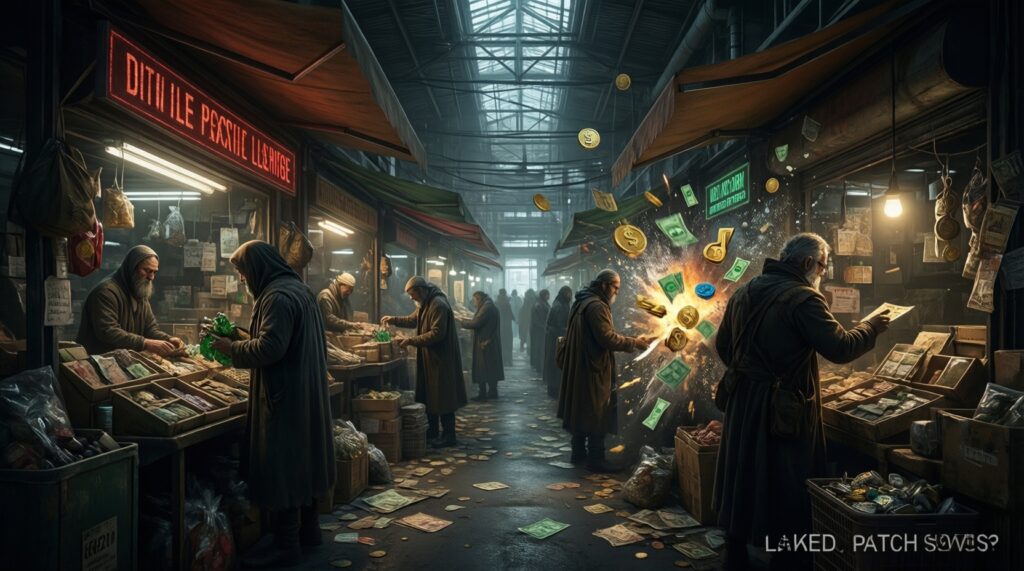
- Hoarding spirals when visibility of supply is low (thin order books, few listings).
- Manipulation via coordinated buyouts, relisting walls, or wash trading (where possible).
- Patch-note arbitrage that rewards insiders or leaks, undermining trust.
- Cross-currency shocks when premium conversions or promotions change purchasing power.
Interventions developers use: balancing tools, sinks, and monetary policy
Definition. Developer "monetary policy" is any change that alters money supply, money velocity, or the effective demand for goods: reward rates, taxes, fees, crafting costs, binding rules, and conversion options between currencies.
Mechanism. Small changes to high-frequency loops dominate the economy. A tiny tweak to a daily reward can outweigh a major nerf to a rare raid drop, because millions of repetitions beat a few thousand.
Example. Adding a modest auction fee reduces flip-trading volume; adding durability decay increases item turnover and demand for repair materials.
Developer takeaway. Prevent the most common mistakes with these checks:
- Don't add faucets without paired sinks. Every new repeatable reward needs an equal-and-opposite removal path.
- Avoid fixed-price NPCs next to free markets unless you actively monitor vendor arbitrage.
- Be careful with conversion mechanics. If players can buy in game currency during promos, plan for demand spikes and add temporary sinks.
- Don't "solve inflation" by nerfing fun. Reduce exploit yield and improve sinks before cutting core progression rewards.
- Rate changes need communication. Silent tweaks can trigger panic buying and worsen volatility.
- Assume external exchange pressure. Even if RMT is banned, a shadow game currency exchange rate often emerges via services and gifting.
Measuring health: KPIs, experiments, and governance models
Definition. Economy health is the stability and fairness of progression and trade: prices move for understandable reasons, sinks keep up with faucets, and new players can participate without facing runaway costs.
Mechanism. Measurement must separate "design intent" segments (new, mid, endgame; casual vs. trader) and must be resilient to whales, bots, and event spikes.
Example (mini-case + pseudo-logic). You notice in game economy inflation in mid-tier materials after launching a repeatable event. You run an A/B test on a targeted sink and monitor a basket index and net flow:
// Daily aggregation (conceptual)
netFlow = sum(faucets.gold) - sum(sinks.gold)
basketIndex = weightedMedianPrice(["ore_T2","herb_T2","cloth_T2"])

if netFlow > 0 for 7 consecutive days AND basketIndex trending up:
    deploySink("event_token_to_cosmetic", priceScaling="by_player_wealth")
    increaseMarketFee(category="materials", delta="small", duration="event")
    monitor(["new_player_affordability","trade_volume","listing_depth"])
Developer takeaway. Operationalize governance: define who can hotfix rates, what guardrails block extreme changes, and which dashboards are required for any economy patch. Make virtual economy analysis a release gate for features touching currency, trade, or the in game item marketplace.
Concise clarifications on edge cases and terminology
Is "inflation" meaningful if items are unlimited digital goods?
Yes, because constraints shift to time, access, and friction. Even with infinite potential supply, if production is slower than demand, prices rise.
What's the difference between price spikes and in game economy inflation?
A spike is short-lived and often tied to a patch or event. Inflation is sustained and typically aligns with positive net currency flow and broad basket increases.
Does allowing players to buy in game currency always cause pay-to-win inflation?
Not always, but it creates demand shocks and amplifies wealth concentration if sinks don't scale. The risk is highest when purchased currency can be freely traded for progression-critical items.
What is a "game currency exchange" inside a closed ecosystem?
It's any de facto rate between currencies or value units (time, premium tokens, gold, services) that players use to make trade decisions, even without an official exchange UI.
How can speculation be healthy in an in game item marketplace?
It can increase liquidity and improve price discovery when it's competitive and transparent. It becomes harmful when a few actors can corner supply or exploit hidden information.
Do bind-on-pickup rules eliminate real-money trading?
No, they mostly shift it to services (carries), account trading, or indirect transfers. Use binding selectively alongside detection and profit-reduction measures.