


Responsible gambling for gamers means treating skins and crypto as real money, then enforcing hard limits on spend, time, and stake size before you place a bet. The safest workflow is: price your items, choose a fixed bankroll, set platform caps, run timed sessions with cooldowns, and use responsible gambling tools (self-exclusion and tracking) to prevent "chasing" on skin betting sites and crypto gambling sites.
Essential safeguards before wagering skins or crypto
- Convert every skin/coin to a fiat value first, then decide if you can afford to lose that amount today.
- Create a dedicated "betting-only" wallet/inventory slice; never mix it with savings or main gaming inventory.
- Set gambling limits in writing (daily loss limit, weekly deposit cap, max stake per bet) before logging in.
- Use built-in responsible gambling tools first (deposit/loss limits, session timers, self-exclusion) and back them up with OS/app timers.
- Pre-commit to a cooldown rule after losses (no re-deposit, no item top-ups, no "one more bet").
Understanding value: converting skins and crypto into real financial risk

Who this fits: intermediate players who already understand odds/variance and want a repeatable system to control spend on skin betting sites or crypto gambling sites.
When you should not do this: if you are trying to recover prior losses, you're borrowing money, you're selling essential items to fund bets, or you can't stop once you start. In those cases, skip wagering and move straight to the recovery protocol below.
- Skin risk: a "digital item" is still a liquid asset once you can trade/sell it, so price it as cash.
- Crypto risk: your bankroll can change value even if you don't bet (price volatility), so your limits must be in a base currency you understand (THB is easiest in Thailand).
- Hidden cost: fast deposits, instant trades, and "near-miss" feedback loops can make overspending feel painless-plan for that frictionless risk.
Establishing financial boundaries: bankroll sizing, deposit caps and staking rules
To reliably set gambling limits, prepare these items and permissions before you wager:
- A base-currency limit: pick THB (or your salary currency) as your "truth" number for all limits.
- A separate bankroll container: a distinct crypto wallet address and/or a dedicated Steam/storage inventory page you treat as "betting-only."
- Access to platform limit settings: confirm the site offers deposit limits, loss limits, time/session limits, and self-exclusion under account settings (these are core responsible gambling tools).
- A simple tracking note: Notes app / spreadsheet with: date, starting bankroll, stop-loss, stop-win, time cap, and actual result.
- Staking rules you can execute under stress: define exact bet sizes so you don't improvise.
Operational defaults (safe, easy to follow):
- Bankroll definition: money/value you can lose without affecting bills, debt payments, or essentials.
- Max stake per bet: cap each bet at a small slice of bankroll (common practical range: 1-2%).
- Daily stop-loss: a fixed amount you will lose at most in a day/session (example: 5-10% of bankroll).
- Weekly deposit cap: hard cap so you cannot "refill to chase" (example: 0 after a stop-loss day; otherwise a preset weekly ceiling).
Short template you can paste into Notes:
- My limits (THB): Bankroll = ___; Max bet = ___; Daily stop-loss = ___; Daily stop-win = ___; Session time cap = ___ minutes; Cooldown after stop-loss = ___ hours; Weekly deposit cap = ___.
Time management tactics: scheduling, session limits and cooldowns
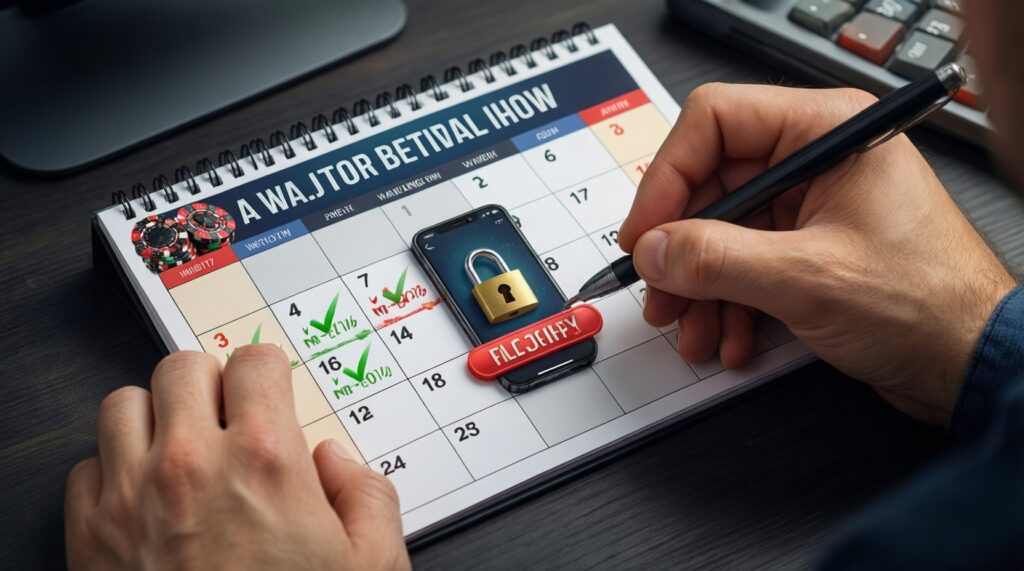
-
Schedule sessions, don't "drop in"
Pick specific days/times you are allowed to bet and block everything else. Unscheduled play is where chasing and impulsive top-ups happen fastest.
- Rule: no betting when tired, angry, or after alcohol/cannabis.
- Rule: no betting within 60 minutes of waking up or before sleep.
-
Start with a written pre-flight checklist
Before logging into crypto gambling sites or skin betting sites, confirm your bankroll, stop-loss, and max stake for that session. If you cannot state the numbers out loud, you do not start.
- Record: starting bankroll value in THB.
- Confirm: limits are enabled on the platform (not "I'll remember").
-
Use a hard session timer and a fixed number of bets
Set a timer (phone/OS) and a maximum bet count to prevent endless "one more." End the session when either limit is hit-time or count.
- Example: 30-45 minutes max, or 10-20 bets max.
- Turn off auto-play and auto-bet features if present.
-
Apply stop-loss and stop-win automatically
When you hit your stop-loss, you end immediately and lock deposits. When you hit stop-win, you also end-because "playing with profit" is still risk.
- After stop-loss: no re-deposit, no skin top-ups, no wallet transfers.
- After stop-win: withdraw the profit portion first, then log out.
-
Cooldown protocol after any high-emotion result
Set a cooldown window that blocks access even if you "feel fine." Cooldowns are the bridge between intention and behavior, and they are a core part of responsible gambling routines.
- Minimum: 24 hours after a stop-loss day.
- Extend to 72 hours if you broke any rule (raised stake, re-deposited, hid activity).
Fast mode: a 60-second limit-setting algorithm
- Convert skins/crypto to THB and write the number as "starting bankroll."
- Set gambling limits: max bet (1-2% bankroll), stop-loss (5-10%), and a weekly deposit cap.
- Set a timer (30-45 minutes) and a max bet count (10-20); stop when either hits.
- After stop-loss: lock deposits and enforce a 24-hour cooldown (no exceptions).
Practical tools: self-exclusion, automated limits and tracking software
- I can find and enable deposit and/or loss limits in account settings (not just notifications).
- I have a session timer enabled (site feature or phone/OS timer) and I obey it.
- I have self-exclusion available and I know how to activate it without support.
- I disabled convenience features that increase speed (saved cards, one-click deposits, auto-bet, instant re-buy prompts).
- I track each session (start value, end value, time spent, rule breaks) in one place.
- I use a separate wallet/inventory slice so I cannot "accidentally" bet savings items/coins.
- I have notifications enabled for deposits/withdrawals so I can't ignore spend.
- I can produce a weekly summary in under 2 minutes (total deposited, total lost/won, total time).
Spotting warning signs: behavioral and performance indicators of problem gambling
- Raising stake size after losses, even "slightly," to recover faster.
- Breaking your time cap or bet-count cap, then rationalizing it as "still controlled."
- Re-depositing the same day you hit stop-loss, especially late at night.
- Switching from skins to crypto (or vice versa) to bypass limits you set.
- Hiding activity (clearing history, using alt accounts, lying about time/spend).
- Using "must win back today" language or feeling panic when not betting.
- Neglecting work/study, sleep, or in-game practice because betting consumes attention.
- Choosing crypto gambling sites or skin betting sites specifically because they feel "harder to track."
- Needing higher risk bets to feel anything (tolerance) or feeling restless when you stop.
Recovery protocol: immediate actions, dispute steps and long-term relapse prevention
- Immediate lock-down (today): activate self-exclusion on every account you used, remove saved payment methods, and move remaining bankroll to a wallet you don't keep on your phone. Use OS-level app/site blocking for the cooldown window.
- Damage containment (this week): freeze deposits by setting caps to the minimum allowed; uninstall apps; hand control of the bankroll container to a trusted person if you can't comply alone.
- Dispute and account hygiene (when relevant): if there were unauthorized transactions or account access issues, secure email/2FA first, then contact the platform support with timestamps and transaction hashes/IDs; avoid continued play while a dispute is open.
- Long-run relapse prevention (ongoing): replace betting sessions with a scheduled alternative (ranked practice block, aim training, gym), keep weekly tracking, and keep limits permanently-even after a "good streak."
Practical concerns answered for everyday bettors
How do I practice responsible gambling if I only bet with skins?
Price the skins in THB before every session and treat them as cash. Then set gambling limits (max bet, stop-loss, time cap) using that THB value, not item rarity or "how easy it was to get."
Which responsible gambling tools should I turn on first?
Start with deposit or loss limits, then add a session time limit, then configure self-exclusion so it's ready when you need it. Use phone/OS timers as a second layer.
What's a simple way to set gambling limits without overthinking strategy?
Pick a bankroll you can lose, cap each bet at 1-2% of it, and stop after a 5-10% loss for the day. Add a weekly deposit cap so you can't refill to chase.
Are crypto gambling sites riskier for limit-setting?
They can be, because volatility and fast deposits make overspending feel abstract. Anchor all limits in THB and keep a separate wallet so you can't "top up" from savings.
How can I tell if I'm using skin betting sites to chase losses?
If you increase stake size, add more items after a stop-loss, or extend sessions beyond your timer, you're chasing. Treat any rule break as a trigger for a 24-72 hour cooldown.
What should I do if I broke my limits mid-session?
End the session immediately, lock deposits, and start a cooldown (minimum 24 hours). Write down what rule broke and what will block it next time (hard caps, app blockers, or self-exclusion).