

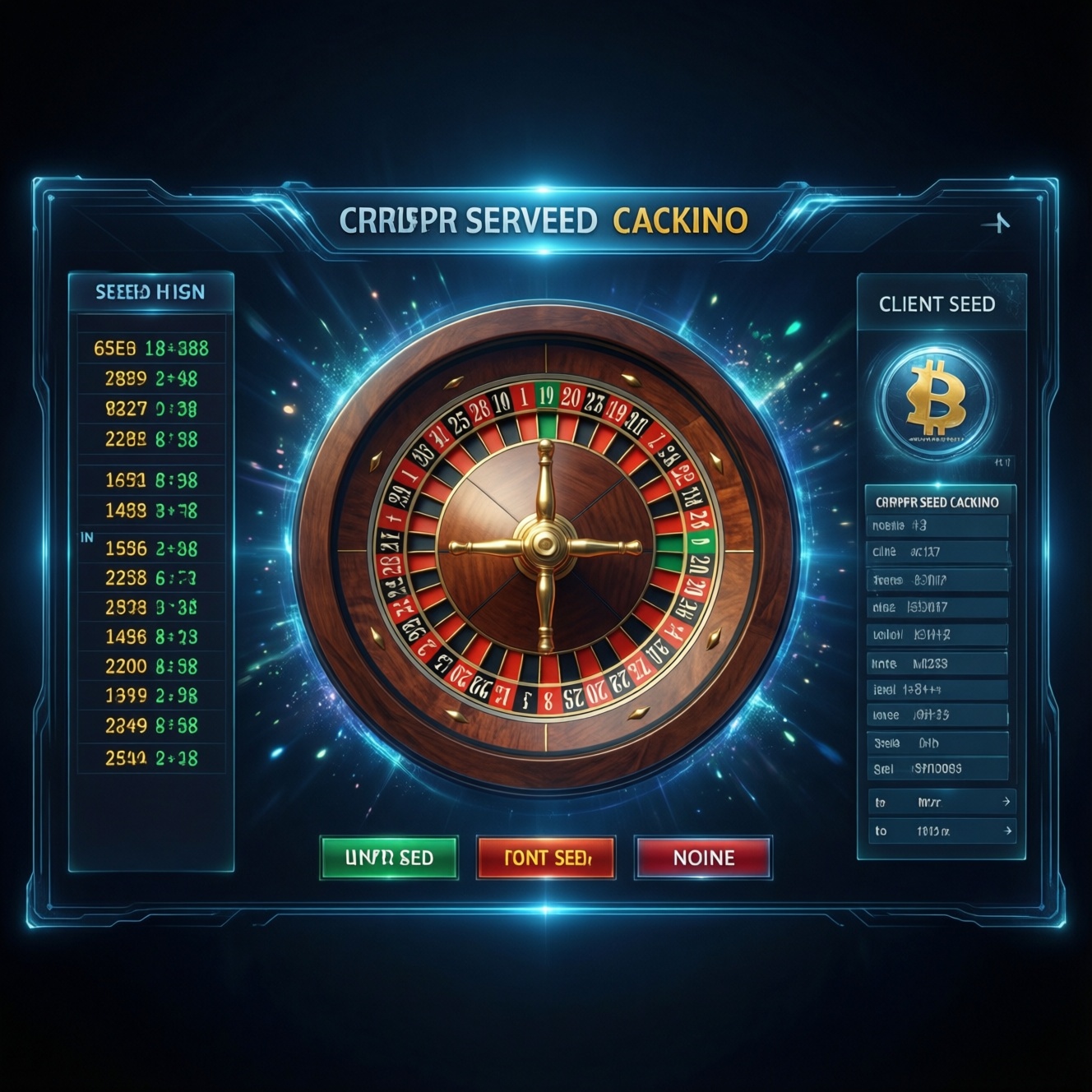
Provably fair systems let you verify that a crypto gambling outcome was generated from pre-committed data (typically a server seed hash) combined with your client seed and a nonce, using public cryptography (hash/HMAC). In a provably fair crypto casino, you can independently reproduce rolls, shuffles, or spins-without trusting the operator's claims.
Core Principles of Provable Fairness
- Commitment before play: the casino publishes a server seed hash before outcomes are generated.
- Player influence: a client seed (chosen or editable by you) is included in the calculation.
- Deterministic replay: given the same inputs (seeds + nonce), anyone can reproduce the same result.
- Tamper-evidence: changing the server seed after the fact breaks the pre-published hash.
- Verifiable mapping: the conversion from hash bytes to a game result (dice, cards, slots) is documented and testable.
Cryptographic Foundations: Hashes, HMAC and RNGs Explained
Most provably fair gambling games are built on two primitives: cryptographic hashes (e.g., SHA-256) and HMAC (a keyed hash). A hash is a one-way fingerprint of data; publishing hash(serverSeed) commits the casino to that seed without revealing it.
HMAC is commonly used to mix inputs safely: the server seed acts like a secret key, while the client seed and nonce become the message. This yields a deterministic stream of bytes that behaves like a pseudorandom output for anyone who later learns the server seed.
Important boundary: provably fair verifies the stated algorithm was followed. It does not prove the game has good RTP, that withdrawals will be honored, or that the operator won't block winners. It also doesn't stop "fair-but-predatory" UX (e.g., confusing seed resets).
Quick verification checklist (low effort)
- Confirm the site shows
serverSeedHashbefore you bet. - Check that your
clientSeedis visible and changeable. - Find the exact formula:
HMAC(serverSeed, clientSeed:nonce)(or equivalent) and the result-mapping rules.
Seed Management Models: Server, Client and Hybrid Approaches
Seed design determines how much control you have and how easy verification is. Common models:
- Server-seed commitment (standard): casino publishes
hash(serverSeed), later revealsserverSeed. You verify the reveal matches the commitment. - Client seed (player-chosen): you set
clientSeed. This prevents the casino from fully controlling outcomes even if it controls server seed. - Nonce/counter per bet: each wager increments
nonceso outcomes can't be reused or selectively shown. - Hybrid with session rotation: server seed rotates periodically; you can rotate client seed anytime. Good implementations keep old seed reveals available for past bets.
- Limited-resource alternative: if you can't run scripts, prefer casinos that provide a downloadable bet log (CSV/JSON) and a one-click verifier page that shows inputs and intermediate steps (bytes/hex).
- Limited-resource alternative: for spot checks, verify only a small sample of bets (start/middle/end of a session) rather than every bet, focusing on correct seed/nonce usage.
Quick verification checklist (seed hygiene)
- Rotate your client seed after any suspicious streak or after large wins.
- Ensure nonce increments by exactly 1 per bet (no gaps, no resets without notice).
- Verify old rounds remain verifiable after seed rotation (reveals are still accessible).
Verification Flow: Reproducing Results Step by Step
Verification means re-running the exact deterministic function the game claims to use. Typical scenarios where you should verify:
- Dice/hi-lo rolls: reproduce a number in a range (e.g., 0-99.99) from hash output.
- Slots: reproduce reel stops or symbol indexes derived from sequential chunks of hash bytes.
- Card shuffle: reproduce a permutation (often Fisher-Yates) where each swap index comes from derived random bytes.
- Crash/multiplier: reproduce a multiplier from a hash interpreted as a large integer with a published formula.
- Dispute resolution: when a round "looks wrong" (unexpected nonce, seed changed), use verification to isolate whether the mismatch is in inputs, mapping, or logging.
Minimal pseudocode (common pattern):
# Inputs from the casino UI / bet log
serverSeedHash_before
serverSeed_revealed_after
clientSeed
nonce

assert SHA256(serverSeed_revealed_after) == serverSeedHash_before

digest = HMAC_SHA256(key=serverSeed_revealed_after, msg=clientSeed + ":" + nonce)

# Example dice mapping (illustrative; must match the casino's documented mapping)
n = bytes_to_uint(digest[0:4])
roll = (n % 10000) / 100.0   # yields 0.00..99.99 if that's the stated rule
Quick verification checklist (step-by-step)
- Check commitment: revealed server seed must hash to the pre-bet server seed hash.
- Recompute HMAC/hash with the exact concatenation format and nonce.
- Reproduce the final game outcome using the documented byte-to-result mapping.
- For limited resources, use a provably fair verification tool that shows intermediate values (not just "pass/fail").
Transparency Mechanisms: Logs, Merkle Trees and Public Ledgers
Transparency determines whether you can audit efficiently and whether the operator can "rewrite history" in the UI. Mechanisms range from simple bet logs to cryptographic append-only structures.
What helps in practice
- Per-bet log exports: downloadable logs with round IDs, timestamps, client seed, nonce, and server seed hash at the time of bet.
- Deterministic round IDs: IDs derived from committed data reduce ambiguity when comparing records.
- Merkle commitments: batching many rounds into a Merkle tree lets the casino publish a single root and later provide inclusion proofs.
- Public ledgers (select cases): some systems anchor commitments (e.g., a Merkle root) to a public chain transaction for stronger anti-tamper signaling.
Limitations and detection heuristics
- UI-only logs are weak: if you can't export or screenshot seed hashes per session, disputes become "your word vs theirs."
- Ledger anchoring ≠ fair mapping: anchoring proves data existed, not that the byte-to-result mapping is honest or implemented correctly.
- Selective reveal risk: a casino can delay server seed reveals; prefer setups where reveals are automatic after a defined rotation.
- Limited-resource tip: even without Merkle proofs, you can keep a small personal record: server seed hash at session start, your client seed, and a few round nonces/outcomes.
Quick verification checklist (transparency)
- Export (or copy) a bet log that includes seed hashes and nonces.
- Confirm server seed reveals happen predictably and remain accessible later.
- Prefer verifiers that disclose intermediate digest/bytes so you can cross-check calculations.
Third-Party Audits, Open Source Clients and Reputational Signals
Audits and open source can increase confidence, but they're not substitutes for doing basic replay verification. Common pitfalls and myths:
- Myth: "Audited" means every game instance is fair forever. In reality, audits can be point-in-time; implementations and configurations can change.
- Myth: Open-source verifier equals open-source backend. A public verifier helps, but the server could still run a different algorithm unless the protocol makes cheating detectable.
- Operator-controlled client seed: if the site silently sets or resets your client seed, your influence is reduced; treat this as a red flag.
- Non-transparent mapping: if the casino doesn't document how bytes become symbols/cards, you can't fully verify fairness, only seed integrity.
- Reputation overreach: "best provably fair casinos" lists are marketing unless they show reproducible checks and dispute records; judge by verifiability features, not badges.
Quick verification checklist (trust signals)
- Look for a public, stable description of the algorithm and mapping (not a vague claim).
- Prefer open-source verifier code or at least a verifier that exposes intermediate values.
- Test one full seed cycle: commitment shown → bets placed → server seed revealed → replay matches.
Known Attack Vectors and Practical Countermeasures
Provably fair reduces certain cheating paths, but failures are usually operational: bad nonce handling, ambiguous encoding, or selective disclosure. A frequent real-world issue is mismatched string formatting-your verifier concatenates inputs differently than the casino, making every result "fail."
Mini-case: ambiguous concatenation (bad) vs explicit encoding (good).
# Risky (ambiguous):
msg = clientSeed + nonce     # "abc1" could mean ("abc",1) or ("ab", "c1")

# Safer (explicit):
msg = clientSeed + ":" + str(nonce)

# Even safer: length-prefix encoding
msg = len(clientSeed) + "|" + clientSeed + "|" + str(nonce)
Countermeasure mindset: you're not only checking randomness-you're checking that inputs are pinned down, logged, and replayable.
Quick verification checklist (attack resistance)
- Verify the exact message format (delimiters, casing, whitespace) used in hashing/HMAC.
- Check nonce continuity and whether any "replay" or "retry" actions change nonce unexpectedly.
- Keep a minimal local record for disputes: server seed hash, client seed, nonce, outcome for a few rounds.
Self-check before trusting a provably fair implementation
- I can reproduce at least 3 past rounds end-to-end using revealed server seed, my client seed, and nonce.
- The casino exposes the byte-to-result mapping for the specific game (dice/slots/cards), not just the seeds.
- Seed rotation and reveal rules are clear, automatic, and historical data stays verifiable.
- I have a lightweight verification path (exported log or transparent verifier) suitable for limited resources.
- For a provably fair bitcoin casino, I confirm the fairness proof is independent of deposit/withdrawal method and still replayable offline.
Practitioner Clarifications
Does provably fair mean the casino cannot cheat at all?

No. It mainly prevents undetectable outcome manipulation within the declared algorithm; it does not guarantee honest payouts, good RTP, or account fairness policies.
What do I need to verify a game result?
You need the pre-bet server seed hash, the revealed server seed, your client seed, the nonce/round number, and the published mapping from hash bytes to outcomes.
Why is a client seed important if the server controls the game?
Your client seed reduces the operator's ability to precompute favorable outcomes for itself because your input changes the digest deterministically.
Is a built-in verifier page enough?
It's a good start, but prefer a verifier that shows intermediate values (digest/hex/byte slices) so you can cross-check with an independent script or another tool.
How can I verify with limited resources (mobile only, no coding)?
Do spot checks: verify a few rounds per session using a transparent provably fair verification tool, and save the server seed hash and your client seed for that session.
What's the biggest red flag in provably fair UI/UX?
Hidden or auto-reset client seeds, missing nonces, or the inability to access past server seed reveals make independent verification unreliable.
Are "best provably fair casinos" lists reliable for choosing where to play?
Use them only as a shortlist. Decide based on whether you can export logs, reproduce outcomes offline, and verify a full seed cycle yourself.