

Loot boxes feel addictive because RNG (random number generation) turns rewards into unpredictable, emotionally charged "maybe next time" moments, reinforced by near-misses, sensory cues, and frictionless payments. To stay in control, treat loot boxes like gambling-adjacent spending: decide rules before you play, use hard caps (a loot box spending limit), and avoid decision-making while aroused or tilted.
Core Psychological Drivers Behind Loot Box Appeal
- Variable rewards train anticipation: uncertainty keeps attention locked on the next opening.
- Near-misses feel like progress, pushing "one more try" even when odds don't change.
- Salient cues (lights, sounds, reveals) intensify emotion and shorten deliberation time.
- Frictionless spending (stored cards, one-tap buys) removes natural stopping points.
- Social comparison (rare skins, streamer pulls) reframes spending as identity/status.
Variable Reward Schedules and Dopamine: How RNG Hijacks Expectation
Mechanism. RNG-driven loot boxes run on a variable ratio schedule: rewards arrive unpredictably, so your brain learns that persistence might pay off at any moment. The pull isn't the item itself; it's the anticipation spike and the relief/joy when the reveal lands.
Supporting evidence (conceptual). In behavioral psychology, variable schedules produce high, persistent responding because each attempt could be "the one." Games amplify this by compressing time-to-result: you can buy loot boxes, open them instantly, and repeat before self-control has time to re-engage.
Practical implication. The most reliable control point is before the first purchase/opening, when your motivation is calmer. If you wait until you feel the urge, you're already negotiating with a system designed to keep you clicking.
- Set a rule before play: "No openings after a loss streak / at night / when stressed."
- Precommit a loot box spending limit that is small enough to be boring if lost.
- Add delay: require a 24-hour wait between deciding and purchasing.
Near-Miss Effects and Salience: Why Almost-Winning Feels Compelling
Mechanism. A near-miss is an outcome framed as "close," even when it's mathematically just another miss. Loot box UIs create closeness through timing, animation pacing, or "teasing" rare colors/icons right before the final reveal.
Supporting evidence (conceptual). Near-misses increase arousal and perceived control: people feel they are learning the system, despite RNG being unaffected by skill. This is a common pathway into loot boxes addiction patterns: not simply chasing the item, but chasing the feeling of being "due."
Practical implication. Treat "almost" as a persuasion tactic, not information. Near-miss feelings are not feedback about improved chances.
- Tease frames: showing rare tiers flash by (or "almost landed" visuals).
- Countdown pacing: slow reveals that build tension and commitment.
- Partial progress meters: fragments/tokens that imply you're converging on a win.
- Streak narratives: "unlucky today" messaging that nudges more attempts.
- Social near-miss: friends/streamers "barely missing" normalizes repeated tries.
- When you feel "close," label it: "This is a near-miss effect, not improved odds."
- Take a 2-minute pause before any new opening-break the arousal loop.
- Track outcomes in plain text (wins/losses), not in-game highlight reels.
Design Mechanics That Reinforce Spending: Visuals, Sound, and Micro-Interactions
Mechanism. Loot box flows are engineered as short habit loops: cue → action → reward → repeat. Sensory design increases emotional intensity, while micro-interactions remove friction so spending feels like "continuing play," not making a purchase.
Supporting evidence (conceptual). Attention-grabbing stimuli and rapid feedback shrink the space for reflective thinking. When the purchase is bundled into the play loop, you're less likely to ask: "Do I actually want to spend money right now?"
Practical implication. Control improves when you relocate the decision outside the loop-different device, different time, different account permissions.
- One-tap replenishment: buying currency mid-opening without leaving the screen.
- Anchored bundles: "best value" packs positioned to make smaller packs feel irrational.
- Limited-time framing: rotating banners that turn hesitation into perceived loss.
- Victory coupling: offering a loot box right after a win (high arousal) or after a loss (relief-seeking).
- Collection pressure: sets that look incomplete unless you keep rolling.
- Disable stored payments where possible; require a manual step to pay.
- Move purchases to a single "admin" moment (weekly) instead of ad-hoc.
- Turn off push notifications and promotional banners in game settings.
Who Is Most Susceptible: Age, Personality Traits, and Comorbidities
Mechanism. Vulnerability rises when impulse control is lower, when rewards strongly regulate mood, or when a person overweights rare outcomes. Susceptibility is not a moral failing; it's a predictable interaction between traits, stress, and persuasive design.
Supporting evidence (conceptual). People differ in reward sensitivity, delay discounting, and how strongly they respond to cues. Practical risk assessment focuses on patterns: loss of control, secrecy, chasing, and financial strain.
Practical implication. Match the guardrails to the risk profile. If someone is repeatedly breaking soft rules, use hard barriers (permissions, caps, or account-level restrictions).
Common risk factors
- Being underage or having limited experience managing digital spending.
- High impulsivity, sensation-seeking, or strong FOMO sensitivity.
- High stress, sleep debt, loneliness, or using games for mood regulation.
- History of gambling problems or other addictive/compulsive behaviors.
Protective factors and limitations of self-assessment
- Protective: clear budgets, transparent family rules, and reduced payment convenience.
- Protective: playing for mastery/social time rather than collecting/rarity.
- Limitation: "I can stop anytime" is unreliable when cues and arousal are present.
- Limitation: a loot box odds calculator can inform, but it won't prevent impulse spending by itself.
- If rules keep failing, upgrade to hard controls (password, parental controls, platform caps).
- Watch for secrecy and chasing; these matter more than the number of openings.
- Keep spending visibility high (shared statements or weekly review).
Industry Practices and Policy Responses: From Monetization to Regulation
Mechanism. Monetization often relies on persuasion architecture: scarcity, obfuscation, and normalization via influencer culture. Policy responses typically target transparency (odds disclosure), youth protection, and consumer safeguards-implementation varies by platform and country, including Thailand context via platform rules and payment controls.
Supporting evidence (conceptual). Confusion thrives when players mix up "published odds" with "my chance right now," or mistake cosmetic-only rewards as harmless when the behavioral loop is still present.
Practical implication. Don't outsource protection to regulation. Use platform-level tools today; treat disclosure as information, not a safety feature.
- Myth: "If odds are shown, it's fair." Reality: transparency doesn't remove variable-reward compulsion.
- Mistake: assuming you can "grind back" losses. Reality: past outcomes don't change RNG.
- Myth: "Cosmetic-only means no risk." Reality: the spending loop can still escalate.
- Mistake: blaming willpower alone. Reality: environment design often beats motivation.
- Myth: "The best loot boxes games are the ones with the most exciting reveals." Reality: excitement is often the hook; evaluate control features, not hype.
- Use odds as a reality check, not a green light to keep opening.
- Prefer games with strong caps, clear history, and easy refund/support pathways.
- Assume hype cycles are designed; plan your spending rules ahead of events.
Evidence-Based Tactics to Regain Control: Practical Steps for Players and Caregivers
Mechanism. Regaining control is mostly precommitment: set rules when calm, then make breaking them inconvenient. You're not trying to "resist forever"; you're trying to reduce cue exposure and shorten the loop.
Supporting evidence (conceptual). Implementation intentions (if-then rules), friction, and accountability are practical behavior-change tools. They work because they move decisions away from peak arousal moments.
Practical implication. Combine three layers: budget guardrails, access controls, and trigger management.
Mini-case (player)
A player notices they overspend after midnight and after losing matches. They set a weekly cap, remove stored card details, and restrict openings to a planned window with a friend present on voice chat.
Simple rule set (pseudocode you can copy)
IF time > 22:30 OR mood in {angry, stressed, tilted}
  THEN do not open loot boxes

IF weekly_spend + planned_purchase > spending_limit
  THEN stop and wait 24h

IF urge >= 7/10
  THEN close game, walk 5 minutes, re-check urge
- Create if-then rules that target your top two triggers (time, mood, event banners).
- Make spending slower: remove saved payments, add a waiting period, require a second person.
- Review once weekly: spending, triggers, and whether rules need hardening.
Self-check before your next session
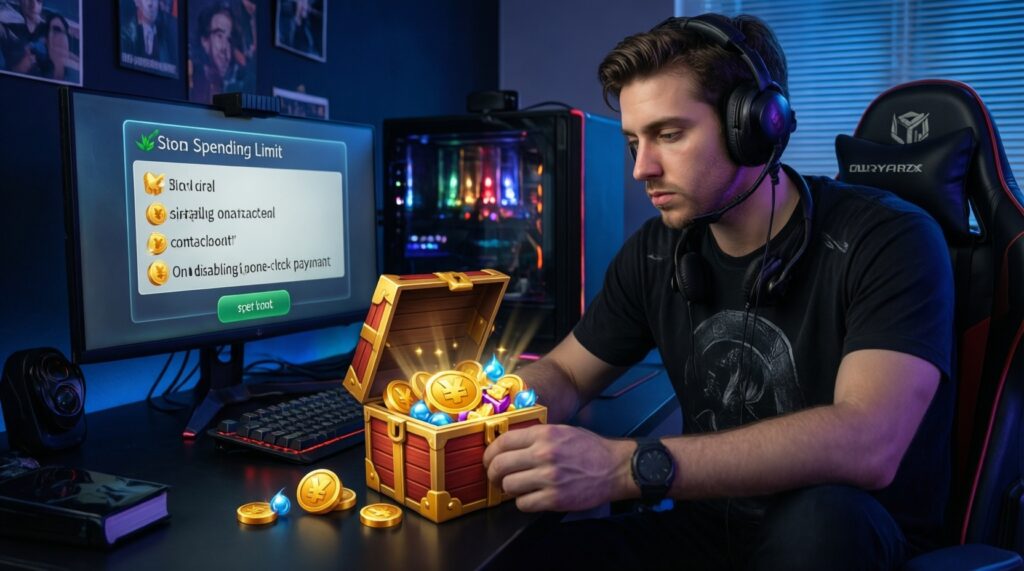
- Do I have a written loot box spending limit that I can't exceed accidentally?
- Have I removed one-click payment convenience on the device I play on?
- Do I know my top trigger (tilt, boredom, FOMO) and the exact action I'll take?
- Will I avoid openings when I'm using loot boxes to change my mood?
Brief Answers to Common Practical Concerns
Is "loot boxes addiction" the same as gambling addiction?
They're not identical diagnoses, but the behavioral loop can be similar: variable rewards, chasing, and impaired control. If spending causes harm and feels hard to stop, treat it seriously and add hard guardrails.
Should I ever buy loot boxes, or avoid them completely?

If you can keep purchases inside a strict cap and feel no urge to chase, limited buying can be a controlled entertainment expense. If you repeatedly break rules, avoid buying and switch to direct-purchase cosmetics when available.
Do the best loot boxes games make it safer because they are popular?
Popularity doesn't equal safety. Judge by control features: clear purchase history, easy caps, low friction to stop, and fewer time-limited triggers.
Does a loot box odds calculator help me decide rationally?
It can clarify how unlikely rare drops are, which helps planning. It won't protect you during high-arousal moments, so pair it with delays and spending caps.
What is a good loot box spending limit?
A good limit is one that you can lose without stress and that you can enforce automatically. If you feel tempted to raise it after losses, it's too high or too flexible.
How can caregivers intervene without constant conflict?
Use neutral rules: platform-level caps, password-protected purchases, and a shared review schedule. Focus on reducing triggers and secrecy rather than arguing about individual items.