
If your goal is a durable economy, choose Play-to-Earn only when you can fund rewards from real revenue and strong sinks; otherwise it tends to inflate and collapse. Choose Gamble-to-Earn only when you can operate like a regulated casino with bankroll, risk limits, and transparent odds. Hybrid designs usually win because they separate fun, spending, and earning.
Core conclusions for tokenomic winners and losers
- Tokenomics win when rewards are paid from verifiable revenue streams and controlled emission, not from new entrants.
- Player retention improves when "earn" is a side benefit of gameplay, not the primary reason to log in.
- Gamble-to-Earn can be sustainable if it's treated as risk-managed wagering with clear house edge, bankroll rules, and anti-abuse controls.
- Most blow-ups come from weak sinks, instant liquidity, and short vesting that accelerates sell pressure.
- Hybrid loops (F2P spend + skill rewards + limited wagering modules) reduce inflation and smooth demand shocks.
- Use telemetry to throttle emissions dynamically; static reward schedules fail under volatility and botting.
Economic primitives: revenue sources, sinks and value capture
For game devs: Before picking between play to earn tokenomics and wagering loops, confirm you have at least one non-speculative revenue source that scales with play: cosmetic sales, season passes, ad inventory, marketplace fees, or licensing. Then design sinks that are desirable (not punitive): upgrades, crafting, rerolls, entry tickets, convenience boosts, cosmetic gacha with caps, and time-limited events that consume tokens or token-priced items.
For token investors: Map value capture explicitly: who pays whom, in what asset, and how often. If token demand is mostly "buy to farm and dump," you're buying future sell pressure. Prefer models where token demand is tied to recurring participation (entries, crafting, governance staking) and where protocol captures revenue in a reserve or buyback budget with rule-based deployment.
For active players: Check whether earnings come from other players' spending (healthy if fun-driven) or from emissions that inflate away your rewards. In play to earn games crypto, the best experience is when you can play free, optionally spend for convenience/cosmetics, and earn modestly from skill, time, or community contributions-without needing constant token appreciation.
Selection criteria (use 5-9, pick what you can truly support)
- Reward funding source: % of rewards backed by revenue (fees, sales) vs. pure emissions.
- Sink strength: Are sinks optional-but-attractive, and can they scale with activity?
- Value capture mechanism: Fee capture, buyback, treasury growth, or inventory deflation-clearly defined.
- Liquidity design: How quickly can winners exit (instant swaps vs. cooldowns/vesting)?
- Unit economics by cohort: Expected payer rate, ARPPU/ARPU drivers, and whether whales dominate outcomes.
- Market dependency: Does the game require token price up-only to feel rewarding?
- Operational burden: Fraud, botting, KYC/AML, geofencing, and dispute handling requirements.
- Regulatory posture (TH context): Whether mechanics resemble wagering, and how you will restrict/segment features.
Incentive alignment: designing for players, builders and speculators
For game devs: Alignment is easiest when you separate "utility" from "payout." Let players buy fun (cosmetics, QoL) with stable pricing, and let earning be throttled by skill, contribution, and seasonal caps. If you add gamble to earn crypto modules, treat them as opt-in, rate-limited, and compartmentalized so they cannot drain the entire economy during a hot streak or exploit.
For token investors: Look for designs that punish mercenary liquidity and reward long-term participation: staking for access, cooldowns on emissions, and multi-asset reserves. "Speculators vs. builders" becomes manageable when builders earn via revenue share or capped incentives, while speculators face vesting, slippage, and reduced APY when participation quality drops.
For active players: The fairest economies avoid pay-to-win and avoid "must gamble to keep up." You should be able to progress through play, with optional competitive entry formats (tournaments, leagues) that have clear odds and limits. When evaluating crypto gambling games, prioritize transparency (provable fairness where applicable), strict limits, and clear separation between wagering and core progression.
| Variant | Who it fits | Pros | Cons | When to choose |
|---|---|---|---|---|
| Inflation-first P2E (high emissions, low sinks) | Short-lived growth hacks; event-based launches | Fast onboarding; simple to explain; early hype | Rapid sell pressure; bot magnet; boom-bust cycles | Only for limited-time campaigns with hard end-date and no promise of permanence |
| Sink-driven P2E (crafting, upgrades, consumables) | Game-first studios; long seasons | Lower inflation; predictable progression; healthier secondary markets | Requires real content cadence; sink tuning is hard | When you can ship frequent items/events and monitor sinks weekly |
| Skill-capped earn (ranked ladders, quests, proof-of-skill) | Competitive games; anti-bot focus | Better fairness; emission tied to performance; higher retention | Smurfing/boosting risk; matchmaking complexity | When skill can be measured and abuse can be policed with telemetry |
| Hybrid F2P + earn (spend is primary, earn is capped bonus) | Mass-market games; sustainable operations | Revenue-backed rewards; smoother token demand; less dependence on price | Harder messaging; "earn" feels smaller | When you want the economics of a normal game with optional earning |
| G2E house-bank (wagering with treasury/bankroll) | Operators with risk controls; compliance-heavy teams | Mathematically fundable; clear revenue model; rewards tied to volume | Regulatory and reputation risk; exploit/arb pressure | When you can enforce limits, geofence, and maintain a defined bankroll policy |
| Tournament entry pools (fee-based prizes, seasonal resets) | Esports-style communities; streamable formats | Self-funded prizes; strong social loop; controllable payout schedule | Can favor whales if not capped; collusion risks | When you can cap entries, segment skill tiers, and run frequent seasons |
Token issuance, monetization cadence and inflation control
For game devs: Treat emissions like server capacity: scale them to verified activity quality, not raw DAU. Set a maximum weekly emission budget, then allocate it across modes (quests, ranked, crafting rebates) and adjust with levers: difficulty, caps, cooldowns, and reward curves. If you rely on marketplace fees, align payout cadence with fee realization (e.g., distribute weekly, not per-match).
For token investors: Prefer projects that publish an issuance schedule with explicit control knobs: epoch-based emissions, dynamic multipliers tied to revenue, and a clear definition of "circulating supply." Watch for mismatches where unlocks (team/investors) hit before sinks mature. Ask whether the treasury can defend liquidity without discretionary, opaque interventions.
For active players: Your practical test is: do rewards feel stable in purchasing power inside the game? If every season makes last season's grind worthless, inflation is not controlled. Look for seasons with resets that keep cosmetics and achievements meaningful, while limiting the carryover advantage of early farmers.
Scenario playbook (configure like "if... then..." rules)
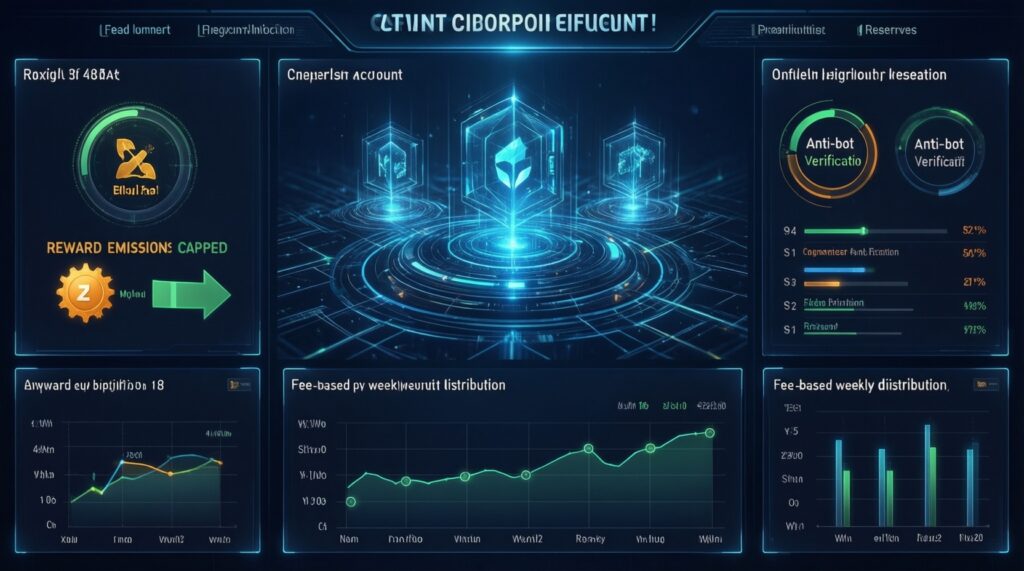
- If most rewards are paid from emissions, then impose per-account daily caps, anti-bot proof (device/behavioral), and reduce marginal rewards with a steep curve after the cap.
- If revenue is mainly marketplace fees, then distribute rewards in weekly epochs based on realized fees, with a reserve ratio and a rule that pauses payouts when fees drop below a predefined floor.
- If you run tournament pools, then set entry fee bands by rank and cap entries per wallet per day; route a fixed portion to treasury/sinks to avoid pure zero-sum churn.
- If you add wagering modules, then separate the bankroll from the utility token (or hard-limit conversion), enforce per-session loss limits, and publish a deterministic bankroll risk policy.
- If token price volatility spikes, then switch rewards to in-game credits or non-transferable points temporarily, and resume token payouts only when liquidity and spreads normalize.
Risk taxonomy: volatility, exploit vectors and behavioral arbitrage

For game devs: Your biggest risks are not "price goes down," but adversarial players finding higher-than-intended ROI loops: multi-accounting, referral farming, market manipulation of thin-liquidity items, and client-side tampering. Design with compartmentalization: isolate modes, throttle rewards, and make every payout depend on verifiable game state and anti-fraud scoring.
For token investors: Treat every attractive APR as a liability unless it's explicitly financed by revenue. Review exploit surface: bridges, oracles, marketplace escrow, randomness, and upgrade systems. Also assess behavioral arbitrage: players switching to the highest-paying mode and abandoning the rest, creating dead queues and collapsing retention.
For active players: Your risk is time-to-value. If exits are unrestricted and whales/bots dominate, your earned assets dilute quickly. Favor ecosystems with clear rules: cooldowns, anti-bot enforcement, and modes where skill or contribution matters more than capital size.
Fast selection algorithm (5-7-step checklist)
- Classify payouts: revenue-backed, fee-funded, or emission-funded; reject "mostly emission-funded" unless heavily capped.
- List top 3 sinks and verify they are desirable (players want them) and scalable (grow with activity).
- Stress-test liquidity: assume a sudden 2-3× increase in sellers; check whether AMM liquidity, vesting, and cooldowns prevent a death spiral.
- Identify top exploit vectors (bots, multi-accounts, RNG abuse, marketplace wash trading) and map a control per vector.
- Run a "mode migration" test: if one mode pays 20% more, does everyone move there? Add balancing levers before launch.
- Decide whether wagering is essential; if yes, isolate bankroll risk and set hard loss/volume limits per wallet and per session.
- Publish the adjustment policy: what triggers emission cuts, payout pauses, or sink discounts-so changes don't look like rug-like discretion.
Sustainability signals: KPIs, on-chain telemetry and lifecycle plans
For game devs: Sustainability is mostly operations: monitor per-mode net token flow (minted vs. burned), wallet-level concentration, bot scores, and time-to-churn after rewards changes. Plan the lifecycle: pre-season bootstrap, growth season, maturity (lower emissions), and sunset or sequel migration with clear asset conversion rules.
For token investors: Ask for dashboards that connect product KPIs to token outcomes: active spenders, fee volume, sink utilization, and circulating supply changes. A project that cannot explain why demand exists will not survive bear regimes. When people search for the best play to earn games, the survivable ones usually have normal game KPIs first and token KPIs second.
For active players: Durable games communicate schedules and limits: season dates, reward caps, and how new content affects old items. If the only "plan" is listing on more exchanges, it's not a lifecycle plan-it's a liquidity plan.
Frequent selection mistakes that create losing tokenomics
- Paying fixed token rewards per action without a dynamic throttle tied to revenue, liquidity, or bot rates.
- Designing sinks that feel like taxes (forced burns) instead of aspirational goals (crafting, cosmetics, power-with-tradeoffs).
- Letting whales convert capital into near-riskless yield (buy, farm, dump) with no cooldowns or diminishing returns.
- Launching with thin liquidity and instant unlocks, making the first sell wave define the project narrative.
- Ignoring off-chain abuse (account farms, collusion) because "on-chain is transparent."
- Assuming marketplace fees will fund rewards before you have meaningful trade volume.
- Mixing core progression with wagering outcomes, turning skill games into bankroll games.
- No segmentation: same economy for casuals, grinders, and speculators, causing one cohort to ruin the others' incentives.
- Changing emissions ad hoc without pre-committed rules, triggering distrust and bank-run behavior.
Governance, vesting schedules and anti-dump mechanics
Best fit guidance: For a game-first studio targeting long retention, a hybrid F2P + earn model with sink-driven P2E features is usually the best fit because it can fund rewards from real spending and control inflation. For a yield-seeking token investor, skill-capped earn plus clear vesting/cooldowns tends to be safer than high-emission P2E. For wagering-focused audiences, tournament pools or a tightly risk-managed house-bank model can fit-if compliance, limits, and transparency are treated as first-class requirements.
Common implementation questions practitioners face
Is Play-to-Earn always inflationary?
No. It becomes inflationary when rewards are mostly emissions without enough sinks or revenue backing. Revenue-backed or fee-funded payouts with caps can keep inflation manageable.
What makes Gamble-to-Earn different from regular P2E rewards?
Gamble-to-Earn is fundamentally wagering: payouts are driven by odds and bankroll risk, not contribution. That requires stricter limits, anti-abuse controls, and clearer disclosures than standard reward loops.
Should I use one token or two (utility + reward)?
Two tokens can reduce sell pressure on utility, but increases complexity and arbitrage routes. One token is simpler but needs stronger sinks, cooldowns, and emission throttles.
How do I prevent "farm and dump" behavior?
Use diminishing returns, cooldowns on withdrawals, season-based reward caps, and sinks that convert liquid rewards into desirable but less-liquid progression. Also tie the best rewards to skill tiers or verified contribution.
What telemetry matters most in the first month?
Net token flow (mint vs. burn), unique active wallets by mode, concentration of rewards, bot/fraud rates, and liquidity health (spreads, depth). If any of these are unstable, adjust emissions before adding new reward modes.
How do vesting schedules interact with player rewards?
If team/investor unlocks happen while player emissions are high, you stack sell pressure. Align major unlock cliffs with matured sinks, stronger revenue, and lower emissions epochs.
Can I run both P2E and wagering modes in the same game?
Yes, but isolate them: separate bankroll accounting, limit conversion paths, and ensure core progression never depends on wagering outcomes. Operationally, treat it like two products with different risk controls.