
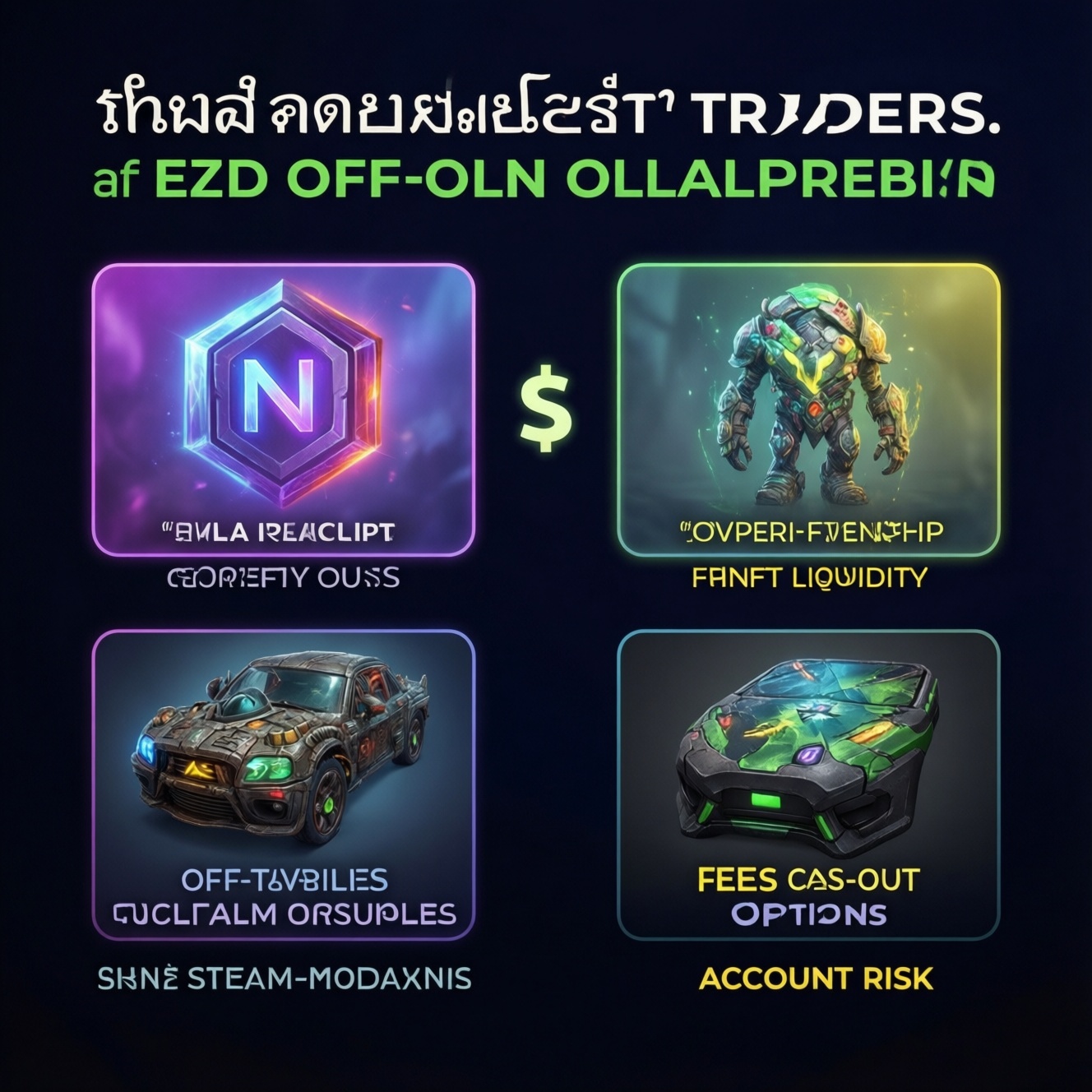
If your main goal is flexible ownership and off-platform trading, NFT items usually fit better; if your goal is fast in-ecosystem liquidity and straightforward buying inside a familiar platform, Steam skins are typically the practical pick. For budget-first traders in Thailand, prioritize fees, cash-out paths, and account risk before you buy NFT items or buy Steam skins.
At-a-glance comparison: ownership, liquidity, real-world value
- Ownership: NFTs are blockchain tokens you control via a wallet; Steam skins are platform-licensed items controlled by your Steam account.
- Liquidity: NFTs can trade across an NFT marketplace ecosystem, but liquidity is collection-specific; Steam skins are liquid inside Steam's economy, but more limited off-platform.
- Real-world value: NFTs may access broader buyers; Steam skins often price around game demand and Steam's constraints.
- Cash-out: NFTs can be sold to crypto and then converted; Steam requires an external route if you want to sell Steam skins for cash.
- Risk surface: NFTs: wallet security, scams, chain fees; Steam: account restrictions, trade holds, policy changes.
- Budget fit: Steam skins often allow smaller "try-and-learn" purchases; NFTs can be cheap too, but fees and spread can erase small gains.
Ownership models: blockchain tokens versus platform-licensed skins
Use these criteria to choose what you're actually buying: a portable tokenized asset (NFT) or an in-platform licensed cosmetic (Steam skin).
- Control of custody: Do you want self-custody (wallet) or account-custody (Steam)?
- Portability: Is "trade outside one platform" a requirement, or is Steam-only fine?
- Counterparty risk: Can you tolerate platform enforcement risk (Steam) versus wallet/key-management risk (NFTs)?
- Liquidity venue: Do you prefer one main order-book (Steam) or multiple venues across an NFT marketplace landscape?
- Exit path: Do you need a clear route to local currency, or is in-platform value acceptable?
- Fee sensitivity: Are you making small buys (fees matter more) or larger positions (spread and liquidity matter more)?
- Time horizon: Flipping needs tight spreads and frequent buyers; collecting can tolerate lower liquidity.
- Utility: Do you value in-game use (skins) or perks/utility tied to a token/community (NFTs)?
- Compliance comfort: Are you okay operating through crypto rails, or do you prefer purely platform-based trading?
Legal rights and transferability: resale, gifting, and intellectual property
Neither option typically grants IP ownership of the underlying art/game assets. The practical difference is enforcement and transfer rails: NFTs are transferred on-chain; Steam skins are transferred within Steam's rules and technical limits.
| Option | Who it fits | Pros | Cons | When to choose |
|---|---|---|---|---|
| Self-custodied NFT item (wallet) | Collectors/traders who want off-platform control | Token is portable; you can move it without platform permission; broad potential buyer base | You manage keys; phishing risk; transfer mistakes can be irreversible | When you want maximum custody control and are comfortable with wallet hygiene |
| NFT item held on a custodial marketplace account | Budget buyers who want simplicity | Easier onboarding; fewer wallet steps; often simpler listings | Custodian can freeze/limit; withdrawal rules may change; less control | When you buy NFT items as a small test position before moving to self-custody |
| Steam skin owned via Steam account license | Players who mainly want in-game cosmetics | Seamless in-platform use; familiar UI; convenient to buy Steam skins quickly | Transferability constrained by Steam policies/holds; platform risk; limited off-platform rights | When your main utility is in Steam games and you accept Steam's rules |
| Steam skin trading within Steam Community Market | Frequent in-ecosystem traders | Consolidated demand; quick price discovery; easy re-listing | Proceeds stay in Steam ecosystem; cash-out needs external steps if you want to sell Steam skins for cash | When you plan to recycle balance into games/skins and prioritize speed |
| Off-platform cash-out via third-party skin sites | Traders prioritizing real-world liquidity | Possible route to real-world money; sometimes faster exits than NFT cycles | Higher scam/counterparty risk; verification/limits; pricing discounts vs Steam | When cash-out is essential and you can manage additional platform risk carefully |
| NFT item with explicit license terms (project-specific) | Buyers who care about commercial use/derivatives | Clearer usage rights if terms are stated; better for creators/brands | Terms vary; enforcement uncertain; still no guarantee of broad IP rights | When the license text is clear and you actually need the granted permissions |
Market structure and liquidity: decentralized exchanges vs Steam marketplace
Choose based on the scenario you're in, not the headline concept of "NFTs vs skins".
- If you want the simplest loop of buy → list → re-buy inside one ecosystem, then use the Steam skins marketplace path (Steam Community Market) and treat it as a closed economy.
- If you need off-platform reach to more buyer pools, then list NFT items across relevant venues in an NFT marketplace ecosystem (where the collection is active) and focus on collections with consistent volume.
- If you are budget-first and making small trades, then prefer venues with the lowest total friction (fees + spread + transfer costs). For many small buys, Steam skins often win because you avoid multi-step on-chain actions.
- If you are premium-focused and deploying larger capital, then prioritize depth and credible buyers: high-liquidity NFT collections or top-tier Steam skins with strong demand history, even if absolute fees are higher.
- If your exit requirement is "to cash", then map the full route first: with skins, confirm where you can sell Steam skins for cash and the payout method; with NFTs, confirm the crypto-to-fiat bridge you can actually use without delays.
- If you can't monitor markets daily, then avoid thin NFT floors and obscure skins; pick items with consistent demand and fewer surprise price gaps.
Valuation drivers: rarity, utility, demand, and external factors

- Define your use case: play value (skins), community/perk value (NFTs), or pure flip (either, but liquidity matters most).
- Check liquidity signals: recent sales activity, bid/ask spread, and how quickly comparable items move.
- Identify rarity that matters: not "low supply" alone, but whether buyers pay for that trait/finish/edition.
- Assess utility durability: game popularity and policy stability for skins; project relevance and ecosystem support for NFTs.
- Stress-test exit price: assume you must undercut the market to sell quickly; if that makes the trade unattractive, skip.
- Account for external shocks: platform rule changes (Steam), contract/mint changes or hype cycles (NFTs).
Costs, fees, and budget-first acquisition strategies
Common mistakes that destroy returns for intermediate buyers, especially on smaller budgets:
- Buying the asset first and only then discovering the cash-out path is limited (common when you plan to sell Steam skins for cash).
- Ignoring total friction: marketplace fees + transfer costs + spread + currency conversion, especially painful on small trades.
- Overpaying due to thin order books (both NFT floors and niche skins can gap suddenly).
- Confusing "listed price" with realizable price (what actually clears quickly).
- Using an unfamiliar NFT marketplace without verifying collection authenticity and contract details.
- Buying Steam skins from the first listing without checking comparable recent sales and current depth.
- Chasing hype announcements and ignoring time-to-exit (you can be right and still stuck).
- Not budgeting for security costs: hardware wallet (NFTs) or account security recovery readiness (Steam).
- Trading too many small positions instead of fewer, more liquid items where spreads are tighter.
Practical workflow for collectors and traders: custody, listing, and exit
Best for budget-first, fast iteration is usually Steam skins: you can buy Steam skins, re-list quickly on the Steam skins marketplace, and keep complexity low while you learn pricing. Best for off-platform ownership and broader reach is typically NFT items: buy NFT items through a reputable NFT marketplace, control custody via a wallet, and plan your fiat exit route before sizing up.
Practical clarifications for buyers, sellers, and budget traders
Can I truly own an NFT item in a way I can't own a Steam skin?
You can control the NFT token via your wallet and transfer it on-chain without Steam's internal permission. A Steam skin is generally a license bound to platform rules and account status.
Is Steam always more liquid than NFTs?
Not always. Steam can be very liquid for popular items, while many NFTs are thin; however, top NFT collections can be highly liquid within their own markets.
What's the safest beginner path if I'm trying to buy NFT items?
Start with small sizes, verify the collection contract, and use a well-known NFT marketplace. Move to self-custody only after you have repeatable wallet security habits.
Where do I buy Steam skins with the least hassle?
The most straightforward path is within Steam's own market and trading features, effectively using the Steam skins marketplace as your primary venue. It reduces external counterparty risk compared with unfamiliar third-party sites.
What should I check before I try to sell Steam skins for cash?
Confirm the payout method you can actually use in Thailand, expected verification steps, and the discount versus in-Steam prices. Treat any unusually generous offer as a scam signal.
Do fees matter more for budget traders than premium traders?
Yes: on small trades, fixed and percentage frictions can wipe out the edge. Premium trades can absorb costs better, but liquidity and exit reliability become the main constraints.
Should I diversify across NFTs and skins?
Diversification can reduce platform-specific risk, but it increases operational complexity. Only diversify if you can manage both wallet security (NFTs) and account/trade safety (Steam) reliably.