

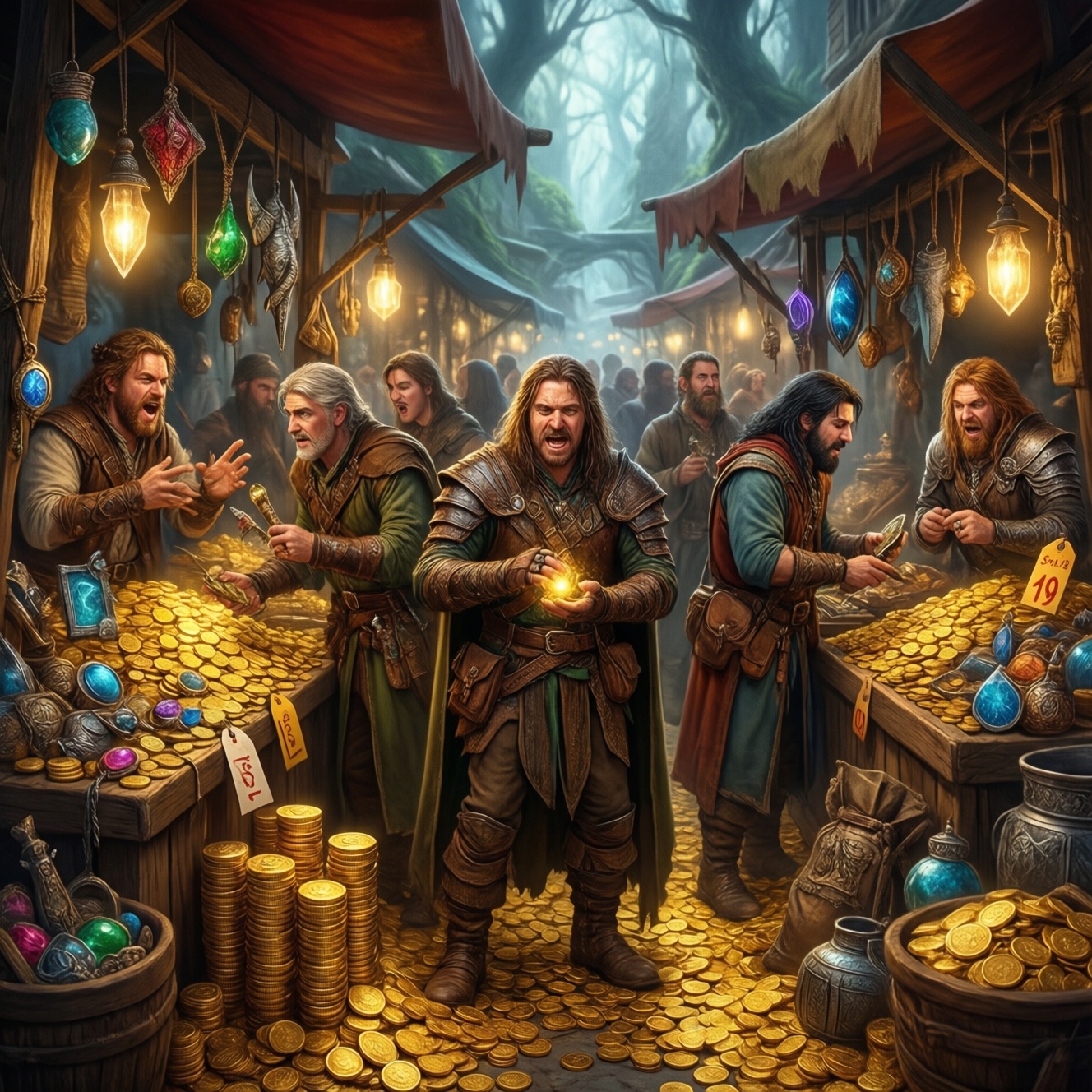
In-game item economics is about how digital scarcity, currency creation, and player expectations shape what items cost and how markets behave. Scarcity sets the baseline value, in-game currency inflation pushes nominal prices up, and price bubbles appear when speculation and hype detach prices from utility. You can manage this by instrumenting sinks/sources, controlling supply, and stabilizing expectations.
Executive Summary of Core Mechanisms

- Scarcity is engineered: drop rules, crafting gates, and tradability determine what is truly limited.
- Inflation is usually systemic: daily rewards, faucets, and weak sinks expand money faster than item supply.
- Bubbles are behavioral: players buy because they expect others will pay more, not because the item got better.
- Marketplace design (listing fees, taxes, price bounds, visibility) changes liquidity and volatility as much as content does.
- Stability comes from measurement: track currency flows, item velocity, and dispersion of in-game items prices.
- Mitigation is a toolbox: throttle faucets, strengthen sinks, pace releases, and communicate policy to reduce panic buying.
Defining Scarcity in Virtual Economies
Scarcity in a game economy means an item's availability is constrained by rules (time, skill, randomness, limits), not by physical production. It is real to players because it affects their probability of obtaining the item at a given effort or cost.
In an in-game items marketplace, scarcity is not just "low drop rate"; it also depends on whether items can be traded, how quickly they circulate, and whether substitutes exist. A "rare" item that can be resold freely can become abundant in listings if veteran players farm it efficiently.
Applied examples (what to check):
- Time-gated scarcity: A limited-time event mount becomes scarce after the event ends; value depends on whether reruns or recolors are likely.
- Skill-gated scarcity: A PvP rank weapon is scarce because only a small share of players can earn it consistently; boosting services can secretly increase supply.
- Policy-driven scarcity: A "bind on equip" change instantly reduces effective supply on the market without changing drop tables.
Inflation Dynamics in Persistent Game Worlds
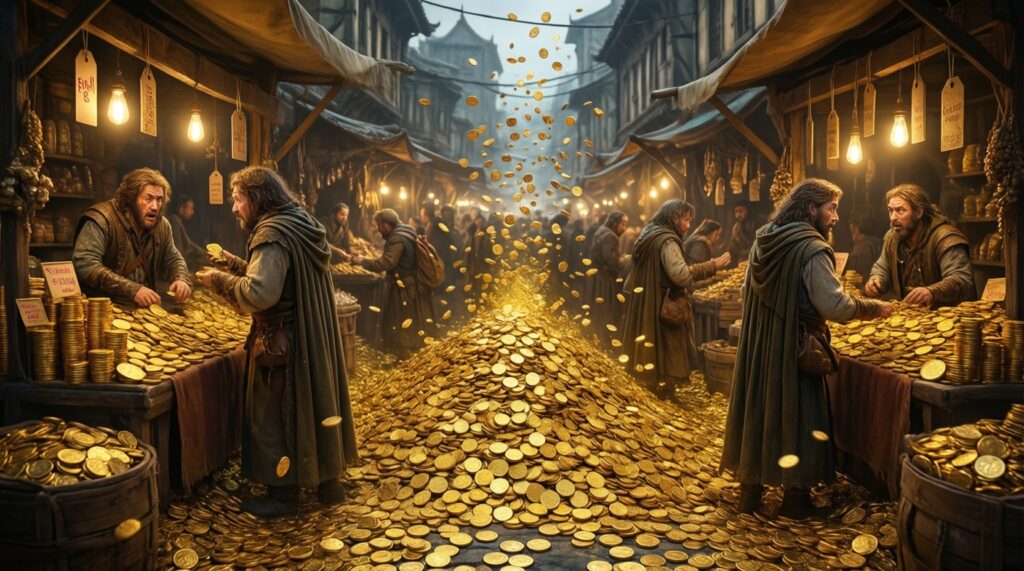
Inflation is when the same basket of goods costs more currency over time because currency supply grows faster than valuable goods and services. In games, in-game currency inflation typically comes from repeatable rewards that scale with playtime while sinks stay flat.
- Currency faucets outpace sinks: daily quests, login rewards, bots, and farming loops create net new money; repair costs and NPC fees don't scale with wealth.
- Progression accelerators: catch-up systems inject currency to reduce grind, but also raise the floor price of essentials.
- Wealth concentration: top players hoard currency, then set higher reservation prices; newcomers experience "everything is expensive."
- Denomination mismatch: low-value currencies become meaningless while high-value items reprice in alternative units (tokens, premium currency, barter).
- Market microstructure effects: low listing costs enable constant relisting and price stepping, making inflation feel faster than it is.
Applied examples (what it looks like):
- After a new farming zone: gold/hour rises for most players, and common crafting mats reprice upward within days because buyers are richer.
- After a generous event: currency piles up, but supply of top-tier items doesn't; premium gear becomes the "store of value."
- After bot waves: raw materials flood the market (some prices fall), but high-demand crafted outputs can rise if bots mainly produce currency.
Mechanisms Behind Price Bubbles in Item Markets
A price bubble occurs when an item's market price is driven primarily by expectations of future resale rather than its current utility, rarity, or replacement cost. Bubbles form easily when information is uneven and players can quickly buy in-game items for speculation.
- Patch-note anticipation: A hinted buff makes players stockpile an item before the patch; price spikes even if the buff ends up minor.
- Influencer-driven demand: A build guide or streamer trend causes sudden demand for a previously ignored item with fixed short-run supply.
- Artificial cornering: A guild or trader buys out listings to create the illusion of scarcity, then relists at stepped-up prices.
- Liquidity shock: A new server, cross-region merge, or marketplace UX change increases trading velocity and amplifies upward moves.
- Store-of-value behavior: When currency is expected to lose value, players park wealth in "safe" rare items, inflating them first.
Mini-scenarios you can run to diagnose market behavior fast
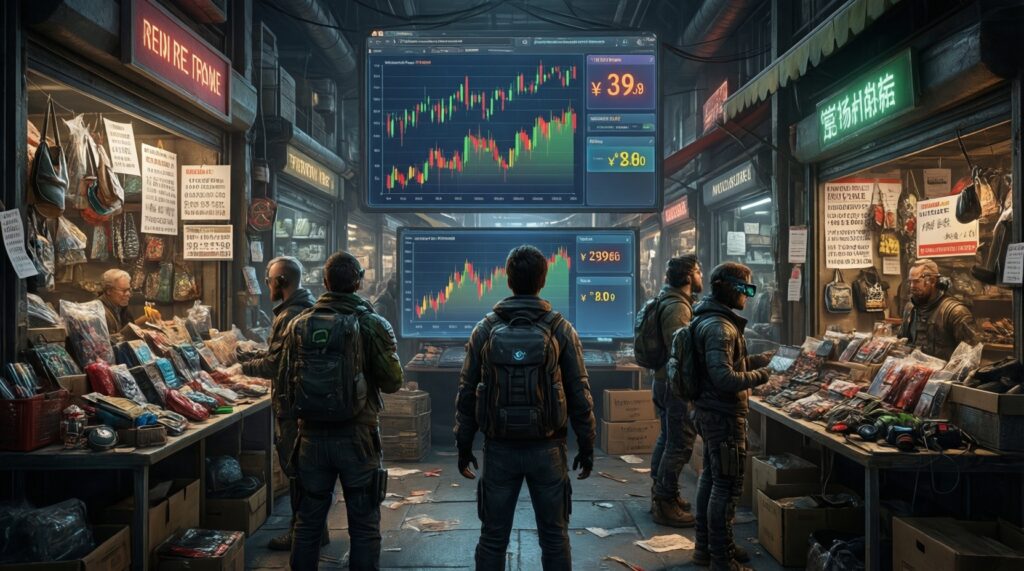
- Utility check: Ask: "If resale were disabled, would players still want this item?" If demand collapses, the price is likely expectation-driven.
- Supply elasticity test: If a 24-48 hour price jump is followed by a surge in listings (farmers respond), it's often a spike, not a durable scarcity shift.
- Substitute scan: If substitutes exist (similar stats/skins), a sustained bubble usually needs strong social signaling (status, flex value), not gameplay power.
Measuring Value: Metrics, Data Sources, and Tables
Measurement means turning market activity into signals you can act on: what moved, why it moved, and whether intervention is likely to help. In a gaming virtual items economy, the most practical approach is to combine marketplace telemetry with a small set of interpretable indicators.
Metrics that stay actionable
- Median transaction price: more robust than last-listed price; track per item tier and per server/region.
- Volume and turnover: number of trades and how quickly inventory sells; bubbles often show rising price plus falling depth (thin book).
- Listing depth: how many units are available near the median; scarcity shows persistent low depth even after price rises.
- Currency flow balance: net faucet minus sink; rising net creation predicts broad upward repricing even without item changes.
- Price dispersion: spread between low and high listings; manipulation often increases dispersion before it stabilizes at a higher plateau.
Where to pull data (and what each misses)
- Marketplace logs: best for transaction prices and volume; weak on "off-market" trades (direct swaps, guild banks).
- Item generation logs: drop/craft counts; doesn't show hoarding or mule accounts that reduce circulating supply.
- Currency ledgers: faucets/sinks by source; doesn't show how wealth concentration changes price-setting power.
- Community signals: Discord, trade chat, creator content; qualitative but early-useful for anticipating hype cycles.
| Phenomenon | Typical player-visible symptom | Best indicators to watch | Most likely root cause | Low-risk first response |
|---|---|---|---|---|
| Engineered scarcity | Item stays hard to find even as price rises | Persistent low listing depth; stable high turnover; low generation rate | Supply is genuinely constrained (time gates, bind rules, low drop) | Add alternative acquisition path or controlled reissue; keep utility constant |
| Currency inflation | Many unrelated items cost more over time | Net faucet > sink; rising median prices across categories; currency holdings trend up | Repeatable rewards scale faster than sinks; wealth concentrates | Strengthen scalable sinks (fees, repairs, vanity sinks); throttle top faucets |
| Price bubble | Sudden spike tied to hype; big spread between listings | Price up with unstable volume; rising dispersion; rapid relisting | Expectation-driven buying, cornering, patch speculation | Increase market friction temporarily (tax/fee); publish clarity on upcoming changes |
Design Levers: How Developers Shape Supply and Demand
Design levers are controllable rules that shift supply, demand, or trading behavior without needing to "nerf the economy" globally. The practical goal is to shape incentives so that prices reflect utility and effort rather than exploitable loops.
- Mistake: Only tweaking drop rates. If farming efficiency or botting is the real driver, drop-rate changes can punish legitimate players while supply still leaks in through automation.
- Mistake: Flat currency sinks. Static fees stop mattering as players get richer, so inflation pressure returns; prefer sinks that scale with activity or wealth.
- Myth: More tradability always helps players. Full tradability increases liquidity but also enables cornering and real-money incentives; selective binding can stabilize critical progression items.
- Myth: Transparency always prevents bubbles. Partial information can still be gamed; what helps most is clarity about what will not change (no surprise buffs) and predictable cadence.
- Mistake: Ignoring UX friction. Search, sorting, price history visibility, and undercut mechanics can amplify volatility more than content updates.
Mitigation Strategies: Policy, Monetization, and Community Tools
Mitigation means applying targeted controls that reduce exploitability and stabilize expectations while keeping the economy fun to engage with. The safest interventions are reversible and measurable within your own telemetry.
Mini-case: stabilizing a spiking crafting material without killing player profit
- Instrument first: segment buyers (crafters vs speculators) by holding time and relist frequency; track whether the spike is broad or item-specific.
- Add a scalable sink: introduce a crafting station fee or refinement loss that scales with batch size, so heavy speculation pays more friction than casual crafting.
- Release controlled supply: add a weekly quest or NPC exchange that injects a bounded amount, preventing hard lockouts without flooding.
- Set expectations publicly: communicate whether upcoming patches will change drop sources; reduce panic buying by removing uncertainty.
Implementation sketch (rules logic, not code)
- If net currency creation rises and median prices rise across categories, then prioritize scalable sinks over item nerfs.
- If one item spikes with high relist frequency and widening dispersion, then increase temporary market friction and publish patch clarity.
- If scarcity is intentional (prestige), then protect it with binding/limits and add cosmetic substitutes to absorb demand.
Practical Clarifications and Common Implementation Concerns
Is high price always proof of real scarcity?
No. High price can come from currency inflation, hype, or cornering. Confirm with listing depth and item generation logs before treating it as a supply problem.
What is the quickest way to tell inflation from a bubble?
Inflation lifts many categories together; bubbles are narrow and spiky. Check whether unrelated essentials reprice alongside the headline item.
Do marketplace taxes actually help, or do they just annoy players?
They help when they scale with activity and are transparent. A small, consistent fee reduces rapid flipping and absorbs excess currency without blocking normal trade.
How can I prevent manipulation without removing player trading?
Increase friction for extreme behaviors: higher fees for frequent relists, rate limits on cancellations, and better price history visibility. Keep ordinary listing and buying simple.
When should developers intervene versus letting the market self-correct?
Intervene when core progression becomes inaccessible or when exploit-driven supply/currency is confirmed. Let it self-correct when supply can respond naturally and no essential systems are blocked.
How do you handle cross-region effects in Thailand-focused servers?
Watch for time-zone driven liquidity spikes and event schedules that concentrate farming. Stagger releases and align sinks with peak activity windows to avoid predictable arbitrage cycles.