

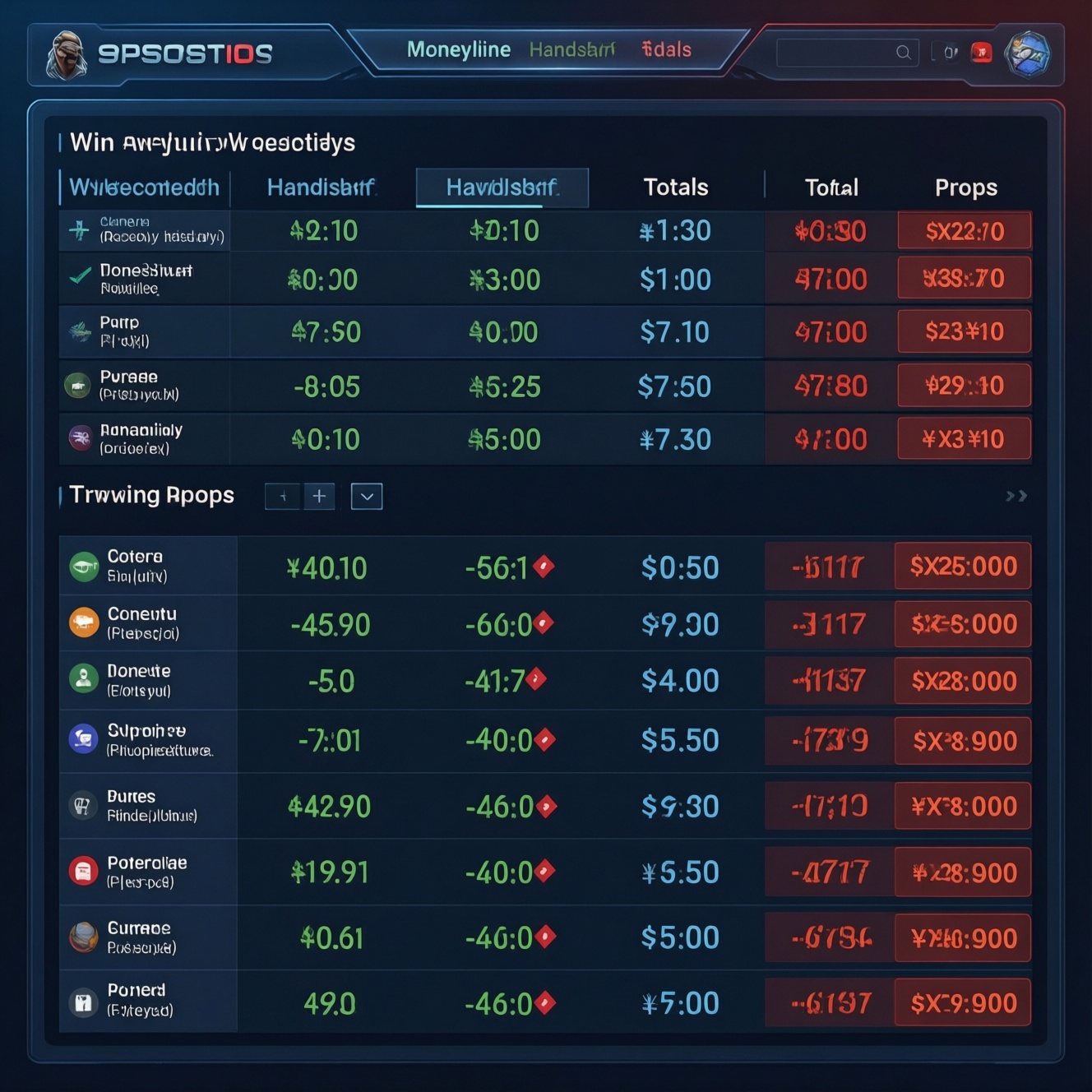
Esports betting odds tell you two things: what you win if you're right, and what probability the bookmaker is implying. For beginners, the fastest path is to map each market to one question: moneyline = who wins, handicap = by how much (maps/rounds), totals = how many, props = what specific event happens.
Quick Odds Primer for Esports Bettors
- Start by choosing the market that matches your read: winner (moneyline), margin (handicap), volume (totals), or event (props).
- Convert odds to implied probability before comparing teams or lines.
- Don't mix formats: decimal, American, and fractional describe the same price differently.
- Handicap and totals are often better when you can model maps/rounds, not just the winner.
- Prop markets can be soft but are easier to misprice if you ignore rules, roles, and sample size.
Understanding Moneyline: How Winners Are Priced
Moneyline esports betting is the simplest market: you bet on which team (or player) wins the match. Odds reflect the bookmaker's view of each side's chance of winning, plus margin.
Use moneyline when your edge is mainly about the win condition (draft matchup, map pool, recent roster change, travel/online conditions). Avoid forcing moneyline if you think the favorite wins often but not cleanly; that's usually a handicap or totals angle.
Action step: convert the price to implied probability, then ask "Is my true win probability higher than implied?" If not, pass-even if you like the team.
Handicap Betting Demystified: Spreads and Map Advantages
Esports handicap betting adjusts the score with a head start/penalty so the bet depends on the winning margin. In map-based games it's commonly "maps handicap" (e.g., -1.5 maps). In round-based games it can be "round handicap" (e.g., -3.5 rounds).
- Pick the unit: maps (Bo3/Bo5), rounds (CS2/Valorant), kills/objectives (game-dependent).
- Read the line: -1.5 means your team must win by 2+ (you can't "half-win" a map).
- Understand pushes: whole numbers (e.g., -1.0) can push; half numbers (e.g., -1.5) cannot.
- Match the line to series length: -1.5 in Bo3 is much stricter than -1.5 in Bo5.
- Model distribution, not just average: a team can be consistent (good for handicaps) or volatile (dangerous for big spreads).
- Check rules: map/round handicaps can be voided or graded differently if a match ends by forfeit/technical decision (book-specific).
Totals (Over/Under): Modeling Game Scores and Rounds
Esports totals over under means you bet whether the combined total (maps, rounds, kills, etc.) finishes above (Over) or below (Under) a set line. Totals often outperform winner markets when your insight is about pace, style, or map pool rather than raw strength.
- Bo3 map totals: Over 2.5 maps is essentially "goes to a decider"; Under 2.5 is "ends 2-0".
- CS2/Valorant round totals: Over hits when teams trade rounds and reach close scorelines; Under hits with blowouts.
- Patch/meta shifts: changes in economy, agent balance, or objective timing can move totals more than moneyline.
- Map veto effects: two slow maps can inflate under value even if the favorite is strong.
- Team identity: high-variance teams create totals value when the market anchors too hard to recent results.
Prop Bets in Esports: Types, Valuation, and Examples
Esports prop bets are wagers on specific events rather than the match outcome. They can be profitable when you specialize (roles, maps, playstyles), but they punish sloppy rule-reading and small-sample thinking.
Where props are strongest
- Role-based props: e.g., a primary entry fragger's kills, or a support's assists (game/market dependent).
- Map-specific props: performance props tied to certain maps where teams run repeatable setups.
- Objective props: first objective, total objectives, or special events that correlate with pace and composition.
Common limitations to price in
- Unclear settlement rules: overtime inclusion, map count, remakes, substitutions, and format changes.
- Lineup volatility: stand-ins and role swaps can break a prop model instantly.
- Data quality: public stats can lag patches or miss context (strength of opponents, map selection).
Implied Probability & Converting Odds Across Formats
To compare esports betting odds across books (and to your own estimates), convert them to implied probability first. Then compare probabilities-not payouts.
| Decimal | American | Fractional | Implied probability (no margin) | Quick read |
|---|---|---|---|---|
| 1.50 | -200 | 1/2 | 1 / 1.50 | Strong favorite |
| 2.00 | +100 | 1/1 | 1 / 2.00 | Even money |
| 2.50 | +150 | 3/2 | 1 / 2.50 | Underdog |
| 3.00 | +200 | 2/1 | 1 / 3.00 | Bigger underdog |
- Mistake: comparing payouts instead of probabilities. Always translate odds into implied probability first (decimal:
p = 1 / odds). - Mistake: ignoring bookmaker margin. Two-sided markets usually sum to more than 100% implied probability; look for the best price, not "fairness."
- Mistake: mixing markets. A handicap line and a moneyline aren't interchangeable; they price different distributions.
- Myth: higher odds means better value. Value is "your probability minus implied probability," not the size of the payout.
- Myth: recent results are the best forecast. In esports, patch changes, map pool, and roster moves can dominate recency.
Building a Betting Model: Bankroll, Edge, and Risk Management
You don't need a complex model to bet cleaner-you need a repeatable workflow: estimate probability, compare to implied probability, stake consistently, and track results by market type (moneyline, handicap, totals, props).
Mini workflow you can copy
- Define the market question: winner (moneyline), margin (handicap), volume (totals), event (props).
- Estimate true probability: your number based on matchups (map pool, pace, roles, format).
- Compute edge:
edge = p_true - p_implied. - Stake rule: keep stakes proportional and capped; avoid "all-in" swings when variance is high (especially props).
- Review: track by league/patch and market type to see where you actually perform well.
# Pseudocode (odds in decimal)
p_implied = 1 / odds
edge = p_true - p_implied

if edge <= 0:
    skip_bet
else:
    stake = bankroll * min(max(edge, 0.005), 0.02)  # example cap range
Self-check before placing the bet
- I can state the exact condition for winning (maps/rounds/props settlement), not just "Team A is better."
- I converted odds to implied probability and wrote my own probability estimate.
- I chose the market that fits my read (moneyline vs handicap vs totals vs props), not the one with the prettiest payout.
- I sized the stake consistently and can survive a normal losing streak for this market type.
Common Betting Doubts Resolved
Are moneyline odds always the safest option?
No. Moneyline is simpler to settle, but it can be overpriced on popular teams; handicaps or totals can be lower-variance when your edge is about margin or pace.
What's the fastest way to compare two sportsbooks' prices?
Convert both to implied probability and compare. For decimal odds, use p = 1 / odds before deciding which is better.
When should I prefer esports handicap betting over moneyline?
Prefer handicaps when you expect a consistent margin (clean 2-0s, round dominance) and the moneyline is too short to offer value.
How do I think about esports totals over under in a Bo3?
For map totals, Over 2.5 maps means the match goes to a decider; Under 2.5 means a 2-0. Anchor your view on map pool and how likely each team is to take a map.
Why do esports prop bets feel inconsistent?

Props are sensitive to role changes, substitutions, and settlement rules (overtime, remakes). Treat them as higher-variance unless you track context tightly.
Do I need American odds to bet, or is decimal enough?
Decimal is enough and is common in Thailand-facing sportsbooks. What matters is consistent conversion to implied probability so you can compare prices.