

Loot boxes are randomized reward bundles sold or earned in games, where outcomes are selected from a defined item pool via RNG and governed by disclosed or hidden drop rates. Practically, you manage them by specifying probability models, implementing trustworthy server-side draws, and auditing logs-while mitigating "one more roll" escalation through UX, limits, and transparent odds.
Essential concepts to grasp
- A loot box is a transaction plus a random draw from an item pool, not just a "reward animation."
- loot boxes drop rates are a probability distribution; payouts depend on pool design, not player "luck."
- loot box RNG explained: RNG selects an outcome; "fair" means correctly implemented, logged, and tamper-resistant.
- Pity/guarantee systems change expected value and variance; they also change player pacing and spend curves.
- Near-miss and variable reinforcement mechanics can amplify "one more roll" behavior; design needs guardrails.
- Operationally: define odds, implement securely, audit continuously, and align with Thailand-facing compliance and harm reduction.
Defining loot boxes: mechanics, item pools, and transaction flow
A loot box is a packaged random reward mechanism where a player exchanges something of value (money, premium currency, time, or a limited entitlement) for a draw from a pre-defined pool. The defining parts are: (1) a pool (what can drop), (2) weights/odds (how likely each outcome is), and (3) a draw procedure (how the system selects and grants items).
In practice, the "transaction" is broader than buy loot boxes. A "free" box can still be monetized indirectly (engagement loops, ad views, battle pass progression) and can still require the same integrity controls because it affects retention and competitive balance.
Boundaries that matter for implementation and policy:
- Deterministic bundles (fixed contents) are not loot boxes even if they look similar in UI.
- Crafting/merge systems may be RNG-adjacent, but if there is no paid/limited random draw, regulation and disclosure expectations differ.
- Gacha/pack openings are essentially loot boxes; naming varies by genre and region.
RNG and drop rates: probability models, pity systems, and expected value
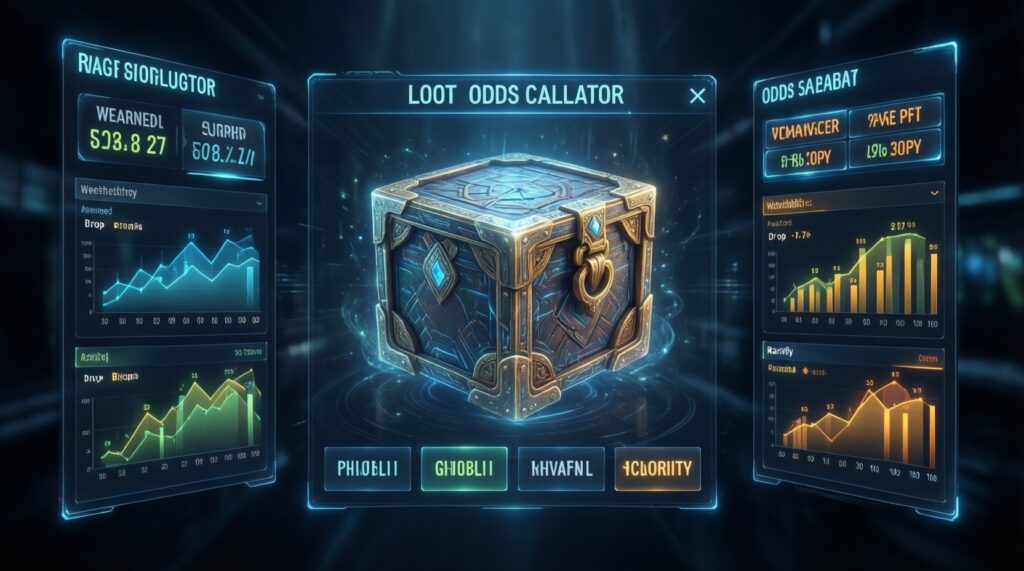
Drop logic is typically a weighted categorical draw, sometimes multi-stage (rarity first, then item). A "loot box odds calculator" is just a way to compute derived probabilities (e.g., chance to obtain a specific item after N opens) from your base rates and pity rules.
- Single-stage weighted draw: each item
ihas weightw_i, probabilityp_i = w_i / sum(w). - Two-stage model (rarity → item):
P(item) = P(rarity) * P(item | rarity). This is easier to tune without breaking headline rarity odds. - Probability of at least one success in N independent opens: if chance per open is
p, thenP(>=1) = 1 - (1 - p)^N. - Expected opens until first success (geometric, no pity):
E[N] = 1/p. Useful for setting "how grindy it feels," not for guaranteeing outcomes. - Pity / guarantee: rules like "increase p after k misses" or "guarantee at N." This reduces long tails and changes perceived fairness.
- Duplicate protection: modifies the effective pool over time; you must define how the distribution updates as the player collects items.
- EV thinking: for designers, compute "expected value" in progression units (power, cosmetics scarcity, crafting shards), not just currency. EV should match your economy sinks.
Concrete calculation example (no pity): Suppose a featured cosmetic has p = 0.02 per box. After N = 50 opens, P(>=1) = 1 - 0.98^50. This is the kind of number players implicitly reason about when deciding whether to keep rolling; your pacing and messaging should anticipate that.
Mini-scenarios: practical usage before you tune monetization
- Balance a limited-time banner: lock headline rarity odds, then adjust within-rarity weights to control which items dominate the outcome distribution.
- Reduce support tickets: add a hard guarantee (e.g., "by N") to prevent extreme bad-luck cases that feel like fraud, then audit that it always triggers.
- Prevent economy inflation: if duplicates convert to shards, compute shard faucet rate from odds to avoid breaking upgrade pacing.
- Make odds disclosures consistent: ensure displayed odds reflect conditional rules (pity, protection) or clearly state when they don't.
Implementation details: server vs client RNG, RNG sources, and auditing
Security and trust hinge on where randomness is generated and how outcomes are committed. If you want defensible loot box RNG explained behavior, treat the draw like a financial transaction: deterministic inputs, auditable outputs, and tamper resistance.
- Server-authoritative draw (recommended): client requests an open; server validates entitlement, draws outcome, writes immutable logs, then grants items. Best for anti-cheat and dispute resolution.
- Client-side draw (high risk): even with obfuscation, it is vulnerable to manipulation, replay, and seed extraction; avoid for real-money or competitive-impact outcomes.
- Hybrid "precomputed tickets": server pre-allocates a sequence (or batch) of outcomes tied to an account/session; client reveals them. Still must log issuance and consumption to avoid double-spend bugs.
- RNG source selection: use a cryptographically secure PRNG for draws. Non-crypto PRNGs can be predictable, especially if seeded poorly.
- Audit logging: persist request ID, player ID, box type, pool version, RNG seed reference (not the seed itself if sensitive), outcome, timestamp, and grant confirmation.
Audit checkpoints you can run weekly
- Verify observed distribution against configured weights per pool version (watch for silent config drift).
- Ensure idempotency: the same open request cannot grant twice after retries/timeouts.
- Check that pity counters and guarantee triggers match specs under edge cases (disconnects, refunds, account restores).
- Confirm entitlement accounting: premium currency decremented exactly once; free tickets consumed exactly once.
Monetization strategies and designer levers that shape drop profiles
Monetization design is mostly about controlling variance, pacing, and perceived control. The technical levers below are what actually change player spend and sentiment-more than the animation or storefront placement.
Levers you can tune without rewriting the system
- Pool size and composition: smaller pools make targeted items easier; larger pools increase variance and frustration.
- Weight shaping: adjust within-rarity weights rather than headline rarity to keep disclosures stable.
- Time gating: rotate banners; remove items to create urgency (but disclose availability clearly).
- Guarantee design: hard guarantee at N, soft pity ramps, or token exchange after N opens.
- Duplicate conversion: shards/tokens can cap "wasted" opens and lower regret.
Constraints and trade-offs to plan for
- Disclosure complexity: pity and protection make "true odds" conditional; your UI/legal copy must not imply a flat rate if it isn't.
- Economy stability: improving generosity (pity, smaller pools) increases currency-to-reward throughput; you need new sinks or lower drop value.
- Perceived fairness: players compare outcomes socially; "best loot boxes games" reputations often come from transparent odds and strong bad-luck protection.
- Fraud/refunds: when money is involved, you need reversible grants or clear refund policies; otherwise support becomes the bottleneck.
Player psychology: variable rewards, near‑miss effects, and escalation loops
Loot boxes leverage intermittent reinforcement: unpredictable rewards can sustain repeated attempts. Practical design work is to avoid unintended harm while still meeting business goals.
- Myth: "RNG evens out soon". Without pity, streaks are normal. Players misread variance as "rigging," so communicate mechanics and provide protections.
- Near-miss amplification: showing "almost got the rare" states can increase repeats; treat near-miss UX as a risk factor requiring review.
- Sunk-cost escalation: progress meters and pity counters can motivate completion; they can also push overspending if poorly bounded.
- Illusion of control: "tap timing" or "special rituals" don't change probabilities, but UI can imply they do. Avoid designs that suggest player actions affect RNG when they don't.
- Social pressure: public pulls and streamer-style reveals can normalize high spending; offer privacy options and spending reminders.
Policy, compliance, and practical mitigation for harm reduction
For Thailand-facing products, align loot box operations with platform rules, local consumer expectations, and internal harm-reduction standards. The goal is to make odds accurate, outcomes auditable, and spend controllable-even when users repeatedly buy loot boxes.
Concrete mitigation pattern: transparent odds + spend friction + safe pity
- Disclose headline rarity odds and key conditional rules (pity, guarantees, duplicate protection) in the storefront and before purchase.
- Limit risk: session cooling-off prompts, optional caps, and clear price anchors (currency → THB equivalent where applicable).
- Protect players: hard guarantees for high-impact items, and a non-random path (tokens) after repeated misses.
- Audit continuously: config versioning, immutable logs, anomaly detection (e.g., sudden deviation after a hotfix).
Mini pseudo-code: server-authoritative open with pity and logging
// Inputs: playerId, boxType, requestId
// State: pityCount[playerId, boxType], poolVersion[boxType]

if (isDuplicateRequest(requestId)) return previousResult(requestId)

assert(entitlementAvailable(playerId, boxType))
consumeEntitlement(playerId, boxType)

v = poolVersion[boxType]
k = pityCount[playerId, boxType]

p = baseProbability(boxType, v)
p2 = applySoftPity(p, k)
result = weightedDrawSecureRNG(boxType, v, p2)

if (isHardGuaranteeHit(k)) result = guaranteeOutcome(boxType, v)

grant(playerId, result)
pityCount[playerId, boxType] = updatePity(k, result)

logOpen(requestId, playerId, boxType, v, k, result)
return result
Quick clarifications for common practitioner issues
Are loot boxes the same as gacha or card packs?
Mechanically, yes: a paid/limited random draw from a pool. Differences are mostly genre conventions and how pools are presented.
Do I need to publish exact loot boxes drop rates for every item?
That depends on your platform and jurisdiction, but you should at minimum publish meaningful odds players rely on (rarity and key featured items) and clearly explain conditional mechanics like pity.
Can players or cheaters predict outcomes if RNG is client-side?
Often yes, especially with weak PRNGs or exposed seeds. Use server-authoritative draws with secure RNG and strong logging.
Is a loot box odds calculator useful for developers, not just players?
Yes: it helps validate pity design, compute "chance by N opens," and catch configurations that create extreme tails or economy inflation.
Why do "one more roll" loops feel so strong even when odds are low?
Variable reinforcement, near-miss presentation, and progress meters can increase persistence. Reducing harm means adding transparency, caps, and non-random alternatives.
What's the simplest way to make loot box RNG explained to support teams?
Document the pool version, the exact pity/guarantee rules, and provide a per-open log view showing entitlement consumption and granted item.