

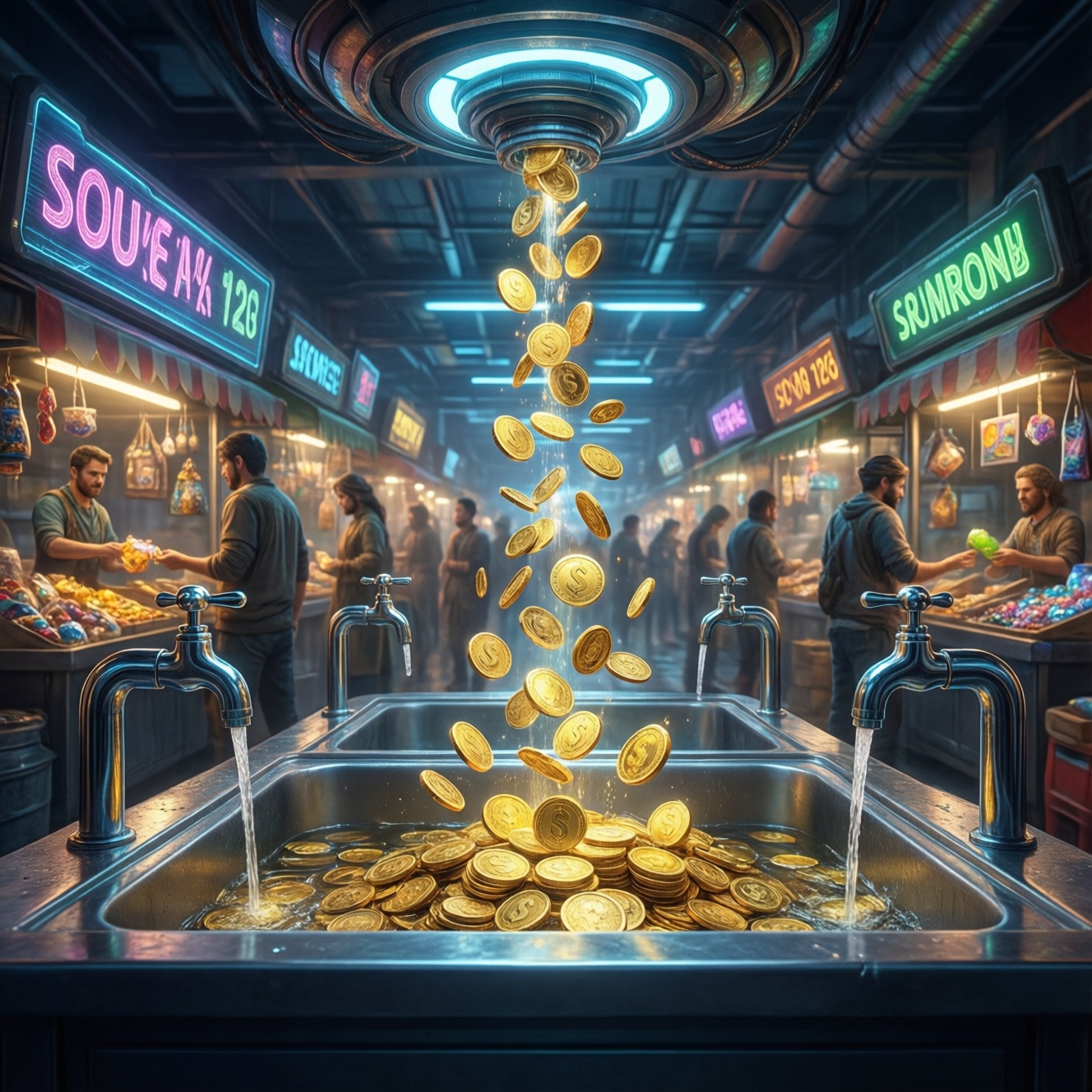
An in game economy works when your game continuously creates resources (faucets), removes resources (sinks), and shapes player choices that create demand. Prices and player behavior shift as money supply and item availability change, leading to virtual economy inflation or deflation. Managing it is practical: track a few core metrics, adjust faucets/sinks, and test changes safely.
Core Concepts of Virtual Market Mechanics
- Faucet: any system that injects currency/items (quests, drops, payouts).
- Sink: any system that removes currency/items (taxes, crafting fees, durability loss).
- Scarcity: limited supply relative to player demand; it's created by rules, not by "rarity labels."
- Price discovery: players collectively find a price via trading, time cost, and risk.
- Money supply vs. purchasing power: more currency doesn't mean "richer" if prices rise faster.
- Policy loop: measure → change one lever → observe → iterate (avoid stacking changes).
Foundations of In-Game Currency Systems
An in-game economy is the network of rules that governs how players earn, trade, store, and spend value. Value can be expressed as soft currency (earnable), hard currency (premium), items, crafting materials, time, or access (cooldowns/energy).
Virtual markets appear when players can compare alternatives (buy vs. craft vs. farm vs. trade) and when the game provides a clearing mechanism: an auction house, direct trading, NPC vendors, or implicit markets (best-in-slot farming routes). Even if your game has no player-to-player trading, you still have a market because players "pay" with time and opportunity cost.
Define boundaries early: which goods are tradable, which are bound, which are time-gated, and where real money intersects. If players can buy game currency directly or indirectly, you've introduced a second monetary system and must design for conversion pressure and fairness perceptions.
One-line definition: a game currency exchange rate is the conversion ratio between two value units (e.g., soft↔hard, hard↔item bundles, or player time↔currency via farming efficiency).
- List your value units (soft, hard, items, time) and where each enters/exits.
- Decide which trades are allowed (P2P, auction, NPC-only) and document "no-trade" zones.
- Write down the primary exchange rates players will infer (time→gold, gems→gold, gold→gear).
Mechanics of Supply: Item Generation and Removal

Supply is the rate at which currency and items enter circulation, minus the rate at which they are destroyed or permanently removed. Most instability comes from unbalanced or poorly targeted faucets and sinks.
- Reward faucets: quests, dailies, achievements, battle passes-predictable injections that set baseline money supply growth.
- Drop faucets: monster loot tables, gathering nodes-stochastic supply that can spike due to farming metas.
- Production faucets: crafting converts inputs to outputs; if inputs are too abundant, crafted items become de facto faucets.
- NPC buyback: vendor prices create a floor (and can accidentally print money if buyback exceeds acquisition cost loops).
- Currency sinks: repair, travel, rerolls, crafting fees, auction fees, housing upkeep-remove currency continuously.
- Item sinks: durability break, consumption, binding-on-equip, upgrade failure destruction-remove items or reduce supply of "usable" items.
- Event shocks: limited-time boosts, catch-up mechanics, compensation grants-temporary but often long-lasting supply changes.
- Map every faucet/sink to a player segment (new, mid, endgame) so sinks hit where money accumulates.
- Check for "infinite loops" (buy low from NPC → transform → sell high to NPC).
- Control supply at the source (drop tables, payout formulas) before adding more sinks as a patch.
Demand Drivers: Player Incentives and Utility
Demand is why players want currency/items and how urgently they want them. In practice, demand comes from power, convenience, identity, and social pressure-then gets amplified by trading and uncertainty.
- Progression demand: upgrades, gear checks, crafting tiers; demand peaks at bottlenecks and new content releases.
- Convenience demand: fast travel, inventory expansions, rerolls-players pay to reduce friction.
- Competitive demand: PvP rankings, guild races, speed clears; scarcity becomes status.
- Collection demand: cosmetics, mounts, pets; demand is driven by identity and limited availability.
- Risk-hedging demand: stockpiling consumables or materials when players expect price increases.
- Speculation demand: players trade to profit; it accelerates price discovery and volatility.
When players can trade, demand propagates through the entire market. When they cannot, demand still exists but expresses itself as "time-to-acquire" (the implicit price). Your game economy analysis should treat time cost as a first-class price signal.
- Identify top 5 "must-have" purchases per stage (early/mid/endgame) and ensure sinks match those stages.
- Watch for social multipliers (guild requirements, meta builds) that can instantly double demand for one item.
- Design at least one non-power demand track (cosmetic/collection) to absorb surplus currency safely.
Inflation and Deflation: Detection and Quantification
Virtual economy inflation is a sustained decline in purchasing power: players hold more currency, but goods cost more. Deflation is the reverse: currency becomes more valuable, trade slows, and progression can feel blocked. The goal is not "zero change," but predictable, fair change aligned with content pacing.
What to measure (simple, practical metrics)
- Money supply: total currency held by players (optionally split by percentiles to see hoarding).
- Net issuance: faucets minus sinks per day/week; direction matters more than raw size.
- Velocity: how often currency changes hands in a period (proxy: traded/spent currency ÷ average balances).
- Price index: track a fixed basket (e.g., core consumables + key materials + a mid-tier upgrade input).
- Affordability: time-to-buy for that basket using median earning rate (time is the universal comparator).
- Exchange pressure: changes in the game currency exchange rate between soft↔hard or soft↔time-efficient activities.
Benefits and limits of these signals
- Benefit: a basket index catches broad inflation even if individual items fluctuate.
- Benefit: velocity reveals "dead money" (hoarded currency) versus active trading.
- Limit: averages lie-segment by progression stage and by spender/non-spender cohorts.
- Limit: prices can rise due to real scarcity (content bottlenecks), not just excess currency.
- Limit: event weeks distort baselines; annotate dashboards with patch/event markers.
| Signal | What it usually means | First lever to try |
|---|---|---|
| Rising basket price + rising net issuance | Classic inflation: too many faucets or weak sinks | Reduce high-frequency payouts or add an always-on sink at the hoarding tier |
| Rising price + flat issuance | Supply shock: scarcity, meta shift, or bottleneck | Adjust drop rates/crafting inputs; add substitutes |
| Falling price + low velocity | Deflationary stagnation: players stop spending/trading | Create desirable sinks (non-power or QoL) and reduce punitive fees |
| Soft↔hard exchange rate shifts fast | Conversion pressure (events, bundles, farming exploit, sentiment) | Stabilize via targeted offers, caps, or sink alignment with the converted currency |
- Track a fixed "basket" and time-to-buy; don't rely on one headline item.
- Segment by stage and wealth (median vs top holders) before you change anything.
- Log every patch/event next to your charts to avoid chasing noise.
Design Tools for Balance: Sinks, Faucets, and Monetary Policy
Balancing is applied policy: you pick which players should gain purchasing power, which activities should be profitable, and how quickly markets should react. Make small, reversible changes and avoid broad "tax everything" fixes that punish newcomers.
- Mistake: only adding sinks. If the faucet is the problem, new sinks become busywork and players route around them.
- Mistake: flat fees for everyone. Flat costs are regressive; scale sinks with wealth, tier, or optionality.
- Mistake: ignoring non-trade economies. Even without trading, inflation shows up as shortened time-to-upgrade and trivialized progression.
- Myth: "More rare drops fixes inflation." Rarity can raise prices but doesn't remove currency; it can worsen inequality and volatility.
- Myth: "Auction house tax solves everything." Taxes reduce velocity, but if players avoid trading, you lose your best price signals.
- Risk: monetization shortcuts. If players can buy game currency during scarcity spikes, the economy can feel pay-gated unless alternatives stay viable.
One-line definition: monetary policy in games is the deliberate adjustment of faucet/sink parameters to target stability (purchasing power, progression pacing, and fairness).
- Change one major lever per patch (one faucet or one sink), then observe for a full cycle.
- Prefer "opt-in" sinks (cosmetics, convenience) to drain surplus without blocking progression.
- Align sinks to where currency accumulates (late-game upkeep, prestige crafting, trading fees for high-value items).
Real-World Case Studies: Lessons from Live Games
Mini-case: A live RPG adds a lucrative daily activity. Within weeks, players report higher auction prices for core materials, while new players feel priced out. The immediate temptation is to raise auction taxes, but the cleaner fix is to rebalance the daily faucet and add a targeted sink for endgame holders.
Practical workflow (weekly cadence):
- Compute net issuance (faucets − sinks) for soft currency by stage.
- Update a basket price index and time-to-buy using median earning routes.
- Check velocity proxies (spent/traded ÷ balances) to see if currency is circulating or hoarded.
- Inspect the top drivers: which faucet grew, which sink weakened, which item supply changed (drop table, crafting input).
- Apply one change (e.g., reduce the daily payout formula, or add an optional prestige sink) and A/B if possible.
// Pseudocode: simple basket index and affordability
basketIndex = sum_over_items( medianPrice[item] * basketQty[item] )
affordabilityHours = basketIndex / medianCurrencyPerHour

// Velocity proxy (period-based)
velocity = (currencySpent + currencyTraded) / avgCurrencyHeld- Diagnose with issuance + basket index + affordability, not with player sentiment alone.
- Fix the dominant faucet/supply shock before adding broad taxes.
- Document every change as a hypothesis you can validate next week.
Main-content self-check (before you ship changes)
- Can you name the top 3 faucets and top 3 sinks per progression stage?
- Do you have a stable basket index and time-to-buy metric tracked over patches?
- Is your intervention targeted (segment-aware) rather than a flat penalty?
- Did you avoid bundling multiple economic changes into one update?
- Did you consider how monetization and the game currency exchange rate will react?
Practical Questions About Managing Virtual Markets
How do I know if I have virtual economy inflation or just a temporary spike?
Inflation persists across multiple cycles and shows up in a basket index and affordability (time-to-buy) worsening. A temporary spike usually aligns with a patch/event or a specific supply bottleneck for one item.
What's the fastest "good enough" setup for game economy analysis?
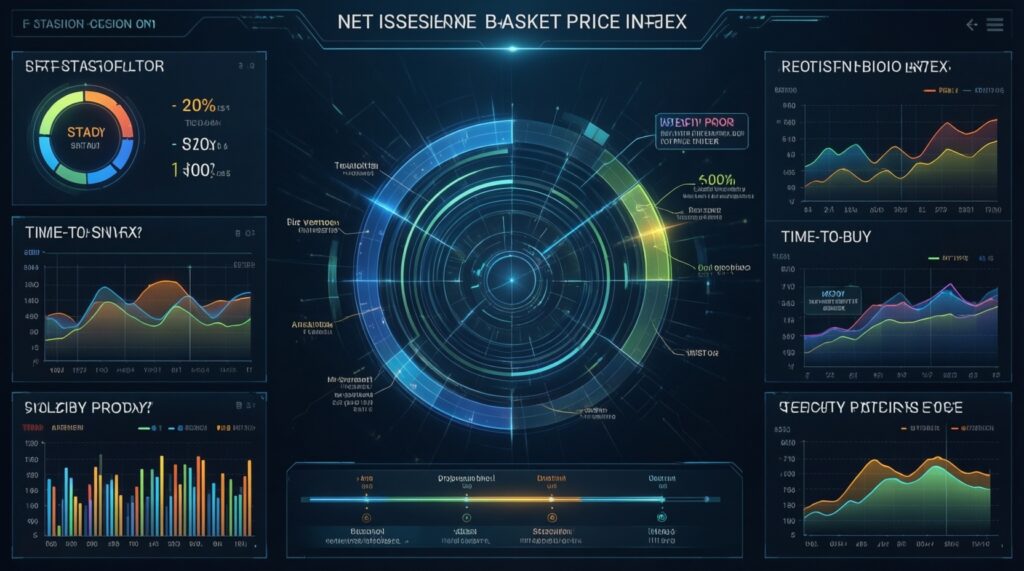
Track net issuance, a fixed basket price index, time-to-buy, and a velocity proxy segmented by progression stage. Add patch/event annotations so you can attribute changes to causes.
How should I set a game currency exchange rate between soft and hard currency?
Anchor it to a time-based earning reference and keep conversion paths consistent (avoid multiple hidden exchange routes). Watch for rate swings during events because players will arbitrage any mismatch.
Does letting players buy game currency always break balance?
No, but it raises the bar for sink design and affordability safeguards. Ensure non-paying paths remain viable in time-to-buy terms and avoid coupling purchases to scarcity spikes.
Why do prices rise even when I didn't increase rewards?
Supply shocks (drop rate changes, new meta, crafting input bottlenecks) can raise prices without extra currency entering. Segment analysis often reveals one activity became dominant, redirecting demand.
Should I solve inflation with higher auction house taxes?
Use taxes carefully: they can reduce velocity and harm price discovery. Prefer addressing the largest faucet first, then add targeted sinks that scale with wealth or tier.