


CS2 skins are tradeable digital items whose value comes from scarcity signals (rarity tiers, floats, patterns), market microstructure (liquidity, fees, spread), and shifting demand. You can buy CS2 skins and later resell, but ownership is platform-bound and pricing is imperfect. Treat them like volatile collectibles: compare venues, verify items, and plan exits.
Core Concepts: CS2 Skins as Tradeable Digital Assets
- A skin's "value" is a market quote, not an appraised intrinsic price; liquidity and spread matter as much as the last sale.
- On-chain ownership does not apply; the item exists inside Valve's ecosystem and your rights are constrained by platform rules.
- CS2 skins prices are shaped by supply constraints (rarity, float distributions) and demand waves (updates, esports, creators).
- Marketplace choice changes outcomes via fees, withdrawal options, fraud controls, and execution speed.
- Valuation requires comparable sales plus a discount for selling friction (fees + time-to-sell + risk).
- Long-term value is exposed to policy, regulation, delistings, and account-level security failures.
Mechanics and Ownership: How CS2 Skins Operate in the Ecosystem
CS2 skins are cosmetic inventory items tied to a Steam account and governed by Steam/Valve rules. You can trade or sell them where permitted, but the item never becomes "yours" in the property-rights sense outside the platform; it remains a revocable entitlement inside the ecosystem.
In practice, "ownership" means you control the account that holds the item, you can transfer it via Steam trading (subject to restrictions), and you can list it on supported venues. This is why account security (2FA, API key hygiene, trade confirmation discipline) is part of asset custody.
As digital assets, skins behave like thinly regulated collectibles with high variance: pricing is discovery-based, not centrally set. A single listing can anchor expectations, but the realizable price depends on whether you can actually execute at that level after fees and time.
Pricing Drivers: Rarity, Float Value, Pattern IDs, and Trend Demand
- Rarity tier and supply cadence: Drop/collection availability, case cycles, and discontinuations influence how quickly supply can expand.
- Wear/float value: Lower float (cleaner condition) often commands a premium; the premium can be nonlinear (top-percentile floats jump sharply).
- Pattern IDs and special variants: Certain patterns (and perceived "best" looks) can create sub-markets where one pattern sells far above the baseline.
- Liquidity and order-book depth: A skin with many active buyers can hold value better than an illiquid one, even if the "headline" last sale is similar.
- Demand catalysts: Game updates, sticker/collection hype, esports visibility, and creator coverage can shift demand quickly.
- Venue constraints: Where you list (Steam vs third-party) changes the buyer pool, which changes the clearing price.
Marketplaces Compared: Fees, Liquidity, Verification, and Counterparty Risk
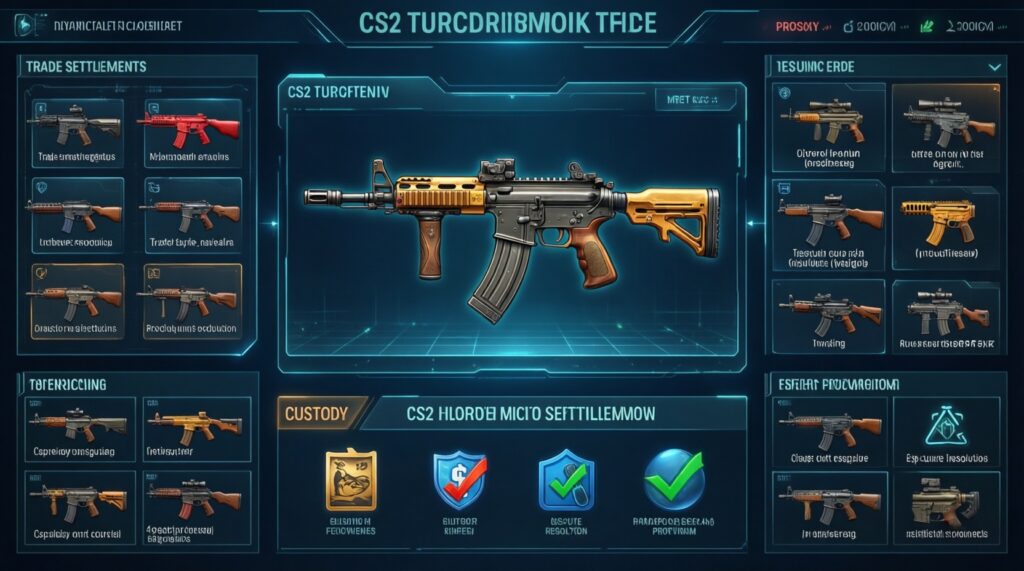
A "CS2 skins marketplace" is not just a storefront; it is a set of settlement rules (who holds custody, how trades clear, how disputes work). Pick the venue based on your goal: speed, maximum proceeds, or minimum risk.
| Venue type | Typical liquidity | Typical fees/spread profile | Verification & safety posture | Best use case | Key risk to manage |
|---|---|---|---|---|---|
| Steam Community Market | High for mainstream items | All-in friction often shows up as platform fees; no cash-out to bank | Strong platform controls; limited external settlement risk | Fast turnover, staying inside Steam balance | Cannot withdraw cash; price may diverge from cash markets |
| Large third-party marketplaces | Medium-high (varies by item) | Fee structure varies; spreads can be meaningful on thin items | KYC/AML may apply; dispute systems vary by operator | Cash-out workflows; broader pricing discovery | Counterparty/platform risk; policy changes |
| P2P trading (direct trades / brokers) | Variable | Lower explicit fees possible; higher implicit risk premium | Verification depends on you; scams more common | Niche patterns, high-end items, bespoke deals | Impersonation, fake middlemen, trade-link/API scams |
Mini-scenarios: choosing the right channel
- You want speed and simplicity: List on Steam Community Market, accept that proceeds stay as Steam balance, and prioritize liquid skins to reduce time-to-sell.
- You want to rotate inventory with cash-out: Use a reputable third-party venue, budget for fees, and treat withdrawal time as part of your holding risk.
- You have a rare pattern/low-float piece: Avoid rushing into the first offer; validate pattern premiums using multiple comps and consider P2P only with strict verification.
- You're arbitraging venue differences: Track net proceeds after fees on both sides; many "price gaps" disappear once you include selling friction.
Valuation Techniques: Comps, Time-Weighted Metrics, and Risk Adjustments
- Comparable sales (comps): Match item + wear/float band + pattern where relevant; ignore outlier prints and suspect single-sale spikes.
- Cross-venue normalization: Translate Steam-balance pricing to cash-market reality by focusing on what you can net after fees and settlement constraints.
- Segmented pricing: Separate "baseline skin price" from "float premium" and "pattern premium" to avoid paying twice for the same attribute.
- Spread-aware quoting: If the best bid is far below the lowest ask, the true executable price is closer to the bid unless you can wait.
- Use a CS2 skin price checker carefully: Treat it as a starting point for comps, not a final quote; verify the data source, recency, and whether it reflects actual executions.
- Limitations: Low-frequency items can't be valued reliably from one sale; manipulation is easier when volume is thin.
- Risk adjustments: Discount for time-to-sell, account/settlement risk, and venue policy risk; increase the discount for niche patterns and hype-driven spikes.
- Execution reality: Your sell outcome depends on order-book depth and buyer trust; a high list price is not the same as a realizable sale.
Long-Term Risks: Regulation, Delisting, Fraud, and Platform Dependency
- Platform dependency: Changes to trading rules, cooldowns, or API access can reduce liquidity or disrupt common trading workflows.
- Delisting and visibility risk: Marketplaces can remove items/listings or restrict regions; reduced visibility can widen spreads.
- Fraud vectors: API key compromise, fake trade bots, lookalike profiles, and malicious browser extensions can drain inventory quickly.
- Regulatory pressure: Rules around digital items, gambling-adjacent features, or cash-out processes can tighten, affecting how you can sell.
- Myth: "It always goes up": Collections can fall out of fashion; demand can rotate, leaving you with illiquid inventory at lower bids.
Investment Practices: Position Sizing, Diversification, and Exit Rules
Define your strategy before you buy CS2 skins: what you're optimizing (liquidity, aesthetics, or resale), what would make you exit, and how much friction you'll accept. This avoids "anchoring" to a peak listing and overexposing to one theme.
Mini-case: rotating a small inventory with rules
Goal: keep inventory liquid, avoid niche pattern risk
Universe: mainstream skins with steady volume

For each candidate skin:
  net_sell = expected_sale_price * (1 - fees) - expected_withdrawal_costs
  risk_discount = function(time_to_sell, spread, policy_risk)
  fair_buy = net_sell * (1 - risk_discount)

Buy only if market_ask <= fair_buy
Set exit:
  - Take profit if price rises and spread stays tight
  - Cut if liquidity drops (spread widens / bids disappear)
  - Rebalance if one item becomes too large a share
Mini-scenarios: what to do next based on your situation

- You're collecting first, investing second: Pay for aesthetics, but keep at least part of the budget in liquid staples so you can exit without heavy discounts.
- You're trading short-term: Focus on items with tight spreads; avoid paying large float/pattern premiums unless you have verified buyer demand.
- You want to sell CS2 skins for real money: Plan the route (venue → settlement → withdrawal), and treat every step as potential friction that reduces net proceeds.
Self-check checklist before your next trade
- I can explain the skin's premium: baseline vs float vs pattern vs hype.
- I compared net proceeds across at least two venues, not just headline prices.
- I verified account security (2FA, trade URL, no suspicious API key activity) before listing/trading.
- I have an exit rule tied to liquidity/spread, not just an aspirational target price.
- I used a CS2 skin price checker only to gather comps, then validated with recent executions.
Practical Clarifications and Common Concerns
Are CS2 skins "owned" like crypto or NFTs?
No. They are account-bound digital entitlements governed by Valve's rules, which can change; you control access through your Steam account rather than a public blockchain.
Why do CS2 skins prices differ between Steam and cash marketplaces?
Different buyer pools, fee structures, and settlement constraints create different clearing prices. Steam prices also reflect the fact that proceeds stay as Steam balance rather than cash.
What's the safest way to buy CS2 skins?
Use reputable venues, verify the exact item (wear/float/pattern), and secure your account before trading. Avoid deals that require "quick" off-platform steps or unusual links.
Can a CS2 skin price checker be wrong?
Yes. If it relies on stale listings, low-volume sales, or doesn't separate patterns/floats, the quote can mislead; confirm with multiple recent comparable sales.
How do I reduce the chance of overpaying for a rare pattern?
Price the baseline skin first, then add a pattern premium only if you can find repeatable comps. If comps are scarce, assume a larger discount for time-to-sell.
What's the biggest mistake when trying to sell CS2 skins for real money?
Ignoring net proceeds. Fees, spread, and withdrawal friction often turn an apparent profit into break-even or loss.