


In-game economies behave like markets when players can earn, trade, and price goods under scarcity; inflation, sinks, and speculation are the core forces that determine whether a virtual world economy market stays stable. Treat currency as a controllable system: measure faucets versus sinks, watch price indices, and govern trading rules so player profit-seeking doesn't overwhelm progression.
Executive summary: market mechanics distilled for operators
- Inflation is usually a design-side imbalance of currency creation versus currency removal, not a "player problem" or a content drought.
- Build virtual currency inflation sinks that scale with activity and target the cohorts generating excess money.
- Good game currency sinks design is paced, segmented, and optional enough to avoid pay-to-win backlash while still being effective.
- In-game item speculation trading is predictable: it spikes around patches, limited drops, and information asymmetry.
- Run a lightweight daily algorithm: reconcile money supply change, price index change, and inventory hoarding signals before you patch.
Common misconceptions about virtual economies and why they mislead designers
Myth 1: "It's not a real market because it's a game." If players can exchange scarce items for a generally accepted medium (gold, credits, tokens), you have market-like price discovery. The "realness" comes from player incentives, not from the currency being fiat or backed by anything.
Myth 2: "Inflation means players are getting richer, so it's fine." In-game economy inflation often makes new and returning players poorer in practice because entry costs (gear, materials, services) rise faster than their earning rate, widening the gap between cohorts.
Myth 3: "Just add more content and prices will normalize." New content often adds new faucets (rewards, loot conversion, event grants) faster than it adds sinks. Without deliberate sink capacity, content updates can accelerate inflation.
Myth 4: "A single big sink fixes everything." One-time sinks (a prestige mount, a vanity mansion) drain hoarded wealth once, then stop. Sustainable stability needs recurring sinks tied to ongoing play.
How player-driven inflation forms: supply chains, faucets, and creation loops
Inflation typically emerges when the system creates currency faster than it is destroyed, while item supply and player demand shift unevenly across tiers. Common creation loops are subtle: players convert time into currency, currency into power, power into faster farming, and the loop compounds.
- Primary faucets outrun sinks. Quests, dailies, mob drops, event mail, and NPC buybacks push money supply up with every active session.
- Conversion faucets appear via crafting chains. If materials can be generated cheaply and sold to NPCs, crafting becomes a money printer.
- Velocity increases with convenience. Auto-pathing, offline gains, and boosted drop rates raise currency minted per hour without players feeling "more rewarded."
- Power creep multiplies minting. Higher DPS/clear speed increases faucet throughput; a balance patch can change the economy more than it changes combat.
- Market arbitrage creates secondary inflation. If players can flip between currencies, shards, and items with low friction, they amplify profitable loops.
- Uneven supply chains raise specific price indices. One bottleneck material can lift an entire equipment tier's price, even if overall money supply is stable.
Virtual vs real-market metrics: a practical mapping
| Concept | Real-world analogue | Virtual-world implementation | What to monitor |
|---|---|---|---|
| Money supply | M0/M1 measures | Total currency held by players + in mail/escrow | Daily net change = faucets − sinks |
| Inflation | Consumer price inflation | Price index of representative basket (materials, consumables, entry gear) | Index trend by tier/cohort, not one global average |
| Interest/incentives | Rates, opportunity cost | Event schedules, limited-time drops, crafting ROI | ROI spikes around updates and timers |
| Taxation | Sales/VAT/capital gains | Marketplace fees, listing fees, repair costs | Effective sink rate by trade volume |
| Capital controls | Trading limits, compliance | Bind rules, transfer caps, anti-RMT enforcement | Suspicious networks, mule behavior, price manipulation |
Practical sink design: types, sizing, and timing to absorb excess currency
Sinks work when they remove currency at the same place your faucets create it: by cohort, activity, and time. Use multiple sinks with different friction levels so you can tune without shocking the whole economy.
- Transaction sinks. Marketplace fees, listing fees, and escrow fees scale with trading volume; tune them to target high-velocity traders rather than casual players.
- Maintenance sinks. Repairs, durability restoration, ammo, and consumables drain currency proportional to playtime and power usage.
- Progression sinks. Skill resets, enchant attempts, crafting station fees; best for absorbing currency during mid/late game when earning accelerates.
- Vanity and status sinks. Cosmetics, housing décor, guild emblems; safe from pay-to-win accusations but must be refreshed and themed.
- Risk-based sinks. Optional "high roll" systems (e.g., rerolls, upgrade protection) can drain large amounts, but must be clearly communicated to avoid churn.
Rules of thumb for sizing and timing
- Match cadence: daily faucets need daily sinks (repairs/fees), event faucets need event sinks (limited cosmetics, event crafting fees).
- Segment by tier: new-player sinks should be light and predictable; late-game sinks can be heavier and more discretionary.
- Prefer elastic sinks: percentage-based fees (within reason) scale automatically as prices rise.
- Avoid "mandatory pain": if a sink feels like a tax on fun (travel fees in a travel-heavy game), players route around it or quit.
Speculation, hoarding, and market psychology: behavioral drivers and exploits
Speculation is not inherently bad: it can provide liquidity and smooth supply. The risk is when information advantage, patch cadence, or weak governance lets a few actors corner bottlenecks and turn normal profit-seeking into systemic instability.
Behavioral drivers you can plan for
- Patch anticipation: players hoard inputs for announced recipes and sell into hype.
- Loss aversion: after a nerf rumor, players dump assets, temporarily crashing prices.
- Anchoring: early listings set perceived "fair" prices, especially in low-liquidity servers.
- Social proof: streamer/Discord calls can move prices faster than in-game fundamentals.
Common exploit patterns to defend against
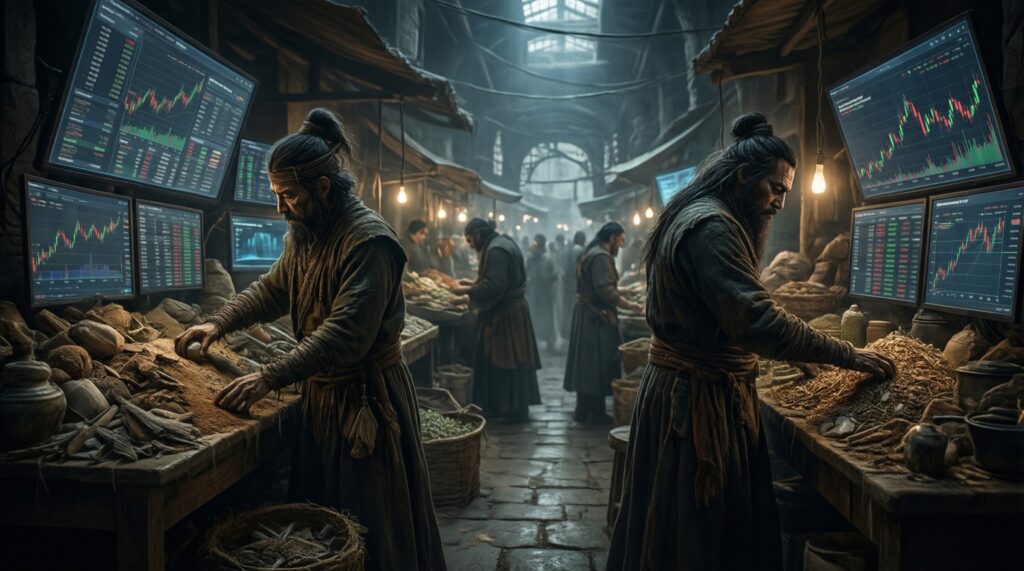
- Cornering bottlenecks: buying out a key material, relisting at multiples, and forcing downstream inflation.
- Wash trading: self-trading to fabricate "market price" and lure buyers.
- Cross-market arbitrage: abusing regional/server differences, time windows, or currency exchange quirks.
- RMT-linked manipulation: price pumping to move value into tradable goods for extraction.
Quantitative indicators of market health: metrics, dashboards, and simple models
Dashboards fail when they show only averages. Market stability is usually broken in a segment: one tier, one material class, one server, or one event loop. Track money, prices, and inventories together; any one alone will mislead you.
- Only tracking "total gold created." You need net flow:
NetCurrency(t) = Faucets(t) − Sinks(t). - Using a single global price average. Build a basket index by tier and role (new-player gear vs endgame mats).
- Ignoring concentration. If top holders accumulate faster, prices can inflate even when median wallets are flat.
- Confusing activity spikes with inflation. Events can raise both trading volume and prices temporarily; confirm with sustained index movement after the event ends.
- Missing inventory hoards. If listings fall while prices rise, hoarding/speculation may be the driver, not money supply.
A short algorithm to validate your intervention result (daily/weekly)
- Reconcile currency flow: compute
NetCurrencyper cohort (new, mid, endgame) and per activity (PvE, PvP, crafting, trading). - Check price response: update a fixed basket index and compare
ΔPriceIndextoΔNetCurrency; divergence suggests supply bottlenecks or manipulation. - Scan liquidity: for each key item, track
ListingsCountandMedianTimeToSell; low liquidity makes prices easy to manipulate. - Detect hoarding/speculation: flag items where
Price↑andListings↓for multiple periods around patch notes. - Verify sink effectiveness: estimate
SinkCaptureRate = SinksPaid / FaucetsEarnedper cohort; raise or retarget sinks where capture is low. - Sanity-check player impact: confirm early progression costs (core consumables, entry crafting) did not rise faster than new-player earning.
Developer interventions and governance: taxes, caps, trading rules, and enforcement
Interventions should be reversible, cohort-targeted, and observable within one or two content cycles. In Thailand's mobile-first, event-driven live ops reality, abrupt rule changes can cause social backlash; prefer gradual fee curves, clear patch notes, and server-side enforcement over "surprise" nerfs.
Mini-case: stabilizing a marketplace after a material corner
Scenario: a mid-tier crafting material gets cornered after you announce a new recipe. Prices spike, listings vanish, and crafting progression stalls. You respond with temporary governance plus a long-term sink/faucet rebalance.
- Immediate governance: add a temporary listing fee that increases with repeated relists of the same item (targets manipulators without punishing one-off sellers).
- Supply relief: add limited alternative sources (e.g., account-bound drops from relevant content) to break the corner without flooding the market.
- Long-term stability: move some currency rewards from the affected loop into non-tradable rewards, and add a recurring crafting station fee to absorb excess currency.
Pseudo-algorithm: progressive relist fee to deter manipulation
For each account A, item I, within window W (e.g., 48h):
  relists = count_relistings(A, I, W)
  baseFee = max(minFee, feeRate * listingPrice)

  multiplier = 1 + k * max(0, relists - freeRelists)
  listingFee = baseFee * multiplier

  charge(A, listingFee)   // pure sink
  post_listing(A, I, price)
Operator questions on market stability and player behavior
What is the fastest way to confirm we have inflation, not just a temporary event spike?
Compare net currency flow (faucets minus sinks) with a stable basket price index after the event ends. If both remain elevated across multiple periods, it's inflationary pressure, not a one-off demand shock.
Which sink type is safest for perception in a free-to-play game?

Vanity/status sinks and moderate marketplace fees are usually safest because they don't block core progression. Maintenance sinks work too if they are predictable and scale with playtime.
How do we prevent speculation without killing the player-driven economy?
Reduce information asymmetry (clear drop tables and patch notes), increase market liquidity, and add targeted anti-manipulation fees. Avoid blanket trade bans unless RMT is dominant.
When should we use binding rules (bind on pickup/equip)?
Use binding for power-critical items when RMT or cornering threatens progression access. Keep crafting inputs more tradable to preserve a healthy supply chain and player specialization.
Why do prices rise even when total currency doesn't?
Supply bottlenecks, hoarding, and concentration can push specific indices up without an overall money supply surge. Check listings, drop rates, and top-holder inventory changes.
How do we know our marketplace tax is too high?
If listings fall sharply, median time-to-sell rises, and off-market trading increases, your tax is suppressing liquidity. Lower the fee or shift to a smaller listing fee plus a modest sale fee.
What's a practical first dashboard for a small live ops team?
Track net currency flow by cohort, a tiered basket price index, and liquidity (listings/time-to-sell) for the top traded items. Add concentration and hoarding flags once the basics are stable.